Refugee camps in France and Turkey
10 Feb 2016 Leave a comment
in Economics of international refugee law, International law
@nzlabour @greencatherine @johnkeymp @actparty Australia and New Zealand country of asylum numbers since 1965
10 Oct 2015 1 Comment
in Economics of international refugee law, International law, politics - Australia, politics - New Zealand Tags: Australia, economics of migration, refugees
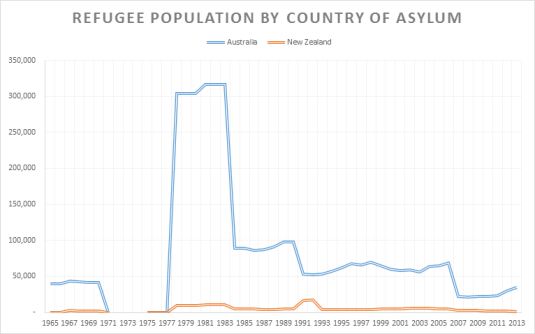
Australia and New Zealand at times has taken in a great many refugees from abroad according to the United Nation’s High Commissioner for Refugees data. Oddly enough these bursts of generosity coincided with a Liberal Country party government in Australia and National Party governments in New Zealand. The Left of New Zealand politics was too busy fighting to be nuclear free to make New Zealand a place of refuge for the victims of oppression when they had their hands on the wheels of power.
Source: UNHCR – UNHCR Statistical Online Population Database.
Because Australia took in so many hundreds of thousands of refugees, it is difficult to read the New Zealand data so I have reproduced the New Zealand data on refugees as a separate graph.

Source: UNHCR – UNHCR Statistical Online Population Database.
At times of crisis such as after the Vietnam War and the chaos in the Balkans, New Zealand has taken in a great many refugees – many times its current generosity.
@NZNationalParty @nzlabour @NZGreens inflow of asylum seekers into #UK #Canada, #Australia and #NewZealand since 1980
08 Oct 2015 Leave a comment
in economic history, Economics of international refugee law, International law, politics - Australia, politics - New Zealand, population economics Tags: Australia, British politics, economics of migration, refugees
New Zealand’s intake of asylum seekers has been embarrassingly low. The left-wing parties in New Zealand should be ashamed of themselves given the way they wear their international consciences on their sleeves about New Zealand being above it all morally, nuclear free, and can lecture the rest about war, peace and compassion from on high.

Data extracted on 08 Oct 2015 09:06 UTC (GMT) from OECD.Stat; Dataset: International Migration Database.
The UK absorbed an immense number of asylum seekers in the 1990 as did Canada. The data stops in 2013.
@GreenpeaceNZ should not support the vexatious claims of climate refugees @NZGreens
22 Sep 2015 Leave a comment
in Economics of international refugee law, environmental economics, global warming, international economics, law and economics, politics - New Zealand Tags: climate refugees, global warming, Greenpeace, Kiribati, nuisance suits, political refugees, vexatious litigation, war refugees
Political support is tenuous enough for admitting more political refugees and war refugees to New Zealand without visa overstayers trying it on with claims for asylum on the basis of climate change – that they are a climate refugee.
Currently New Zealand small refugee quota of 750 is under review. Chances of that been increased to 1000 are reasonable. If people are trying to open the floodgates to millions of people as potential refugees of climate change, if Greenpeace’s own alarmist rhetoric about global warming is to be believed, Greenpeace only strengthens the hand of the anti-immigration and xenophobic parties such as New Zealand First and within the National Party caucus.
Not everyone is a worthy cause, particularly those who make vexatious legal claims that were always going to fail in court. The High Court, the Court of Appeal and the Supreme Court all ruled that it is not their place to expand the scope of the international refugee convention to cover those displaced by climate change. As the Court of Appeal ruled
No-one should read this judgment as downplaying the importance of climate change. It is a major and growing concern for the international community. The point this judgment makes is that climate change and its effect on countries like Kiribati is not appropriately addressed under the Refugee Convention.
Source: Doing Business in Kiribati – World Bank Group
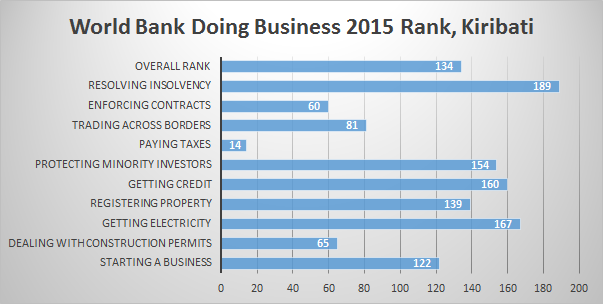
Kirabati can do a lot more to help itself rather than looking to others to solve its problems. It is ranked 133rd in the World Bank’s Doing Business database. This means it can do a lot to help its own development, which strengthens its resilience against climate change and rising sea levels. In the High Court, Priestley J observed:
The economic environment of Kiribati might certainly not be as attractive to the applicant and his fellow nationals as the economic environment and prospects of Australia and New Zealand. But he would not, if he returns, be subjected to individual persecution…
The appellant raised an argument that the international community itself was tantamount to the “persecutor” for the purposes of the Refugee Convention. This completely reverses the traditional refugee paradigm. Traditionally a refugee is fleeing his own government or a non-state actor from whom the government is unwilling or unable to protect him. Thus the claimant is seeking refuge within the very countries that are allegedly “persecuting” him.
Kiribati’s Human Development Index value for 2012 is 0.629—in the medium human development category—positioning the country at 121 out of 187 countries and territories. The rank is shared with Indonesia and South Africa. Kiribati is not unusually poor if it is similar in human development index ranking is to Indonesia and South Africa. Since 1980, Kiribati life expectancy at birth has increased from 55 years to 68 years. Average years of schooling is nearly 8 years and expected years of schooling for their children is now 12 years.
Syrians are taking the Arctic route to Europe
16 Sep 2015 Leave a comment
in Economics of international refugee law, war and peace Tags: Middle-East politics, Syria, Syrian Civil War
Syrians are taking the Arctic route to Europe. Fascinating story by @malkyl @WSJ on.wsj.com/1hWlGdS http://t.co/HMFQyAUb3N—
Georgi Kantchev (@georgikantchev) September 03, 2015
Myth and reality about the countries hosting the most Middle-Eastern refugees
12 Sep 2015 1 Comment
in Economics of international refugee law Tags: economics of migration, economics of refugees, Middle-East politics
https://twitter.com/ianbremmer/status/640518268579614720/photo/1
Where are the World's Refugees?
Not in the West http://t.co/MsfxuP9ZRV—
ian bremmer (@ianbremmer) September 10, 2015
Income from selling citizenships is now 16% of Malta government’s budget
01 Aug 2015 Leave a comment
in Economics of international refugee law, international economic law, international economics, law and economics Tags: Malta, passports, trading on sovereignty
Income from selling citizenships is now 16% of Malta government's budget bloom.bg/1GFbhJK @dslesperance http://t.co/C5HS8PjOb0—
Old Whig (@aClassicLiberal) March 22, 2015
Per capita receipt of asylum seekers
19 Jun 2015 Leave a comment
in Economics of international refugee law, international economic law, International law, law and economics, politics - Australia, politics - New Zealand, politics - USA Tags: asylum seekers, economics of immigration
Sweden – the OECD's highest per capita recipient of asylum seekers bit.ly/1vfFEUh http://t.co/y6DmdJjAsE—
Guardian Data (@GuardianData) December 02, 2014
A refugee boat from Libya
22 Apr 2015 Leave a comment
in Economics of international refugee law, law and economics Tags: European Union, Italy, Libya, refugees
Libyans are dying as they flee a mess that Britain helped create. It's time to help: specc.ie/1GMxFoc http://t.co/zyRgLFPZJ2—
Fraser Nelson (@FraserNelson) April 18, 2015
Equivalent of 5 passenger planes full of people have drowned last week alone amn.st/6010frwe #DontLetThemDrown http://t.co/bEIE2mpJIh—
Amnesty UK (@AmnestyUK) April 20, 2015
Where are the internally displaced people in the world?
13 Apr 2015 1 Comment
in Economics of international refugee law, war and peace Tags: refugees
number of internally displaced people worldwide stands at an all time high: 33 million. here's a map of them. http://t.co/2Q6MLJCKTs—
Laurence Chandy (@laurencechandy) June 13, 2014
Australia takes eight times as many refugees as New Zealand, per capita
27 Mar 2015 Leave a comment
in Economics of international refugee law, politics - Australia, politics - New Zealand Tags: economics of immigration, refugees
Sweden – the OECD's highest per capita recipient of asylum seekers bit.ly/1vfFEUh http://t.co/y6DmdJjAsE—
Guardian Data (@GuardianData) December 02, 2014
Sweden has offered permanent residence to all Syrians fleeing the conflict
06 Dec 2014 1 Comment
in Economics of international refugee law, war and peace Tags: refugees, Sweden, Syria

Asylum applications to Sweden
2012: 44,000
2013: 55,000
2014: 83,000 (projected)
2015: 95,000 (projected)
The population of Sweden is about twice that New Zealand and a million more. The population of Syria is almost 23,000,000.

Nearly half of Syria’s population has been displaced since the start of the civil war in 2011. Half. It’s the equivalent of 135 million Americans being forced to move.
I admire Sweden’s generosity, but not their wisdom. Three million Syrians have become refugees abroad and 6.5 million more have fled their homes for other locations within the country.
The economics of refugee asylum, refoulement and jumbo jets
23 Jun 2014 Leave a comment
in Economics of international refugee law, law and economics Tags: international refugee law

Before 1914 it was possible to travel between a number of countries without a passport. British subjects were free to move to and from countries that were part of the British Empire and British Commonwealth of Nations long after they gain full sovereignty. Scots were automatically French citizens for 500 years up until 1907.
The British Nationality Act 1948 allowed the 800 million British subjects in the British Empire to live and work in the United Kingdom without needing a visa. Commonwealth citizens were not subject to immigration control until 1962.
The Aliens Act 1905 was the first major piece of modern immigration legislation and set up an inspectorate at ports of entry to the UK. Its officers had the power to refuse entry to aliens who were considered ‘undesirable
The 1951 refugees’ convention was signed three years after the UK passed the British Nationality Act 1948. Back in the 1950s, easy international travel was a luxury for the few so uncontrollable borders and mass economic migration from afar was not foreseen. Welfare states were in their infancy.
Many people can now save up to travel far away by air, sea and land. This leads to a screening problem caused by economic migrants lying about their backgrounds.
This gives countries an incentive to evade their obligations raising standards of proof under the 1951 Convention, resulting in ‘more refoulement of refugees to their place of persecution’.
See The Economics of International Refugee Law, Ryan Bubb, Michael Kremer, and David I. Levine Journal of Legal Studies (June 2011) for more discussion.
Their suggestion that developed countries pay poor countries to take refugees from persecution just shows how bare the policy cupboard appears to be. The transfer of refugee claimants from wealthy states to poorer states could ameliorate the screening problem by inducing self-selection among refugee claimants. Fewer economic migrants will apply for refugee states if they have to go to another poor country.


Recent Comments