What a man wants, then (1939) and now (2008) » Graphic Sociology
09 Jan 2015 Leave a comment
in economics of love and marriage, economics of media and culture Tags: assortative mating

The $245,000 price tag for raising an American child – Vox
07 Jan 2015 Leave a comment
in applied welfare economics, economics of love and marriage, economics of media and culture, labour economics, politics - USA Tags: cost of chidlren, fertility
/cdn0.vox-cdn.com/uploads/chorus_asset/file/658572/Screen_Shot_2014-08-18_at_6.15.10_AM.0.png)
/cdn0.vox-cdn.com/uploads/chorus_asset/file/658612/Screen_Shot_2014-08-18_at_10.00.36_AM.0.png)
/cdn0.vox-cdn.com/uploads/chorus_asset/file/658588/Screen_Shot_2014-08-18_at_6.13.34_AM.0.png)
Richard Posner on the changing attitude of radical feminists to the commodification of labour
23 Dec 2014 Leave a comment

Is welfare dependence optimal for whom – part 7: the role of tagging in welfare benefits system
16 Dec 2014 Leave a comment
in economics of love and marriage, labour economics, labour supply, welfare reform Tags: child poverty, labour supply, poverty and inequality, welfare reform
The unambiguously favourable labour supply effects of work requirements are often contrasted with the ambiguous results of changes in benefit abatement regimes.
The twist is work requirements need to be accompanied by a categorisation of the welfare population into those who can work and those who cannot work. The latter do need welfare support because they are unable to earn a wage in the labour market or have carer responsibilities such as for pre-schoolers.
There is already a large population on other welfare benefits with short and long-term barriers to work because of sickness or invalidity classifications.
The favourable labour supply effects of work requirements depend on an ability to adequately categorise the welfare population into different groups. The large differences between otherwise comparable countries in the number on sickness and disability benefits suggest that this classification and sorting process is knowledge intensive and error prone.

The original support for negative income taxes from Friedman (1962) and Stigler (1946) was born of the notion that welfare bureaucracies are unable to adequately screen, categorise and tag welfare claimants by their capacity to work and diligent job search in a dynamic world with dispersed knowledge and moral hazard.
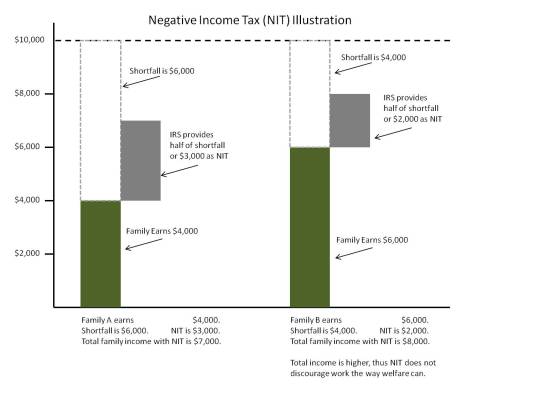
Negative income taxes were proposed as an administratively simple welfare reform to give adequate income support to the low paid, out of work and unable to work, while still providing reasonable work incentives for the low paid. The negative income tax was originally intended to replace existing welfare benefits for families at least.
The modern incarnations of negative income taxes manifest as in-work tax credits that supplement welfare benefits and reduce poverty among the working poor.

The ambiguous effect of negative income taxes on the net labour supply among the low-paid was acknowledged at the outset, and was borne out in experimental trials and experience with in-work tax credits.
The existing system of domestic purpose, unemployment, sickness and invalid benefits are all examples of screening, categorising and tagging of welfare claimants with varying degrees of success.
The tagging is based on relatively coarse screening devices such as job loss, sole parenthood and medical grounds.
Akerlof (1978) noted that the truly needy—those with low job skills who have extreme difficulty in becoming employed—can be partly identified by some measurable, observable characteristic, which he called tagging the poor. Some combination of indications of poor health, low levels of education and spotty employment histories might be indicators of low job skills.
If the government moves from a negative income tax, in which all those with income are paid benefits regardless of their characteristics, to a tagged system in which only the subset who have the particular set of characteristics indicating that they are needy are paid benefits, then higher benefits could be paid to the tagged individuals without changing total expenditure.
Depending on whether the welfare tag is job loss, sole parenthood, sickness or invalidity, different abatement regimes, benefit levels and work tests apply. ACC is another example of tagging with the screening based on accidental injury.
Most welfare systems tag Akerlof partly with family structure in mind as a characteristic, with benefits heavily concentrated on families with a single parent.
Family tax credits are based on tagging through the number of hours worked and the number of children that are dependent upon the wage earner.
Nichols and Zeckhauser (1982) argued that the imposition of “ordeals” on welfare recipients, of which work requirements were one example, but onerous application procedures and participation requirements are others, could serve to deter entry of the able-bodied.
The experience with tagging to date suggest that it’s not particularly accurate. social insurance systems for injury and illness have significant issues with moral hazard.
For example, before 15 July 1980, an employee injured in a workplace accident in Kentucky received compensations proportional to his or her wage with an upper limit of $131 per week.
On 15 July 1980, this limit was raised to $217 per week. The better paid wage-earners were substantially better compensated for accidents that occurred after that date.
The periods of convalescence of these better-paid workers grew 20 per cent longer. For accidents that occurred before 15 July, these employees had been off work for an average of 4.3 weeks; for accidents after 15 July caused the same employees to stay home for an average of 5.2 weeks.
The average convalescence period for injured workers who were less well paid was unaffected by the rise in the upper limit stayed the same before and after 15 July. It is absurd to suggest that workplace accidents had suddenly become more serious for these better-paid workers and only for them after 15 July 1980.
In the past three decades, the number of people who are on disability benefit has skyrocketed but incidence of disabling health conditions among the working age population is not rising. Autor (2006) found that disability rolls in the USA expanded because:
- congressional reforms to disability screening in 1984 that enabled workers with low mortality disorders such as back pain, arthritis and mental illness to more readily qualify for benefits;
- a rise in the after-tax income replacement rate, which strengthened the incentives for lower-skilled workers to seek benefits; and
- a rapid increase in female labour force participation that expanded the pool of insured workers.
Autor found that the aging of the baby boom generation has contributed little to the growth of disability benefit numbers to date.
David Autor and Mark Duggan (2003) found that low-skills and a poor education is predictor of disability: in the USA in 2004, nearly one in five male high school dropouts between ages 55 and 64 were in the disability program; that was more than double that of high school graduates of the same age and more than five times higher than the 3.7 % of college graduates of that age who collect disability. Unemployment is another driver of disability.
The only major success in reducing beneficiary numbers anywhere has been time limits in the USA in 1996. Time limits on welfare for single parents reduced caseloads by two thirds, 90% in some states.

The subsequent declines in welfare participation rates and gains in employment were largest among the single mothers previously thought to be most disadvantaged: young (ages 18-29), mothers with children aged under seven, high school drop-outs, and black and Hispanic mothers. These low-skilled single mothers were thought to face the greatest barriers to employment. Blank (2002) found that
nobody of any political persuasion predicted or would have believed possible the magnitude of change that occurred in the behaviour of low-income single-parent families.
Rebecca Blank is the field leader on the economics of welfare reform and got as high as Acting Secretary of the Department of Commerce for Obama.
Employment are never married mothers increased by 50% after the US reforms: employment a single mothers with less than a high school education increased by two thirds: employment of single mothers aged of 18 in 24 approximately doubled.

With the enactment of welfare reform in 1996, black child poverty fell by more than a quarter to 30% in 2001. Over a six-year period after welfare reform, 1.2 million black children were lifted out of poverty. In 2001, despite a recession, the poverty rate for black children was at the lowest point in national history.

This great success of US welfare reforms was that after decades of no progress, poverty among single mothers and among black children declined dramatically.
The best solution to poverty is to move people into a job. Simon Chapple is also quite clear in his mid-year book with Jonathan Boston that a sole parent in full-time work, and a two parent family with one earner with one full-time and one part-time worker, even at low wages, will earn enough to lift their children above most poverty thresholds. Welfare benefits trap children in poverty.
The best available analysis, the most credible analysis, the most independent analysis in New Zealand or anywhere else in the world that having a job and marrying the father of your child is the secret to the leaving poverty is recently by the Living Wage movement in New Zealand.
According to the calculations of the Living Wage movement, earning only $18.80 per hour with a second earner working only 20 hours affords their two children, including a teenager, Sky TV, pets, international travel, video games and 10 hours childcare.
This analysis of the Living Wage movement shows that finishing school so your job pays something reasonable and marrying the father of your child affords a comfortable family life.
Blogs so far:
part-one-the-labour-leisure-trade-off-and-the-rewards-for-working
part-two-the-labour-supply-effects-of-welfare-benefit-abatement-rate-changes
part-3-abatement-free-income-thresholds-and-labour-supply
part-4-in-work-tax-credits-and-labour-supply
part-5-higher-abatement-rates-and-labour-supply
The economics of parenting | VOX, CEPR’s Policy Portal
10 Dec 2014 Leave a comment
in economics of education, economics of love and marriage, human capital, labour economics, liberalism, population economics Tags: inequality and poverty, nature versus
across OECD economies parents in more unequal countries place more emphasis on hard work, and consider imagination and independence to be less important.


Claudia Goldin and the power of the pill
04 Dec 2014 1 Comment
in economics of education, economics of love and marriage, gender, human capital, labour economics, labour supply Tags: Claudia Goldin, engines of liberation, gender wage gap, sex discrimination, single parenthood
Claudia Goldin has documented well that the availability of reliable contraception in the late 1960s led to an explosion in female investment in higher education, and in particular, long duration professional educations.
Although rapidly disseminated among married women once it came on the market in 1960, the pill at first was almost inaccessible to single females, due to the prevailing state laws on prescriptions of drugs.
Liberalisation of availability for single females was on a state-by-state basis and was staggered over a few years. This allowed Claudia Goldin to study what happened to investment in professional education by young women in each of those states as they reformed their laws on the dispensing of contraception to single females.

As contraception was made lawful for single women on a state-by-state basis in the USA in the late 60s and 1970s, young women started investing in long duration professional educations at an explosive rate. They stayed in high school the longer, more young women went on to college, and more of these college female students majored in long duration professional degrees.

In the 1960s, it was common to get engaged and even marry while at college in the USA. As Claudia Goldin, and her co-author Larry Katz explain:
It was a stark choice, you could be celibate, get your career started, and potentially face a very thin marriage market once you were done.
Or, you could have fun, get married earlier, and not necessarily have a career.
The availability of the pill allowed college-age women to have certainty in their career investments and therefore the payoff of investing in professional educations was much greater.

By decoupling sex for marriage, women could afford to defer marriage and shop around looking for better partners. Postponing marriage for at least a few years didn’t mean all the “good guys” would be taken. In addition, with higher career incomes for female college graduates, as Goldin explained:
You might think of it as the decline of the trophy wife, as women with careers who might not be as intrinsically good-looking became more highly valued than—or at least as equally valued as—women for whom appearance was a primary asset.
But as Goldin’s co-author Larry Katz explained:
Potential losers in this equation, in addition to trophy wives, are women with poor career prospects.
The clear winners are women with careers and, of course, the men they marry… Guys have more money, more sex, and less responsibility.
One side effect of the availability of contraception to better educated women was that young women with poor career prospects were also left with a pool of more unattractive men to marry.
Many of these young women who wanted to have baby chose just to have the child, and perhaps marry the father later if the responsibilities of fatherhood turned him into marriage material.
This reversal in order of parenthood and marriage among less well educated young women was one of the surprising social developments in the mid to late 20th century.
A favourite line from Seinfeld
03 Dec 2014 Leave a comment
in economics of love and marriage, gender, human capital, labour economics, TV shows, unemployment Tags: Seinfeld
Environmental and Urban Economics: Do Demographers Really Predict Future Population Trends Without Incorporating Women’s Economic Incentives?
26 Nov 2014 Leave a comment
in discrimination, economics of love and marriage, gender, health economics, human capital, labour economics
To my amazement, this work does not discuss how women’s potential earnings in the labor market correlates with fertility decisions.
At least in the Demography paper linked to above, the word “incentives” does not appear in the paper and nobody makes a choice based on the costs and benefits of fertility.
Without incorporating such factors, how can a statistical model yield a credible prediction?
Women graduates increasingly put their partner’s career first after they graduate | Daily Mail Online
19 Nov 2014 Leave a comment
in discrimination, economics of love and marriage, gender, human capital, labour economics, labour supply, occupational choice Tags: asymmetric marriage premium, Claudia Goldin, gender wage gap, motherhood penalty, power couples


Women are increasingly putting their husband’s career before their own, a controversial new study of Harvard Business School graduates has found.
It canvassed over 25,000 male and female students, and found 40 percent of Gen X and boomer women said their spouses’ careers took priority over theirs.
The researchers also said only about 20 percent of them had planned on their careers taking a back seat when they graduated.
This gender gap found by Robin Ely, Colleen Ammerman and Pamela Stone can be better explained by the marriage market combined with assortative mating.
1. Harvard business graduates are likely to marry each other and form power couples.
2. There tends to be an age gap between men and women in long-term relationships and marriages of say two years.
This two year age gap means that the husband as two additional years of work experience and career advancement. This is highly likely to translate into higher pay and more immediate promotional prospects.
Maximising household income would imply that the member of the household with a higher income, and greater immediate promotional prospects stay in the workforce.
It is entirely possible that women to anticipate this situation both in their subject choices and career ambitions.
Claudia Goldin found that the wage gap between male and female Harvard graduates disappears in the presence of one confounding factor.
That confounding factor is obvious: the male in the relationship earns less. When this is so, Goldin found that the female in the relationship earns pretty much as do similar male Harvard graduates, except for the fact that they work less hours per week:
We identify three proximate factors that can explain the large and rising gender gap in earnings: a modest male advantage in training prior to MBA graduation combined with rising labour market returns to such training with post-MBA experience; gender differences in career interruptions combined with large earnings losses associated with any career interruption (of six or more months); and growing gender differences in weekly hours worked with years since MBA.
Differential changes by sex in labour market activity in the period surrounding a first birth play a key role in this process. The presence of children is associated with less accumulated job experience, more career interruptions, shorter work hours, and substantial earnings declines for female but not for male MBAs.
The one exception is that an adverse impact of children on employment and earnings is not found for female MBAs with lower-earning husbands.
This sociological evidence reported in the Daily Mail is entirely consistent with the choice hypothesis and equalising differentials as the explanation for the gender wage gap. As Solomon Polachek explains:
At least in the past, getting married and having children meant one thing for men and another thing for women. Because women typically bear the brunt of child-rearing, married men with children work more over their lives than married women.
This division of labour is exacerbated by the extent to which married women are, on average, younger and less educated than their husbands.
This pattern of earnings behaviour and human capital and career investment will persist until women start pairing off with men who are the same age or younger than them.
Too few good men – rational behaviour and the causes of teen pregnancies
21 Aug 2014 Leave a comment
in applied price theory, applied welfare economics, economics of love and marriage, labour economics, labour supply, population economics Tags: teen pregnancies
Teenage pregnancy rates have been cut in half in the past 20 years. buff.ly/1PnIpdN http://t.co/1SIJeTeZjj—
HumanProgress.org (@humanprogress) August 14, 2015
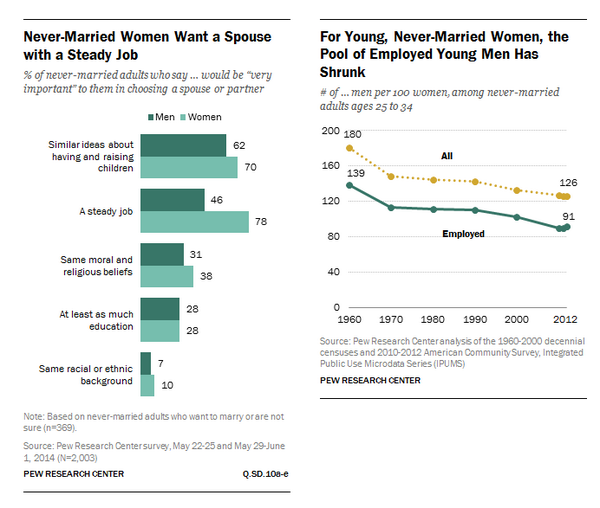
The causes of teen pregnancies are well described in Kathryn Edin and Maria Kefalas’s Promises I Can Keep: Why Poor Women Put Motherhood Before Marriage and Jason DeParle’s American Dream: Three Women, Ten Kids, and a Nation’s Drive to End Welfare. See Amy Wax’s superb book review Too few good men.

Women on a low social trajectory see no reason to wait before having a baby and they look down upon those women that wait.
People now regard marriage as a luxury good rather than as a necessity. They refuse to tie the knot unless they have first achieved economic success. A house, a well-paying job, and enough money for a nice wedding are now needed before considering a trip to the altar.
These young women put motherhood first and have no intention of marrying the layabouts that often father their children, most of all, because of repeated and open infidelity.
The women do not complain of men’s failure to earn enough, but rather of their unwillingness to grasp opportunities, work steadily, and spend wisely. The objection is not to modest earning power, but to financial profligacy, defiant attitudes, and lack of work discipline…
The most vociferous complaints are reserved for men’s chronic criminal behaviour, drug use, violence, and, above all, repeated and flagrant sexual infidelity.
Most men made no effort to hide their frequent liaisons, which were often carried on simultaneously. More often than not, those relationships produced babies
Having a baby changes these young women from extras on the stage of life to a mother and all the community respect and social standing that commands.
Babies need not await the achievement of an elevated position in life, because childbearing is a fundamental hallmark of female adulthood that is central to poor women’s dignity and identity.
In the authors’ words, “women rely on their children to bring validation, purpose, companionship, and order to their often chaotic lives — things they find hard to come by in other ways.” In a perverse inversion of old values, these woman have come to regard lone motherhood as the ultimate heroic act, the proving ground of their responsible devotion to others.
These new mothers try and clean up their act. They stop drinking and taking drugs. For the first time in their lives they have a purpose, which is to raise a child.

Far too many social commentators see a teen pregnancy through their own lens as a middle class parent and the despair they would fell because their daughter will not go to university and all that brings including a better class of husband.

University educated couples are not called power couples for nothing – their earning power is this stunning compared to going it on your own. The emergence of power couples means that less educated women may prefer to stay single and raise children on their own rather than marry what is left in the marriage pool.
On marriage as a humanly devised set of constraints
18 Jun 2014 Leave a comment
in economics of love and marriage, law and economics Tags: Doug Allen

Doug Allen challenges you to describe marriage to a 19 year old male who had never heard of it before:
- Marriage is all about responsibility, monogamy and a painful exit if things go awry.
- Yes, there is the prospect of children, and mutual support, but only if you sign up to child support obligations, community property rules and many other constraints that are enforceable.
The role of the state in marriage is all about protecting mothers from opportunistic breach of a long-term contract with sequential performance. Mothers produce the children up-front while the fathers support the children over a long period subsequent. The problem is dead-beat dads.


Recent Comments