Why no boat people via PNG? Why from Indonesia?

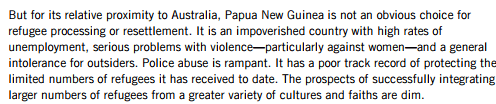
The northernmost tip of Australia is 5 km from Papua New Guinea. Instead, boat people take off from Indonesia in leaky boats too unseaworthy to get to where they are going, much less be turn backed, to land on Christmas Island which is an offshore territory. A strong swimmer could get to the State of Queensland from Papua New Guinea on a good day. A decent paddle boat would do the job.

If the PNG authorities tolerated people smuggling, their relationship with Australia would be jeopardised. On the other hand, there is plenty of votes at the ballot box in Indonesia from sticking it to Australia. Little wonder that a substantial part of the Pacific solution to illegal maritime arrivals by boat people is bribing Indonesian authorities to crack down on people smuggling.

.@Greens policy would have meant many more drownings of boat people

Source: THE RIGHT WAY FORWARD ON REFUGEES HUMANE, EFFECTIVE, LEGAL The Greens’ plan for a genuine regional response and safer pathways.

The most recent policy of the Australian Greens drops the above ideas about an open border but has other weird things like a skilled refugee visa. Very odd for a social justice policy. Obviously all well-founded fears of persecution are not created equal. The university educated deserve more protection. Good luck assessing a claim for asylum within 30 days, much less an identity check.

The crime rate of high school dropouts is high

Image

The PNG Supreme Court on #ManusIsland #Manus

From https://www.scribd.com/document/363707115/Boochani-v-State-of-Papua-New-Guinea

“Re:scam” This Hilarious Chatbot Messes with Scammers for You

Orson Welles on Cold Reading

Generation gaps in drug abuse

Image

An understandable response

Does addiction and mental illness dull responses to incentives

I found the chapter in Tullock and McKenzie’s book on token economies in mental hospitals to be most enlightening in regard to addictions and mental illness clouding judgement.

The tokens in a token economy were spending money at the hospital canteen and trips to town and other privileges. They were earned by keeping you and your area clean and helping out with chores at the mental asylum.

The first token economies were for chronic, treatment-resistant psychotic inpatients. In 1977, a major study, still considered a landmark, successfully showed the superiority of a token economy compared to the standard treatments of these type of psychotic inpatients.

Experiments which would now be unethical showed that the occupational choices and labour supply of certified lunatics responded to incentives in the normal, predictable way. For example, tokens were withdrawn for helping clean halls and common areas. The changes in occupational choice and reductions in labour supply was immediate and as predicted by standard economics.

Some patients would steal the tokens for other patients, so the tokens were individually marked. The thefts almost stopped. Crime must pay even for criminally insane inpatients. Kagel reported that:

The results have not varied with any identifiable trait or characteristic of the subjects of the token economy – age, IQ, educational level, length of hospitalization, or type of diagnosis. Most people age out of addiction to drugs or to alcohol.  By age 35, half of patients with active alcoholism or addiction diagnoses during their teens and 20s no longer take drugs or drink:

The average cocaine addiction lasts four years, the average marijuana addiction lasts six years, and the average alcohol addiction is resolved within 15 years. Heroin addictions tend to last as long as alcoholism, but prescription opioid problems, on average, last five years. In these large samples, which are drawn from the general population, only a quarter of people who recover have ever sought assistance in doing so (including via 12-step programs). This actually makes addictions the psychiatric disorder with the highest odds of recovery.

Studies of demand elasticity normally find that consumption of hard drugs is quite sensitive to price. Addicts respond to incentives, in particular, to price rises by cutting back on their drug taking.

At the beginning of this century, the Dutch government controlled the opium market in the Dutch East Indies–nowadays Indonesia–for several decades. This state monopoly was called the opiumregie. Using information gathered during the opiumregie, this paper estimates price elasticities of opium consumption. It appears that short-term price elasticities of opium use are about -0.7. Long-term price elasticities are about -1.0.

The callousness of the compassionate green left

PS, the boat people that the left never mention

Why Trophy Hunting Can Be Good for Animals

Chris Rock – How not to get your ass kicked by the police!

Does Israel Discriminate Against Arabs?

Times are changing

Image

When war refugees find paradise Down Under

When a Cambodian man and his pregnant wife, having fled the Khmer Rouge, were on the bus from Sydney Airport, they quickly concluded that they were in paradise.

Despite the cold of winter, they slept on top of the blankets of their neatly made bed at the migrant hostel in 1978 because they did not want to get into any trouble for messing up the bed and be sent back to hell. Such was their ingrained fear of arbitrary power and victimisation.

After a few weeks, they stopped stealing the sauces and other condiments from the dining hall at the hostel because they realised that the food would keep coming and there was no need to hoard. They then started to act as mentors to incoming refugees assuring them that they could sleep under the blankets, and the food would arrive three times a day, every day.

When the Salvation Army helped them and their new baby into a house in suburban Sydney, it was plain on the faces of these Salvos that they were most embarrassed about the quality of the furniture they managed to scrounge for them.

The Cambodian couple thought they were in paradise again. The house and furniture were better than anything they had seen in a middle-class home in Phnom Penh.

After a few years of hard work, the father saved enough to open an electrical retailing franchise.

The mother went to the store one afternoon to fill in for an absent worker. She did not come back for 7-years. She was great at bargaining with fellow refugees. She knew that her fellow refugees only had a certain amount of money, and she bargained to find out what that was. She wrapped the goods up tightly because she knew that they took public transport home.

The word spread that her store was a good place for a bargain, and the store prospered. Their daughter grew up to be a lawyer and wrote one of the best autobiographies I have read.

I had some Cambodian friends at graduate school in Japan in 1995 to 1997. Friendly, kind people despite growing up in hell.

They also gave me great insight into the blinding power of nationalism. My two Cambodian friends, educated urbane people, referred to the time after the Vietnamese invasion of Cambodia as when they were a Vietnamese colony.

Another Cambodian, who no one liked, when he annoyed his Vietnamese class mates too much, they would say, “Remember 1979.”

This taunt would throw this Cambodian into a fit of nationalist pique. He raged against the invasion. If any country would have benefited from an invasion even from hell, it would have been Cambodia under Pol Pot and the Khmer Rouge by 1979.

My best mate at University was the son of a war refugee from the Ukraine. His Dad was rounded up to be a slave in a Nazi factory in Germany.

My mate’s dad came to Australia because it was the first country to accept him. He did not want to go back to the Ukraine because it was now Russian rather than Polish.

Despite finding paradise in Australia, his daughter is now a senator, he was still touched by the fever of nationalism.

When he and his two sons, both graduates in economics, went back to the Ukraine to visit his brother in 1988, they had to go by a very indirect route via Warsaw, sleeping in a train station overnight, because their father refused to set foot on Russian soil.

The usual way to visit the former USSR as a Western tourist was first to fly to Moscow. His sons were as kind and level-headed as anyone you would like to meet. Both wanted to go via Moscow because their Dad might have found going the long way around too much for a retired factory worker.

Another mate of mine served on the eastern front for the Germans and later ended up as a prisoner of war in Canada. My Austrian friend had strong views on nationalism too.

When the Balkan wars broke out in the early 1990s, local ethnic social clubs in Canberra were fundraising for whatever side of that madness they supported. A few went back to join the fighting.

My friend with a passion wanted to put them all on the first boat back home to Europe so they can experience what they were bankrolling good and hard, first hand. He came Down Under to escape ethnic hatred.

Previous Older Entries Next Newer Entries

Vincent Geloso

Econ Prof at George Mason University, Economic Historian, Québécois

Bassett, Brash & Hide

Celebrating humanity's flourishing through the spread of capitalism and the rule of law

Truth on the Market

Scholarly commentary on law, economics, and more

The Undercover Historian

Beatrice Cherrier's blog

Matua Kahurangi

Celebrating humanity's flourishing through the spread of capitalism and the rule of law

Temple of Sociology

Celebrating humanity's flourishing through the spread of capitalism and the rule of law

Velvet Glove, Iron Fist

Celebrating humanity's flourishing through the spread of capitalism and the rule of law

Why Evolution Is True

Why Evolution is True is a blog written by Jerry Coyne, centered on evolution and biology but also dealing with diverse topics like politics, culture, and cats.

Down to Earth Kiwi

Celebrating humanity's flourishing through the spread of capitalism and the rule of law

NoTricksZone

Celebrating humanity's flourishing through the spread of capitalism and the rule of law

Homepaddock

A rural perspective with a blue tint by Ele Ludemann

Kiwiblog

DPF's Kiwiblog - Fomenting Happy Mischief since 2003

The Dangerous Economist

Celebrating humanity's flourishing through the spread of capitalism and the rule of law

Watts Up With That?

The world's most viewed site on global warming and climate change

The Logical Place

Tim Harding's writings on rationality, informal logic and skepticism

Doc's Books

A window into Doc Freiberger's library

The Risk-Monger

Let's examine hard decisions!

Uneasy Money

Commentary on monetary policy in the spirit of R. G. Hawtrey

Barrie Saunders

Thoughts on public policy and the media

Liberty Scott

Celebrating humanity's flourishing through the spread of capitalism and the rule of law

Point of Order

Politics and the economy

James Bowden's Blog

A blog (primarily) on Canadian and Commonwealth political history and institutions

Science Matters

Reading between the lines, and underneath the hype.

Peter Winsley

Economics, and such stuff as dreams are made on

A Venerable Puzzle

"The British constitution has always been puzzling, and always will be." --Queen Elizabeth II

The Antiplanner

Celebrating humanity's flourishing through the spread of capitalism and the rule of law

Bet On It

Celebrating humanity's flourishing through the spread of capitalism and the rule of law

History of Sorts

WORLD WAR II, MUSIC, HISTORY, HOLOCAUST

Roger Pielke Jr.

Undisciplined scholar, recovering academic

Offsetting Behaviour

Celebrating humanity's flourishing through the spread of capitalism and the rule of law

JONATHAN TURLEY

Res ipsa loquitur - The thing itself speaks

Conversable Economist

In Hume’s spirit, I will attempt to serve as an ambassador from my world of economics, and help in “finding topics of conversation fit for the entertainment of rational creatures.”

The Victorian Commons

Researching the House of Commons, 1832-1868

The History of Parliament

Articles and research from the History of Parliament Trust

Books & Boots

Reflections on books and art

Legal History Miscellany

Posts on the History of Law, Crime, and Justice

Sex, Drugs and Economics

Celebrating humanity's flourishing through the spread of capitalism and the rule of law

European Royal History

Exploring the Monarchs of Europe

Tallbloke's Talkshop

Cutting edge science you can dice with

Marginal REVOLUTION

Small Steps Toward A Much Better World

NOT A LOT OF PEOPLE KNOW THAT

“We do not believe any group of men adequate enough or wise enough to operate without scrutiny or without criticism. We know that the only way to avoid error is to detect it, that the only way to detect it is to be free to inquire. We know that in secrecy error undetected will flourish and subvert”. - J Robert Oppenheimer.

STOP THESE THINGS

The truth about the great wind power fraud - we're not here to debate the wind industry, we're here to destroy it.

Lindsay Mitchell

Celebrating humanity's flourishing through the spread of capitalism and the rule of law

Alt-M

Celebrating humanity's flourishing through the spread of capitalism and the rule of law

croaking cassandra

Economics, public policy, monetary policy, financial regulation, with a New Zealand perspective

The Grumpy Economist

Celebrating humanity's flourishing through the spread of capitalism and the rule of law