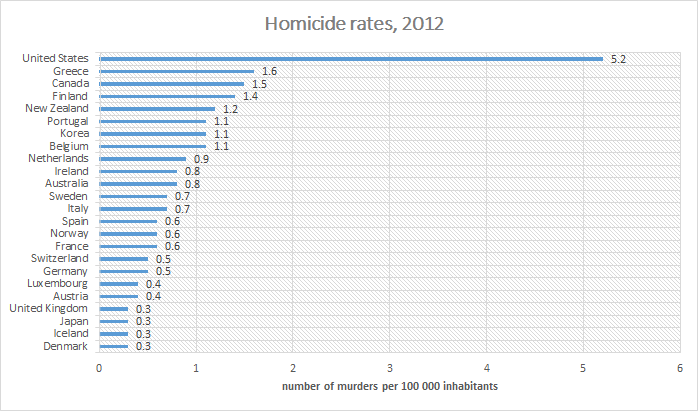
Data extracted on 08 Jan 2016 21:44 UTC (GMT) from OECD.Stat
Celebrating humanity's flourishing through the spread of capitalism and the rule of law
12 Jan 2016 Leave a comment
in economics of crime, law and economics Tags: crime and punishment, law and order
12 Jan 2016 Leave a comment
in economics of crime, law and economics Tags: crime and punishment, law and order
Why are assault rates so low in the USA that they are next to Japan?
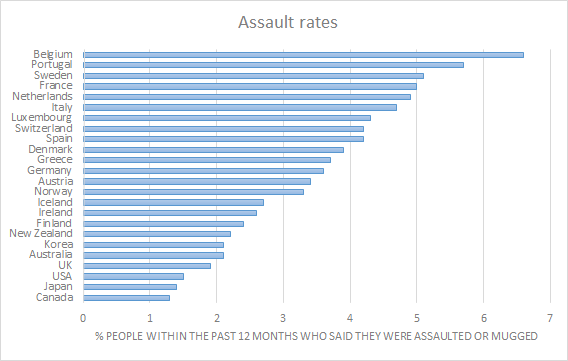
Data extracted on 08 Jan 2016 21:44 UTC (GMT) from OECD.Stat
08 Jan 2016 Leave a comment
in economics of crime, law and economics, politics - USA Tags: crime and punishment, law and order, tasers
06 Jan 2016 Leave a comment
in economics of crime, law and economics, politics - USA Tags: crime and punishment, law and order, police shootings
Despite what you see on TV, surprisingly few unarmed people are shot because they are reaching for a weapon. Most unarmed suspects shot by police last year were resisting arrest. A few were killed in crossfire or by mistake. The chart below does not include unarmed Blacks who were attacking police when they were shot and killed according to Washington Post database.

06 Jan 2016 Leave a comment
in economics of crime, law and economics, politics - USA Tags: crime and punishment, law and order, police shootings
05 Jan 2016 1 Comment
in economics of crime, politics - USA Tags: law and order, police shootings
04 Jan 2016 Leave a comment
in economics of crime, politics - USA
Despite the media hype this year, surprisingly few people are shot by police who are unarmed and not resisting. The Washington Post estimated that less than 5% of police killings are in any way suspicious.
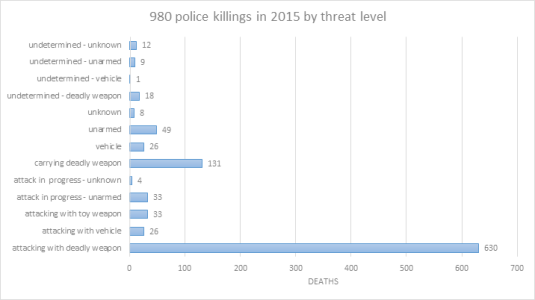
Source: Investigation: Police shootings – Washington Post.
When I previously posted data such as this on the Data is Beautiful sub-Reddit, some of the comments accused me of racism. Apparently, to post data from a highly reputable source on police shootings by threat level is a racist act.
02 Jan 2016 Leave a comment
in entrepreneurship, law and economics, property rights Tags: creative destruction, intellectual property, patents and copyright
30 Dec 2015 Leave a comment
in economics of crime, law and economics Tags: marijuana decriminalisation, war against drugs
28 Dec 2015 Leave a comment
in economics of crime, law and economics Tags: law and order
28 Dec 2015 Leave a comment
in economics of crime, law and economics, occupational choice Tags: law and order, New York City
24 Dec 2015 Leave a comment
in economics of crime, law and economics
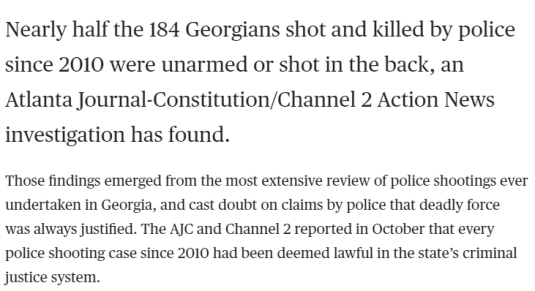
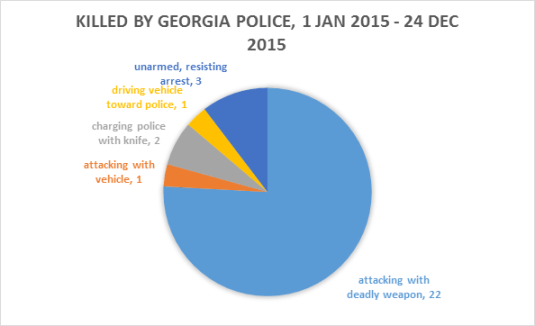
Source: OVER THE LINE: Police shootings in Georgia.
Every Georgia police shooting this year was in response to threats to the life of officers.
22 Dec 2015 Leave a comment
in economics of crime, economics of education, labour economics, labour supply, law and economics, occupational choice, politics - USA Tags: crime and punishment
19 Dec 2015 Leave a comment
in discrimination, gender, labour economics, labour supply, law and economics, occupational choice
Many young women choose to not pursue science, technology, engineering and maths (STEM) careers because there are other career options that allow them to better use their superior verbal and reading abilities.
Further reasons for women to hesitate entering STEM occupations is their faster rate of human capital depreciation. It has been well known for a long time that human capital atrophy rates differ greatly by occupation and are much higher in professional, managerial and craft occupations.
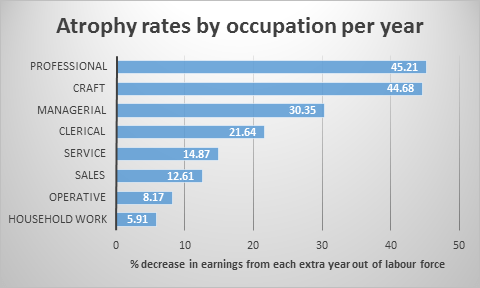
Source: Polachek (1981).
Even a year out of the workforce can greatly reduce earning power because of a rapid depreciation of the human capital accumulated from certain occupations. Women make education and career choices that minimise these losses in light of periods away from work because of motherhood.
Women self-selecting to those occupations with low rates of human capital depreciation. As De Grip explains using German data:
…women who anticipate career interruptions for family reasons take account of the wage penalties related to such a break when they choose their occupational field, i.e. women select occupations where human capital deprecation during a career interruption is the lowest…
Our estimation results have important implications for public policies which attempt to encourage the interest of female students in technical studies and occupations. Obviously, the higher human-capital depreciation rates for workers with family-related career breaks in these male occupations can be a serious threshold for women to choose these occupations
Women choose the occupations that maximise the returns from their skills. Occupations that neither well-reward superior verbal and reading skills and have rapid rates of depreciation on occupational human capital are not a good investment for many of the women anticipating spells out of the workforce because of motherhood.
Rendall and Rendall (2015) recently investigated differential depreciation rates on verbal and maths skills in competing occupational choices for college educated women. Not surprisingly, they found that in the USA verbal skills suffered only minor depreciation during career interruptions but maths skills experience costly depreciation. They found that:
…college educated women avoid occupations requiring significant math skills due to the costly skill atrophy experienced during a career break. In contrast, verbal skills are very robust to career interruptions. The results support the broadly observed female preference for occupations primarily requiring verbal skills – even though these occupations exhibit lower average wages.
Thus, skill-specific atrophy during employment leave and the speed of skill repair upon returning to the labour market are shown to be important factors underpinning women’s occupational outcomes. This research suggests that a substantial portion of female occupational sorting could be determined by skill-specific atrophy-repair characteristics.
This is no surprise as verbal skills improve with age because of expanding vocabularies and better judgement based on accumulated experience. Maths skills tend to be the type of skills where your best years in your 20s and after that things fall away.
These findings by Rendall and Rendall reinforce the initial bias women have against STEM occupations because of their superior reading and verbal skills. STEM occupations are a poor career choice for women because they undervalue their innate skills and heavily penalise career interruptions.
Such is the fatal conceit of politicians is they want to encourage women to make poor education and occupational investments. Women self-selecting into vastly different occupations to men because they are smarter than the average politician about what is the best of them.
Differential atrophy rates on human capital as drivers of the gender wage gap and occupational segregation have nothing to do with the choices of employers – nothing to do with blameworthy behaviour on their part. The blameworthy behaviour can be explicit prejudice, implicit bias or statistical discrimination.
Much of occupational segregation is the result from self-selection by women into occupations on the basis of superior innate skills and the slow rates at which these verbal and reading skills depreciate with time both in general and with time away from the workforce.
Celebrating humanity's flourishing through the spread of capitalism and the rule of law
A History of the Alt-Right
Econ Prof at George Mason University, Economic Historian, Québécois
Celebrating humanity's flourishing through the spread of capitalism and the rule of law
Scholarly commentary on law, economics, and more
Beatrice Cherrier's blog
Celebrating humanity's flourishing through the spread of capitalism and the rule of law
Celebrating humanity's flourishing through the spread of capitalism and the rule of law
Celebrating humanity's flourishing through the spread of capitalism and the rule of law
Why Evolution is True is a blog written by Jerry Coyne, centered on evolution and biology but also dealing with diverse topics like politics, culture, and cats.
Celebrating humanity's flourishing through the spread of capitalism and the rule of law
A rural perspective with a blue tint by Ele Ludemann
DPF's Kiwiblog - Fomenting Happy Mischief since 2003
Celebrating humanity's flourishing through the spread of capitalism and the rule of law
The world's most viewed site on global warming and climate change
Tim Harding's writings on rationality, informal logic and skepticism
A window into Doc Freiberger's library
Let's examine hard decisions!
Commentary on monetary policy in the spirit of R. G. Hawtrey
Thoughts on public policy and the media
Celebrating humanity's flourishing through the spread of capitalism and the rule of law
Politics and the economy
A blog (primarily) on Canadian and Commonwealth political history and institutions
Reading between the lines, and underneath the hype.
Economics, and such stuff as dreams are made on
"The British constitution has always been puzzling, and always will be." --Queen Elizabeth II
Celebrating humanity's flourishing through the spread of capitalism and the rule of law
Celebrating humanity's flourishing through the spread of capitalism and the rule of law
WORLD WAR II, MUSIC, HISTORY, HOLOCAUST
Undisciplined scholar, recovering academic
Celebrating humanity's flourishing through the spread of capitalism and the rule of law
Res ipsa loquitur - The thing itself speaks
In Hume’s spirit, I will attempt to serve as an ambassador from my world of economics, and help in “finding topics of conversation fit for the entertainment of rational creatures.”
Researching the House of Commons, 1832-1868
Articles and research from the History of Parliament Trust
Reflections on books and art
Posts on the History of Law, Crime, and Justice
Celebrating humanity's flourishing through the spread of capitalism and the rule of law
Exploring the Monarchs of Europe
Cutting edge science you can dice with
Small Steps Toward A Much Better World
“We do not believe any group of men adequate enough or wise enough to operate without scrutiny or without criticism. We know that the only way to avoid error is to detect it, that the only way to detect it is to be free to inquire. We know that in secrecy error undetected will flourish and subvert”. - J Robert Oppenheimer.
The truth about the great wind power fraud - we're not here to debate the wind industry, we're here to destroy it.
Celebrating humanity's flourishing through the spread of capitalism and the rule of law
Celebrating humanity's flourishing through the spread of capitalism and the rule of law


 Utopia, you are standing in it!
Recent Comments