
How long do drugs and alcohol stay in your system?
28 Oct 2015 Leave a comment
in economics of crime, health economics, labour economics
Occupational choice and the marriage market
28 Oct 2015 Leave a comment
in economics of love and marriage, law and economics, occupational choice Tags: dating market, marriage and divorce, marriage market
What Professions Are Most Likely To Marry Each Other?
priceonomics.com/what-professio… http://t.co/1FVQRA67qc—
Priceonomics (@priceonomics) September 16, 2015
@PeterDunneMP The dangerous political opportunism of the marijuana decriminalisation lobby
26 Oct 2015 Leave a comment
in economics of crime, economics of regulation, health economics, politics - New Zealand, Public Choice
Preview of @NZQandA tomorrow https://t.co/svYBRTpUeR—
Peter Dunne (@PeterDunneMP) October 23, 2015
Associate Health Minister Peter Dunne was onto something when he pointed out that a number of those supporting the legalisation of medicinal cannabis oils are using it as a stalking horse to legalise the marijuana leaf.
After reading the wonderful investigation in Saturday’s Dominion Post, it’s quite clear that cannabis oil has nothing to do with marijuana liberalisation.
The Associate Health Minister pointed out on television yesterday that there is already one cannabis oil derivative product approved by Medisafe and available on prescription. It is open to any pharmaceutical company to submit any other cannabis oil and marijuana derivative medicine for approval. There will be a fair hearing.
Medical marijuana is already legal in New Zealand. Few cannabis oil and marijuana leaf derivatives have been approved under the Medicines Act because few have shown to be an effective medication.
Those campaigned for a marijuana law reform would do a lot of sick people a service by saying that the campaign from better access and government funding of cannabis oil and other marijuana derivatives is a separate issue from which they stand apart. They should be not trying to follow in medicinal cannabis deregulation to liberalise recreational use of marijuana.
The issues have nothing to do with each other. Those who want marijuana liberalisation should stand on their own political feet.
US deaths (2013)
Tobacco 437k
Alcohol 29k
Opoids 16k
Heroin 8k
Cocaine 5k
Marijuana 0vox.com/2014/5/19/5727… http://t.co/o8yMDf7oE0—
Conrad Hackett (@conradhackett) August 04, 2015
By infiltrating the medical marijuana lobby, their entryism slows any deregulation of the medicinal uses of cannabis oil and marijuana leaf because of slippery slope arguments.
A group of men and women gleefully demonstrate against Prohibition in 1932. http://t.co/686SwVHyC0—
Old Pics Archive (@oldpicsarchive) January 29, 2015
The marijuana decriminalisation lobby should be honest and say that it happens to be a coincidence that marijuana has other constituents that have medicinal uses. They want to decriminalise marijuana because they just want to get high.

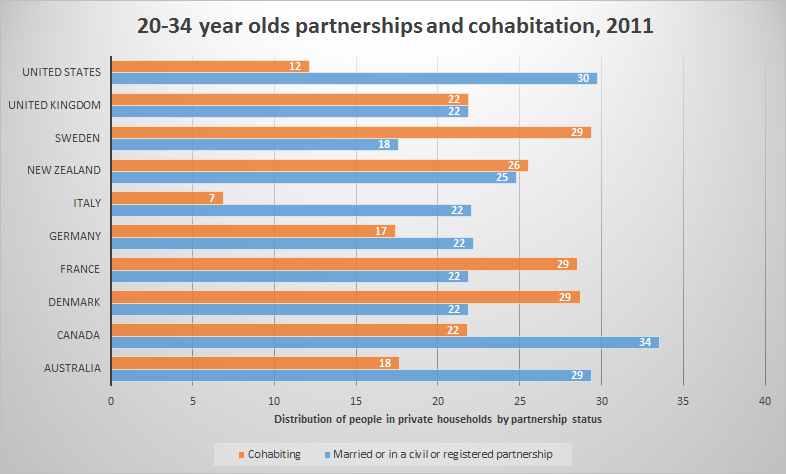
Partnership status of young adults, USA, UK, Sweden, New Zealand, Italy, Germany the, France, Denmark, Canada and Australia
26 Oct 2015 Leave a comment
in economics of love and marriage, population economics Tags: economics of fertility, family demographics, marriage and divorce, search and matching
They certainly don’t go much for cohabiting in Italy or indeed the USA among young adults. Cohabitation is pretty much the same everywhere else. Marriage is not so common in Sweden generally among young people.
Source: OECD Family Database – OECD.
@thecounted @radleybalko police shootings of blacks by threat level @PostGraphics
25 Oct 2015 1 Comment
in economics of crime, politics - USA
The Washington Post wrote a wonderful investigative journalism article today on police shootings in the USA. The Washington Post started with a Wisconsin state trooper murdered in a shoot-out with an escaping bank robber.

The young state trooper was on his first solo patrol. State Trooper Trevor Casper was tailing a bank robber who suddenly turned his car back on him and shot repeatedly at the state trooper. Both died in the gun battle. The bank robber used armour piercing ammunition to pierce the body armour of the state trooper.

Source: Investigation: Police shootings – Washington Post.
I have augmented the graphics of the Washington Post by breaking it down for shooting of blacks, which is the main political controversy in the USA at the moment. In the chart above I broke down those with signs of mental illness only when they were attacking with a deadly weapon to avoid clutter in what is already a busy pie chart.
With your help, we've counted 928 people killed in the US by police this year. Send us tips @thecounted. https://t.co/s8ahmm6ZdK—
The Counted (@thecounted) October 23, 2015
The big secret again from the Washington Post database is don’t confront armed police with a weapon. Most people who are shot by police are either attacking police or brandishing a weapon.
Of 800 fatal shootings by police in 2015, 595 occurred after a range of violent crimes wapo.st/on-duty-under-… https://t.co/cYtbY2ohwP—
Post Graphics (@PostGraphics) October 24, 2015
Police officers who shoot an unarmed suspect at a safe distance are highly likely to be charged as I have previously argued. The Washington Post found that only 5% of the police shootings it reviewed for 2015 were suspicious in terms of police misconduct.

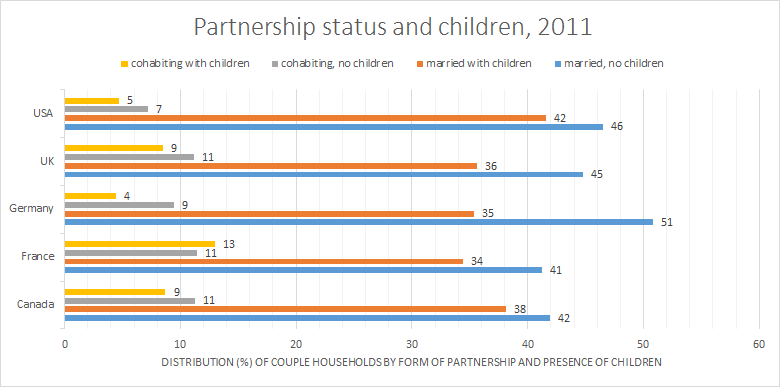
Who is married with children in USA, UK, Canada, Germany and France?
25 Oct 2015 Leave a comment
in economics of love and marriage, population economics Tags: economics of fertility, marriage and divorce, search and matching, single parents, soul parents
Source: OECD Family Database – OECD.
The truth about gun free zones
25 Oct 2015 Leave a comment
in applied price theory, economics of crime, economics of regulation, law and economics Tags: expressive voting, gun control, gun free zones, meddlesome preferences, nanny state, offsetting behaviour, rational rationality, unintended consequences
The marital division of labour
24 Oct 2015 Leave a comment
Women still do most of the household chores? Data on who does what in the house: goo.gl/3doqy4 #statistics https://t.co/fnY0d9OgkT—
DataStories (@LindaRegber) October 24, 2015
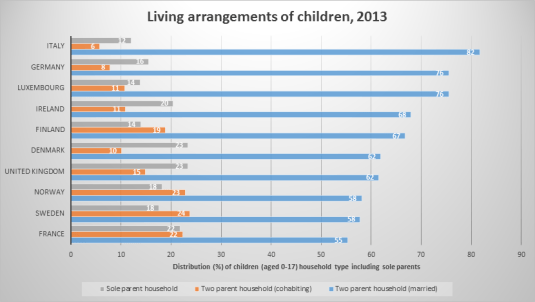
How common is marriage in two-parent households, selected OECD countries
24 Oct 2015 Leave a comment
in economics of love and marriage, population economics
Living in sin is much more popular in some countries. The French and Scandinavians are really big on not bothering to marry but live together and raise children.
Source: OECD Family Database.
Data on the number of two-parent households who were married or not was not available for the USA, Australia or New Zealand, unfortunately.
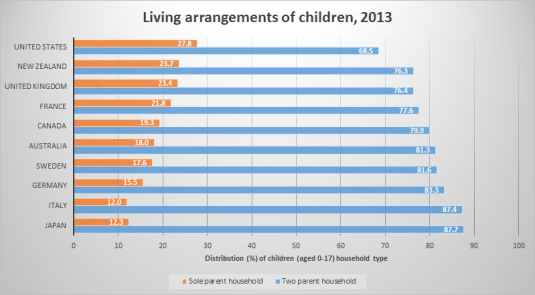
Living arrangements of children, USA, UK, New Zealand, France, Canada, Australia, Sweden, Germany, Italy and Japan
24 Oct 2015 Leave a comment
in economics of love and marriage, population economics
The percentage of sole parent households varies widely across the OECD member countries charted below including between the English-speaking countries.
Source: OECD Family Database.
Private police reduce crime by more
22 Oct 2015 Leave a comment
in economics of crime, industrial organisation Tags: police, privatisation
UPenn private police do extremely well too, in another high crime area (Philly) law.utexas.edu/wp-content/upl… http://t.co/knWHw82EjU—
Ben Southwood (@bswud) July 28, 2015
The official salaries of African presidents
22 Oct 2015 Leave a comment
in development economics, economics of crime, growth disasters, growth miracles, law and economics Tags: Africa, bribery and corruption
What African Presidents Make (Officially) http://t.co/X3F0j5DYHG—
ian bremmer (@ianbremmer) July 23, 2015
Why 788 people were shot dead by police so far this year
20 Oct 2015 Leave a comment
in economics of crime, politics - USA Tags: crime and punishment, law and order, police, police shootings
The Washington Post also compiles a list of Americans shot dead by their police. The police hate speech host site, The Countered at The Guardian has some competition.
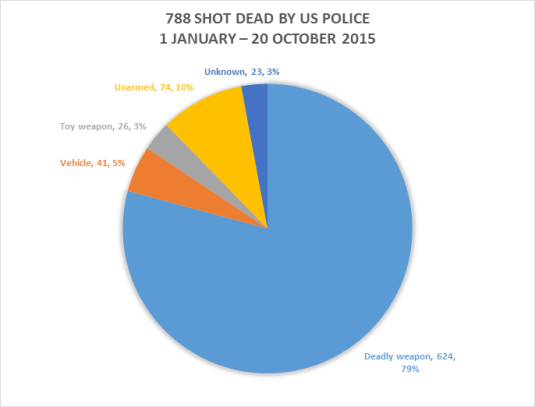
Source: Investigation: Police shootings – Washington Post.
The Washington Post counts 788 police shot dead by police. The Counted counts 922 because it includes deaths in custody, Taser deaths and people collapsing after a struggle. The Countered even included one poor sod who was lost at night-time and accidentally run over by the police cruiser searching for him. He wasn’t on the run. He was just run over at night.

Source: Investigation: Police shootings – Washington Post.
In common with The Counted, the Washington Post does not present the data on police shootings in the simple pie chart graphics to get a handle on how many times police shot armed criminals. That is why I am posting this pie chart today presenting this most basic information necessary for a balanced view.


 Utopia, you are standing in it!
Recent Comments