
Source: Osland v R [1998] HCA 75; 197 CLR 316; 159 ALR 170; 73 ALJR 173 (10 December 1998).
Celebrating humanity's flourishing through the spread of capitalism and the rule of law
20 Nov 2015 Leave a comment
in economics of crime, law and economics, politics - New Zealand, politics - USA Tags: battered woman's defence, crime and punishment, criminal deterrence, criminal procedure, Justice Michael Kirby, law and order
19 Nov 2015 Leave a comment
in economics of crime, law and economics, politics - USA
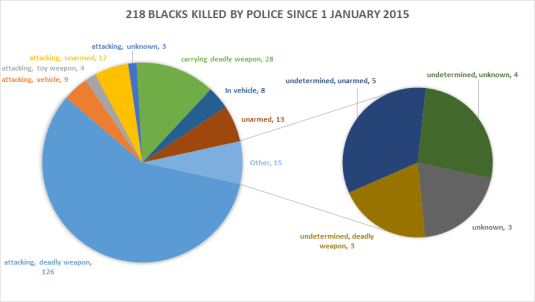
Surprisingly few Blacks killed by police this year in the USA were simply unarmed – at least 13 but no more than 20 or so. Nearly all of the rest were attacking or carrying a deadly weapon.
19 Nov 2015 Leave a comment
in economics of crime, law and economics, politics - USA
18 Nov 2015 Leave a comment
in economics of crime, law and economics, politics - Australia, politics - New Zealand Tags: battered woman's defence, crime and punishment, criminal deterrence, criminal procedure, Justice Michael Kirby, law and order
18 Nov 2015 2 Comments
in economics of crime, law and economics
The Guardian numbers are higher than those of the Washington Post investigation in part because they include deaths in custody and people run over by police including in routine car accidents.
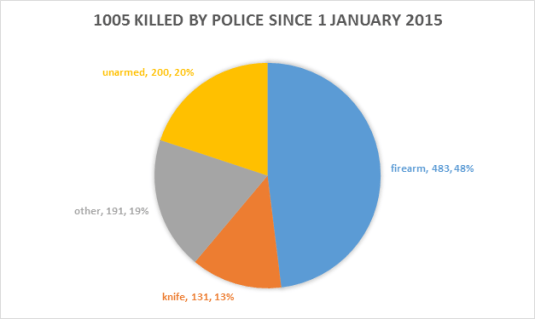
The Washington Post breakdown includes threat level such as whether the deceased were attacking police and what type of weapon they were found to have been carrying, if any.
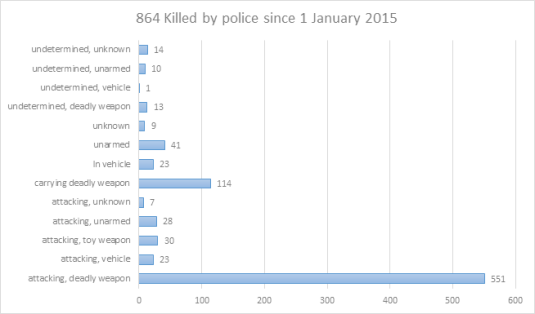
Source: Investigation: Police shootings – Washington Post.
Before you get too excited, in the aftermath of the recent Paris attacks, it was pointed out that the British police have difficulty recruiting to their armed response units because of the legal hassles involved if an armed police officer shoots anyone. There are 6000 authorised firearm officers in the UK. All 288,000 French police are armed – often with automatic weapons.
17 Nov 2015 Leave a comment
in economics of love and marriage, labour economics, labour supply
Unlike their British compatriots, German fathers are working longer hours than in the past.

Source: OECD Family Database.
16 Nov 2015 1 Comment
in economics of love and marriage, labour economics, labour supply Tags: asymmetric marriage premium, British economy, male labour force participation, marriage and divorce
The number of British fathers in a couple who worked more than 45 hours a week has dropped from about 60% to under 40% since 1998.
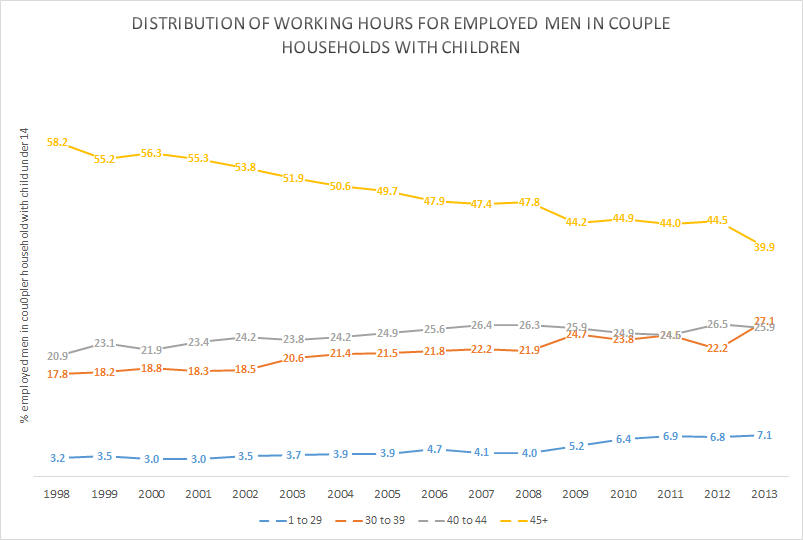
Source: OECD Family Database.
13 Nov 2015 Leave a comment
in economics of love and marriage, labour supply, politics - Australia, politics - New Zealand, politics - USA Tags: Australia, British economy, France, Ireland, Italy, maternal labour supply, single parents, sole parents, welfare state
Despite supposedly having stingy welfare states, both New Zealand and Australia have a lot of sole parents who do not work at all. There is no separate breakdown of full-time and part-time work status in the USA. About 72% of sole parents in the USA either work full-time or part-time.
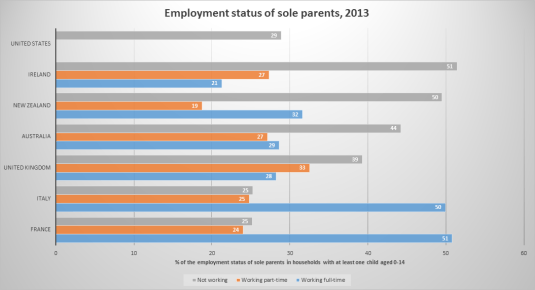
Source: OECD Family Database.
13 Nov 2015 Leave a comment
in economics of love and marriage Tags: dating market, marriage and divorce, search and matching
“The researchers looked at different variables to understand why divorces tend to be filed by women. They suggest three main explanations:

Source: Are Women More Likely Than Men To End A Relationship? | FiveThirtyEight
12 Nov 2015 Leave a comment
in applied price theory, economics of crime, politics - Australia
Some poor bugger died shortly after escaping from the Australian immigration detention facility on Christmas Island a few days ago. I wonder where he was intending to escape?
Christmas Island is in the middle of the Indian Ocean and the only way off is by the airport. He had nowhere to run. There would be lucky to be 2000 people living on the small island of Christmas Island so he would stand out very quickly.
Many years ago, a fight broke out one breakfast time between the different nationalities regarding the management of the canteen at the Port Hedland immigration detention facility. They resolved the differences about this largely self-managed canteen where each cooked their own foods by deciding to stage a spontaneous escape.
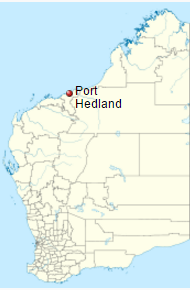 As they marched down the road, free at last, the manager of the facility caught up with them. He asked them where were they going? He said it already telephoned Greyhound buses and told them not to sell them bus tickets. Perth is 1300 km away from Port Hedland. The manager of the facility suggested they all come back to settle things over a cuppa as it was warming up as noon was approaching.
06 Nov 2015 1 Comment
in economics of love and marriage, population economics
05 Nov 2015 Leave a comment
in economics of media and culture, law and economics Tags: police
05 Nov 2015 2 Comments
in economic history, law and economics, property rights
https://twitter.com/SadHappyAmazing/status/662133451286380545
The history of Australian aboriginals is sad enough without making up complete lies about their mistreatment. Their actual mistreatment was bad enough without making stuff up.
I sat on the Student Representative Council with a Tasmanian aboriginal. Stephen was one of the Maynards. Another prominent aboriginal family in Tasmania was the Mansells. This is despite the myth that the last Tasmanian aboriginal died in 1876. Michael Mansell was an excellent lawyer and a pragmatic advocate for his clients
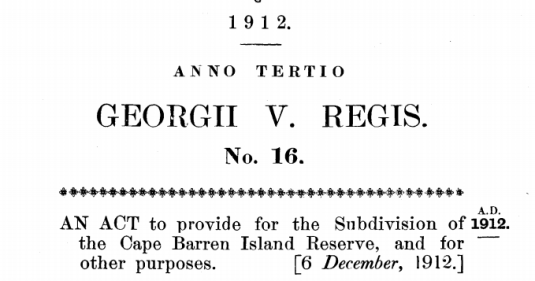
In 1912, the Tasmanian Parliament passed a law recognising the land rights of Tasmanian aboriginals on Cape Barron Island. They were to be offered leases on land set aside for them. At the time they are itinerant mutton bird hunters.
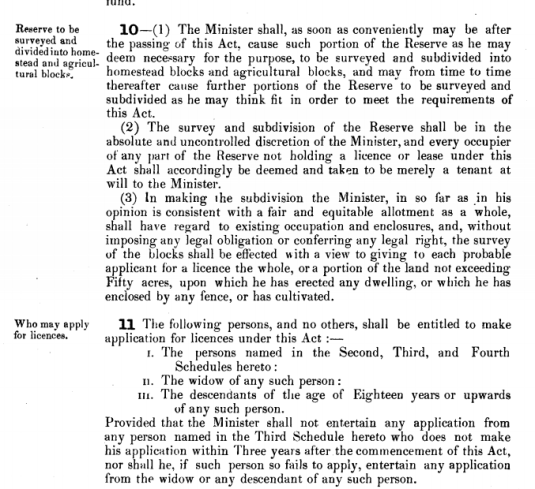
That Act of Parliament created a reserve for them, listed them by name to ensure no doubt that they could apply for leases and prohibited the sale of alcohol to them to reduce alcoholism:
The Cape Barren Island Reserve Act 1912 provided that unless the residents of the Island constructed dwellings and fenced and cultivated land they would lose their right to occupy that land. It also stated that `in order to encourage the settlement of the half-castes in other parts of Tasmania outside the Reserve’ the Minister for Lands could authorise an applicant for a licence to occupy Crown land elsewhere in Tasmania… The subsequent Cape Barren Island Reserve Act 1945 was similar to the 1912 Act but it imposed more rigorous conditions on the lessees in return for a free land grant.
The 1912 Act also made an offer of 50 acres of land on the mainland of Tasmania to Cape Barren Island aboriginals. In common with the 1912 Act, The 1945 Act listed by name the Tasmanian aboriginals who were to benefit from the 99 year leases exactly where those leases were to remove any doubt or need for litigation:
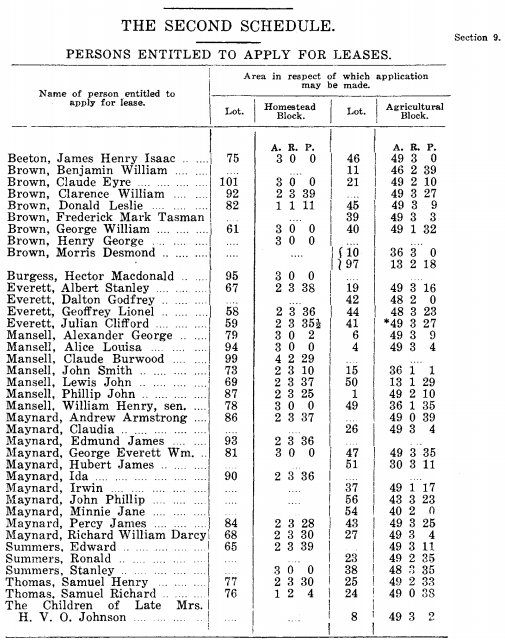
The Tasmanian approach to aboriginal land rights stressed private property and the ability of each aboriginal to establish his own economic independence and make a living. Helen Hughes discussed the mainland solution which was communal rights, quoting a Palm Island resident:
The difference between a black man and a white man is this, when a white man dies his family gets his house. When a black man dies the government gets it.
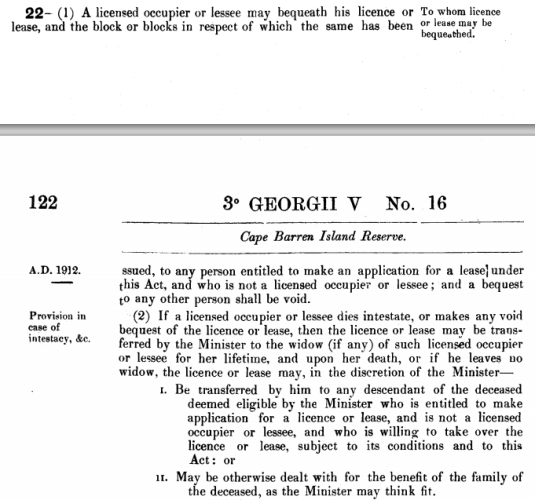
The Tasmanian 1912 legislation provided for leases to be inherited by family members both through a will with specific provisions to deal with those who didn’t write a will to ensure the family still benefited:
05 Nov 2015 Leave a comment
in applied price theory, economics of crime, law and economics Tags: crime and punishment, criminal deterrence, criminal psychiatry, economics of personality traits, law and order, psychopaths, sociopaths
Psychopath and sociopath are popular psychology terms to describe violent monsters born of our worst nightmares. Think Hannibal Lecter in Silence of the Lambs (1991), Norman Bates in Psycho (1960) and Annie Wilkes in Misery (1990). In making these characters famous, popular culture has also burned the words used to describe them into our collective consciousness.
Most of us, fortunately, will never meet a Hannibal Lecter, but psychopaths and sociopaths certainly do exist. And they hide among us. Sometimes as the most successful people in society because they’re often ruthless, callous and superficially charming, while having little or no regard for the feelings or needs of others.
These are known as “successful” psychopaths, as they have a tendency to perform premeditated crimes with calculated risk. Or they may manipulate someone else into breaking the law, while keeping themselves safely at a distance. They’re master manipulators of other peoples’ feelings, but are unable to experience emotions themselves.
Sound like someone you know? Well, heads up. You do know one; at least one. Prevalence rates come in somewhere between 0.2% and 3.3% of the population.
If you’re worried about yourself, you can take a quiz to find out, but before you click on that link let me save you some time: you’re not a psychopath or sociopath. If you were, you probably wouldn’t be interested in taking that personality test.
You just wouldn’t be that self-aware or concerned about your character flaws. That’s why both psychopathy and sociopathy are known as anti-social personality disorders, which are long-term mental health conditions.

Although most of us will never meet someone like Hannibal Lecter from Silence of the Lambs, we all know at least one sociopath. from shutterstock.com
Psychopaths and sociopaths share a number of characteristics, including a lack of remorse or empathy for others, a lack of guilt or ability to take responsibility for their actions, a disregard for laws or social conventions, and an inclination to violence. A core feature of both is a deceitful and manipulative nature. But how can we tell them apart?
Sociopaths are normally less emotionally stable and highly impulsive – their behaviour tends to be more erratic than psychopaths. When committing crimes – either violent or non-violent – sociopaths will act more on compulsion. And they will lack patience, giving in much more easily to impulsiveness and lacking detailed planning.
Psychopaths, on the other hand, will plan their crimes down to the smallest detail, taking calculated risks to avoid detection. The smart ones will leave few clues that may lead to being caught. Psychopaths don’t get carried away in the moment and make fewer mistakes as a result.
Both act on a continuum of behaviours, and many psychologists still debate whether the two should be differentiated at all. But for those who do differentiate between the two, one thing is largely agreed upon: psychiatrists use the term psychopathy to illustrate that the cause of the anti-social personality disorder is hereditary. Sociopathy describes behaviours that are the result of a brain injury, or abuse and/or neglect in childhood.
Psychopaths are born and sociopaths are made. In essence, their difference reflects the nature versus nurture debate.
There’s a particularly interesting link between serial killers and psychopaths or sociopaths – although, of course, not all psychopaths and sociopaths become serial killers. And not all serial killers are psychopaths or sociopaths.

Thomas Hemming murdered two people in 2014 just to know what it felt like to kill. Tracey Nearmy/AAP Image
But America’s Federal Bureau of Investigation (FBI) has noted certain traits shared between known serial killers and these anti-social personality disorders. These include predatory behaviour (for instance, Ivan Milat, who hunted and murdered his seven victims); sensation-seeking (think hedonistic killers who murder for excitement or arousal, such as 21-year-old Thomas Hemming who, in 2014, murdered two people just to know what it felt like to kill); lack of remorse; impulsivity; and the need for control or power over others (such as Dennis Rader, an American serial killer who murdered ten people between 1974 and 1991, and became known as the “BTK (bind, torture, kill) killer”).
The Sydney murder of Morgan Huxley by 22-year-old Jack Kelsall, who arguably shows all the hallmarks of a psychopath, highlights the differences between psychopaths and sociopaths.
In 2013, Kelsall followed Huxley home where he indecently assaulted the 31-year-old before stabbing him 28 times. Kelsall showed no remorse for his crime, which was extremely violent and pre-meditated.
There’s no doubt in my mind he’s psychopathic rather than sociopathic because although the murder was frenzied, Kelsall showed patience and planning. He had followed potential victims before and had shared fantasies he had about murdering a stranger with a knife with his psychiatrist a year before he killed Huxley, allegedly for “the thrill of it”.
Whatever Kelsall’s motive, regardless of whether his dysfunction was born or made, the case stands as an example of the worst possible outcome of an anti-social personality disorder: senseless violence perpetrated against a random victim for self-gratification. Throughout his trial and sentencing, Kelsall showed no sign of remorse, no guilt, and gave no apology.
A textbook psychopath, he would, I believe, have gone on to kill again. In my opinion – and that of the police who arrested him – Kelsall was a serial killer in the making.
In the end, does the distinction between a psychopath and sociopath matter? They can both be dangerous and even deadly, the worst wreaking havoc with people’s lives. Or they can spend their life among people who are none the wiser for it.
This article was originally published on The Conversation in July 2015. Read the original article. Republished under the a Creative Commons Attribution No Derivatives licence.
Celebrating humanity's flourishing through the spread of capitalism and the rule of law
A History of the Alt-Right
Econ Prof at George Mason University, Economic Historian, Québécois
Celebrating humanity's flourishing through the spread of capitalism and the rule of law
Scholarly commentary on law, economics, and more
Beatrice Cherrier's blog
Celebrating humanity's flourishing through the spread of capitalism and the rule of law
Celebrating humanity's flourishing through the spread of capitalism and the rule of law
Celebrating humanity's flourishing through the spread of capitalism and the rule of law
Why Evolution is True is a blog written by Jerry Coyne, centered on evolution and biology but also dealing with diverse topics like politics, culture, and cats.
Celebrating humanity's flourishing through the spread of capitalism and the rule of law
A rural perspective with a blue tint by Ele Ludemann
DPF's Kiwiblog - Fomenting Happy Mischief since 2003
Celebrating humanity's flourishing through the spread of capitalism and the rule of law
The world's most viewed site on global warming and climate change
Tim Harding's writings on rationality, informal logic and skepticism
A window into Doc Freiberger's library
Let's examine hard decisions!
Commentary on monetary policy in the spirit of R. G. Hawtrey
Thoughts on public policy and the media
Celebrating humanity's flourishing through the spread of capitalism and the rule of law
Politics and the economy
A blog (primarily) on Canadian and Commonwealth political history and institutions
Reading between the lines, and underneath the hype.
Economics, and such stuff as dreams are made on
"The British constitution has always been puzzling, and always will be." --Queen Elizabeth II
Celebrating humanity's flourishing through the spread of capitalism and the rule of law
Celebrating humanity's flourishing through the spread of capitalism and the rule of law
WORLD WAR II, MUSIC, HISTORY, HOLOCAUST
Undisciplined scholar, recovering academic
Celebrating humanity's flourishing through the spread of capitalism and the rule of law
Res ipsa loquitur - The thing itself speaks
In Hume’s spirit, I will attempt to serve as an ambassador from my world of economics, and help in “finding topics of conversation fit for the entertainment of rational creatures.”
Researching the House of Commons, 1832-1868
Articles and research from the History of Parliament Trust
Reflections on books and art
Posts on the History of Law, Crime, and Justice
Celebrating humanity's flourishing through the spread of capitalism and the rule of law
Exploring the Monarchs of Europe
Cutting edge science you can dice with
Small Steps Toward A Much Better World
“We do not believe any group of men adequate enough or wise enough to operate without scrutiny or without criticism. We know that the only way to avoid error is to detect it, that the only way to detect it is to be free to inquire. We know that in secrecy error undetected will flourish and subvert”. - J Robert Oppenheimer.
The truth about the great wind power fraud - we're not here to debate the wind industry, we're here to destroy it.
Celebrating humanity's flourishing through the spread of capitalism and the rule of law
Celebrating humanity's flourishing through the spread of capitalism and the rule of law


 Utopia, you are standing in it!
Recent Comments