A Constitutional Trojan Horse: advancing change through political stealth Trade Minister Hon Todd McClay has announced that the New Zealand-India free trade agreement has been signed and that the formal parliamentary treaty scrutiny process is now under way. The full text of the agreement is now public and has been referred to Parliament’s Foreign Affairs, Defence and Trade Committee […]
The Sting in the India Trade Deal
The Sting in the India Trade Deal
16 May 2026 Leave a comment
in comparative institutional analysis, constitutional political economy, development economics, economic history, economics of regulation, international economic law, international economics, International law, law and economics, politics - New Zealand, property rights Tags: India, preferential trading agreements
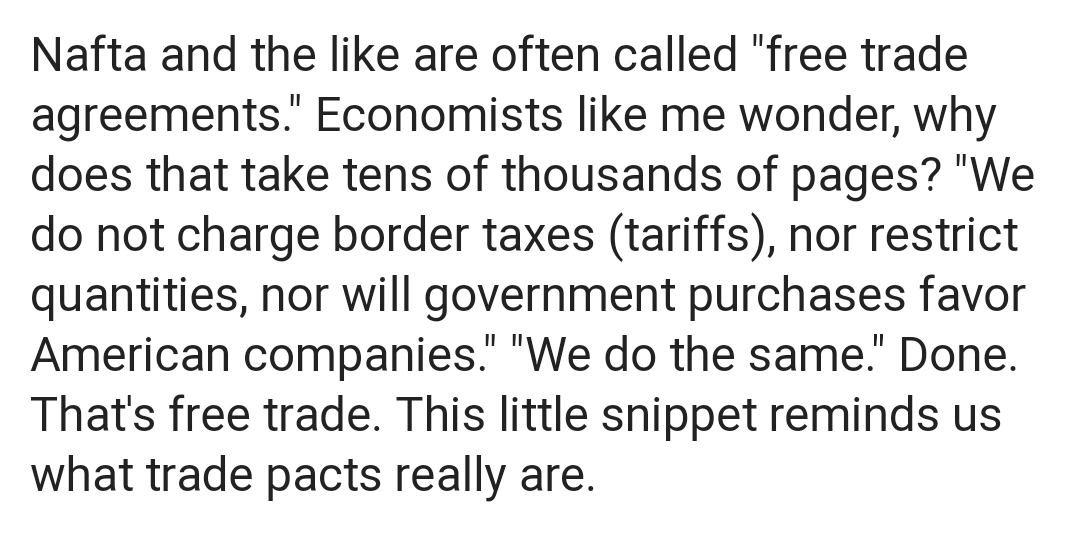
.@JohnHCochrane says free trade agreements should be 2 lines @golrizghahraman
10 Aug 2018 Leave a comment
in applied price theory, comparative institutional analysis, international economics, politics - New Zealand, politics - USA Tags: preferential trading agreements
Can free trade agreements help solidify emerging democracies?
24 May 2016 Leave a comment
in constitutional political economy, defence economics, international economics, Public Choice, rentseeking Tags: autocracy, customs unions, emerging democracies, free trade agreements, military coups, preferential trading agreements
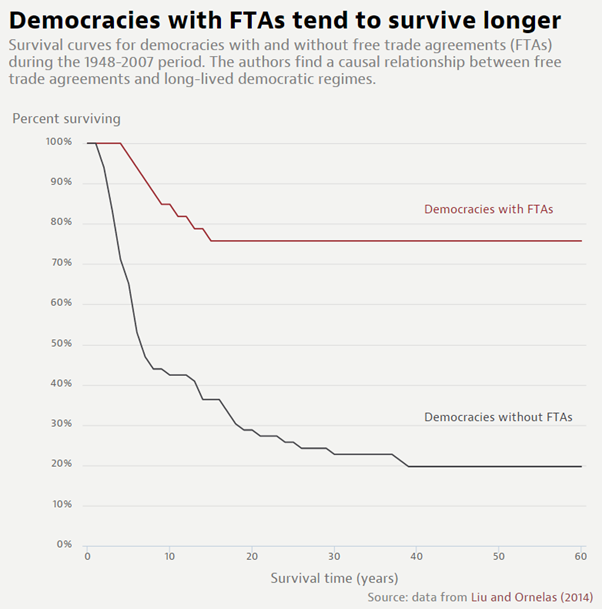
Source: “Free Trade Agreements and the Consolidation of Democracy” (April 2014) American Economic Journal: Macroeconomics. American Economic Association.
The 1st @PaulKrugman on globalisation & development @harleyhs #TPPANoWay
22 Mar 2016 Leave a comment
in development economics, economic history, growth disasters, growth miracles, international economics Tags: anti-market bias, antiforeign bias, GATT, gender analysis, gender wage gap, makework bias, NAFTA, pessimism bias, preferential trading agreements, rational irrationality, TPPA, WTO
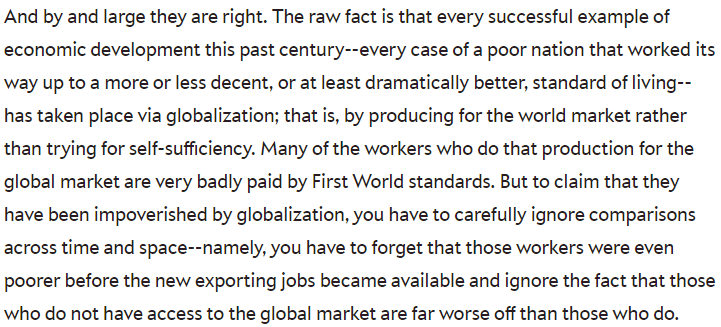
Source: Paul Krugman (1997) Enemies of the WTO.
This visiting American education professor who specialises in globalisation, claimed in the linked radio interview that real wages had fallen in the USA and Mexico. Even for the bottom 20% of the USA, their after-tax household incomes increased by 40% since 1979, with most of that after the signing of NAFTA.
Everything that is bad in crony capitalist Mexico is the fault of NAFTA if our visiting academic is to be believed despite trade tripling and investment increasing 600% because of NAFTA.
Women’s earnings growth has been perfectly fine over the last 40 years despite the horrors of NAFTA and the attack on unions and workers rights by a top 1% emboldened by NAFTA and globalisation, if our visiting academic is to be believed.
Gender analysis, gender analysis, where is his gender analysis of NAFTA? Few labour market statistics make sense without being broken down by sex because of the immense economic progress of women in the last 50 years. Can NAFTA claim credit for that?
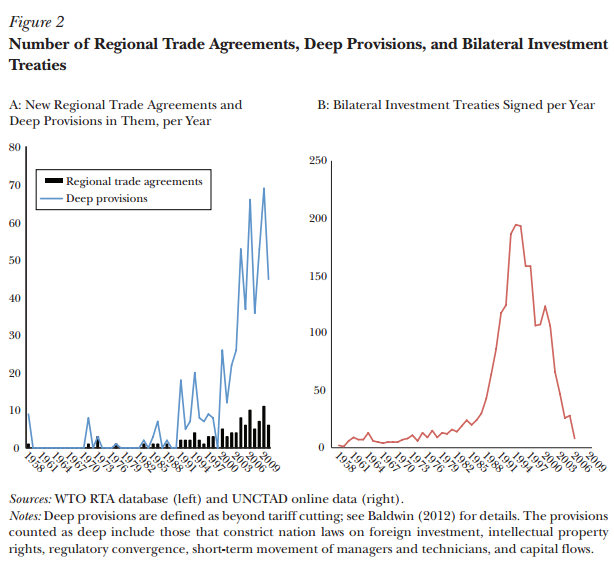
The explosion of lead in the saddlebags of trade agreements @KennedyGraham @DavidShearerMP #TPPANoWay
16 Mar 2016 Leave a comment
in economics of bureaucracy, international economic law, international economics, law and economics, politics - New Zealand, property rights, Public Choice, rentseeking Tags: crony capitalism, customs unions, free trade agreements, international investment law, investor state dispute settlement, preferential trading agreements
@toddmcclaymp #MFAT hasn’t heard of trade diversion? @DavidShearerMP #TPPANoWay @KennedyGraham
15 Mar 2016 Leave a comment
in economics of bureaucracy, international economics, politics - New Zealand, Public Choice, rentseeking Tags: customs unions, free trade agreements, preferential trading agreements, TPPA, trade creation, trade diversion
Trade diversion occurs when preferential trading agreements cause imports to shift from low cost countries to higher cost countries. Rather than gaining tariff revenue from inexpensive imports from world markets, a country may import expensive products from member countries but not gain any tariff revenue. An example of trade diversion is when Britain closed its doors to New Zealand agricultural exports after joining the common market.
Preferential trading agreements are trade agreements between countries in which they lower tariffs for each other but not for the rest of the world. The mass media mislabel them free trade agreements.
Under trade diversion, the partner country benefits from this change as an exporter, but the importing country loses due to this higher cost, as does the third country whose exports fall.
The loss to the importing country is not visible to consumers, who find the higher-cost product cheaper due to the absence of tariff. The country as a whole loses, with that loss being lost tariff revenue – lost to cover the cost of the higher cost imports from a member of the new preferential trading agreement.

It does not take much trade diversion to make a preferential trading agreement welfare reducing because of this switch to high cost producers.
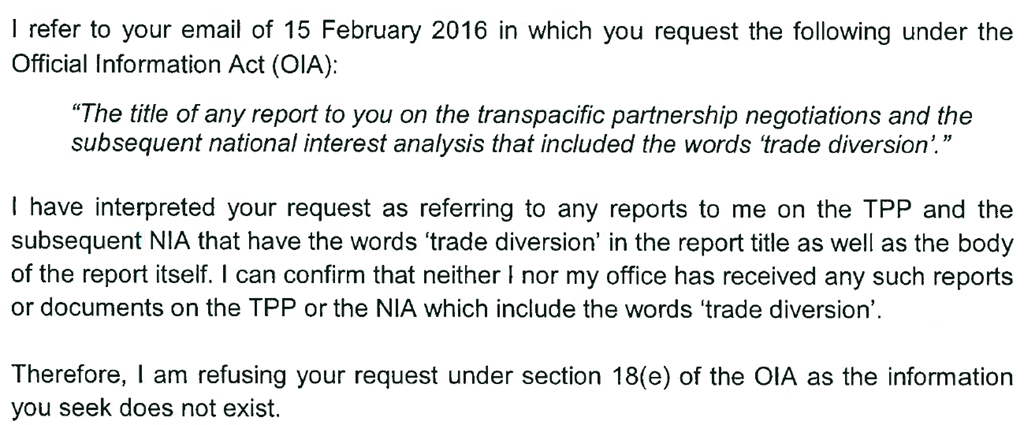
The New Zealand Minister of Trade and the Ministry of Foreign Affairs and Trade did not discuss this major risk even from the simplest preferential trading agreement in recent policy analysis of the TPPA as my Official Information Act request has revealed. The term trade version does not appear in any of their analysis.
Adherents of the natural trading partner hypothesis argue that preferential trade agreements are more likely to improve welfare if participating countries already trade disproportionately with each other. Opponents of the hypothesis claim that the opposite is true: welfare gains are likely to be greater if participating countries trade less with each other. The powerful critique by Bhagwati and Panagariya (1996) is now widely accepted and one hears little justification of on preferential trading agreements on the grounds of the natural trading partners hypothesis
My submission to Parliamentary committee on TPPA treaty examination
15 Feb 2016 2 Comments
in applied welfare economics, international economic law, international economics, politics - New Zealand Tags: customs unions, intellectual property, preferential trading agreements, TPPA, trade creation, trade diversion
Despite all the passions about the TPPA, the correct starting post for an economist on regional trade agreements is lukewarm opposition. That is the position of Paul Krugman. Paul Krugman summarised the TPPA well recently from a standpoint of a professional economist:
I’ve described myself as a lukewarm opponent of the Trans-Pacific Partnership; although I don’t share the intense dislike of many progressives, I’ve seen it as an agreement not really so much about trade as about strengthening intellectual property monopolies and corporate clout in dispute settlement — both arguably bad things, not good, even from an efficiency standpoint….
What I know so far: pharma is mad because the extension of property rights in biologics is much shorter than it wanted, tobacco is mad because it has been carved out of the dispute settlement deal, and Republicans in general are mad because the labour protection stuff is stronger than expected. All of these are good things from my point of view. I’ll need to do much more homework once the details are clearer.
Krugman then reminded that a trade agreement is most politically viable when it is most socially harmful. This is the point that the opponents of the TPPA miss. They will not want to discuss how some trade agreements are good deals but others are bad. That would admit that trade agreements can be welfare enhancing, and sometimes they are but sometimes not.
The correct economic name for free trade agreements is preferential trading agreements. These agreements give tariff and other preferences to some countries over others.
Tariffs are lower for the members of the agreement, creating more trade, but there is also trade division.
CER offers a neat example of trade diversion. Instead of buying cars from the cheapest source and collecting tariff revenue, the hopelessly inefficient Australian car industry did not have to pay tariffs so it made New Zealand into a major export market until tariffs were abolished in 1998.
Less tariff revenue because of CER but we still paid way over the odds for Australian instead of Japanese cars. We were worse off. Less tariff revenue but car prices pretty much as high as before.
New Zealand tariffs are minimal these days. The TPPA reduces the key tariffs on our exports at an excruciatingly slow pace.
There is no discussion of trade diversion in the National Interest Analysis before this committee. For that reason alone, the National Interests Analysis is inadequate and should be returned to the Ministry for further work. Right now, it would not pass a first semester test in a basic international economics course because that most basic risk from trade agreements is not discussed.
Most of the TPPA is not about tariffs. Many of these other chapters are suspicious add-ons to trade talks.
Developing countries rightly regard trade and environment clauses in any trade agreement as a new form of colonialism.
Unions, the Labour Party and Greens happily demand these intrusions into the regulatory sovereignty of developing countries to protect special interests against import competition.
The sovereignty objections to trade agreements are no different to those that can be made to climate change treaties and International Labour Organisation conventions. It is all in the details – what do we get in return?
Consistency would help too. Trade agreements should not include labour or environmental standards as they, for example, limit our right to deregulate our labour market. Be careful for what you wish for when you oppose international agreements on sovereignty grounds.
The intellectual property chapters of the TPPA are truly suspicious. With each new day, the case for patents and copyrights is weakening in the economic literature. Some have made powerful arguments to abolish patents and copyrights altogether.
There are modest extensions of the term limits of drug patents and much more mischief on copyright terms. These should be watched carefully in future trade talks and one day will be a deal breaker.
Good arguments can be made against investor state dispute settlement provisions even after the carve-outs. These provisions have no place in trade agreements between democracies.
Foreigners can take their chances in democratic politics like the rest of us. They might occasionally get a short deal because of left-wing or right-wing populism but these gusts of xenophobia are mostly an occasional irritant in the rich fabric of Western democracies.
Developing countries sign-up to investor state dispute settlement to signal they are open for business. Foreign investors do not have to put up with their corrupt courts and bureaucracies and hopelessly venial politicians.
The logic of regional trade negotiations is we cut tariffs we should have cut long ago in return for others cutting their tariffs which they too should have cut long ago.
Much is made of the cost-benefit analysis of the TPPA. All the critics are really saying is cost benefit analysis is really hard and often imprecise.
If the econometric estimates were not in doubt in this or any other public policy field, the academics are simply not trying hard enough to win tenure and promotion. Academics make their careers by being contrarian.
For this lukewarm opponent of regional trade agreements, the TPPA is a so-so deal with small net gains. There is no harm in signing it.
#TPPANoWay @oxfamNZ @GreenpeaceUSA The Effects of Globalization
07 Feb 2016 Leave a comment
in applied price theory, applied welfare economics, development economics, economic history, growth disasters, growth miracles, international economics, Marxist economics Tags: customs unions, expressive voting, free trade, Leftover Left, ODA, preferential trading agreements, rational ignorance, rational irrationality, The Great Escape, The Great Fact, TPA, TPPA, Twitter left, Tyler Cowen
@TrevorMallard what next for #TPPANoWay? Repeal CER?
31 Jan 2016 Leave a comment
in economic history, international economics, International law, law and economics, politics - Australia, politics - New Zealand, Public Choice, television, TV shows Tags: CER, closer economic relations, Hollywood economics, ISDS, preferential trading agreements, rational irrationality, single market, TPPA, Twitter left

New Zealand filmmakers have used trade treaties to pry open access to foreign markets by challenging failures to honour promises of nondiscrimination in trade and investment in the Federal Court of Australia.
This should please the Twitter Left because they are also a film going left as are most members of the educated middle class as a point of identity and snobbery.
Back in the day, New Zealand television programming was sold cheaply into the Australian market. Many cultural and other products are exported into foreign markets and sold for whatever they can get above the price of shipping or digital transmission. What else explains all that rubbish on cable TV?
Under the Closer Economic Relations agreement that creates a single market between Australia and New Zealand, New Zealand made television programming content must be treated the same way as Australian content so it was included in their 50% local content rules for commercial television back from whenever I remember this story from.
There was a Federal Court of Australia case that ruled that New Zealand television programming was Australian content programming for the purposes of the relevant media regulations because of Closer Economic Relations.
From the late 1990s, with revival of the New Zealand film and television industry, New Zealand content was starting to flood the Australian market, especially in the off-season in the summer when stations were looking for cheap content to fill a low ratings period.
Naturally, this Kiwi invasion did not please the rent seeking Australian television programme production industry and many a mendicant actor, writer and producer
Where there is a will, where there is a way: minimum quality standards are introduced into the Australian content rules defined by price – a price that happen to be above what the television stations used to pay for New Zealand made programming in the off-season.
This court victory in favour of various New Zealand film industry in enforcing a trade and investment treaty puts the Twitter left in a bit of a conundrum. Which is more important? The New Zealand film industry or their hatred of globalisation and the rule of law.
The 1st @NYTimeskrugman on #TPPANoWay @Oxfamnz #JaneKelsey
30 Jan 2016 Leave a comment
in applied price theory, applied welfare economics, development economics, economic history, growth disasters, growth miracles, international economics Tags: customs unions, free trade agreements, globalisation, Jane Kelsey, Leftover Left, Oxfam, Paul Krugman, preferential trading agreements, rational irrationality, TPP, Twitter left, Yes Minister
https://twitter.com/TPPMediaMarch/status/692055631579185152
If George Bush had not won the 2000 presidential election, Paul Krugman would have taken over as the best communicator of economics since Milton Friedman. Instead, he became patient number no.1 of George Bush derangement syndrome. Ann Coulter was patient no. 1 of Clintons derangement syndrome.

Source: Enemies of the WTO.
Development & Trade: Empirical Evidence @DavidShearerMP @oxfamnz @TPPANoWay
29 Jan 2016 Leave a comment
in applied price theory, applied welfare economics, development economics, economic history, growth disasters, growth miracles, international economics, politics - New Zealand, politics - USA Tags: free trade, free trade agreements, preferential trading agreements, The Great Enrichment, The Great Fact, TPPA, WTO
Original EU Labor Productivities Relative to U.S. @NickCohen4 @iainmartin1 @CapX
17 Jan 2016 Leave a comment
in currency unions, economic growth, economic history, Euro crisis, international economics, macroeconomics Tags: Brexit, Common market, customs unions, European Union, free trade agreements, preferential trading agreements
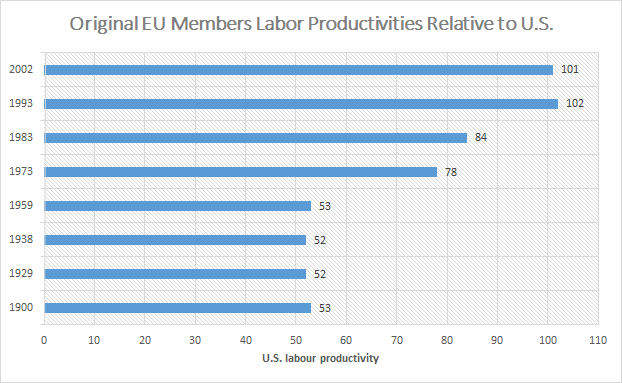
Source: Edward Prescott.
@HillaryClinton positions on #TPA trade deal over time
21 Oct 2015 Leave a comment
in international economics, politics - USA Tags: 2016 presidential election, customs unions, free trade agreements, preferential trading agreements, regional trade agreements, TPA, TPPA
Timeline of Hillary Clinton's positions on Pacific trade deal over time: on.wsj.com/1OA728c by @willmauldin http://t.co/iPN0p5VZhn—
WSJ Think Tank (@WSJThinkTank) October 18, 2015
Jane Kelsey oppose handcuffs on the democratic choices of future governments! Does she opposes labour and environmental standards in trade agreements too?
06 Oct 2015 Leave a comment
in development economics, international economic law, international economics, International law, politics - New Zealand, politics - USA Tags: colonialism, GATT, Leftover Left, preferential trading agreements, TPA, TPPA
What's in the #TPP? Robust enforceable environmental protections. Get the facts ustr.gov/tpp #LeadOnTrade http://t.co/hzapJwGaCa—
USTR (@USTradeRep) October 05, 2015What's in the #TPP? Protections for American workers. Get the facts: ustr.gov/tpp #MadeInAmerica http://t.co/VPeV70zaPT—
USTR (@USTradeRep) October 05, 2015https://twitter.com/JimRose69872629/status/651230008875220992
One of my policy essays for my Masters of Public Policy Degree in Japan was on the social clauses of the GATT. I described the labour and environmental clauses is a new form of colonialism.
My classmates were government officials from all around Asia, more than 20 countries. As they spoke English as a second language, they were pleased to learn of a new way of describing social clauses in trade agreements in English.
A Filipino friend had a blunter way of referring to social clauses in trade agreements: “the whites are back, telling us what to do”.
Environmentalists are praising wildlife measures in the Trans-Pacific Partnership trade deal nyti.ms/1hlu7hS http://t.co/ZLYarL9QE7—
The New York Times (@nytimes) October 05, 2015

Jane Kelsey in a television interview said she opposes the reductions in sovereignty in trade agreements that result from investor-state dispute settlement (ISDS) provisions because they limit the democratic choices of future governments.
If so, she must oppose environmental and labour standards in trade agreements and, more importantly, binding the hands of future governments with climate treaties. All international treaties are about restrictions on sovereignty.
Environmental and labour clauses in trade agreements and climate treaties all limit the powers of governments to legislate on environmental and employment law in accordance with the will of the people as expressed in the most recent election and change of government. Power to the people.
https://twitter.com/rorymccourt/status/625540621457960960
Jane Kelsey would do better focusing on those parts of the TPPA deal that lowers the net value of the deal such as those extending the term of patents over the drugs. All international treaties are about trade-offs.
View original post 212 more words


Recent Comments