https://twitter.com/oldpicsarchive/status/560770364100579328
Spurious correlations alert: executions and murder rates – updated
30 Jan 2015 Leave a comment
in applied price theory, economics of crime, labour economics, labour supply, law and economics, occupational choice Tags: crime and punishment, death penalty, deterrence, occupational hazards, prison conditions, punishment
– Updated
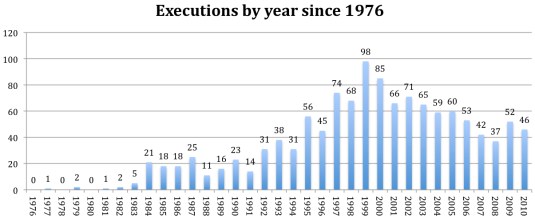
Many a data shyster will make hay with the above chart on the simple correlation between executions and the drop in the US murder rate.

The reality is there are so few executions and they are so infrequent with the exception of Texas that any purported correlation between the death penalty and murder rates requires careful study.

Indeed, for some condemned prisoners, gang bangers are an example, their life expectancy may be increased by the long time they spend on death row versus been murdered by a business associated or a business rival on the streets. As Levitt noted:
no rational criminal should be deterred by the death penalty, since the punishment is too distant and too unlikely to merit much attention.
As such, economists who argue that the death penalty works are put in the uncomfortable position of having to argue that criminals are irrationally overreacting when they are deterred by it.
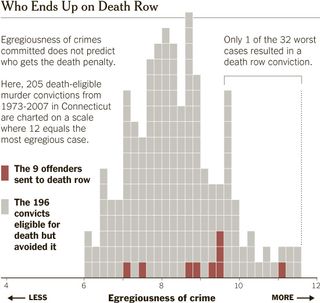
The occupational hazard of been murdered by business rival for gang bangers is higher than the chance of them been arrested, tried , convicted, and condemned to death and then executed after a long appeals process. Not surprisingly, Levitt argued that:
…the quality of life in prison is likely to have a greater impact on criminal behaviour than the death penalty.
Using state-level panel data covering the period 1950–90, we demonstrate that the death rate among prisoners (the best available proxy for prison conditions) is negatively correlated with crime rates, consistent with deterrence. This finding is shown to be quite robust.
In contrast, there is little systematic evidence that the execution rate influences crime rates in this time period.
What are the courts to do about improper laws passed by a sovereign parliament?
30 Jan 2015 Leave a comment

Are Uber drivers twice as likely to be murdered as a cop?
30 Jan 2015 2 Comments
in economics of crime, economics of regulation, health and safety, labour economics, law and economics, occupational choice Tags: compensating differentials, occupational hazards, police, taxi regulation, Uber

How the American family has changed
29 Jan 2015 Leave a comment
in economics of love and marriage, labour economics, welfare reform Tags: family demographics, marriage and divorce, single parents
Greece should default and abandon the euro – Jeff Miron
27 Jan 2015 Leave a comment
in budget deficits, currency unions, development economics, economic growth, economic history, Euro crisis, fiscal policy, global financial crisis (GFC), growth disasters, law and economics, macroeconomics, poverty and inequality Tags: currency unions, Euroland, Greece, optimal currency area, sovereign default

The Public Has Lightened Up on Weed
27 Jan 2015 Leave a comment

Best mug shot ever
27 Jan 2015 Leave a comment
in economics of crime Tags: Darwin awards, dumbest criminals, mug shots

Double standards on terrorism
26 Jan 2015 Leave a comment
in economics of crime, politics - Australia, politics - New Zealand, politics - USA, war and peace Tags: Gaza Strip, Hamas, Israel, Leftover Left, Osama bin Laden, war on terror
It is only illegal if you get caught?
26 Jan 2015 Leave a comment
These are undercover officers?
25 Jan 2015 Leave a comment
in economics of crime, economics of media and culture, law and economics, personnel economics, politics - USA Tags: Undercover police

Hsieh and Moretti on Allocations across Cities
23 Jan 2015 Leave a comment
in applied price theory, applied welfare economics, economics of regulation, geography, law and economics, politics - New Zealand, politics - USA, rentseeking, urban economics Tags: agglomeration, green rent seeking, land supply, zoning
the implied cost of housing restrictions across the whole U.S., and Chang and Enrico find that aggregate output is lower by about 10-14% because of them.


Last post on the NBER growth session. Chang-Tai Hsieh (Chicago) and Enrico Moretti (Berkeley) presented a paper on wage dispersion across cities in the U.S. Wage dispersion (New Yorkers earn more than people in Cleveland) either represents compensation for living costs (housing in New York is more expensive than in Cleveland), a real difference in productivity (New Yorkers are more productive than Clevelanders), or some combination of the two.
What Chang and Enrico find is that the increase in wage dispersion across cities in the U.S. over the last thirty-ish years is due almost entirely to rising house prices in six cities: NY, DC, Boston, San Fran, San Jose, and Seattle. Wages have gone up rapidly in those cities, but that is basically just compensating their citizens for the higher costs of living.
Now, given the costs of living, the allocation of population across cities in the U.S. is…
View original post 274 more words
A simple model of crime waves, riots and revolution
23 Jan 2015 Leave a comment
in applied price theory, economics of crime, labour economics, law and economics, occupational choice Tags: Alexander Tabarrok, crime waves, revolutions, riots
In ‘A simple model of crime waves, riots, and revolutions’, Alexander Tabarrok puts forward a model of crime waves that applies not only to crime but also to phenomena like riots, strikes, and revolutions.
- In each of these cases, the probability of being punished is a decreasing function of the total amount of the activity.
- The probability that a rioter is apprehended falls the more rioters there are.
- The probability that a striker or a revolutionary is punished is less the greater the number of strikers and revolutionaries. This is true even if the revolution or strike fails.
The standard model of crime analyses a criminal’s decisions as if they were unrelated to the decisions of other criminals.

The game-theoretic approach examines the entire system of criminal decisions exploring the implications of interdependence.

As crime increases, police resources become strained at the margin and the probability of punishment falls, causing other criminals to increase their criminal activities.
As others turn to crime, the probability of punishment falls even further, giving each individual an additional reason to increase his criminal activities.
Joining into a revolution or a riot has the same calculus of independence. You are less likely to be caught and punished if you will face in the crowd.
This interdependence in the probability of detection, arrest and punishment lowers the cost of participation. Not surprisingly, judges of been aware of this for some time and have hand out severe punishments such as after the 2011 London riots. These riots fell away sharply once these penalties were handed out and more police were on the streets to catch rioters.
 Utopia, you are standing in it!
Recent Comments