Legal Systems Very Different from Ours – David Friedman’s forthcoming book
14 Oct 2014 Leave a comment
in comparative institutional analysis, constitutional political economy, David Friedman, law and economics Tags: comparative economic analysis, comparative law, David Friedman, law and economics, Legal systems very different to ours
The central idea of David Friedman’s forthcoming book on legal systems of different societies is they face similar problems and solve them, or fail to, in an interesting variety of ways.
Looking at a range of such societies and trying to make sense of their legal systems provides a window into both problems and solutions, useful for the general project of understanding law—in particular but not exclusively from an economic point of view—and for the narrower project of improving it.
Unlike the usual course in comparative law, he did not look at systems close to ours such as modern Civil Law or Japanese law. Instead, Friedman examined systems from the distant past (Athens, Imperial China), from radically different societies (saga period Iceland, Sharia), or contemporary systems independent of government law (gypsy law, Amish).
System Chapters
Icelandic Law
18th c. English Criminal Law
Gypsy Law
Chinese Law
Athenian Law: The Work of a Mad Economist
Jewish Law
Islamic Law [Recently Updated]
Plains Indian Law
Puzzles of Irish Law
Amish Law
Somali Law [Recently Updated]
Commanche, Kiowa and Cheyenne: The Plains Indians
Thread Chapters
Enforcement Mechanisms: Civil, Criminal, And Lots More
The Incentive to Enforce: What and How Much
Embedded and Polylegal Systems
God as Legislator
Making Law
Guarding the Guardians
His Class web page is based on Student Papers from the SCU Seminar

David Friedman on Director’s law and and poverty and inequality under capitalism
13 Oct 2014 Leave a comment
in applied welfare economics, comparative institutional analysis, David Friedman, Marxist economics Tags: David Friedman, Director's Law, poverty versus inequality, That Great Enrichment

HT: Cafe Hayek
On the economics of nuisance suits
10 Oct 2014 Leave a comment
in law and economics Tags: Eric Rasmusen, law and economics, nuisance suits, vexatious litigation
A lawsuit with a low probability of success at trial, brought even though the plaintiff knows that his probability of prevailing would not justify his costs if the judicial process were to be completed instantly.
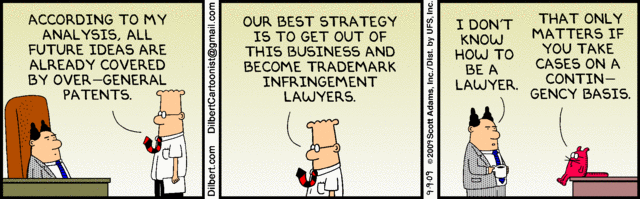
There are a range reasons why plaintiffs bring suits with little or no chance of success; some of these reasons include extracting a small cash settlement from a respondent who is too busy to spend time in court, and preparing for court. In the area of intellectual property law, nuisance suits are sometimes called patent trolls. Patent trolls are a real problem with major corporations spending large sums of money to defend these suits.
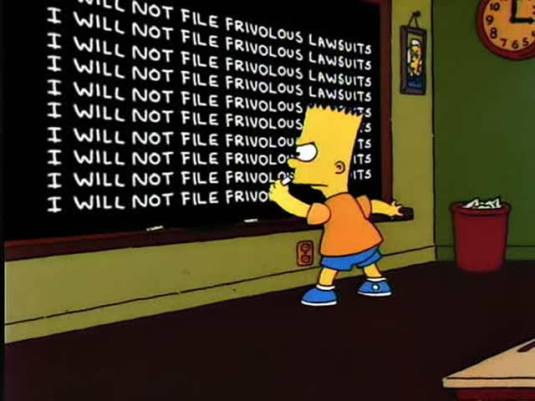
Courts are increasingly used as a high-cost, last-resort venue of business negotiation for parties who are unable to negotiate more economically.
It is costly to respond to the plaintiff’s nuisance suit and failure to respond will lead to a default judgment against the defendant. The defendant will settle with a plaintiff for any amount less than the cost of responding to the plaintiff’s complaint even if the suit is wholly meritless.
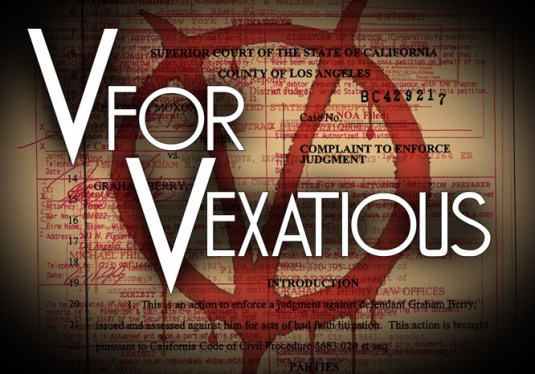
The source of nuisance suits is the ability of the plaintiff cheaply to place the defendant in a position where he would lose unless he engaged in a relatively costly defence.
Nuisance suits actually have quite a simple solution in the case of plaintiffs who really don’t want to go to court even in the American system where each party pays their own legal fees.
That solution is to call their bluff by tying your own hands in terms of offering a settlement out of court. Introduce a legal rule that gives defendants the right to have courts declare that settlement agreements will not be enforced. Defendants can simply waive their right to settle out of court and have any such settlements enforced in courts.

This burning of the bridges by the defendant on any option of settlement puts the vexatious litigant in the position of having to go to court even though they don’t want to incur those expenses.
The vexatious litigant will drop the case because they have nothing to gain, and something to lose by going to court, especially in the English system where the losing party pays part of the other side’s costs. Anticipating that the defendant would elect to prevent court enforcement of any settlement, the plaintiff would not bring his nuisance suit in the first place.
The optional for going the right to settle out of court will not deter all nuisance suits.
- The suits might be a a grudge suit or official vindication of one’s cause.
- The plaintiff may value the publicity as is commonly suspected of public prosecutors who bring sensational but legally dubious civil or criminal suits.
- The plaintiff may value the delay that litigation brings. If the suit includes a preliminary injunction, or if the plaintiff can win with a biased lower court even if he knows he will lose on appeal, he is able to delay something costly to them. The defendants may be able to delay yielding up property or complying with rules. Also, especially in land-use disputes, delay may enable a litigant to lobby to change the relevant law to his advantage.
There are limited versions of this prevention of the enforcement of offers of settlement through payment into court and Calderbank offers of settlement without prejudice save as to costs.
Under each of these litigation cost rules, if an offer of settlement is made without prejudice save as to costs, if the plaintiff does no better in court than he does under a prior settlement offer made without prejudice save as to costs, he is not entitled to recover costs of litigation beyond the point where the settlement offer was made.
The issue with which of the American and English system of liability for costs deters low value litigation is for another blog. As a hint, the English system where the losing party pays a substantial part of the winning party’s costs, makes strong cases stronger and weak cases weaker. Strong cases are more likely to go to trial because they also get the costs back.
A loser-pays rule for legal fees doesn’t work if the nuisance suit is filed with the intention of never ending up in court, but rather to waste the time of defendant, and that time is sufficiently valued by the defendant that it will pay a small cash sum for the suit to go away.
Nuisance suits are different to suits that profit from errors of law by the courts. Many suits that appear ridiculous win. Their problem is not procedure, but substance.
The proper derogatory term is court error and unjust law, depending on whether other courts would replicate the same bad result. Such suits may make up the bulk of what the public complains of as nuisance suits, but are hard to remedy by procedural reform.
HT: Eric Rasmusen


The share market speaks: the boom in marijuana shares
03 Oct 2014 Leave a comment
in applied price theory, economics of crime, economics of regulation, entrepreneurship, financial economics, industrial organisation Tags: marijuana decriminalisation, marijuana legalisation

Over the past two years, investors bid up penny stocks, which are stocks that trade for less than $5 a share, for marijuana from a $500,000 market to more than $7 billion.
The sale and use of marijuana is now approved for medical purposes in 22 states and the District of Columbia and is legal for recreational sales in Colorado and Washington state.

Among those will have to put their money where their mouth is, their entrepreneurial forecast is marijuana legalisation is only going to spread and the legal marijuana market is going to grow. Florida will vote on legalizing medical marijuana, and recent polls suggest the measure has the support needed to pass.

In February 2014, President Obama signed a law that allows states to experiment with industrial hemp. In response, 17 states have removed barriers to hemp production.
HT: Vox.com/marijuana-legalization-maps-charts-facts and https://twitter.com/business/status/479287579263524864
Many doubts have been raised about all types of ultrasonic pest repellers
02 Oct 2014 Leave a comment

The Economics of Europe’s Insane History of Putting Animals on Trial and Executing Them
02 Oct 2014 Leave a comment
in applied price theory, economics of religion, law and economics, Public Choice, public economics, rentseeking, taxation Tags: economics of religion, follow the money, Peter Leeson, rent seeking

The fantastically creative and insightful Peter Leeson published an article in the Journal of Law and Economics in 2013 on the practice of putting animals on trial in the Medieval ages.
Abstract
For 250 years insects and rodents accused of committing property crimes were tried as legal persons in French, Italian, and Swiss ecclesiastic courts under the same laws and according to the same procedures used to try actual persons.I argue that the Catholic Church used vermin trials to increase tithe revenues where tithe evasion threatened to erode them.
Vermin trials achieved this by bolstering citizens’ belief in the validity of Church punishments for tithe evasion: estrangement from God through sin, excommunication, and anathema.
Vermin trials permitted ecclesiastics to evidence their supernatural sanctions’ legitimacy by producing outcomes that supported those sanctions’ validity. These outcomes strengthened citizens’ belief that the Church’s imprecations were real, which allowed ecclesiastics to reclaim jeopardized tithe revenue
Leeson’s paper is also closely connected to Ekelund, Herbert, and Tollison’s (1989, 2002, 2006) and Ekelund et al.’s (1996) work. They study the medieval Catholic Church as a firm. They discuss how ecclesiastics used supernatural sanctions to protect the Church’s monopoly on spiritual services against heretical competition.
HT: Wired – fantastically-wrong-europes-insane-history-putting-animals-trial-executing/


 Utopia, you are standing in it!
Recent Comments