Reading the new Nicholas Wapshott book and also Krugman’s review (NYT) of it, it all seemed a little too rosy to me. So I went back and took a look at Paul Samuelson the macroeconomist. I regret that I cannot report any good news, in fact Samuelson was downright poor — you might say awful […]
How good was Paul Samuelson’s macroeconomics?
How good was Paul Samuelson’s macroeconomics?
25 Feb 2024 Leave a comment
in business cycles, economic history, history of economic thought, macroeconomics, Milton Friedman, monetary economics Tags: monetary policy, wage and price controls
T. C. Koopmans Demolishes the Phillips Curve as a Guide to Policy
12 Feb 2024 Leave a comment
in business cycles, econometerics, economic history, history of economic thought, macroeconomics, monetary economics
Nobel Laureate T. C. Koopmans wrote one of the most famous economics articles of the twentieth century, “Measurement Without Theory,” a devastating review of an important, and in many ways useful and meritorious, study of business cycles by two of the fathers of empirical business-cycles research, Arthur F. Burns and Wesley C. Mitchell, Measuring Business […]
T. C. Koopmans Demolishes the Phillips Curve as a Guide to Policy
What’s the Right Interest Rate for the Fed Anyway?
08 Feb 2024 Leave a comment
in business cycles, econometerics, economic growth, inflation targeting, labour economics, macroeconomics, monetary economics, unemployment Tags: monetary policy
Standard models watched by economists at the Federal Reserve and elsewhere suggest that rates should now be lowerBy Justin Lahart of The WSJ. Excerpt:”So where should rates be? There has been a lot of focus recently on the long-term neutral rate—the just-right level of rates for when inflation is at the Fed’s 2% target, and…
What’s the Right Interest Rate for the Fed Anyway?
The Conway speech
08 Feb 2024 Leave a comment
in budget deficits, business cycles, econometerics, economic growth, economic history, economics of bureaucracy, fiscal policy, inflation targeting, labour economics, macroeconomics, monetary economics, politics - New Zealand, Public Choice, unemployment Tags: monetary policy
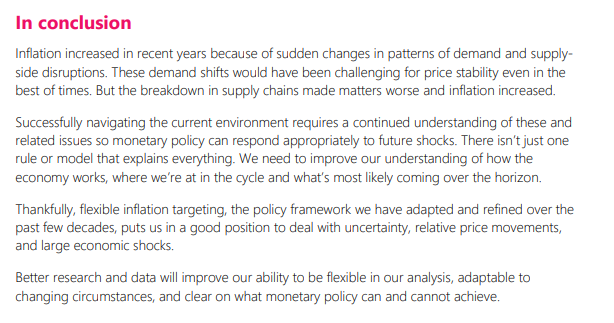
I’ve been rather tied up with other stuff for the last few weeks (including here) which is why I’ve not previously gotten round to writing about the first piece of monetary policy communications from our Reserve Bank this year. That was the “speech” by the Bank’s chief economist (and MPC) member Paul Conway given to […]
The Conway speech
Avoiding scrutiny
19 Jan 2024 Leave a comment
in business cycles, economics of bureaucracy, macroeconomics, monetary economics, politics - New Zealand, Public Choice Tags: monetary policy

Regular readers will recall that I have, intermittently, been on the trail of the approach taken to the selection (and rejection) of external MPC members when the current crop were first appointed in 2019. I have been pursuing the matter since a highly credible person who was interested in being considered for appointment told me that […]
Avoiding scrutiny
A congestion theory of unemployment fluctuations
17 Jan 2024 Leave a comment
in business cycles, econometerics, economic history, history of economic thought, job search and matching, labour economics, labour supply, macroeconomics, monetary economics, unemployment
Yusuf Mercan, Benjamin Schoefer, and Petr Sedláček, newly published in American Economic Journal: Macroeconomics. I best liked this excerpt from p.2, noting that “DMP” refers to the Nobel-winning Diamond-Mortensen-Pissarides search model of unemployment: This congestion mechanism improves the business cycle performance of the DMP model considerably. It raises the volatility of labor market tightness tenfold, […]
A congestion theory of unemployment fluctuations
Mattei Misjudges Hawtrey
15 Jan 2024 Leave a comment
in budget deficits, business cycles, economic growth, economic history, fiscal policy, great depression, history of economic thought, macroeconomics, monetary economics
Clara Mattei, associate professor of economics at the New School for Social Research, recently published a book, The Capital Order: How Economists Invented Austerity and Paved the Way to Fascism, (University of Chicago Press) in which she argues that the fiscal and monetary austerity imposed on Great Britain after World War I to restore the […]
Mattei Misjudges Hawtrey
Solow on Market Advantages and Market Failures
31 Dec 2023 Leave a comment
in applied price theory, business cycles, economic growth, economic history, economics of regulation, entrepreneurship, history of economic thought, labour economics, macroeconomics, Milton Friedman, monetarism, monetary economics, unemployment
Robert Solow (1924-2023) died last week. As a starting point for understanding his life and his work on growth theory, the Nobel prize website, since he won the award in 1987, includes an overall description, a biographical essay, and his Nobel lecture. I can also strongly recommend an interview that Steven Levitt carried out with…
Solow on Market Advantages and Market Failures
How Were So Many Economists So Wrong About the Recession?
30 Dec 2023 Leave a comment
in budget deficits, business cycles, economic growth, economic history, fiscal policy, labour economics, macroeconomics, monetary economics, unemployment Tags: monetary policy
That is the topic of my latest Bloomberg column, I thought it was time to call out all the Orwellian rewriting of intellectual history going on, so here goes: As Treasury Secretary Janet Yellen said last week: “So many economists were saying there’s no way for inflation to get back to normal without it entailing a […]
How Were So Many Economists So Wrong About the Recession?
The Worst Journalism of 2023
29 Dec 2023 Leave a comment
in budget deficits, business cycles, development economics, economic history, fiscal policy, growth disasters, macroeconomics, monetarism, monetary economics Tags: Argentina
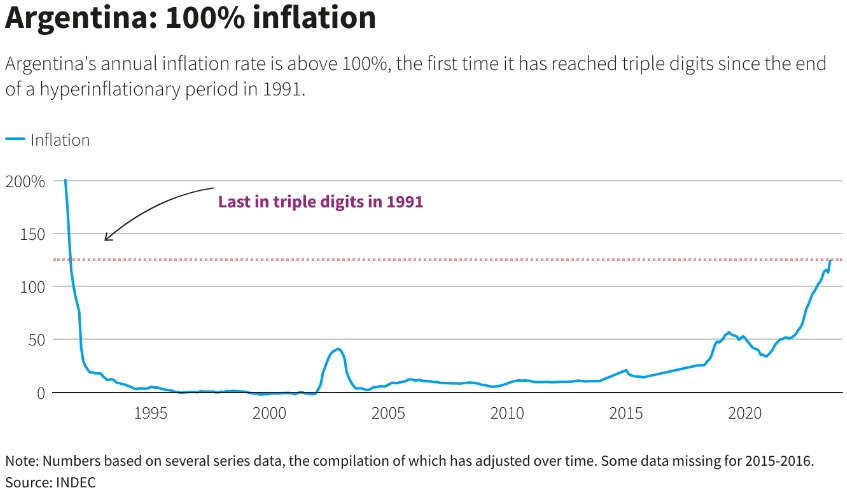
Writing about the economic tragedy of Argentina, I’ve explained that one major problem is inflation, thanks to that country’s version of “modern monetary theory.” This is not a trivial problem. Here’s a chart, from a recent report by Reuters, showing how prices have been rising for nearly 10 years and skyrocketing for the past three […]
The Worst Journalism of 2023
190308 [Webinar] Consistent Economic Policy and Economic Development
29 Dec 2023 Leave a comment
in applied price theory, budget deficits, business cycles, defence economics, economic growth, economic history, economics of information, Euro crisis, fiscal policy, fisheries economics, global financial crisis (GFC), great recession, growth disasters, growth miracles, history of economic thought, human capital, inflation targeting, labour economics, labour supply, macroeconomics, monetary economics, Public Choice, public economics, unemployment
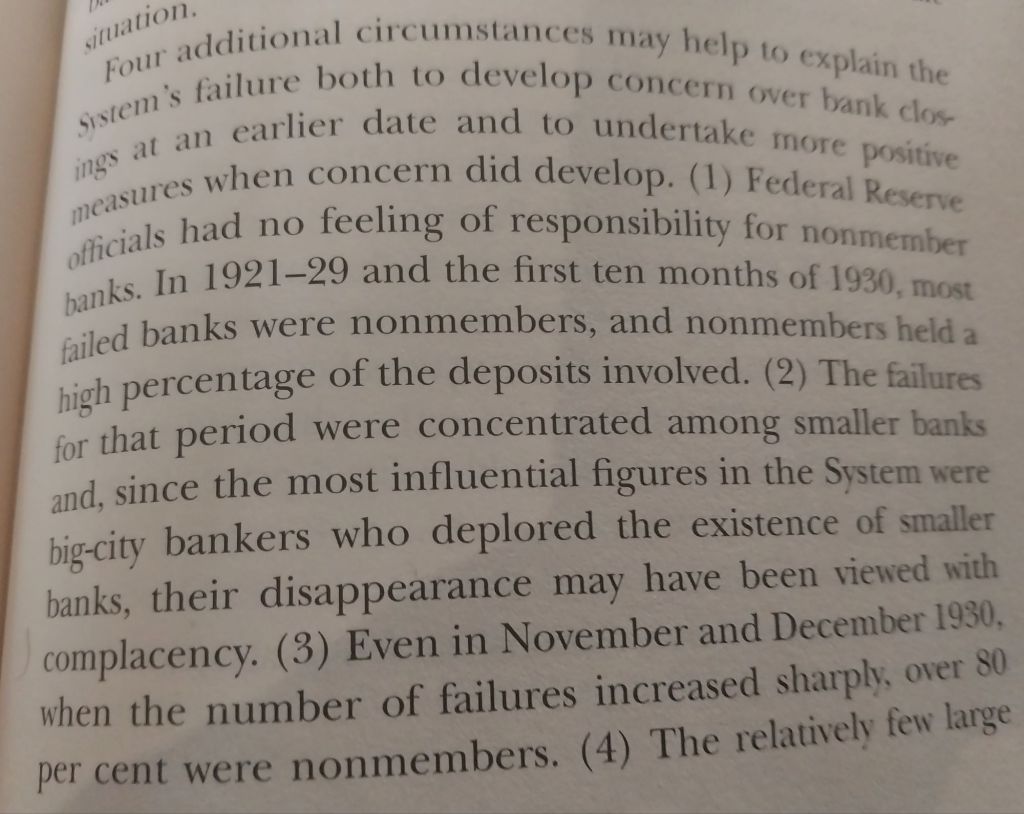
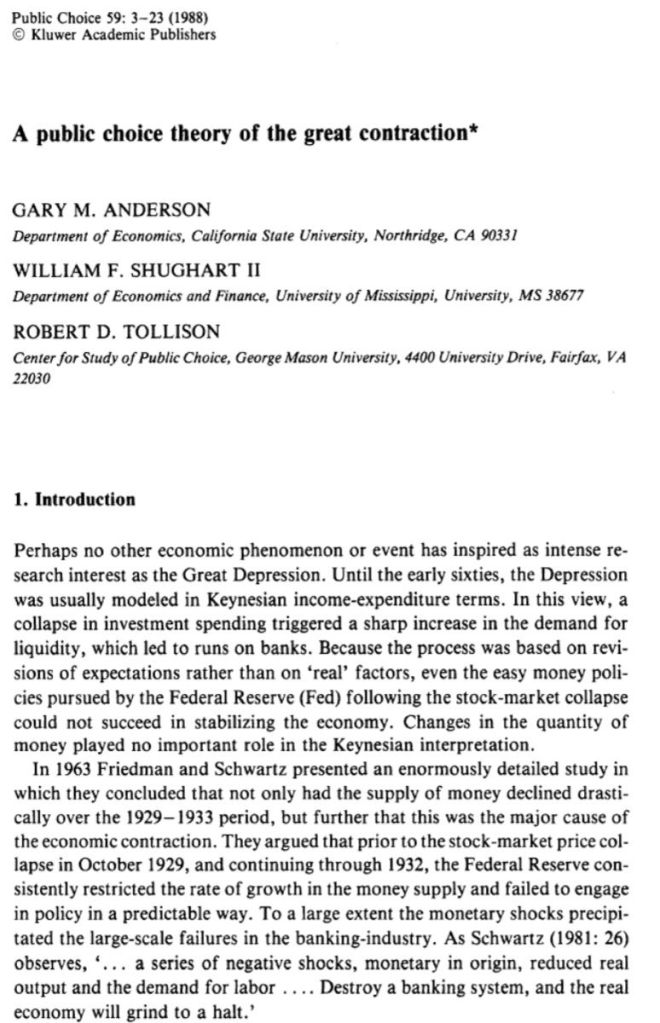
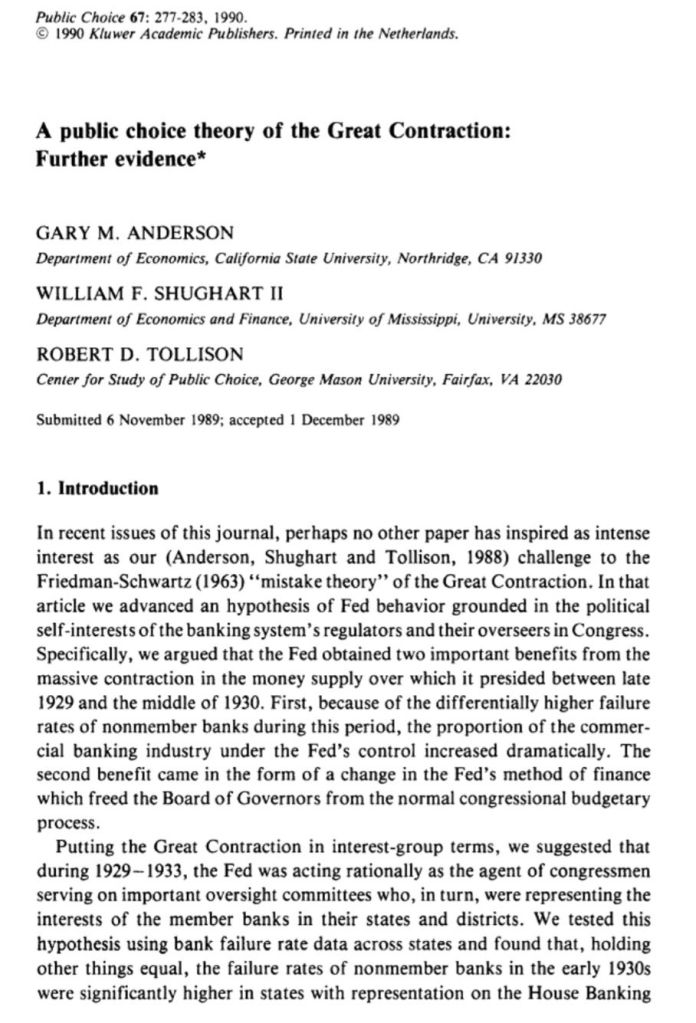
Friedman and Schwartz agreed with Anderson, Tollison and Shughart on the public choice origins of the Great Contraction!
28 Dec 2023 Leave a comment
in applied price theory, business cycles, economic history, economics of bureaucracy, great depression, history of economic thought, macroeconomics, Milton Friedman, monetarism, monetary economics, Public Choice, rentseeking Tags: monetary policy
Argentina Milei reform impressions
23 Dec 2023 Leave a comment
in applied price theory, budget deficits, business cycles, comparative institutional analysis, constitutional political economy, development economics, economic growth, economics of bureaucracy, economics of regulation, fiscal policy, growth disasters, history of economic thought, income redistribution, international economics, labour economics, law and economics, liberalism, libertarianism, macroeconomics, Marxist economics, monetary economics, property rights, Public Choice, public economics, rentseeking, unemployment Tags: Argentina
I didn’t have much time in Argentina, but I can pass along a few impressions about how Milei is doing, noting I hold these with “weak belief”: 1. He is pretty popular with the general population. He is also popular in B.A. in particular. People are fed up with what they have been experiencing. It […]
Argentina Milei reform impressions
FMI Public Speaker Series – Finn Kydland
23 Dec 2023 Leave a comment
in applied price theory, budget deficits, business cycles, comparative institutional analysis, development economics, economic growth, economic history, economics of bureaucracy, fiscal policy, global financial crisis (GFC), great depression, great recession, growth disasters, growth miracles, history of economic thought, human capital, income redistribution, labour economics, labour supply, macroeconomics, Public Choice, public economics, rentseeking
Finn E. Kydland Nobel Lecture at CERGE-EI
22 Dec 2023 Leave a comment
in applied price theory, budget deficits, business cycles, comparative institutional analysis, development economics, economic growth, economic history, economics of regulation, fiscal policy, global financial crisis (GFC), great depression, great recession, growth disasters, growth miracles, history of economic thought, human capital, income redistribution, labour economics, labour supply, macroeconomics, monetary economics, Public Choice, public economics
 Utopia, you are standing in it!
Recent Comments