Chris Trotter writes – “There is a tide in the affairs of men, which taken at the flood, leads on to fortune”. Those words, taken from Shakespeare’s Julius Caesar, are often quoted in the context of politicians facing the hard choice between doing it now, or not doing it at all.
If the election was scheduled for next week, Hipkins could win – but (luckily for Luxon) it’s next year
If the election was scheduled for next week, Hipkins could win – but (luckily for Luxon) it’s next year
26 Aug 2025 Leave a comment
in economic growth, inflation targeting, macroeconomics, monetary economics, politics - New Zealand, Public Choice Tags: 2026 general election
Reading Grant Robertson
25 Aug 2025 Leave a comment
in budget deficits, business cycles, economic growth, economic history, economics of bureaucracy, fiscal policy, inflation targeting, macroeconomics, monetary economics, politics - New Zealand, Public Choice Tags: economics of pandemics, monetary policy

I got home from Papua New Guinea at 1:30 on Saturday morning and by 3:30 yesterday afternoon I’d finished Grant Robertson’s new book, Anything Could Happen, and in between I’d been to two film festival movies, a 60th birthday party, and church. It is that sort of book, a pretty easy read. In some respects, […]
Reading Grant Robertson
Milei’s Achievements…and Challenges
17 Aug 2025 1 Comment
in development economics, economic growth, economics of bureaucracy, economics of regulation, fiscal policy, growth disasters, income redistribution, industrial organisation, labour economics, law and economics, liberalism, libertarianism, macroeconomics, Marxist economics, monetary economics, property rights, Public Choice, public economics, rentseeking, unemployment Tags: Argentina

I’m back in Argentina, the South American country with the world’s best leader. What Javier Milei has accomplished is amazing. And the economic effects have been wonderful. One of my meetings earlier this week was with Marcelo Elizondo, the head of the International Chamber of Commerce for Argentina. He shared a presentation with me that […]
Milei’s Achievements…and Challenges
Greg Mankiw on Modern Monetary Theory
30 Jun 2025 Leave a comment
in applied price theory, budget deficits, business cycles, economic growth, economics of education, fiscal policy, macroeconomics, monetary economics Tags: cranks, monetary policy
Modern Monetary Theory (MMT) had a real moment in the spotlight in the late 2010s, with political support in the US from Presidential hopefuls Bernie Sanders and Alexandria Ocasio-Cortez. However, mainstream economists mostly didn’t understand it, or ridiculed it, or both. I mostly ignored the detail of it, only picking up what I knew about it from…
Greg Mankiw on Modern Monetary Theory
How New Zealand invented inflation targeting
13 Jun 2025 1 Comment
in business cycles, history of economic thought, inflation targeting, labour economics, macroeconomics, monetary economics, politics - New Zealand, unemployment Tags: monetary policy
…the very next day, [Roger] Douglas appeared on TV declaring his intention to reduce inflation to ‘around 0 or 0 to 1 percent’ over the next couple of years, and then went on to make several similar comments in the following days. Douglas would soften his stance on specific timelines but ask the Reserve Bank and […]
How New Zealand invented inflation targeting
The Orr story (well, part of it anyway)
11 Jun 2025 Leave a comment
in economics of bureaucracy, inflation targeting, macroeconomics, monetary economics, politics - New Zealand, Public Choice Tags: monetary policy

Months after various OIAs had been lodged on the question of Adrian Orr’s sudden departure on 5 March, we finally got a partial dump of documents this morning. (Sufficiently mishandled that at 10:04 this morning they’d send an email to OIA requesters saying they’d email out the response at 10:45 and then have it on […]
The Orr story (well, part of it anyway)
Monetary Policy and the Great Crash of 1929: A Bursting Bubble or Collapsing Fundamentals?
11 Jun 2025 Leave a comment
in business cycles, economic history, great depression, macroeconomics, monetary economics Tags: monetary policy
By Timothy Cogley. He was then at the Federal Reserve Bank of San Francisco (1999). He is now at New York University. “In recent years, a number of economists have expressed concern that the stock market is overvalued. Some have compared the situation with the 1920s, warning that the market may be headed for a…
Monetary Policy and the Great Crash of 1929: A Bursting Bubble or Collapsing Fundamentals?
Advertising for a Governor
03 Jun 2025 Leave a comment
in economics of bureaucracy, inflation targeting, macroeconomics, monetary economics, politics - New Zealand, Public Choice Tags: monetary policy

If you want to be Reserve Bank Governor, think you have what it takes, (and haven’t yet been approached by the Board’s recruitment company) you will need to get moving. Applications close on Friday. As a reminder, much of the process (unusually by international standards) is controlled by the Bank’s Board, most of whom were […]
Advertising for a Governor
*Crisis Cycle*
02 Jun 2025 Leave a comment
in budget deficits, business cycles, currency unions, Euro crisis, fiscal policy, global financial crisis (GFC), great recession, history of economic thought, international economic law, international economics, macroeconomics, monetarism, monetary economics, Public Choice Tags: European Union
That is the new book by John H. Cochrane, Luis Garicano, and Klaus Masuch, and the subtitle is Challenges, Evolution, and Future of the Euro. Excerpt: Our main theme is not actions taken in crises, but that member states and EU institutions did not clean up between crises. They did not reestablish a sustainable framework […]
*Crisis Cycle*
MPC members speaking
31 May 2025 Leave a comment
in budget deficits, business cycles, economic growth, economics of bureaucracy, macroeconomics, monetary economics, politics - New Zealand, Public Choice Tags: monetary policy

In both The Post and the Herald this morning there are reports of interviews with executive members of the Reserve Bank’s Monetary Policy Committee: the Bank’s chief economist Paul Conway in The Post and his boss, and the deputy chief executive responsible for monetary policy and macroeconomics, Karen Silk in the Herald. In a high-performing […]
MPC members speaking
May Monetary Policy Statement
30 May 2025 Leave a comment
in budget deficits, business cycles, economic growth, fiscal policy, inflation targeting, labour economics, macroeconomics, monetary economics, politics - New Zealand, public economics, unemployment Tags: monetary policy
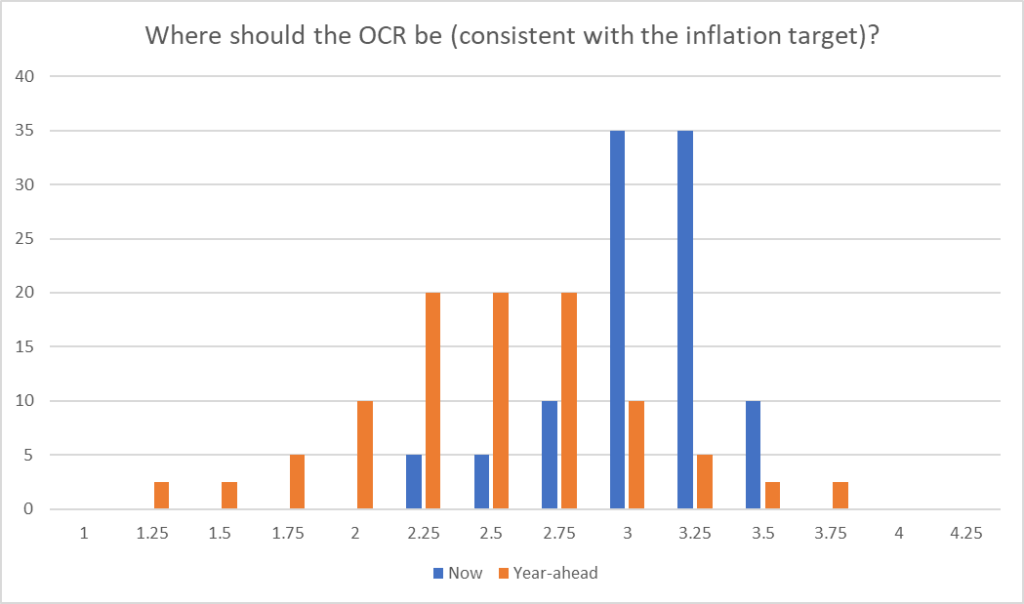
Michael Reddell writes – Procrastinating this morning, I asked Grok to write a post in my style on yesterday’s Monetary Policy Statement. Suffice to say, I think I’ll stick to thinking and writing for myself for the time being. Among the many oddities of Grok’s product was the conviction that Adrian Orr was still Governor. Mercifully […]
May Monetary Policy Statement
US Holders of Foreign Assets, Foreign Holders of US Assets, and Exorbitant Privilege
18 May 2025 Leave a comment
in financial economics, macroeconomics, monetary economics

US investors put money in assets of other countries, including “portfolio investment” which focuses on ownership of stocks and bonds without a management interest, and “foreign direct investment” which is owning enough of a foreign company to have a management interest. Conversely, foreign investors put money into US dollar assets in the US economy. Erin…
US Holders of Foreign Assets, Foreign Holders of US Assets, and Exorbitant Privilege
Why the housing market imploded
29 Apr 2025 Leave a comment
in applied price theory, behavioural economics, economic history, economics of information, financial economics, global financial crisis (GFC), great recession, macroeconomics, monetary economics
In a recent paper, Christopher L. Foote, Kristopher S. Gerardi, and Paul S. Willen report (pdf): This paper presents 12 facts about the mortgage market. The authors argue that the facts refute the popular story that the crisis resulted from financial industry insiders deceiving uninformed mortgage borrowers and investors. Instead, they argue that borrowers and […]
Why the housing market imploded
Not much parliamentary scrutiny
01 Apr 2025 Leave a comment
in business cycles, econometerics, economic history, economics of bureaucracy, inflation targeting, labour economics, labour supply, macroeconomics, monetary economics, politics - New Zealand, Public Choice, unemployment Tags: economics of pandemics, monetary policy

This was the post I was planning to write this morning to mark Orr’s final day. That said, if the underlying events – deliberate attempts to mislead Parliament – were Orr’s doing, the post is more about the apparent uselessness of Parliament (specifically the Finance and Expenditure Committee) in holding him and the rest of […]
Not much parliamentary scrutiny
Bosses Don’t Need a ‘What Did You Do’ Email. They’re Already Tracking You. (and how this might be related to Keynes’ theory of sticky wages)
27 Mar 2025 Leave a comment
in applied price theory, human capital, labour economics, labour supply, law and economics, macroeconomics, managerial economics, monetary economics, organisational economics, personnel economics, property rights, unemployment Tags: efficiency wage, wage rigidity
Elon Musk’s email to federal employees prompted angst, but lots of employers use technology for continuous feedback on worker performanceBy Natasha Khan and Ray A. Smith. Excerpts:”What did you do last week?The question that Elon Musk lobbed to federal workers in an email set off anger and angst from unions and employees. It also prompted…
Bosses Don’t Need a ‘What Did You Do’ Email. They’re Already Tracking You. (and how this might be related to Keynes’ theory of sticky wages)
 Utopia, you are standing in it!
Recent Comments