When writing GOAT: Who is the Greatest Economist of all Time, and Why Does It Matter? I vowed I would write the whole truth. Not just that I agreed with everything I wrote (the case with every book), but I that I would relate all that I was thinking. Here is one part of the […]
*GOAT* on Friedrich A. Hayek and his delusions
*GOAT* on Friedrich A. Hayek and his delusions
31 Oct 2023 Leave a comment
in Austrian economics, business cycles, history of economic thought, macroeconomics, monetary economics
Accountability
27 Oct 2023 Leave a comment
in economics of bureaucracy, macroeconomics, monetary economics, Public Choice

On Saturday dozens of candidates for the governing Labour Party stood for election to Parliament. The aim was to form (at least a big part of) the next government. They didn’t succeed. People will debate for decades precisely what motivated the public as a whole to vote as we did, but having governed for the […]
Accountability
Finding external balance
26 Oct 2023 Leave a comment
in business cycles, economic growth, fiscal policy, international economics, macroeconomics, monetary economics

That was the title of a ten page piece published last week by the ANZ economics team (chief economist Sharon Zollner and one of her offsiders, who appears to be a temporary secondee from the Reserve Bank). You can find a link to the paper here. The gist is captured in the paper’s summary I […]
Finding external balance
What is it we do and do not know about macroeconomics?
25 Oct 2023 Leave a comment
in global financial crisis (GFC), great recession, history of economic thought, macroeconomics
That is the topic of my latest Bloomberg column, here is one excerpt: Another episode frequently cited as evidence against economists is the Great Recession of 2007-2009. Economists did make some mistakes on that one — but they are not the ones you usually hear about. When real estate prices started to slow down and then […]
What is it we do and do not know about macroeconomics?
What should be done about the Reserve Bank?
19 Oct 2023 Leave a comment
in business cycles, economic history, economics of bureaucracy, inflation targeting, macroeconomics, monetary economics, politics - New Zealand, Public Choice Tags: monetary policy

Monday’s post was on the important place effective accountability must have when government agencies are given great discretionary power which – as is in the nature of any human institutions – they will at times exercise poorly. My particular focus is on the Reserve Bank, both because it is what I know best, because it […]
What should be done about the Reserve Bank?
Ireland’s Corporate Tax and the Laffer Curve
19 Oct 2023 Leave a comment
in economic growth, economic history, fiscal policy, macroeconomics, Public Choice, public economics Tags: taxation and investment
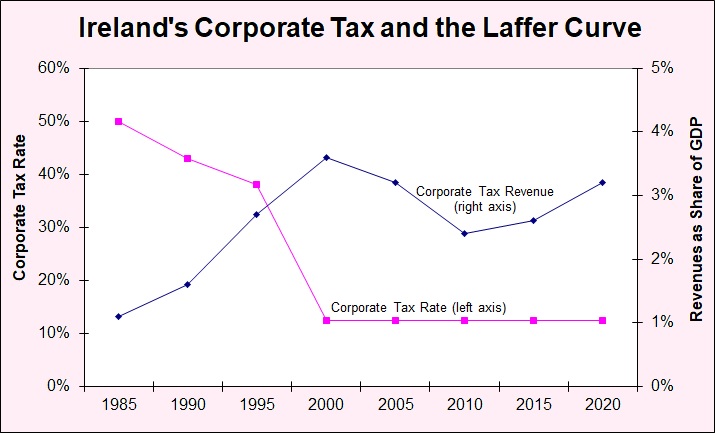
About 15 years ago, I narrated a three-part series on the Laffer Curve. Here’s Part II, which looks at real-world evidence. About halfway through the video (3:15-3:55), I discuss what happened when Ireland dramatically lowered its corporate tax rate. The net result was an increase in tax revenue. But not just by a small amount. […]
Ireland’s Corporate Tax and the Laffer Curve
Heterogeneous Agent Fiscal Theory
14 Oct 2023 Leave a comment
in budget deficits, business cycles, fiscal policy, macroeconomics, monetary economics

Today, I’ll add an entry to my occasional reviews of interesting academic papers. The paper: “Price Level and Inflation Dynamics in Heterogeneous Agent Economies,” by Greg Kaplan, Georgios Nikolakoudis and Gianluca Violante. One of the many reasons I am excited about this paper is that it unites fiscal theory of the price level with heterogeneous agent…
Heterogeneous Agent Fiscal Theory
‘Do enlarged government deficits cause inflation?’ By Michael Bordo.
09 Oct 2023 Leave a comment
in economic history, fiscal policy, macroeconomics, monetarism, monetary economics
“There Is A Design Problem In Climate Policy” Featuring Dr. Roger Pielke Jr.
05 Oct 2023 Leave a comment
in applied price theory, applied welfare economics, economic growth, economics of natural disasters, macroeconomics

On Wednesday in Denver, we had the pleasure of joining Dr. Roger Pielke Jr. (UC Boulder) and Chris Wright, CEO and Chairman of Liberty Energy for a live discussion as part of Liberty Energy’s “Liberty and Energy” Presentation Series. Roger is a Professor in the Environmental Studies department at the University of Colorado Boulder and […]
“There Is A Design Problem In Climate Policy” Featuring Dr. Roger Pielke Jr.
Why Sweden Isn’t an Example of Socialism
04 Oct 2023 Leave a comment
in economic growth, economic history, economics of regulation, history of economic thought, industrial organisation, labour economics, macroeconomics, welfare reform Tags: Sweden
When I meet Americans who self-identify as “socialists,” it is quite uncommon for them to advocate the abolition of private property and the “collective or governmental ownership and administration of the means of production and distribution of goods”–which is the dictionary definition of socialism. Instead most of the American “socialists” I meet favor a more…
Why Sweden Isn’t an Example of Socialism
Some charts on our underperforming economy
04 Oct 2023 Leave a comment
in economic growth, macroeconomics

It is election season, and since the performance of the economy enables (or disables) so much of what political parties want to do, or to spend, it is worth having a look at a few charts. There have been plenty on inflation this year, and plenty of fiscal policy in just the last few weeks. […]
Some charts on our underperforming economy


Recent Comments