I often get asked when the United States will suffer a Greek-style fiscal crisis. My answer is always “I don’t know,” though I freely admit we are heading in that direction. My lack of specificity isn’t merely because economists are lousy forecasters. I tell people it’s all about investor sentiment, and it’s hard to know […]
I’ve never really been persuaded that it is a good idea for public servants to be giving speeches, unless perhaps they are simply and explicitly explaining or articulating government policy. If they are, instead, purporting to run their own views or those of their agency it is almost inevitable that we will be getting less […]
I’m still riding high after Javier Milei’s political party won a landslide in last month’s mid-term elections in Argentina. And I’m very much hoping and expecting that gives him enough legislative support to enact big reforms next year to further liberate the Argentinian economy (tax reform, free trade, and labor market liberalization). But let’s take […]
I supported Brexit for two reasons. The European Union is a sinking ship and a vote for Brexit spares British taxpayers from being on the hook when massive bailouts occur. Leaving the European Union would give the United Kingdom more leeway to choose a pro-market, Singapore-on-Thames policy agenda. The good news is that Point #1 […]
Honest leftists (the “Okunites“) generally acknowledge that laissez-faire policies deliver more growth, but they nonetheless favor high taxes and redistribution because they argue that social equality matters a lot. However, according to this chart, there’s a negative relationship between bigger government and social welfare indicators such as health, education, unemployment, and exclusion. Looking specifically at […]
Antitrust should center on dynamic market forces that drive major technological change, rather than on static “big is bad” market analysis, based on the work of the 2025 economics Nobel Prize winners. Antitrust enforcers in the United States and around the world could benefit by incorporating these insights into their policy development. Focus on Dynamic […]
Economists and [insert basically every other group of people] often don’t agree. Take, for instance, the recent discussion of price controls. The headline of this opinion piece on the subject in The New York Times literally begins with “Economists Hate This Idea.” Yet voters aren’t so skeptical. (I’m not ready to say the idea has…
The Constitution of Innovation The continent faces two options. By the middle of this century, it could follow the path of Argentina: its enormous prosperity a distant memory; its welfare states bankrupt and its pensions unpayable; its politics stuck between extremes that mortgage the future to save themselves in the present; and its brightest gone…
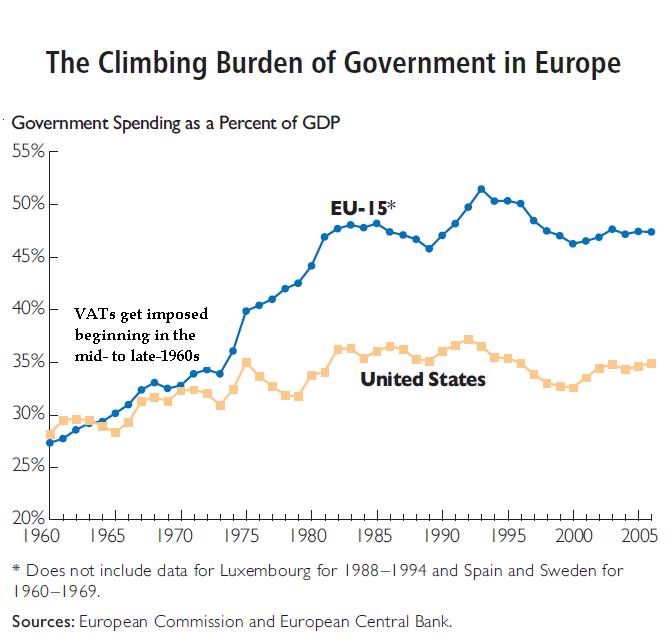
The case against the value-added tax (VAT) is not complicated. Simply stated, this hidden type of national sales tax was a key precursor for the expansion of the European welfare state. As you can see in the chart, the burden of government spending in Europe after World War II was similar to the size of […]
Peter Dunne writes – In 1994 the then Labour Opposition resolved to introduce a new top tax rate of 39 cents in the dollar. The reason for the policy was purely political, not fiscal. Labour was shedding votes to Jim Anderton’s left-wing Alliance at the time and wanted to do something symbolic to staunch the flow. […]
In yesterday’s column, I celebrated the huge victory for Javier Milei and his libertarian LLA party in Argentina’s mid-term elections. Today, let’s contemplate the consequences. Starting with this video. The above video is from an interview yesterday with the great Ross Kaminsky of KOA in Denver. He wanted to know the big-picture meaning of Sunday’s […]
I explained two months ago that Argentina’s mid-term elections are critically important, and here’s some of what I said in an interview with Austin Peterson. I’ll be paying close attention to the results later today for three reasons. The mid-term elections will determine whether Milei has legislative support for the additional reforms that are desperately […]
Robert MacCulloch isn’t partisan in his political views. He is scathing about Labour and its potential partners and often goes very hard on National and the coalition government. But he’s found some good news: . . The Opposition’s Coalition of Chaos hasn’t come up with one sensible idea since losing power. Now the only brain […]
There can be honest and constructive debates about the size of government, such as when I cross swords with someone on the left who understands Arthur Okun’s efficiency-equity tradeoff. Another legitimate debate is about the impact of tax policy, specifically whether higher or lower tax rates have big effects or small effects. But to have […]
A historian’s perspective on how to deal with the Nobel frenzy I generally try to stay away from the Economics Nobel frenzy, if only because the hyper-personalization of scientific achievements it entails it at odds with how we historians understand credit dynamics in science. Economics research has become increasingly collective, drawing on expertise in theory, […]
Why Evolution is True is a blog written by Jerry Coyne, centered on evolution and biology but also dealing with diverse topics like politics, culture, and cats.
“We do not believe any group of men adequate enough or wise enough to operate without scrutiny or without criticism. We know that the only way to avoid error is to detect it, that the only way to detect it is to be free to inquire. We know that in secrecy error undetected will flourish and subvert”. - J Robert Oppenheimer.






 Utopia, you are standing in it!
Recent Comments