My First Theorem of Government is the simple observation that insiders are the biggest beneficiaries of government. I was motivated to release that theorem because bad news for taxpayers is good news for bureaucrats, consultants, contractors, lobbyists, and politicians. A classic example is the Department of Education in Washington, which has squandered more than $2.6 […]
In our textbook, Modern Principles, Tyler and I write: Imagine how difficult it would be to get a date if every date required marriage? In the same way, it’s more difficult to find a job when every job requires a long-term commitment from the employer. In two new excellent pieces, Brian Albrecht and Pieter Garicano…
Ask anyone in Australia’s competition law community what transformed the economy, and you will hear a familiar story. Australia was once a cartelised, complacent place where businesses divided up markets and consumers paid the price. Then came the Trade Practices Act in 1974, and competition law forced firms to compete. This is not a fringe […]
In the United States, much of the gap in earnings between men and women is due to the persistent gap for high wage earners. This paper explores changes in the gender wage gap for MBAs graduating from a large public university over 30 years. We document large gender wage gaps on average, which grow in…
HBR: SUMMARY:THE CHALLENGE: Major companies competing in many industries struggle to stay abreast of rapidly changing technologies. ONE MAJOR CAUSE: They are typically organized into business units, each with its own set of functions. Thus the key decision makers—the unit leaders—lack a deep understanding of all the domains that answer to them.THE APPLE MODEL: The company is organized…
Eric Crampton writes – Yesterday [November 17], the Supreme Court ruled that Uber did not merely facilitate connections between four drivers and their various passengers – as Uber has maintained. And that the four drivers were not contractors for Uber either. Instead, those drivers were Uber employees while logged into the app.
A good report from the NZ Initiative that looks at whether ownership of state houses is the best way to help low income NZ families with housing. Some key extracts: That $29,000 per unit estimated cost is not the cost of income related rents – they are the same regardless of whether the state or […]
Economists have been thinking for a long time about the operation of buying and selling in markets. However, they have traditionally spent less time studying what happens inside a firm–a setting in which forces of supply and demand are replaced by managerial decision-making. Anyone who has had both a good boss and bad boss knows…
In the halcyon days of 2015-19, openings on the economics job market hovered at around 1900 per year. In 2020, Covid was a major shock, but the market bounced back quickly in 2021 and 2022. Since then, though, the market has clearly been in a funk. 2023, my job market year, saw a sudden dip […]
New Zealand’s economic development has always been a partnership between the public and private sectors. Brian Easton writes – Public-Private-Partnerships (PPPs) have become fashionable again, partly because of the government’s ambitions to accelerate infrastructural development. There is, of course, an ideological element too, while some of the opposition to them is also ideological. PPPs […]
Elon Musk’s email to federal employees prompted angst, but lots of employers use technology for continuous feedback on worker performanceBy Natasha Khan and Ray A. Smith. Excerpts:”What did you do last week?The question that Elon Musk lobbed to federal workers in an email set off anger and angst from unions and employees. It also prompted…
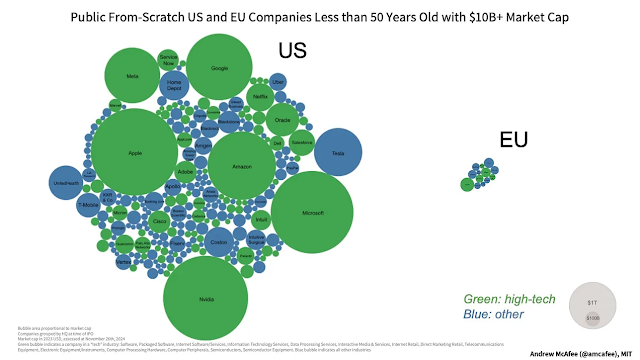
Over at the Geek Way, Andrew McAfee has created a startling visualization related to entrepreneurship in the US and EU. The Draghi Report on EU competitiveness is generating a small buzz among economists. One startling claim is thatthere is no EU company with a market capitalisation over EUR 100 billion that has been set up…
Why Evolution is True is a blog written by Jerry Coyne, centered on evolution and biology but also dealing with diverse topics like politics, culture, and cats.
“We do not believe any group of men adequate enough or wise enough to operate without scrutiny or without criticism. We know that the only way to avoid error is to detect it, that the only way to detect it is to be free to inquire. We know that in secrecy error undetected will flourish and subvert”. - J Robert Oppenheimer.

 Utopia, you are standing in it!
Recent Comments