
Signs of poor management – Not listening and not making people feel valued
12 Mar 2015 Leave a comment
Security cameras in prison showers and the case for private prisons
06 Mar 2015 Leave a comment
in economics of crime, entrepreneurship, law and economics, organisational economics, politics - New Zealand, politics - USA Tags: do gooders, law and order, prisons
I was listening to a radio show the other day on the introduction of close circuit television into New Zealand prisons that were to be monitored by both male and female guards. This is regarded as an indignity by some because these new close circuit cameras would be in showers and toilets.

The initial commentators on the radio programme immediately said they had watched plenty of TV programs where people were shanked in the showers.

The close circuit television was for the safety of prisoners. Close circuit cameras in all parts of prisons made prisons a safer place and that was that. It was the price of safety, especially for prisoners vulnerable to intimidation and sexual assault.

Greg Newbold, a New Zealand criminologist and an ex-prisoner in itself, then came on air to criticise the introduction of close circuit televisions in showers and other intimate areas such as toilets as an indignity on prisoners. Prisoners have a right to intimate privacy in his view. He said only 12 prisoners had been murdered in the New Zealand prisons since 1979.
Only 12 murders is 12 murders too many. Every one of those murders would have been subject of outrage about the failure of the prison administration from the bleeding hearts brigade.
The most interesting thing that Greg Newbold said on the radio was about how these close circuit television systems first emerged in prisons, initially in the USA.
Close circuit television systems will put throughout prisons initially in private prisons to avoid being sued for wrongful death and injury. The private prisons introduced this rather obvious security measure to reduce liability in the civil courts.
Public prisons are supposedly a safer place for prisoners to be if you listen to the bleeding hearts brigade and the Left over Left. Pubic prisons but never got around introducing what seems to me to be a rather basic security measure in confined areas of prisons. Close circuit television systems would protect both inmates and guards.
The different incentives facing public and hybrid prisons, in this case, exposure to litigation, is an illustration of the superior efficiency of private prisons.

Private prisons did something because it affects the bottom line. One way to reduce liability for deaths and injuries is prison security measures that reduce the number of deaths and injuries in prisons.
More importantly, private prisons have unforgiving critics in the form of the bleeding hearts brigade and Left over Left. No one on the Left will defend or protect a prison that is private from closure out of a knee-jerk defence of the public sector, and in particular, public-sector unions.
Oddly enough the only prison that the Left over Left want to close in New Zealand is the highest performing prison, Mt Eden, which happens to be privately run.

The main problem with private prisons is contracting over quality where it is difficult to define quality and measure performance against quality standards specified in a contract as Andrew Shleifer explains:
…critics of privatization often argue that private contractors would cut quality in the process of cutting costs because contracts do not adequately guard against this possibility
Privatisation for many government services is simply an extension of the make-or-buy decision. Every firm faces a make-or-buy decision – should the firm buy a production input from outside suppliers or should it make what it needs itself with existing or additional internal resources?
As any industry grows, there is more room for more specialised producers to supply to firms of all sizes at a lower cost than in-house production (Stigler 1951, 1987; Levy 1984). As an example, all with the largest firms intermittently hire legal, accounting and many other professional skills from specialists.
By contracting-out to these more specialised and niche suppliers, firms can enjoy all available economies of scale in production unless its needs are unique or the firm has some special competency in producing the input in-house (Lindsay and Maloney 1996; Shughart 1997; Roberts 2004). Firms in most industries capture all available economies of scale at relatively small sizes after which they have a long region of production where their marginal cost of further increases in production are constant (Stigler 1958; Lucas 1978; Barzel and Kochin 1992; Shughart 1997).
Put simply, an entrepreneur makes what he or she cannot buy at the quality preferred through contracting in market:
The case for in-house provision is generally stronger when non-contractible cost reductions have large deleterious effects on quality, when quality innovations are unimportant, and when corruption in government procurement is a severe problem. In contrast, the case for privatization is stronger when quality reducing cost reductions can be controlled through contract or competition, when quality innovations are important, and when patronage and powerful unions are a severe problem inside the government.
The way in which the market process dealt with chiselling on quality where quality reducing cost reductions where costly to control through contract or competition was the emergence of non-profit institutions. The competitive edge of these non-profit institutions was they had fewer incentives to dilute hard to measure qualities of the product transacted.

Any additional profits from this dilution of quality were not distributed to the owners because the non-profit organisation was either run by a charity or was owned mutually by the customers. The proceeds from cutting corners on quality could not be paid out to the owners in dividends because there were none.
Examples of non-profits competing successfully in the market are obvious, such as life insurance. Until recent decades, most life insurance companies were mutually owned by the policyholders. Life insurance companies were mutually owned as an assurance that no one could run off with the money by paying high dividends to the owners before policyholders died many years after they have paid their premiums.
Most private universities are run as non-profit institutions even when they are set up by private developers with profits in mind. The private university itself is owned by a charity with esteemed persons on the board to assure quality and probity. The active involvement of alumni is encouraged as a further guard of the future quality of the University from which they graduated. The private developers make their profit on the surrounding land as the university grows and prospers. Land grant universities in the USA may have operated this way.
Other examples of the emergence of non-profit institutions to assure quality in a competitive market are private schools, private hospitals, and private day care centres where concerns about the private provision of a quality service arise, with or without justification. Andrew Shleifer again:
…entrepreneurial not-for-profit firms can be more efficient than either the government or the for-profit private suppliers precisely … where soft incentives are desirable, and competitive and reputational mechanisms do not soften the incentives of private suppliers [to dilute quality].
Of course, any proper analysis must compare like with like and compare the dismal record of public prisons date in terms of prisoner and prison guard safety and preventing escapes with any scandals in the private prison systems. Few do that.
What do industrial and organisational psychologists help employers do?
03 Mar 2015 Leave a comment
in managerial economics, organisational economics, personnel economics Tags: Dilbert, industrial psychology

HT: sageassessments
France, here the New Zealand labour market comes! The Employment Court’s long march to re-regulate
03 Mar 2015 Leave a comment
in economics of regulation, job search and matching, labour economics, law and economics, organisational economics, politics - New Zealand Tags: employment protection laws, France, The fatal conceit, vexatious litigation
If the Employment Court had its way, New Zealand case law under the Employment Relations Act regarding redundancies and layoffs would be as strict as those in France. As top employment lawyer Peter Cullen explained in the Dominion Post today:
Former Employment Court chief justice Tom Goddard said employees could not be made redundant unless the company would otherwise go to the wall.
The employer appealed.
The Court of Appeal said something quite different. Its view was that if a business could be run more efficiently without a particular position, then it was entitled to disestablish it.
The Court of Appeal made it plain that it would not critically examine the logic behind the employer disestablishing a role. If the reason behind the redundancy was genuine, that was all that really mattered. Of course a fair process and consultation ought to precede any decision, but the outcome nevertheless was that the position could go.
The Employment Court wanted the position to be the same as at that in France where layoffs are permissible only to avoid bankruptcy:
…firms still cannot lay off workers to improve competitiveness when the business is healthy; they can only make economic dismissals to preserve competitiveness when already in financial straits. In France, it ought to be legal to fix small problems before they become big.
This French standard of regulation of layoffs and redundancies, if it had survived on appeal, would have come as a surprise to many, including the OECD who rates New Zealanders having no regulation of layoffs in its Index of Employment Protection.
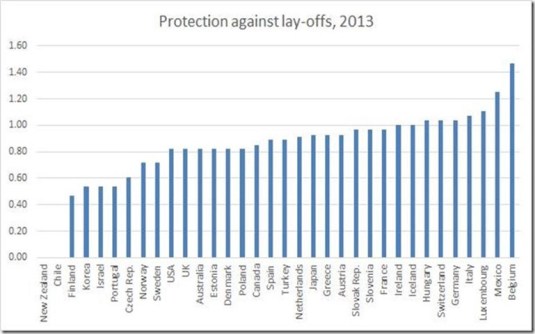
Source: OECD employment protection index.
But you can’t keep an activist Employment Court down. It’s next tactic was salami tactics. Chipping away at the right of the employer to run its business and decide how large its labour force is. Peter Cullen again with the Employment Court pretending it can second-guess entrepreneurial judgements and arithmetic:
In the case between Grace Team Accounting and employee Judith Brake, the Employment Court found that the decision to make Brake’s position redundant was based upon mistaken arithmetic. The Court of Appeal held that Brake’s redundancy amounted to an unjustified dismissal.
Next cab off the rank was requiring employers to give preference to redundant employees pretty much no matter what. Peter Cullen again:
In the case of Neil Wang and his employer the Hamilton Multicultural Services Trust, the trust encouraged Wang to apply for another role within the organisation.
However, the Employment Court said the trust should have considered whether they should have simply offered Wang the position without having to go through an application process.
The court found that even though the other role was not the same, it required the same skills and minimal retraining and so the trust should have simply given Wang the role.
It is standard in the redundancies and restructurings I’ve been involved with for non-managerial employees to go through internal reassignment panels. Some didn’t make it and were laid off.

It’s common for the managerial vacancies to be advertised externally so that redundant managers must compete with external applicants so that the workplace can renew itself. Quite a few managers don’t make it through this process because of the external competition.
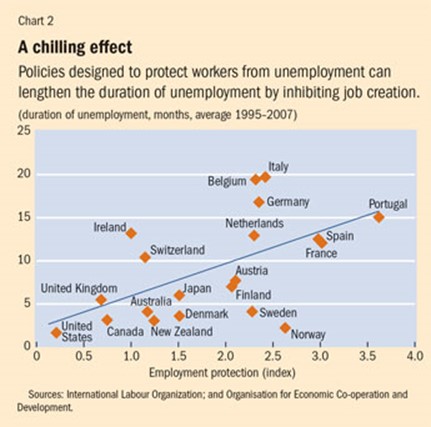
This clear preference for existing employees is a major reregulation of the labour market. Now, every redundant employee can engage in vexatious litigation and squeeze a few thousand dollars extra out of the employer by threatening to go to the Employment Court for a second opinion on the entrepreneurial judgements of the employer. To save managerial time as well is legal fees, it’s cheaper for most employers to pay the redundant employee off with a small settlement.

Anything that makes it more expensive to fire an employee makes it more expensive to hire an employee. This will reduce job creation in New Zealand now that the French standard applies:
…businesses remain obligated to assist laid-off employees in finding other jobs and in retraining them for their new positions – a distinctly French phenomenon. For businesses with more than 1,000 employees, this limbo period before dismissal can last from four to nine months.


Zero hours contracts prevalence, the class struggle and the gales of creative destruction
26 Feb 2015 1 Comment
in labour economics, labour supply, managerial economics, occupational choice, organisational economics, personnel economics Tags: class struggle, Class war, creative destruction, false consciousness, inherent inequality of bargaining power between workers and employers, job satisfaction, preference formation, work life balance, zero hours contracts

Source: Use of zero hours contracts rises to record levels | City A.M.
The number of workers on zero hours contracts has certainly exploded in the UK, going from about 100,000 to 700,000 in about five years. The UK data also suggests that most of these contracts will be in the accommodation and food services sector.
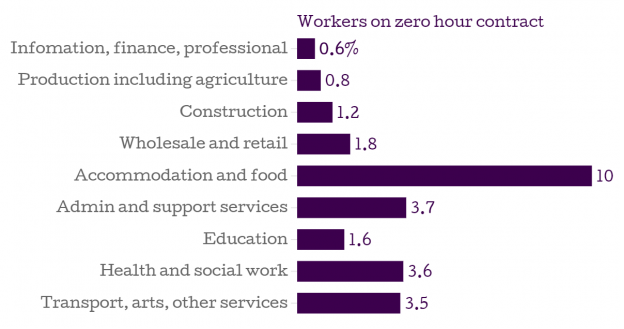
Source: Use of zero hours contracts rises to record levels | City A.M.
Zero hours contracts is creative destruction at work in the labour market, sweeping away obsolete working time arrangements, mostly in the retail services sector.

Zero hours contracts is creative destruction at work in the labour market, sweeping away obsolete working arrangements mostly in the retail services sector.
New Zealand data is hard to come by on zero hours contracts. Data on working hours arrangements is in the Survey of Working Life which is conducted every couple of years. This survey doesn’t give any data directly on the prevalence of zero hours contracts, but it does tell you how many people are temporary employees and among these, who is a casual and seasonal employee and whether they have regular hours.
Source: Survey of Working Life December Quarter 2012, Statistics New Zealand.
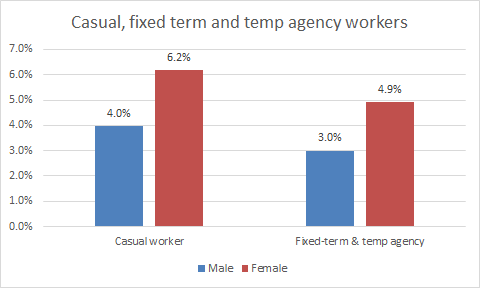
The first thing can be said about the prevalence of zero hours contracts in New Zealand is two years ago the number of workers both male and female who were casual, fixed term and temp agency workers was relatively small. Less than one in 20 male workers was a casual worker; 3% of male workers was on a fixed term or temp agency worker. For women, 6% were casual workers and 4.9% were either fixed term or temp agency workers.
Source: Survey of Working Life December Quarter 2012, Statistics New Zealand.
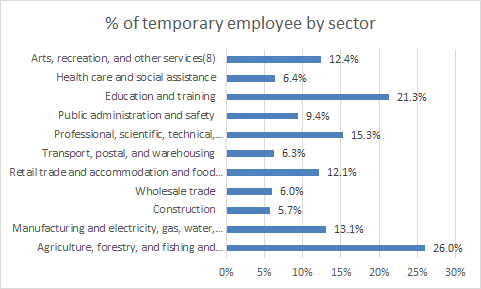
Temporary employment is most common In the agriculture, forestry and fishery sectors, which is no surprise because of the prevalence seasonal workers in that sector.The retail trade accommodation and food sectors is not the next cab off the rank for temporary employment. Temporary employment is rather common in the education and professional science sectors.
Source: Survey of Working Life December Quarter 2012, Statistics New Zealand.
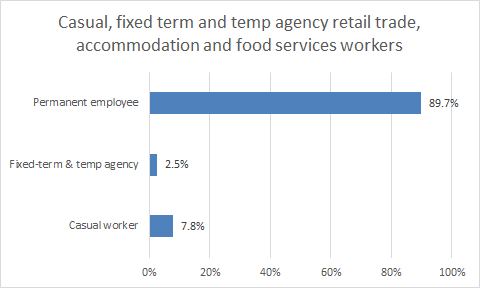
In the retail trade commendation and food services worker, 90% of all employees are still permanent. There are about 32,000 workers in the retail trade, accommodation and food services sectors.
Source: Survey of Working Life December Quarter 2012, Statistics New Zealand.
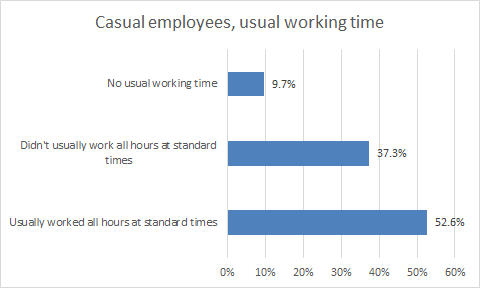
Among all casual employees across all sectors, 50% work standard hours and about 10% have no usual working time. That is, out of the 92,000 casual employees in New Zealand, about 9000 of them have no usual working times, which is the equivalent of a zero hours contract. No data was published by Statistics New Zealand on fixed term and temp agency workers because the sample sizes were too small so the data was suppressed confidentiality reasons.
Source: Survey of Working Life December Quarter 2012, Statistics New Zealand.
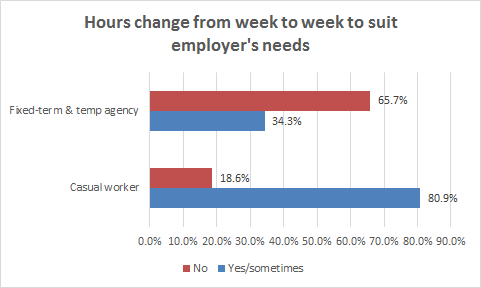
For casual, fixed term and temp agency employees, it is commonplace for them to change their hours from week to week to suit the needs of their employees. The equivalent of zero hours contracts Is commonplace among employees who do not have permanent employment status. It goes with the territory. Those who want fixed hours seek permanent employment.
For zero hours employment to become common, this form of contract in over working time arrangements will have to be come more common among permanent employees. If that is so, such a trend will make the notion of a permanent employee somewhat vague considering these employees, although permanent, are not guaranteed regular hours.
Source: Survey of Working Life December Quarter 2012, Statistics New Zealand.
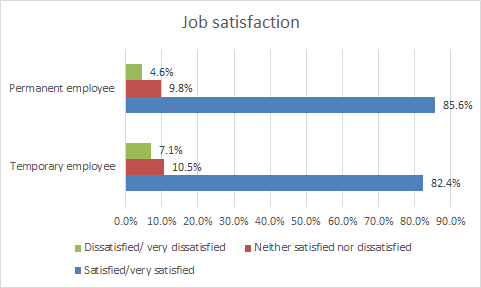
They are a happy lot are temporary employees. Pretty much enjoy their jobs as much as permanent employees do when it comes to their job and, by implication, that perennial left-wing bugbear, the inherent inequality of bargaining power between the bosses and the workers and the violence inherent in the capitalist system. All is not well for the class war.
Source: Survey of Working Life December Quarter 2012, Statistics New Zealand.
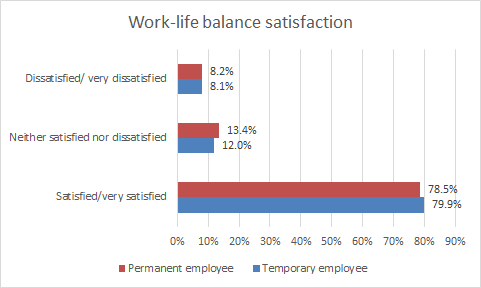
What is worse for the future of the class struggle is that these temporary employees are rather happy lot when it comes to work life balance. Just as happy as permanent employees. Indeed, temporary or permanent employment status has no effect on job satisfaction and work life balance.
Source: Survey of Working Life December Quarter 2012, Statistics New Zealand.
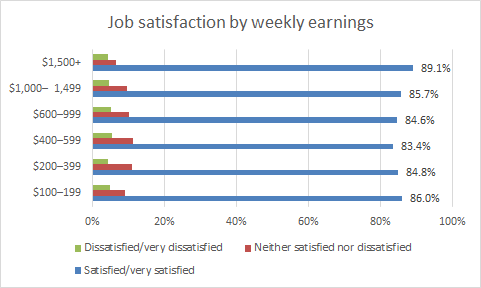
Rise up ye workers, rise up for you have nothing to lose but your zero hours contracts may have to be put on hold as the next battle cry of the class war in New Zealand. Indeed, a lot of consciousness-raising will be in store for our friends on the Left because the working class seem a rather happy lot in their jobs, slightly less grumpy than the middle class, and almost as happy as the ruling class.
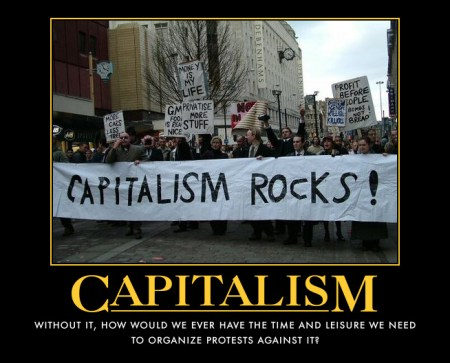
Kicking in the rotted door of capitalism to bring on the permanent revolution has never been easy. Zero hours contracts just does not seem to be the new straw that will break the capitalists’ back any time soon. Workers seem to be rather happy with them or their equivalent that has been around for a long time in the labour market.

Critics overplay their hand if they suggest that somehow workers a very much disadvantaged and employers are holding all the cards. Job turnover and recruitment problems are a serious cost to a business. Workers will not sign contracts, such as zero hours contracts or casual work contracts if they are not to their advantage.
The Effect of Police Body-Worn Cameras on Use of Force and Citizens’ Complaints Against the Police
26 Feb 2015 Leave a comment
in economics of crime, law and economics, managerial economics, organisational economics, personnel economics Tags: camera surveillance, crime and punishment, moral hazard, police
The results are no surprise. There is a 50% drop in the use of force by police when they are required to wear body cameras.
We conducted a randomized controlled trial, where nearly 1,000 officer shifts were randomized over a 12-month period to treatment and control conditions.
During ‘‘treatment shifts’’ officers were required to wear and use body-worn-cameras when interacting with members of the public, while during ‘‘control shifts’’ officers were instructed not to carry or use the devices in any way.
We observed the number of complaints, incidents of use-of-force, and the number of contacts between police officers and the public, in the years and months preceding the trial (in order to establish a baseline) and during the 12 months of the
experiment.

Police use of force reports halved on shifts when police wore cameras. It is not known whether this reduction in the use of force is because members of the public were now aware that any misbehaviour by them to be caught on camera and used as evidence against them or police were aware that any excessive force by them would be caught on camera as well.

Morning People Are Less Ethical at Night – HBR
20 Feb 2015 Leave a comment
in economics of crime, law and economics, managerial economics, organisational economics, personnel economics Tags: economics of personality traits

Managerial Econ: Top 5 problem-solving mistakes by MBA’s
19 Feb 2015 Leave a comment
in entrepreneurship, industrial organisation, managerial economics, organisational economics, personnel economics, survivor principle Tags: entrepreneurial alertness, management, MBA

“Avoid jargon” because most people misuse it. Force yourself to spell out what you mean in simple plain English. It will help your thinking and communication.
“What about the organizational design?” Figure out what is causing the problem, and then think about how to avoid the problem. A lot of papers identified a bad decision, and then suggested reversing it. But they neglected to address the issue of why the bad decision was made, and how to make sure the same mistakes wouldn’t be made in the future.
“Don’t define the problem as the lack of your solution.” For example, if the problem is “the lack of centralized purchasing,” then you are locked into a solution of “centralized purchasing.” Instead, define the problem as “high acquisition cost” and then examine “centralized purchasing” vs. “decentralized purchasing” (or some other alternative) as two solutions to the problem.
“What is the trade-off?” Every solution has costs as well as benefits. If you list only the benefits, it makes your analysis seem like an ex post rationalization of a foregone decision, rather than a careful weighing of the benefits and costs. If you spent some time thinking through the tradeoffs, show it. If not, then you should.
“Which language is this?” I write this when I get gobbledygook written in the passive voice with big words that don’t mean anything. Instead write simple declarative sentences that clarify rather than obfuscate. Form is not a substitute for content.
via Managerial Econ: Top 5 problem-solving mistakes by MBA’s.

Follies of Infrastructure: Why the Worst Projects Get Built, and How to Avoid It – Bent Flyvbjerg
16 Feb 2015 Leave a comment
in managerial economics, organisational economics, theory of the firm, transport economics Tags: Bent Flyvbjerg, cost overruns, mega-events, mega-projects
The Law of Crappy Managers
14 Feb 2015 Leave a comment
in economics of bureaucracy, industrial organisation, managerial economics, occupational choice, organisational economics, personnel economics, survivor principle Tags: Peter Principle


 Utopia, you are standing in it!
Recent Comments