Progress and Incidence: The incidence of a capital-income tax
08 Oct 2019 Leave a comment
in applied price theory, income redistribution, labour economics, labour supply, Public Choice, public economics Tags: tax incidence

Surviving Mars – Feat. Andy Weir | Answers With Joe
08 Oct 2019 Leave a comment
in economics of media and culture Tags: Mars
Tackling Enigma (Turing’s Enigma Problem Part 2) – Computerphile
08 Oct 2019 Leave a comment
in defence economics, economics of education, war and peace Tags: World War II
James Robinson: Balance of Power: State Society, and the Narrow Corridor to Liberty
07 Oct 2019 Leave a comment
in comparative institutional analysis, constitutional political economy, defence economics, development economics, economic history, economics of bureaucracy, economics of crime, growth disasters, growth miracles, income redistribution, law and economics, property rights, Public Choice, rentseeking Tags: The Great Enrichment
Steven Spadijer: Miller No 2: Orthodoxy as Hersey, Hersey as Orthodoxy
07 Oct 2019 Leave a comment

 Introduction
Reading the recent Miller No. 2 decision you would be forgiven in thinking that Boris Johnson had the chutzpah to advise the Queen to unilaterally decree a whole range of new criminal offences (Proclamations) – all under the guise of the prorogation power.
Indeed, the Miller No. 2 decision paints itself as pure orthodoxy. We are reminded that it is the emphatic duty and quintessential task of a law court to define the scope of a prerogative power, clearly a justiciable matter. And the scope of the prorogation power, so it turns out, is now limited by this rather innocuous-sounding principle (at para [50]):
A decision to prorogue Parliament (or to advise the monarch to prorogue Parliament) will be unlawful if the prorogation has the effect of frustrating or preventing, without reasonable justification, the ability of Parliament to carry out its constitutional functions as a legislature and…
View original post 2,158 more words
With friends like this, #ClimateEmergency #ExtinctionRebellion won’t live to face its enemies @mfe_news @jamespeshaw
07 Oct 2019 Leave a comment
in applied welfare economics, econometerics, energy economics, environmental economics, global warming


Paul McCartney on how he wrote some of his hits
07 Oct 2019 Leave a comment

As usual, YouTube is a black hole, for when I watch one video, a bunch of other ones “recommended for you” pop up on the right side. And how well they know me! Yesterday this 27-minute video of Paul McCartney appeared, and I had no choice but to click on it.
It’s a fascinating soliloquy by McCartney on how he (with John Lennon, of course) wrote some of the biggest hits of his career, including mostly Beatles songs but a few solo songs. They include I Lost My Little Girl, Yesterday, I Saw Her Standing There, And I Love Her, Eleanor Rigby, A Day in the Life, Hey Jude, Helter Skelter, Blackbird, Let It Be, Hi Hi Hi, Here Today, Jet and I Don’t Know.
Since the Beatles are the greatest rock group of all time, and I brook no dissent on this issue, you might enjoy it, too. If…
View original post 15 more words
Green Ideology: It was never about the Environment
07 Oct 2019 Leave a comment

In order to improve conditions in the environment we need to protect nature from what has proven to be its greatest threat: Green activists and environmentalists.
While this may seem counter-intuitive, in the 25 years I have been involved in discussions on environmental-health concerns, I have understood how the complexity of the issues, the increasingly more accurate data and the speed of emerging technologies require a flexibility and an open-mindedness to adapt to the best available knowledge, technologies and tools at our disposal. In such situations, the biggest obstacle to protecting the environment is the dogmatic fundamentalism widely expressed by most green cultists, zealots and ideologues.
Over that quarter century I have had my fair share of
confrontations with a wide range of “environmentalists” – from
activists to gurus to politicians (to sisters-in-law). Two common threads in
many of these interactions with activists became evident:
- Their inherent cynicism – that…
View original post 1,711 more words

Portrait of a strongman
07 Oct 2019 Leave a comment

It didn’t seem like the best weekend for Reserve Bank Governor Adrian Orr.
First, there was Radio New Zealand’s Insight documentary on the Governor’s bank capital plans, and other possible new regulatory burdens. I was impressed with the huge amount of time and energy that was put into the programme, although inevitably there are limitations in what a programme designed for a mainstream Sunday morning audience can deal with. In some ways, the best public service now would be if Radio New Zealand and/or the Reserve Bank agreed to release the full interview Guyon Espiner did with the Governor – we were told it was an hour long, but no more than five minutes would have been used in the programme (I presume this was par for the course on Espiner’s background work, as I did an interview with him that went for perhaps 40+ minutes).
In commenting…
View original post 2,621 more words
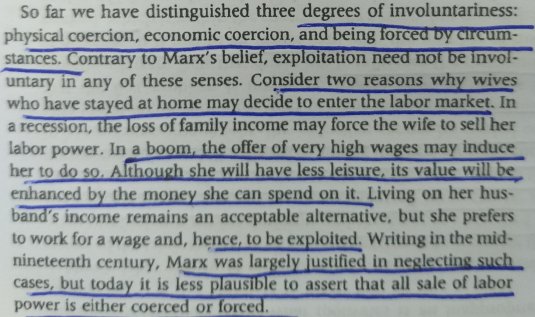
Jon Elster on the lack of gender analysis in the labour theory of value
07 Oct 2019 Leave a comment
in applied price theory, discrimination, economics of love and marriage, gender, income redistribution, labour economics, labour supply, Marxist economics, occupational choice, Public Choice Tags: female labour force participation, marital division of labour


Recent Comments