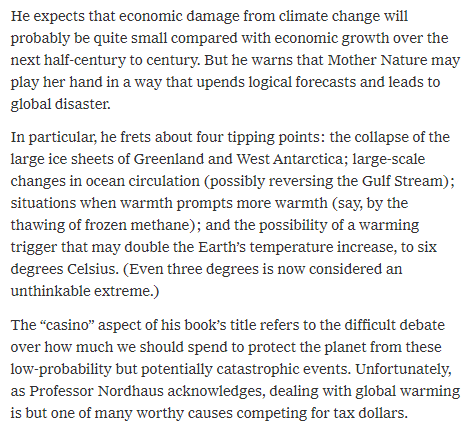
From https://www.nytimes.com/2013/12/01/business/climate-casino-an-overview-of-global-warming.html
Celebrating humanity's flourishing through the spread of capitalism and the rule of law
27 Sep 2019 Leave a comment
27 Sep 2019 Leave a comment
in comparative institutional analysis, constitutional political economy, economics of crime, law and economics, politics - New Zealand, politics - USA, Public Choice Tags: free speech
27 Sep 2019 Leave a comment
in economics of crime, law and economics, politics - USA Tags: 2020 presidential election
27 Sep 2019 Leave a comment
This new video, narrated by former NASA astronaut (and Columbia professor) Mike Massimino, answers a lot of your pressing questions about how astronauts keep clean in space. His answers apply to the Space Shuttle and to the International Space Station, though procedures sometimes differ between them. Here are some of the important issues addressed in the video.
How do you shower?
How do you pee and poo? And what happens to the feces and urine?
Can you shave in space?
How do you wash your hair or brush your teeth?
Can you wear contact lenses?
How can you do laundry?
What if you have to go to the bathroom during a space walk?
And does it get stinky up there? (Answer: yes indeed!)
In the end, Massimino speculates about future hygiene problems as we travel farther and longer from Earth.
27 Sep 2019 Leave a comment
in economics of regulation, entrepreneurship, industrial organisation, labour economics, labour supply, law and economics, managerial economics, minimum wage, occupational choice, occupational regulation, organisational economics, personnel economics, politics - USA, poverty and inequality, property rights, Public Choice, rentseeking, survivor principle, unemployment Tags: creative destruction
27 Sep 2019 Leave a comment
in health economics, movies, television
26 Sep 2019 Leave a comment
in economics of education Tags: evolutionary psychology

26 Sep 2019 Leave a comment

 Constitutions do many things. They distribute authority amongst public bodies, enshrine important points of substantive principle, and cement relationships between rulers and the ruled. However, in a more abstract and fundamental sense, constitutions also tell us something about ourselves as political collectives: they express the kind of polity we embody and the kind of people we have come to be.
Whether written or unwritten, constitutions establish the contours of our political communities. To use Hannah Arendt’s metaphor – borrowed from the Ancient Greek understanding of law as nomos – constitutions are the walls that encircle, define, and defend the everyday aspects of our political lives. It is against this normative backdrop that I want to reflect upon one element of what is expressed by the recent judgement of the United Kingdom Supreme Court in the cases of R (on the application of Miller) v The Prime Minister and Cherry and…
View original post 1,682 more words
26 Sep 2019 Leave a comment
 Yesterday the Supreme Court handed down its unanimous judgement in Cherry and Others v The Advocate General and Miller v the Prime Minister. The court found that the Prime Minister’s decision to prorogue parliament was unlawful and, consequently, null and void. This article aims to identify some of the immediate constitutional and political impacts of that decision.
Four key points underpin the court’s reasoning. First, the matter of justiciability. All parties accepted that the court was entitled to determine the existence and extent of prerogative powers. The government parties, however, argued that, where the power was exercised within its lawful bounds, it was not justiciable. Cherry and Miller argued that, even within lawful bounds, the ordinary principles of judicial review applied. The question of justiciability formed the cornerstone of the government’s case. Ultimately, however, the court decided it on entirely uncontroversial terms. The court found that it…
View original post 1,302 more words
26 Sep 2019 Leave a comment
in Alfred Marshall, entrepreneurship, labour economics, personnel economics, theory of the firm
26 Sep 2019 Leave a comment
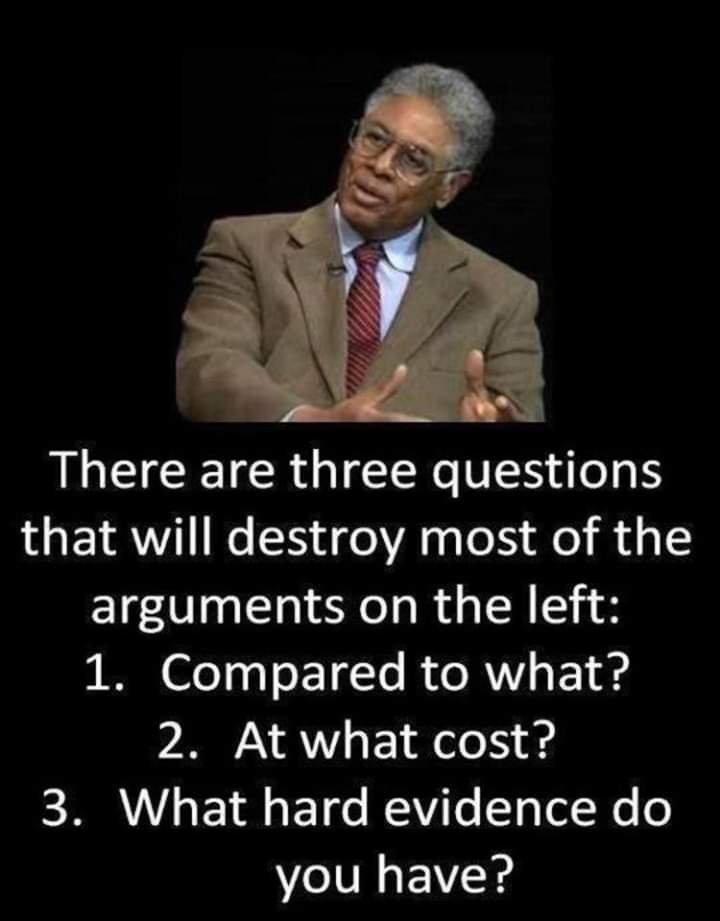
in applied price theory, applied welfare economics, Austrian economics, comparative institutional analysis, constitutional political economy, econometerics, economic history, Public Choice, Thomas Sowell Tags: The fatal conceit
26 Sep 2019 Leave a comment
No longer possible to repeal the Fixed term parliament Act because dissolution by the queen would be subject to judicial review
 The chorus that the United Kingdom Supreme Court’s decision on prorogation (R. (on the application of Miller) v The Prime Minister; Cherry and others v. Advocate General for Scotland [2019] UKSC 41) has “nothing to do with Brexit” cannot withstand serious scrutiny. The British electorate’s decision to leave the European Union is the pivot around which contemporary politics revolves. There is no question to my mind that the aim of prorogation was to ease Britain’s withdrawal from the organisation, and thankfully the question of prime ministerial motivation was not a live issue in the Court’s judgment. This post argues that the Court acted in a partisan fashion as if it were the legal wing of Remain, and that as a result the judiciary now needs to have its wings clipped.
The political fundamentals against which the Miller-Cherry case fell to be decided are as follows: (1) a majority of…
View original post 1,746 more words
26 Sep 2019 Leave a comment
By Bethany Mandel, September 24, 2019, National Review
Activists left and right are protesting an effort to close loopholes in a state law mandating vaccination for schoolchildren. Here’s why they’re wrong.
There aren’t many policy proposals or causes that unite Left and Right these days, but in California, one has emerged: opposition to Senate Bill 276, which aims to close loopholes in a state law mandating vaccination for schoolchildren. Liberal and conservative activists alike have protested the bill at the state capitol and demanded that state legislators scrap it.
Unfortunately, this particular bipartisan movement isn’t just wrong — it’s dangerously wrong.
California has been the epicenter for anti-vaccine sentiment, and measles outbreaks, for the last several years. That’s not a coincidence; the former fuels the latter. When “herd immunity” dips too low, the entire “herd” is placed at risk. Anti-vaccine activists often ask, “If vaccines work and you’re vaccinated, why…
View original post 193 more words
Celebrating humanity's flourishing through the spread of capitalism and the rule of law
Celebrating humanity's flourishing through the spread of capitalism and the rule of law
Celebrating humanity's flourishing through the spread of capitalism and the rule of law
Celebrating humanity's flourishing through the spread of capitalism and the rule of law
Celebrating humanity's flourishing through the spread of capitalism and the rule of law
Celebrating humanity's flourishing through the spread of capitalism and the rule of law
Celebrating humanity's flourishing through the spread of capitalism and the rule of law
Celebrating humanity's flourishing through the spread of capitalism and the rule of law
Celebrating humanity's flourishing through the spread of capitalism and the rule of law
Celebrating humanity's flourishing through the spread of capitalism and the rule of law
Celebrating humanity's flourishing through the spread of capitalism and the rule of law
Celebrating humanity's flourishing through the spread of capitalism and the rule of law
A History of the Alt-Right
Econ Prof at George Mason University, Economic Historian, Québécois
Celebrating humanity's flourishing through the spread of capitalism and the rule of law
Scholarly commentary on law, economics, and more
Beatrice Cherrier's blog
Celebrating humanity's flourishing through the spread of capitalism and the rule of law
Celebrating humanity's flourishing through the spread of capitalism and the rule of law
Celebrating humanity's flourishing through the spread of capitalism and the rule of law
Why Evolution is True is a blog written by Jerry Coyne, centered on evolution and biology but also dealing with diverse topics like politics, culture, and cats.
Celebrating humanity's flourishing through the spread of capitalism and the rule of law
A rural perspective with a blue tint by Ele Ludemann
DPF's Kiwiblog - Fomenting Happy Mischief since 2003
Celebrating humanity's flourishing through the spread of capitalism and the rule of law
The world's most viewed site on global warming and climate change
Tim Harding's writings on rationality, informal logic and skepticism
A window into Doc Freiberger's library
Let's examine hard decisions!
Commentary on monetary policy in the spirit of R. G. Hawtrey
Thoughts on public policy and the media
Celebrating humanity's flourishing through the spread of capitalism and the rule of law
Politics and the economy
A blog (primarily) on Canadian and Commonwealth political history and institutions
Reading between the lines, and underneath the hype.
Economics, and such stuff as dreams are made on
"The British constitution has always been puzzling, and always will be." --Queen Elizabeth II
Celebrating humanity's flourishing through the spread of capitalism and the rule of law
Celebrating humanity's flourishing through the spread of capitalism and the rule of law
WORLD WAR II, MUSIC, HISTORY, HOLOCAUST
Undisciplined scholar, recovering academic
Celebrating humanity's flourishing through the spread of capitalism and the rule of law
Res ipsa loquitur - The thing itself speaks
In Hume’s spirit, I will attempt to serve as an ambassador from my world of economics, and help in “finding topics of conversation fit for the entertainment of rational creatures.”
Researching the House of Commons, 1832-1868
Reflections on books and art



Recent Comments