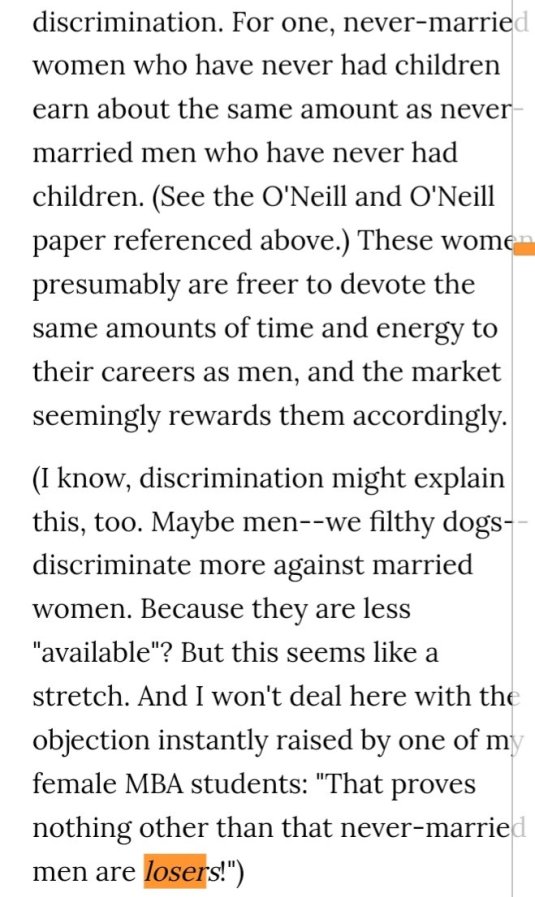
From https://newmarksdoor.typepad.com/mainblog/2005/08/some_notes_on_c.html
Celebrating humanity's flourishing through the spread of capitalism and the rule of law
18 Sep 2019 Leave a comment
in applied price theory, economics of information, economics of love and marriage, human capital, labour economics, labour supply, occupational choice Tags: dating markets, gender wage gap
18 Sep 2019 1 Comment
in applied welfare economics, energy economics, environmental economics, global warming Tags: ice ages
18 Sep 2019 Leave a comment
There are many reasons to oppose the various bailouts of the Greek government. Here are my two main reasons.
Let’s focus today on the second point.
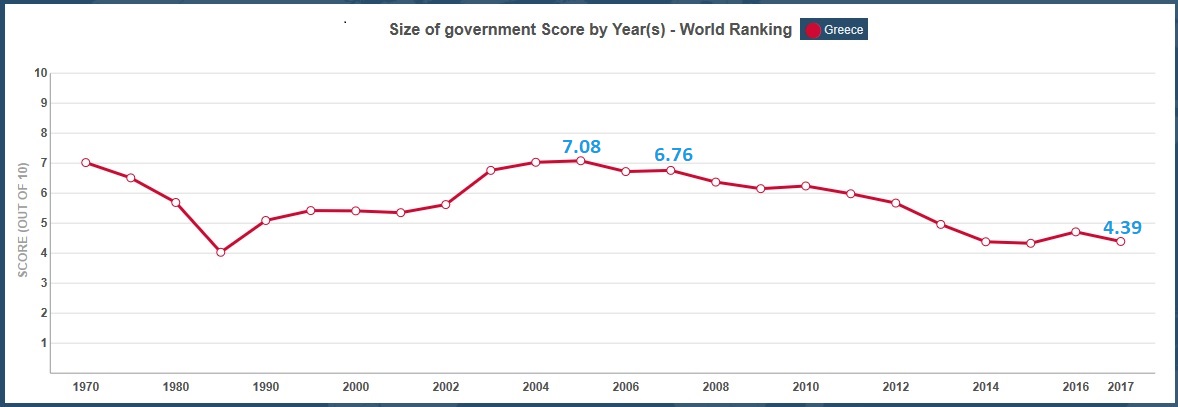
Here’s Greece’s score for the “Size of Government” component from Economic Freedom of the World. As you can see, bailouts have actually subsidized a decline in fiscal responsibility.
And it’s worth pointing out that Greek politicians have been doing a bad job in other areas.
The burden of red tape has been, and remains, stifling.
Greece ranks at the top in difficulty in setting up and running a business among 75 countries, according…
View original post 768 more words
18 Sep 2019 Leave a comment
The world is full of surprises, a fact with which rational-expectations theorists have not yet come to grips. Yesterday I was surprised to find that a post of mine from May 2016, was attracting lots of traffic. When published, that post had not attracted much attention, and I had more or less forgotten about it, but when I quickly went back to look at it, I recalled that I had thought well of it, because in the process of calling attention to Wicksteed’s anticipation of the Coase Theorem, I thought that I had done a good job of demonstrating one of my favorite talking points: that what we think of as microeconomics (supply-demand analysis aka partial-equilibrium analysis) requires a macrofoundation, namely that all markets but the one under analysis are in equilibrium. In particular, Wicksteed showed that to use cost as a determinant of price in the context of…
View original post 1,014 more words
18 Sep 2019 Leave a comment
in economics of education, economics of information, economics of media and culture
18 Sep 2019 4 Comments

When Oklahoma City Council member JoBeth Hamon wassworn inearly this year, she chose to use a copy of Marxist Howard Zinn’s “A People’s History of the United States,” rather than the Bible.
While there’s no law or policy that requires the use of a Bible for swearing-in ceremonies, Hamon upset traditions going back to ninth-century England.
In an email to me, Hamon explained that she comes from a social services background, so she wanted to center her campaign “on uplifting voices that aren’t often at the table when our governments make decisions”— the homeless, the car-less, and so forth, from whose perspective, she claimed, Zinn told U.S. history.
“A People’s History,” she thought, “would be a good reminder of who I seek to serve.”
Implicit in the ritual of taking oaths on the Bible is the acknowledgment of the need for God’s guidance—something that U.S. presidents have signaled…
View original post 687 more words
18 Sep 2019 Leave a comment
in discrimination, economic history, economics of education, economics of information, gender, health economics, human capital, labour supply, law and economics, occupational choice, population economics, poverty and inequality, property rights Tags: dating markets, evolutionary psychology, marriage market
18 Sep 2019 Leave a comment
Why is Africa poor?
More than half of the world’s poorest people live in sub-Saharan Africa. Why? Why is that region so poor? There are lots of theories — some blame a “colonial history.” Others blame the weather or discrimination.
But Magatte Wade, an African entrepreneur, tells John Stossel that she knows the biggest reason from her own first-hand experience: it’s crushing government regulation. “Once you hire someone, good luck getting rid of them for any reason,” she says. Her home country, Senegal, requires government permission to fire an employee. That makes it hard to run a business. It also makes entrepreneurs reluctant to hire. Then there’s the complicated tax code. “Some people say it’s worth at least two or three truckloads of paper,” she says. Hiring an accountant to wade through that is expensive for new businesses.
Magatte started a business anyway — she makes lip balm. She has…
View original post 230 more words
18 Sep 2019 Leave a comment

 The request made by the Privy Council that the Queen prorogue Parliament was a clumsy and inappropriate attempt to shorten the time available for parliamentary scrutiny of the Brexit process. That much seems clear from papers submitted to the Court of Session in Cherry. It is therefore no surprise that the Inner House was receptive to the petitioners’ argument that the advice given to Her Majesty violated the conventional purposes for which prorogation ought to be used and was therefore unconstitutional (Cherry, [1]; see also Lord Sumption). Where the court erred was in concluding that the act of prorogation was itself unlawful. The intimate relationship between the prerogative power to prorogue and the supremacy of Parliament precludes such a conclusion. If, as seems correct, a response to this breach of convention is warranted, it is one that can, constitutionally, only come from Parliament itself.
In this…
View original post 1,911 more words
18 Sep 2019 Leave a comment
If you read The Communist Manifesto, Marx and Engels give a poetic account of how societies evolve. Western society moved out of antiquity into feudalism and then into capitalism. In their view, capitalism is so exploitative and unstable that revolutionary forces will topple the system and impose state control over the economy. Ideally, the state itself will wither and you’ll get an idyllic communist society.
But we now know that’s wrong. The industrialized nations of the West never turned to socialism, though they did institute welfare states in the 20th century. Instead, more rural societies like China and Russia were the biggest customers of Marxism. And very few socialist states of the 20th century remained socialist in the classical senses. Socialism, and communism, was not the end of the story.
So what did we get? If you follow someone like Francis Fukuyama, you might believe that liberal capitalism is…
View original post 453 more words
18 Sep 2019 Leave a comment
in comparative institutional analysis, constitutional political economy, defence economics, development economics, economic history, economics of crime, growth disasters, growth miracles, history of economic thought, income redistribution, international economic law, International law, law and economics, property rights, Public Choice, public economics, rentseeking Tags: economics of colonialism
Celebrating humanity's flourishing through the spread of capitalism and the rule of law
Celebrating humanity's flourishing through the spread of capitalism and the rule of law
Celebrating humanity's flourishing through the spread of capitalism and the rule of law
Celebrating humanity's flourishing through the spread of capitalism and the rule of law
Celebrating humanity's flourishing through the spread of capitalism and the rule of law
Celebrating humanity's flourishing through the spread of capitalism and the rule of law
Celebrating humanity's flourishing through the spread of capitalism and the rule of law
Celebrating humanity's flourishing through the spread of capitalism and the rule of law
Celebrating humanity's flourishing through the spread of capitalism and the rule of law
Celebrating humanity's flourishing through the spread of capitalism and the rule of law
Celebrating humanity's flourishing through the spread of capitalism and the rule of law
Celebrating humanity's flourishing through the spread of capitalism and the rule of law
A History of the Alt-Right
Econ Prof at George Mason University, Economic Historian, Québécois
Celebrating humanity's flourishing through the spread of capitalism and the rule of law
Scholarly commentary on law, economics, and more
Beatrice Cherrier's blog
Celebrating humanity's flourishing through the spread of capitalism and the rule of law
Celebrating humanity's flourishing through the spread of capitalism and the rule of law
Celebrating humanity's flourishing through the spread of capitalism and the rule of law
Why Evolution is True is a blog written by Jerry Coyne, centered on evolution and biology but also dealing with diverse topics like politics, culture, and cats.
Celebrating humanity's flourishing through the spread of capitalism and the rule of law
A rural perspective with a blue tint by Ele Ludemann
DPF's Kiwiblog - Fomenting Happy Mischief since 2003
Celebrating humanity's flourishing through the spread of capitalism and the rule of law
The world's most viewed site on global warming and climate change
Tim Harding's writings on rationality, informal logic and skepticism
A window into Doc Freiberger's library
Let's examine hard decisions!
Commentary on monetary policy in the spirit of R. G. Hawtrey
Thoughts on public policy and the media
Celebrating humanity's flourishing through the spread of capitalism and the rule of law
Politics and the economy
A blog (primarily) on Canadian and Commonwealth political history and institutions
Reading between the lines, and underneath the hype.
Economics, and such stuff as dreams are made on
"The British constitution has always been puzzling, and always will be." --Queen Elizabeth II
Celebrating humanity's flourishing through the spread of capitalism and the rule of law
Celebrating humanity's flourishing through the spread of capitalism and the rule of law
WORLD WAR II, MUSIC, HISTORY, HOLOCAUST
Undisciplined scholar, recovering academic
Celebrating humanity's flourishing through the spread of capitalism and the rule of law
Res ipsa loquitur - The thing itself speaks
In Hume’s spirit, I will attempt to serve as an ambassador from my world of economics, and help in “finding topics of conversation fit for the entertainment of rational creatures.”
Researching the House of Commons, 1832-1868
Reflections on books and art




Recent Comments