
The good old days when we relied on natural immunity
03 Sep 2019 Leave a comment
in economic history, health economics Tags: anti-vaccination movement, cranks, The Great Escape, vaccines
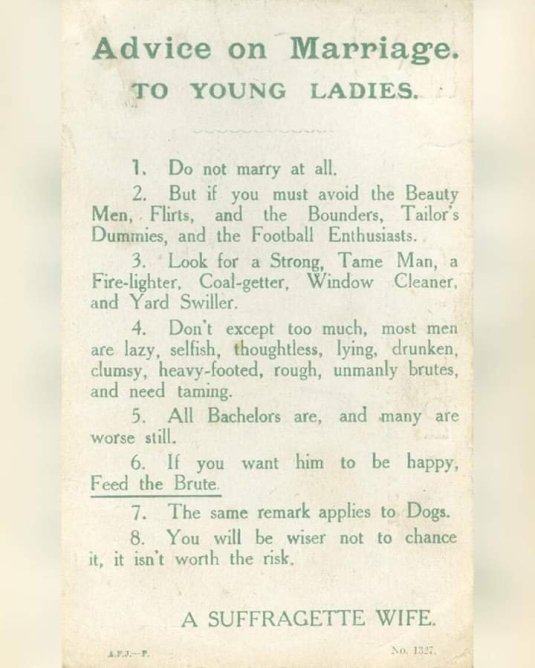
Bitterness isn’t new to women’s movements, sadly
03 Sep 2019 Leave a comment
in discrimination, economics of love and marriage, gender, labour economics, law and economics Tags: dating markets, feminism
Hershleifer contrasts normative versus positive analysis
03 Sep 2019 Leave a comment
in applied price theory, applied welfare economics, comparative institutional analysis, public economics Tags: The fatal conceit

Paul Craig: Prorogation: Constitutional Principle and Law, Fact and Causation
03 Sep 2019 Leave a comment

 The Prime Minister’s recent announcement that Parliament would be prorogued, thereby severely curtailing the opportunity for parliamentary debate, raises important issues of constitutional principle and law, and also issues concerning fact and causation. They are examined in turn.
Constitutional Principle and Law
We begin with constitutional principle and law. We seek to decide whether the courts should intervene via judicial review, in order to prevent Parliament from being prorogued. We do not, however, begin with a clean slate. We look to case law where the courts have intervened to curtail prerogative power, discern the underlying principles, and then decide whether those are applicable to the case at hand.
Consider then the principal case law concerning constraints on prerogative power dating back to the seventeenth century. The constraints on prerogative power embodied in Proclamations, De Keyser and Miller all protect parliamentary sovereignty. Parliament is the legitimate legislator within the UK and…
View original post 1,323 more words
Survivor Bias in World War 2
03 Sep 2019 Leave a comment
in defence economics, war and peace Tags: World War II
Cat Welcomes Home Soldier (awesome)
03 Sep 2019 Leave a comment
in cats, defence economics, war and peace
An interview with James Q. Wilson (1995) | THINK TANK
03 Sep 2019 Leave a comment
in economics of crime, labour economics, law and economics, poverty and inequality, welfare reform Tags: crime and punishment, family poverty, law and order
@AOC @SenSanders @jeremycorbyn
02 Sep 2019 Leave a comment
in comparative institutional analysis, constitutional political economy, development economics, growth disasters, growth miracles, income redistribution, industrial organisation, law and economics, Marxist economics, politics - Australia, politics - New Zealand, politics - USA, property rights, Public Choice, public economics, rentseeking Tags: capitalism and freedom, The Great Enrichment

Can the @NZGreens ever be forgiven by the woke for their anti-immigrant sentiments?
02 Sep 2019 Leave a comment
in international economic law, International law, labour economics, labour supply, politics - New Zealand, Public Choice Tags: economics of immigration

Does the forensic archeology of Maori graves contradict that of all other primitive societies @ChiefSciAdvisor? Evidence of bone and back of skull traumas high for women except for Maori?
02 Sep 2019 Leave a comment
in economic history, economics of crime, law and economics, politics - New Zealand Tags: political correctness


Rogue Prorogations? Suspending Parliament in the Later Middle Ages
02 Sep 2019 Leave a comment

In addition to Dr Vivienne Larminie’s blog about averting the prorogation of Parliament in May 1641, here’s Dr Hannes Kleineke of our House of Commons 1422-1504 project on the origins of the practice of prorogation and examples thereof in the later Middle Ages…
Until recent days, prorogations of Parliament have generally been regarded as an arcane piece of parliamentary theatre, of limited concern to anyone except those interested in the historic procedures and ceremonial of the British legislature. Certainly, the procedure of proroguing Parliament, that is, suspending the meetings of the Lords and Commons until a set future date is of venerable antiquity. The earliest English Parliaments generally met for only a few days, and there was thus no call for these assemblies to be interrupted and resumed. The earliest examples of what was formally styled a ‘prorogation’ thus served to allow for a change of originally…
View original post 886 more words
History Buffs: Saving Private Ryan
02 Sep 2019 Leave a comment
in defence economics, laws of war, movies, war and peace Tags: World War II


Recent Comments