Mussolini’s Pope? – The Geopolitics of the Vatican
16 Jun 2022 Leave a comment
in defence economics, economic history, economics of religion, war and peace Tags: World War II
How does raising interest rates control inflation? | The Economist
16 Jun 2022 Leave a comment
in business cycles, inflation targeting, macroeconomics, monetary economics Tags: monetary policy
The name Louis and the British Monarchy
16 Jun 2022 Leave a comment
Though I’m a bit late with this, I wanted to look at the name Louis given to the new Prince born to the Duke and Duchess of Cambridge. It isn’t a name that has a large history within the British Royal Family (this includes both England and Scotland), Louis has never been used as a first name in the British Royal Family, but it does have some history as a secondary name and a name associated, or connected to, other relatives of the British Royal Family.
Today will be Part I of examining the name Louis and it’s association with the British Royal Family. The name Louis has a long tradition within the French Monarchy and various German States in its long history of monarchy.
Before I get into detail about that, did you know there was almost a King Louis of England? The future King Louis VIII of France…
View original post 840 more words
The Alexandrian War by Aulus Hirtius
15 Jun 2022 Leave a comment
Julius Caesar’s 130-page account of his civil war with Pompey up until the latter’s defeat at the battle of Pharsalus is always published alongside three shorter accounts – of the Alexandrian War, the African War and the Spanish War – even though there is nowadays scholarly consensus that Caesar didn’t write any of these. No one knows for sure who did. Maybe his lieutenant Aulus Hirtius, who is recorded as writing the eighth and final commentary in Caesar’s Gallic Wars, wrote the Alexandrian War, but probably not the African and Spanish texts which are stylistically below Caesar’s standard and also incomplete.
The Alexandrian War
1 to 4: Military preparations
Julius Caesar had arrived with a fleet and army in Alexandria, in pursuit of Pompey. After disgustingly being presented with the head of Pompey, Caesar set about interfering in the civil war between King Ptolemy and his sister Cleopatra, and found…
View original post 4,866 more words
June 14, 1216: Prince Louis of France Captures Winchester
15 Jun 2022 Leave a comment
Louis VIII (September 2, 1187 – November 8,1226), nicknamed The Lion was King of France from 1223 to 1226. From 1216 to 1217, he invaded and claimed the Kingdom of England. Louis participated in the Albigensian Crusade in southern France, driving it to its successful and deadly conclusion. He was the only surviving son of King Philippe II of France by his first wife, Isabelle of Hainaut, from whom he inherited the County of Artois.
In 1215, the English barons rebelled against the unpopular King John in the First Barons’ War. Following a request from some of the rebellious English barons, the prince sailed to England despite discouragement from his father Philippe II and Pope Innocent III.
The barons offered the throne to Prince Louis, who landed unopposed on the Isle of Thanet in eastern Kent, England, at the head of an army on May 21, 1216.
There was little…
View original post 237 more words
June 15, 1215: King John of England signs the Magna Carta at Runnymede
15 Jun 2022 Leave a comment
John (December 2504, 1166 – October 19, 1216) was King of England from 1199 until his death in 1216.
John was the youngest of the four surviving sons of King Henry II of England and Duchess Eleanor of Aquitaine. He was nicknamed John Lackland because he was not expected to inherit significant lands.
John lost the Duchy of Normandy and most of his other French lands to King Philippe II of France, resulting in the collapse of the Angevin Empire and contributing to the subsequent growth in power of the French Capetian dynasty during the 13th century.
The baronial revolt at the end of John’s reign led to the sealing of Magna Carta, a document considered an early step in the evolution of the constitution of the United Kingdom.
John held a council in London in January 1215 to discuss potential reforms and sponsored discussions in Oxford between his agents…
View original post 445 more words
Bret explains lineage selection and its differences with kin and group selection
15 Jun 2022 Leave a comment
in economics of education Tags: evolutionary biology, evolutionary psychology
GOP Tsunamis and Democrat Islands
15 Jun 2022 Leave a comment
It’s taken longer than I expected but the reality of President Biden’s uselessness is finally catching up with him.
The only surprise I have is that so many Democrats are surprised by this.

For almost a year now, every poll has seen increasingly worse numbers for Biden. The trigger was the Afghanistandebacle, no matter how the MSM and his many sycophants around the world tried to spin it.
Since then nothing has gone right for him. But saying that makes it sound simply like a hapless, hopeless President has been overwhelmed by events beyond his control, and while it’s true that this low-IQ, senile, husk of a human being is incapable of dealing with problems that land on his desk, many of those problems stem directly from the idiocies of “his” policies. Actually they’re the policies of the Nancy Pelosi Democrat Party and his Obama-retread staff, policies that…
View original post 1,128 more words
The Optimum Level of Government Spending
15 Jun 2022 Leave a comment
Echoing remarks earlier this month to a group in Nigeria, I spoke today about fiscal economics to the 2022 Africa Liberty Camp in Entebbe, Uganda.
During the Q&A session, I was asked to specify the ideal amount of government spending. I addressed that issue in an April interview while visiting Spain.
You’ll notice that I didn’t give a specific number in the above video. Just like I didn’t give a specific number to the audience in Uganda.
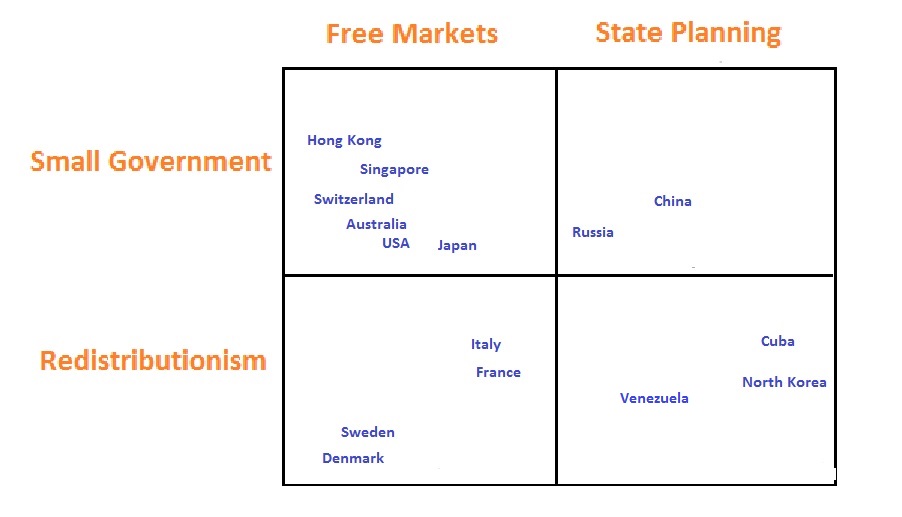
That’s because there is not an exact answer. The only thing we can definitively state is that government in most nations should be far smaller than it is today.
This is illustrated by the “Rahn Curve,” which I discussed both in the interview and in my speech today.
What is the Rahn Curve? Here’s some of what I wrote back in 2015.
…it shows the non-linear relationship between the size of…
View original post 437 more words
Cassandra
15 Jun 2022 Leave a comment
Actually all of the following things that Trump forecast for a Biden Presidency were entirely predictable, including a recession arising from all these forces, the reason being that Biden told people what he was going to do – shutting down the oil and gas industry, for example.
It’s just that Biden, his staff and his Democrat Party were stupid enough to think that these would lead to good results and refused to listen to anybody pointing out to them the perfectly logical consequences.
Stuff – The More Things Change The More They Stay The Same
15 Jun 2022 Leave a comment
Over the last couple of weeks I have been beginning to think that Stuff were becoming more objective in some of the articles they have run on the Government and it’s processes. This morning stuff ran the following on which they stopped comments an hour or so ago.
I commented as follows about an hour or so before they closed comments with this:`
`Interest rates, petrol prices and the economy are only part of the issues that have dragged Labour and Jacinda Ardern down in the polls.
3Waters and Co Governance are equally part of the governments problems and unless they quickly do an about turn they will be down in the mid 20’s in polls – which is where they were when Ardern took over from Little.
You cannot favour one race of people in a multi racial democracy which New Zealand has always been until 2020 and…
View original post 54 more words
‘Too many restrictions could not be thrown in the way of divorce’: Attitudes to Women’s Petitions for Divorce by Act of Parliament 1801-1831
15 Jun 2022 Leave a comment
Ahead of next Tuesday’s Virtual IHR Parliaments, Politics and People seminar, we hear from Dr Alison Daniell of the University of Southampton. On 21 June 2022, between 5.15 p.m. and 6.30 p.m., Alison will be responding to your questions about her pre-circulated paper on divorce by Act of Parliament in the early nineteenth century. Alison’s full-length paper is available here. Details of how to join the discussion are available here.
Before the 1857 Matrimonial Causes Act, the only way to dissolve an otherwise valid marriage was to obtain a divorce by way of Act of Parliament. It was, however, a remedy that had evolved purely for the use of men and was only available on the grounds of adultery. In total, only four women successfully ended their marriages this way. These were the cases of Addison in 1801; Turton in 1831; Battersby in 1840; and Hall in 1850.
The…
View original post 1,086 more words
Raging Inflation, Spiking Rates, Plunging Stocks, Oh, My!
15 Jun 2022 Leave a comment
It has been such a volatile couple of days in the markets that you hardly know where to focus. Friday’s inflation print was 8.6% (year/year), higher than expected and the highest in forty years, showing (yet again) that the Fed’s “transitory inflation” line was always just fantasy. Despite its glacial, foot-dragging pace of response to date, the Fed will need to raise short-rates (which they directly control) faster and farther than earlier planned. The Fed does not directly control long-term rates, but they influence them by buying and selling bonds on the open markets. For years, they have been buying bonds (driving interest rates lower), but they will have to stop that and maybe go the other way, being net sellers of bonds. This will make financing government deficits much more difficult.
Anyway, both short and long term rates have gone vertical in the past few days as markets price…
View original post 239 more words

Recent Comments