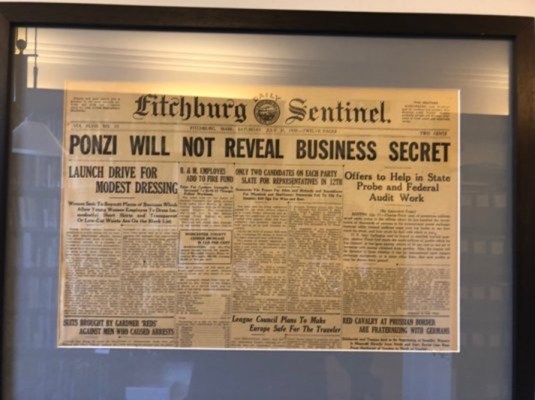
My submission on Crown deposit insurance for finance company Ponzi schemes
21 Feb 2022 Leave a comment
in global financial crisis (GFC), macroeconomics, monetary economics
Misleading?
21 Feb 2022 Leave a comment

Back in mid-December, the Reserve Bank fronted up to Parliament’s Finance and Expenditure Committee for the Annual Review hearing on the Bank. I wrote about it here. You may recall that this was the appearance where (a) the Bank (unsuccessfully) tried to kept secret before the hearing the loss of another couple of senior managers, and (b) seemed to mislead the Committee on just how many of their senior managers had gone or were going. In the wake of it, the Governor forced the early departure of his deputy Geoff Bascand a couple of weeks before he was due to leave anyway, over unauthorised contact with the media [CORRECTION: “shared information to a third party”] (most likely over those two new senior management departures).
But towards the end of the hearing (about 50 minutes in here) there was a brief exchange on matters climate change, with an unusually…
View original post 937 more words
Bombs Away – German Thirst For Caucasian Oil I THE GREAT WAR Week 200
21 Feb 2022 Leave a comment
in defence economics, war and peace Tags: World War I
Dumb & Dumber: Germany Wins Prize For World’s Most Idiotic Energy Policy
21 Feb 2022 Leave a comment


Germany set the gold standard for idiotic renewable energy policies, although the Brits, Californians, Texans and South Australians are keen contenders for that glittering prize.
Thanks to its unhinged obsession with intermittent wind and solar, Germans are in the midst of a power pricing and supply calamity.
Suffering Europe’s highest power prices, is just the beginning.
In a don’t say we didn’t warn you piece, Pierre Gosselin spells out the consequences of running with the dumbest energy policy on earth.
Germany Electricity Prices Soar To World Record Highs After Years Of Energy Policy Folly…Expensive, Unreliable
No Tricks Zone
Pierre Gosselin
9 February 2022
Germany’s power supply, once mostly made up of a mixture of coal and nuclear power, used to be among the most stable and affordable in the world. Power outages were rare and grid interventions were infrequent.
Greens and socialists then tried electrical power engineering
But then in…
View original post 600 more words
Why There’s An Empty Skyscraper In The Middle Of Times Square
20 Feb 2022 Leave a comment
in economics of media and culture
How Europe Colonized Parts Of China
20 Feb 2022 Leave a comment
in defence economics, development economics, economic history, international economic law, International law, war and peace Tags: age of empires, China, economics of borders, economics of colonialism, maps
1919
20 Feb 2022 Leave a comment
in defence economics, economic history, International law, war and peace Tags: maps, World War I

Spending Restraint Is Good Policy…and Good Politics
20 Feb 2022 Leave a comment

Is “austerity” a good thing?
Depends on how it is defined. Johan Norberg points out that spending restraint is the right approach.
Since I’m a fan of spending restraint, I obviously like the video.
But let’s expand on two points.
First, the definition of austerity is critical. Some fiscal policy folks (at the IMF and CBO, for instance) focus on deficits and debt.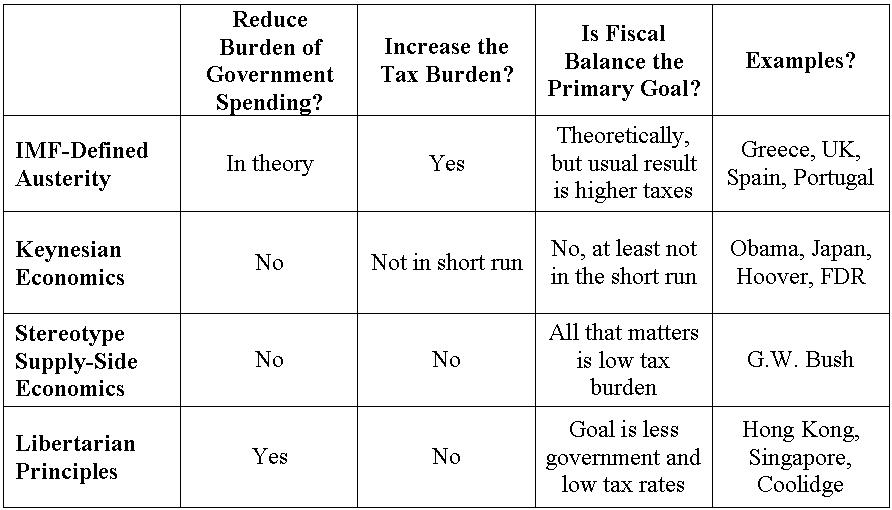 And this means they view spending restraint and tax increases as being equally desirable.
But that’s nonsense. As I’ve repeatedlyexplained, red ink is best viewed as a symptom. The real problem is excessive government spending.
Moreover, higher taxes usually exacerbate the spending problem since politicians can’t resist the temptation to spend at least a portion of any expected new revenue.
And since tax increases generally don’t collect as much money as politicians think they will, you can wind…
View original post 298 more words
Most carbon capture technologies create more emissions than they save
20 Feb 2022 Leave a comment

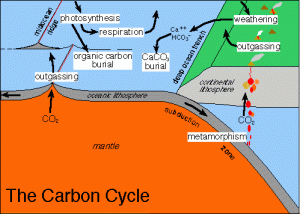 The carbon cycle [credit: laurencenet.net]
Nature’s carbon cycle already does this job. Why waste vast sums of money on dead-end technology ‘fixes’ that can achieve next to nothing in global terms?
– – –
Most carbon capture and utilisation (CCU) technologies, which pull carbon dioxide from the air and use it for other emissions-lowering processes, emit more carbon than they capture, reports New Scientist.
This finding suggests that CCU projects, which have attracted billions of dollars in investment, won’t do much to achieve the Paris Agreement‘s emissions targets to prevent warming by more than 1.5°C.
CCU technologies take carbon dioxide out of the atmosphere, either capturing it directly from the air or absorbing it at polluting sources, and puts it to use in processes such as making fuel, plastics and concrete.
View original post 147 more words
Lucas hooks into Mankiw and Ball
19 Feb 2022 Leave a comment
in business cycles, history of economic thought, macroeconomics, Robert E. Lucas
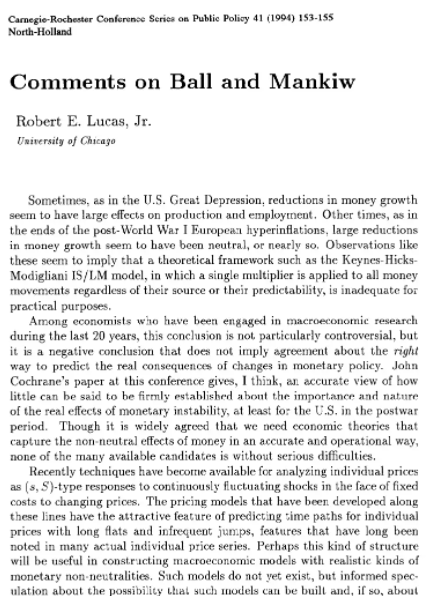
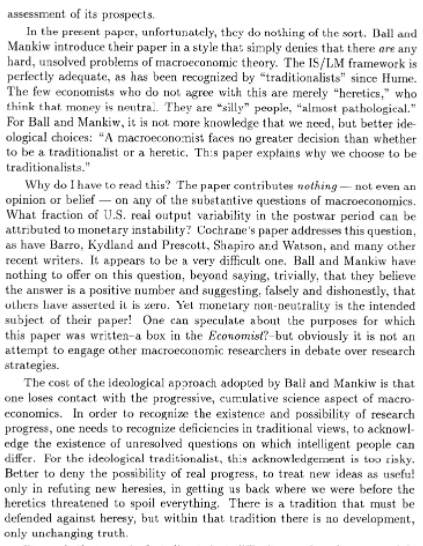
from https://www.reddit.com/r/Economics/comments/1w22mc/comments_on_ball_and_mankiw_robert_lucas_1994/
A deteriorating institution
19 Feb 2022 Leave a comment
I write a lot here about issues around the Reserve Bank. Some of those issues are quite obscure or abstract, and I know some readers find some of those posts/arguments a bit of a challenge to grasp.
But yesterday we had as straightforward an example as (I hope) we are ever likely to find.
Inflation is very much in focus at present. Measure of inflation expectations get more attention than usual. There is a variety of measures, both surveys (in New Zealand mostly conducted for the Reserve Bank and for/by ANZ) and market prices. The Reserve Bank has been surveying households for 27 years, with a fairly consistent (although expanded on a couple of occasions) range of questions. At the Bank there was always a degree of scepticism about the survey – household respondents always seemed (eg) to expect inflation to be quite a lot higher than it actually was…
View original post 1,758 more words
Asymmetric Liability, Common Law, & Urbanization
19 Feb 2022 Leave a comment

Tort law is interesting. You can argue that someone harmed you, and you can cite almost no legislation in the process. Torte law in the US uses case law – the precedent set by previous rulings in the context of social norms. But, what cases did the early cases cite? They also cited earlier cases and social norms, though we may no longer have a record. The beauty of tort law it allows for changing relative costs in prudence and negligence.
Can you imagine a legislature attempting to codify the appropriate amount of neglect by, say, a painter? The standards would quickly go out of date. The relative cost of resources including labor, communications, materials, and the price differences among competitors of differing quality all change over time. Multiply these factors by 20 and then again by the number of occupations and regions in a country. You will quickly see…
View original post 993 more words
Jerusalem Surrenders – Bolsheviks Consolidate Control I THE GREAT WAR Week 177
19 Feb 2022 Leave a comment
in defence economics, war and peace Tags: Russian revolution, World War I
What Is “Rent Seeking”?
18 Feb 2022 Leave a comment
I’ve written columns about wonky economic concepts such as “deadweight loss” and “public goods.” Today’s topic is “rent seeking,” which is part of “public choice” and is described by Professor Alex Tabarrok of George Mason University.
To elaborate, here’s a video from Professor Michael Munger from Duke University.
The basic message of both videos is that “rent seeking” occurs when interest groups manipulate the political system to obtain undeserved riches.
 And there are all sorts of examples of policies that exist solely because interest groups get politicians to tilt the playing field – including trade barriers, farm subsidies, occupational licensing, and bureaucrat salaries.
As pointed out in the videos, these rent-seeking policies reduce prosperity.
But what’s the origin of the term? In the modern era, it’s often associated with Gordon Tullock, one of the founders of public choice…
View original post 503 more words


Recent Comments