The Backbone of Total War – Trains in WW1 I THE GREAT WAR Special
13 Feb 2021 Leave a comment
in defence economics, war and peace Tags: World War I
Amazing Facts About the Age of Sail
13 Feb 2021 Leave a comment
in defence economics, economic history
The World’s Most Economically Illiterate Statement
13 Feb 2021 Leave a comment

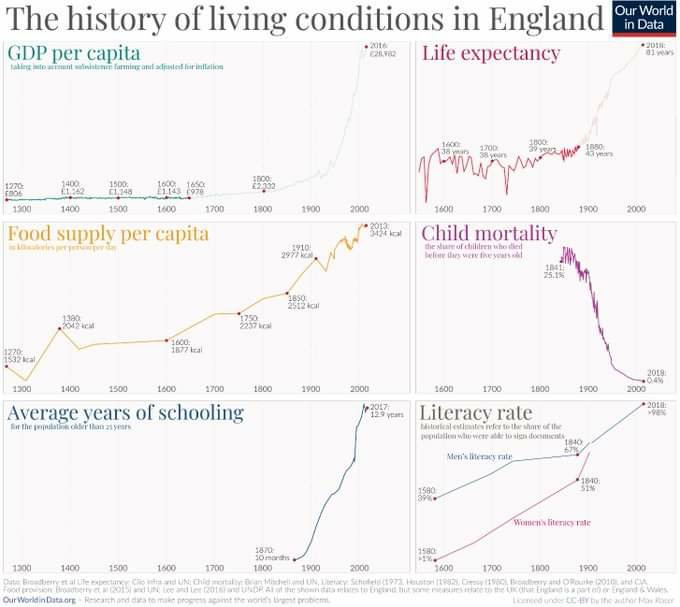
Back in 2014, I shared two videos, one narrated by Prof. Don Boudreaux and the other narrated by Prof. Deirdre McCloskey, making the point that grinding poverty and material deprivation were the norm for most of human history. It wasn’t until capitalism emerged a few hundred years ago that we made the jump from agricultural poverty to industrial prosperity.
I know at least one person who didn’t watch those videos.
Congresswoman Ayanna Pressley isn’t as well known as other members the “The Squad,” especially Alexandria Ocasio-Cortez and Ilhan Omar (jointly featured in this bit of satire), but she deserves some sort of recognition for being totally clueless about economics and history. Indeed, she may even deserve some sort of prize for uttering the year’s most economically illiterate sentence.

The two aforementioned videos illustrate why her statement is nonsensical, but let’s share some updated numbers to…
View original post 224 more words
Banquet of Consequences: Time to Force Wind & Solar Worshippers to Rely Exclusively on Sunshine & Breezes
13 Feb 2021 Leave a comment


Anyone railing against nuclear, coal or gas-fired power hasn’t been forced to rely exclusively on hopelessly unreliable wind and solar. The anti-fossil fuel crowd are, of course, hypocritical and the anti-CO2/anti-nuclear mob are the most hypocritical of all.
For those claiming they’re quite happy to do without coal and gas, wait till one of their loved ones lands in ICU, then tell them that the machines will only go “bing”, when either the sun’s at its zenith in a cloudless sky and/or the wind is blowing just right, and wait for the howls of protest and indignation.
The production and consumption of electricity is, after all, a “here and now”, kind of thing. A megawatt when we don’t need it, is simply a waste but, sometimes, a kilowatt makes all the difference. It’s time to spend some time hanging around in an ICU, if you still think otherwise.
Ross McKittrick…
View original post 778 more words
Book Review: “Young and Damned and Fair: The Life and Tragedy of Catherine Howard at the Court of Henry VIII” by Gareth Russell
13 Feb 2021 Leave a comment

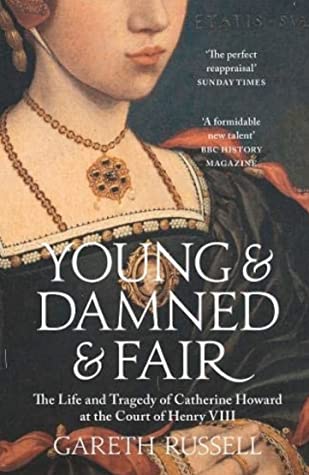 Divorced, beheaded, died. Divorced, beheaded, survived. For those who study Tudor history, we have heard this unimaginative rhyme to refer to the wives of Henry VIII for the longest time. We all know the stories of the queens, especially Anne Boleyn, but the fifth wife and the second one to be beheaded tend to be cast aside for some of the more intriguing tales. Her name was Catherine Howard, Henry’s youngest bride. Her story is full of rumors and myths, just like her cousin Anne Boleyn. Most know of her romantic dalliances that, in the end, led to her demise, but what was her reign like as queen? What was the court of Henry VIII like during his fifth marriage as his health was failing? In Gareth Russell’s brilliant biography, “Young and Damned and Fair: The Life and Tragedy of Catherine Howard at the Court of Henry VIII”, he dives…
View original post 459 more words
Japanese Bombing of Darwin
13 Feb 2021 Leave a comment

On February 19, 1942, the war-crowded northern Australian harbor of Port Darwin was struck by 198 Japanese bombers. This coordinated land and naval-based air strike surprised the ill-prepared defenders and devastated the port and the shipping concentrated within its harbor. Arriving in two waves, the forty-five minute attack sank eight ships, ran four aground, and severely damaged another eleven. More than 240 people were killed, mostly aboard the ships. Two more ships were destroyed as the planes transited home. They also struck the nearby Royal Australian Air Force (RAAF) base, destroying all the aircraft on the ground and downing all but one of the Australian fighters in the air. A follow-up raid finished off the base and inflicted so much wanton destruction that its military personnel fled to the south in panic. Total Japanese losses were only two aircraft. Darwin and its surrounding area endured more than a dozen air…
View original post 960 more words
The Great Enrichment
13 Feb 2021 Leave a comment
in applied welfare economics, economic history, liberalism, Marxist economics Tags: The Great Enrichment, The Great Escape
The Importance of Economics in the Field of Law. David Friedman & Keith Knight
12 Feb 2021 Leave a comment
in applied price theory, comparative institutional analysis, David Friedman, economic history, economics of crime, economics of information, history of economic thought, industrial organisation, law and economics, property rights, Ronald Coase
Matthew Kahn on Climate Change Adaptation
12 Feb 2021 Leave a comment
in applied price theory, applied welfare economics, comparative institutional analysis, development economics, economic history, energy economics, environmental economics, global warming, politics - Australia, politics - New Zealand, politics - USA, public economics, transport economics, urban economics Tags: climate alarmists
February 11: Birth and Death Anniversary of Elizabeth of York, Queen of England (1466-1503).
12 Feb 2021 Leave a comment

Elizabeth of York (February 11, 1466 – February 11, 1503) was Queen of England from her marriage to King Henry VII on 18 January 1486 until her death. Elizabeth married Henry after his victory at the Battle of Bosworth Field, which marked the end of the Wars of the Roses. Together, they had seven children.
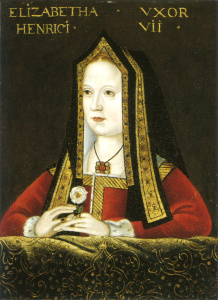
Elizabeth’s younger brothers, the “Princes in the Tower”, mysteriously disappeared shortly after the death of her father, King Edward IV. Although the 1484 act of Parliament Titulus Regius declared the marriage of her parents, Edward and Elizabeth Woodville, invalid, she and her sisters were subsequently welcomed back to court by Edward’s brother, King Richard III. As a Yorkist princess, the final victory of the Lancastrian faction in the Wars of the Roses may have seemed a further disaster, but Henry Tudor knew the importance of Yorkist support for his invasion and promised to marry Elizabeth…
View original post 1,154 more words
The Swedish model – myths and realities – Johan Norberg
12 Feb 2021 Leave a comment
in applied price theory, comparative institutional analysis, constitutional political economy, economic history, economics of education, economics of regulation, entrepreneurship, health economics, history of economic thought, human capital, income redistribution, industrial organisation, labour economics, labour supply, liberalism, Marxist economics, politics - USA, poverty and inequality, privatisation, Public Choice, survivor principle Tags: Sweden
100 years of the Government of Ireland Act: how it provided a model for Westminster-Edinburgh relations
11 Feb 2021 Leave a comment


The Government of Ireland Act 1920 is 100 years old tomorrow. David Torrance examines the legislation and its impact, arguing that a number of the constitutional conventions that regulate relations between Westminster and Holyrood have roots in those that applied to Stormont between 1920 and 1972.
Wednesday 23 December marks the centenary of royal assent for the Government of Ireland Act 1920 (the ‘1920 Act’). That this created the part of the UK known as ‘Northern Ireland’ and its border is well known, but its devolution settlement – a parliament, government, governor and prime minister – has largely faded from public consciousness.
As the historian Graham Walker has observed, Northern Ireland ‘serves as a reminder that devolution and constitutional change has a long, complex, and fascinating history, and did not just appear magically at the end of the twentieth century’ [1]. Indeed, this blog will argue that many of the…
View original post 1,432 more words


Recent Comments