
Tolerance compared
02 Sep 2020 Leave a comment
in discrimination, law and economics, liberalism, politics - Australia, politics - New Zealand, politics - USA, urban economics Tags: racial discrimination
California Puts Off the Inevitable
02 Sep 2020 Leave a comment

The California State Water Resources Board is going to leave some natural gas plants open in an effort to provide power for state residents. However, the political class will only see this as a minor setback and the real problems will start when Diablo Canyon nuclear power plant is shut down in five years.
California extends lives of aging gas plants as state seeks to prevent blackouts
by Abby Smith, Energy and Environment Reporter, Washington Examiner
California will keep four natural gas plants online for another few years instead of shutting them down, in an effort to guarantee the lights stay on as the state rapidly adds more renewable energy.
The decision, made unanimously Tuesday by members of the State Water Resources Control Board, comes just weeks after California grid operators imposed rolling blackouts on residents during peak electricity load amid a severe heat wave.
Republican politicians, including President…
View original post 159 more words
Māori Party reports a pandemic of racism – but on close inspection we find only two universities infected (maybe)
02 Sep 2020 Leave a comment

Our daily check with the Beehive website draw a blank. Nothing has been announced there since the PM announced the offender responsible for the Christchurch terror attack on 15 March 2019 has been designated as a terrorist entity.
But elsewhere in our monitoring of the political scene we found the Māori Party is hot and bothered about goings-on in the education domain . The item was headlined Racism In Education, Second Pandemic In Aotearoa
The Māori Party candidate for Te Tai Tonga, Tākuta Ferris, and Waiariki candidate, Rawiri Waititi, said in the statement they “believe institutional racism within the education system is holding this nation back”.
Ferris raged that:
“This week has highlighted the second pandemic taking hold of this nation, the pandemic of racism in Aotearoa – but particularly in the Aotearoa education system.”
Oh dear. What shameful acts have given risen to this?
View original post 791 more words
Should Obama be cancelled for being late on supporting same-sex marriage?
02 Sep 2020 Leave a comment

COVID comorbidities are not analogous to car crashes: Debunking the 6% mortality claim
02 Sep 2020 Leave a comment

 Recently, the CDC released data on COVID comorbidities, including data showing that 6% of COVID-19 deaths only listed COVID on the death certificate, while the remaining 94% of COVID deaths also listed other conditions. Many have jumped on this as proof that COVID is far less deadly than previously claimed and are arguing that most reported COVID deaths are actually just people who died of some other condition while happening to have COVID. In particular, I keep seeing an analogy of someone who has COVID getting hit by a car, then the death being attributed to COVID. This is a very bad analogy (and faulty argument in general) that horribly mischaracterizes these data. So, I want to briefly explain what is actually going on.
First, you need to realize that when a patient dies, doctors list all of the factors that contributed to the death. This often includes multiple conditions…
View original post 1,224 more words
INCU Global Conference 2014 – Thomas J. Sargent – Keynote Address on the effects of opening borders
02 Sep 2020 Leave a comment
in applied price theory, applied welfare economics, budget deficits, business cycles, comparative institutional analysis, constitutional political economy, currency unions, econometerics, economic history, economics of bureaucracy, economics of regulation, entrepreneurship, financial economics, fiscal policy, growth disasters, growth miracles, history of economic thought, human capital, income redistribution, industrial organisation, international economic law, international economics, International law, labour economics, labour supply, law and economics, macroeconomics, politics - Australia, politics - New Zealand, politics - USA, poverty and inequality, property rights, Public Choice, rentseeking, survivor principle, transport economics, unemployment Tags: custom unions, free trade, tariffs
#globalwarming #climateemergency @GreenpeaceAP @Greens @AOC @BernieSanders @NZGreens
02 Sep 2020 Leave a comment
in energy economics, environmental economics, global warming, politics - Australia, politics - New Zealand, politics - USA Tags: climate alarmists, solar power, wind power

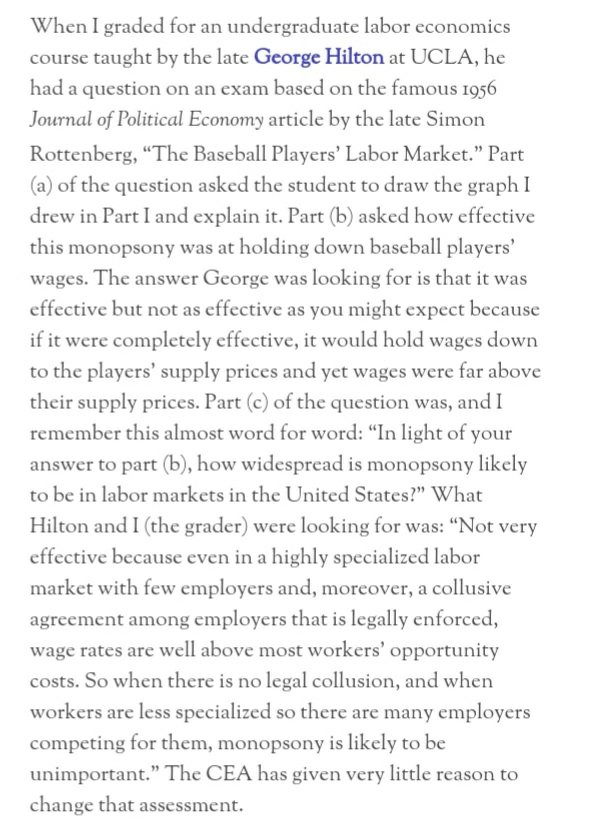
David Henderson on Monopsony
02 Sep 2020 Leave a comment
in applied price theory, applied welfare economics, Austrian economics, discrimination, econometerics, economic history, history of economic thought, income redistribution, labour economics, labour supply, law and economics, minimum wage, occupational choice, poverty and inequality, Public Choice, rentseeking, sports economics Tags: inequality of bargaining power, monopsony
How the Roman Colosseum Was Built
02 Sep 2020 Leave a comment
in economic history, sports economics, transport economics, urban economics Tags: Roman empire
Is Andrew Sullivan beyond the pale?
01 Sep 2020 Leave a comment

by Greg Mayer
[Update: I’ve been informed by Sam Harris that Murray and Herrnstein did not make the quantitative genetics error I attributed to them: they did not suppose that in traits with high heritability mean differences between populations indicate genetic differences between populations. I wasn’t sure they did (not having read the book), hence my noncommittal “or at least their public proponents” caveat. I am happy to be corrected on this point. It makes the demonization of Sullivan even more perplexing.]
Sort of. We may read him, but we must find him “abhorrent”. Or at least so proclaims Ben Smith of the New York Times in “I’m Still Reading Andrew Sullivan. But I Can’t Defend Him.” The headline condemns Sullivan, in Smith’s voice no less, but then opens with Smith visiting Sullivan, apparently late at night, at Sullivan’s vacation home on Cape Cod. The whole piece…
View original post 843 more words
U of C students demonstrate to defund and disarm campus police; University says “no way”
01 Sep 2020 Leave a comment
UPDATE: From Block Club Chicago (click on screenshot):
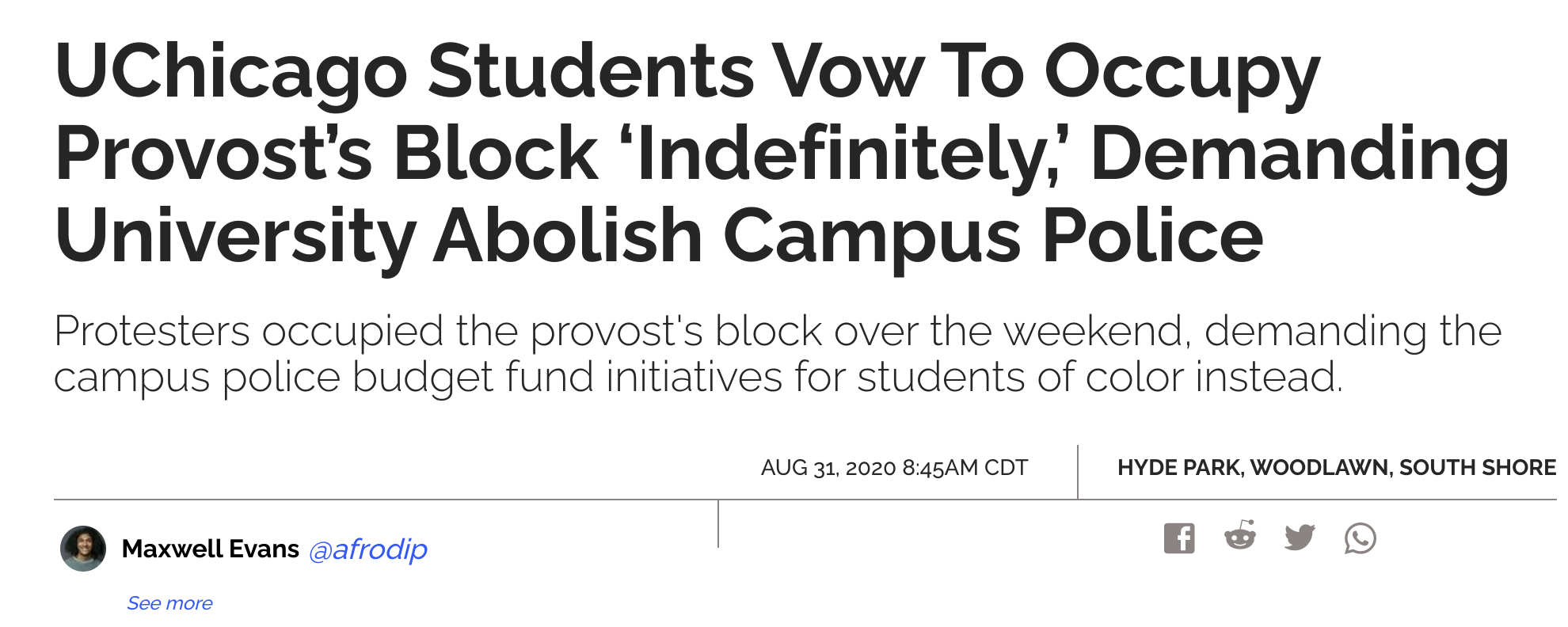
An excerpt:
The action continued into Sunday with yoga, breakfast and organizing workshops. Students will remain there “indefinitely until we hear publicly” from Lee, CareNotCops organizers said in a tweet.
In a statement Monday, organizers said they would remain on the block until Lee agrees to meet their demands.
They’re going to be waiting a LONG time. . . . .
________________
For some time now, I’ve been anxious about my University becoming more and more woke. That’s clearly happening to the student population, and there are signs it’s affecting some of the administration as well. This would break my heart, but I think the tide is unstoppable. I only hope that the highest administrators—the President and the Provost—will hold the line.
The latest instantiation of student wokeness, as reported by the Chicago Tribune (click on screenshot below) is a…
View original post 1,069 more words
Thomas Schelling on #globalwarming, 2005
01 Sep 2020 Leave a comment
in applied welfare economics, development economics, economic history, economics of natural disasters, economics of regulation, energy economics, environmental economics, global warming, Thomas Schelling Tags: climate alarmists, pessimism bias
Tom Sargent Honorary Degree Lecture on the European monetary crisis
01 Sep 2020 Leave a comment
in budget deficits, business cycles, currency unions, economic growth, economic history, economics of bureaucracy, Edward Prescott, financial economics, fiscal policy, global financial crisis (GFC), great depression, great recession, income redistribution, inflation targeting, job search and matching, labour economics, labour supply, macroeconomics, Milton Friedman, monetarism, monetary economics, Public Choice, public economics, rentseeking, Robert E. Lucas, unemployment Tags: monetary policy
The Largest Rocket That Never Launched
01 Sep 2020 Leave a comment
in transport economics Tags: space
How Britain’s grid became ‘cleaner, cheaper, and harder to control’ during the Covid-19 lockdown
31 Aug 2020 Leave a comment


The study talks about the need for more ‘grid flexibility’, but as one union leader put it: “The political aspiration is for a low carbon future but politicians have no credible way of delivering it”. Despite the ‘cheaper’ claim, it turns out that ‘the costs of managing the grid skyrocketed to a record high’, which looks ominous given existing energy policies.
– – –
Lockdown measures taken to combat Covid-19 in March led to a much greener and cheaper electricity system in Britain in the weeks that followed, but at the same time the increased reliance on renewables made managing the grid far more challenging, offering a glimpse of the UK’s future power requirements as the economy transitions towards net zero emissions.
That is the conclusion of independent research released today by Imperial College London and energy firm Drax, which saw experts assess the tumultuous impact of the coronavirus crisis…
View original post 369 more words


Recent Comments