Over the past half-century, the share of men enrolled in college has steadily declined relative to women. Today, 1.6 million more women than men attend four-year colleges in the U.S. This trend has not lowered marriage rates for college women, a substantial share of whom have historically married economically stable men without college degrees. Both […]
Gender gaps in education and declining marriage rates
Gender gaps in education and declining marriage rates
06 Feb 2025 Leave a comment
in applied price theory, econometerics, economics of love and marriage, economics of marriage, human capital, labour economics, law and economics, poverty and inequality Tags: assortative mating, economics of fertility
Could You Survive on British World War Two Rations?
05 Feb 2025 Leave a comment
in defence economics, health economics, war and peace Tags: rationing, World War II
Identity-based hiring goes wild in New Zealand
05 Feb 2025 Leave a comment
in discrimination, economic history, economics of education, human capital, labour economics, labour supply, law and economics, liberalism, Marxist economics, occupational choice, politics - New Zealand, property rights, Public Choice, public economics, rentseeking Tags: affirmative action, Age of Enlightenment, constitutional law, free speech, political correctness, racial discrimination, regressive left

Just to show you how, in the hiring process, New Zealand gives much more weight to identity than to merit, I enclose part of the job description for the position of Chief Operating Officer of Wellington Water, the water utility for the Greater Wellington region (Wellington, a lovely city, is the capital of New Zealand). […]
Identity-based hiring goes wild in New Zealand
*Progressive Myths*: The Caplan-Huemer Interview
05 Feb 2025 Leave a comment
in econometerics, economic history, law and economics, liberalism, Marxist economics, politics - USA, Public Choice Tags: Age of Enlightenment, conjecture and refutation, free speech, philosophy of science, political correctness, regressive left

I recently interviewed Mike Huemer on his new Progressive Myths. To repeat, I consider it “the best book on wokeness.” You know you’re reading a special book by page 3, when Huemer states:I will not give a neutral presentation in the following chapters, but I do aim to give an objective presentation. I am a…
*Progressive Myths*: The Caplan-Huemer Interview
Why do predictions of peak oil always fail?
05 Feb 2025 Leave a comment
in energy economics, environmentalism Tags: Oil prices

The Talkshop is going with the author on this one. See Sir Fred Hoyle’s quote in the text. – – – Has Abiotic Oil Eliminated Peak Oil?
Why do predictions of peak oil always fail?
By 2025 we were supposed to have closed the gap
05 Feb 2025 Leave a comment
in economic growth, economics of regulation, entrepreneurship, human capital, industrial organisation, labour economics, labour supply, macroeconomics, politics - New Zealand, poverty and inequality
Don Brash and Michael Reddell write – When Don was young and Michael’s parents were young, New Zealand had among the very highest material standards of living in the world. It really was, in the old line, one of the very best places to bring up children. But no longer. For 75 years now, with […]
By 2025 we were supposed to have closed the gap
Levels of Industrial Policy
05 Feb 2025 Leave a comment
in applied price theory, comparative institutional analysis, development economics, economic history, entrepreneurship, industrial organisation, Public Choice, rentseeking Tags: industry policy
In arguments over industrial policy, there’s often a moment where someone makes an assertion like: “Every nation has industrial policy. Even not having an industrial policy is a type of industrial policy. The only relevant question is what kind of industrial policy we should choose.” In my experience, the people who make this argument then…
Levels of Industrial Policy
Property, liberty, transparency: the principled basis for the Regulatory Standards Bill
04 Feb 2025 Leave a comment
in Adam Smith, applied price theory, economics of bureaucracy, economics of regulation, law and economics, politics - New Zealand, property rights, Public Choice, rentseeking
Bryce Wilkinson writes – If you believe some of its critics, the pending Regulatory Standards Bill is a demonic measure to end New Zealand society as we know it. This is beyond false; it is ridiculous. In fact, it is a modest transparency measure. It will better inform the public about laws and regulations likely […]
Property, liberty, transparency: the principled basis for the Regulatory Standards Bill
Mocking European Statism
04 Feb 2025 1 Comment
in applied price theory, Austrian economics, comparative institutional analysis, economic growth, economics of bureaucracy, economics of regulation, entrepreneurship, environmental economics, financial economics, industrial organisation, international economics, labour economics, labour supply, law and economics, liberalism, macroeconomics, Marxist economics, property rights, Public Choice, public economics, rentseeking, survivor principle, theory of the firm Tags: employment law, European Union
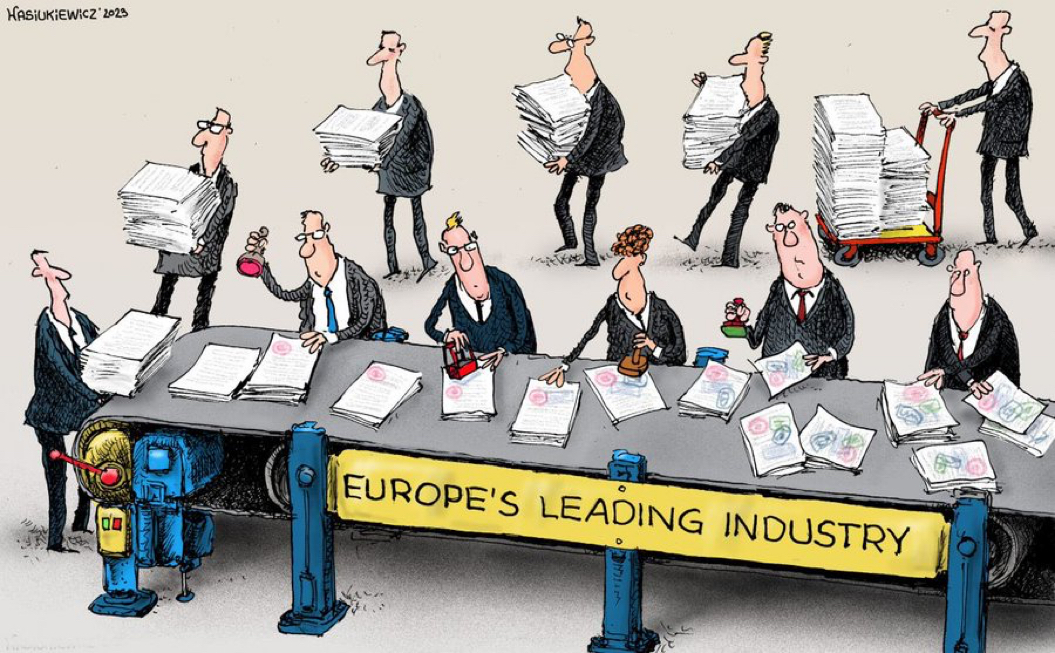
I have a special page for humor involving Europe, but I have not added to it since sharing some Brexit humor in 2016. Let’s being the process of catching up with some amusing cartoons and memes mocking our government-loving cousins on the other side of the Atlantic Ocean. I’ve made the serious point that bureaucrats […]
Mocking European Statism
Spoiling for a Fight: Why Challenging Birthright Citizenship is a Win-Win for Trump
04 Feb 2025 Leave a comment
in International law, labour economics, labour supply, law and economics, politics - USA Tags: 2024 presidential election, constitutional law, economics of immigration, regressive left

Below is my column in the Hill on the move of the Trump Administration against birthright citizenship. The Trump Administration believes that this is fight worth either winning or even losing in the courts. Roughly half of the country oppose birthright citizenship. The key is where those voters are coming from. The minority of voters […]
Spoiling for a Fight: Why Challenging Birthright Citizenship is a Win-Win for Trump
Going for growth…..perhaps
04 Feb 2025 Leave a comment
in applied price theory, comparative institutional analysis, economic growth, economic history, economics of regulation, entrepreneurship, macroeconomics, politics - New Zealand

The Prime Minister’s speech 10 days or so ago kicked off a flurry of commentary. No one much anywhere near the mainstream (ie excluding Greens supporters) questioned the rhetoric. New Zealand has done woefully poorly on productivity for a long time and we really need better outcomes, and the sorts of policy frameworks that would […]
Going for growth…..perhaps
Good question
03 Feb 2025 Leave a comment
in defence economics, economic history, International law, war and peace Tags: Gaza Strip, Middle-East politics, regressive left, war against terror, West Bank

How are Mexico and Turkey right now like the USA in the 1920s? (Prohibition is causing deaths from drug & alcohol poisoning)
03 Feb 2025 Leave a comment
in applied price theory, economic history, economics of regulation, health economics Tags: economics of prohibition
The picture below is of a few paragraphs from the book The Economics of Public Issues, which I often used as a supplemental textbook when I was teaching. Now for modern day Mexico. See How Mexican Cartels Test Fentanyl on Vulnerable People and Animals: A global crackdown on fentanyl has led cartels to innovate production methods…
How are Mexico and Turkey right now like the USA in the 1920s? (Prohibition is causing deaths from drug & alcohol poisoning)
The Child Penalty: An International View
03 Feb 2025 Leave a comment
in applied price theory, discrimination, econometerics, economics of education, gender, human capital, labour economics, labour supply, occupational choice Tags: economics of fertility, gender wage gap, marriage and divorce

It’s well-known that when a couple has a child, the average woman experiences a “child penalty” in labor market outcomes, while outcomes for the man are largely unchanged. For a discussion of this pattern using US data, here’s an article by Jane Waldfogel from back in 1998 in the Journal of Economic Perspectives. As that…
The Child Penalty: An International View
‘Free’ school lunches: Why?
02 Feb 2025 Leave a comment
in economics of education, health economics, politics - New Zealand Tags: child poverty, family poverty

This week, headline after headline bitched about the new ‘free’ school lunch programme. Principals apparently compared the meals to ‘dog food’. There were numerous teething problems with delivery. KidsCan jumped on the bandwagon to promote child poverty and useless government yet again.It beggars belief really. Parents are already paid cash every week to help them…
‘Free’ school lunches: Why?
 Utopia, you are standing in it!
Recent Comments