
Equality for women in sport is a recent accomplishment
18 Apr 2020 Leave a comment
in discrimination, gender, sports economics Tags: gender gap
Anti-fascists, the British left and the David Irving libel trial
18 Apr 2020 Leave a comment

 Coverage in Searchlight (May 2000)
On 11 April 2000, Mr Justice Gray found in favour of Penguin Books, who had been sued for libel by David Irving after the publication of Deborah Lipstadt’s Denying the Holocaust, which stated:
Irving is one of the most dangerous spokespersons for Holocaust denial. Familiar with historical evidence, he bends it until it conforms with his ideological leanings and political agenda. A man who is convinced that Britain’s great decline was accelerated by its decision to go to war with Germany, he is most facile at taking accurate information and shaping it to confirm his conclusions. A review of his recent book, Churchill’s War, which appeared in New York Review of Books, accurately analysed his practice of applying a double standard to evidence. He demands “absolute documentary proof” when it comes to proving the Germans guilty, but he relies on highly circumstantial evidence to…
View original post 1,725 more words
Almost half of UK’s carbon footprint down to ‘invisible’ emissions abroad
18 Apr 2020 Leave a comment
#OTD 1975 #globalwarming #climateemergency @GreenpeaceAP @Greens @NZGreens @jamespeshaw
18 Apr 2020 Leave a comment

Is there an alternative to Obamacare?
18 Apr 2020 Leave a comment
in comparative institutional analysis, constitutional political economy, economic history, economics of bureaucracy, economics of regulation, health economics, politics - USA, Public Choice Tags: health insurance
Poland
18 Apr 2020 Leave a comment
in defence economics, economic history, international economics, International law, war and peace Tags: maps, World War I, World War II

Why are all these pandemics named after countries? Scapegoating or maybe, ease of recollection?
18 Apr 2020 Leave a comment
in health economics Tags: economics of pandemics

#COVID19 tradeoffs
18 Apr 2020 Leave a comment
in applied welfare economics, econometerics, economics of information, economics of regulation, health economics, politics - Australia, politics - New Zealand, politics - USA Tags: economics of pandemics
Capitalism vs. Slavery…and The New York Times’ 1619 Project
18 Apr 2020 Leave a comment
in comparative institutional analysis, constitutional political economy, defence economics, economic history, economics of crime, economics of education, economics of regulation, human capital, labour economics, labour supply, law and economics, property rights Tags: regressive left
Girls Armed With Pitchforks – The Women’s Land Army – On the Homefront 002
18 Apr 2020 Leave a comment
in defence economics, war and peace Tags: World War II
Why Plague Doctors Wore Strange Masks
17 Apr 2020 Leave a comment
in economic history, health economics
Renewable Energy Rip-off: Wind & Solar Consistently Fail to Deliver the Goods
17 Apr 2020 Leave a comment


Adding wind and solar capacity is a bit like pushing on string; the outcome never matches the effort applied.
Across the globe, it’s true to say that there has been a massive expansion in wind and solar power capacity. However, as Rafe Champion points out below, there’s a yawning gulf between the notional capacity of the world’s wind and solar plants and what they actually deliver.
And, of course, where output from the former depends upon ‘just right breezes’ and output from the latter’s determined by the time of day (eg, there’s never much happening at midnight) predicting just when that capacity might be delivered makes betting the house on roulette seem like a canny investment.
Windpower advocates lying with statistics
Catallaxy Files
Rafe Champion
9 April 2020
Windpower Roundup reports.
Roughly 176GW of new renewable energy capacity was added last year, accounting for 72% of global power growth.
View original post 264 more words
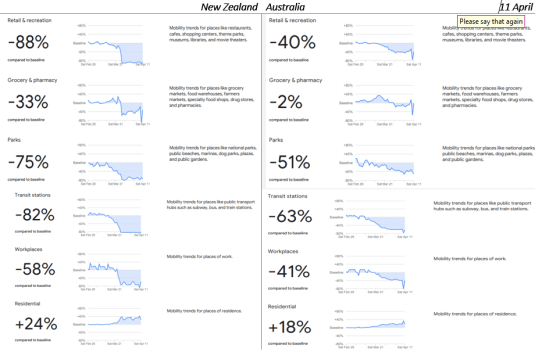
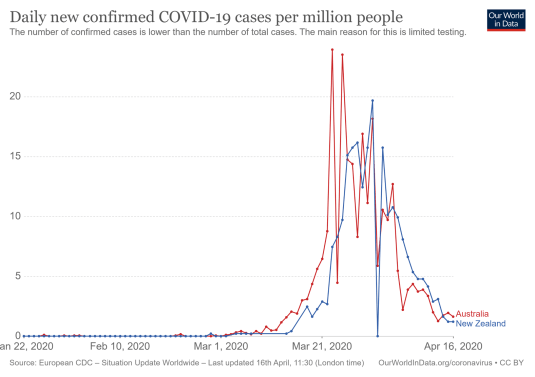
Did NZ panic? Locked-down twice as hard as Oz for same #COVID19 caseload 14 days later
17 Apr 2020 Leave a comment
in applied welfare economics, health economics, politics - Australia, politics - New Zealand


What can economic history teach us about the lockdown?
17 Apr 2020 Leave a comment

The coronavirus pandemic is, of course, first and foremost a social crisis. It is testing the limits of the NHS, bringing out the best in our doctors, nurses and carers, and many others on whom we all rely. But it is also a huge challenge for policymakers who are trying to protect businesses, jobs and incomes, so that the economy can quickly reboot once the lockdown is lifted. And while the saving of lives is rightly the priority, the extent and duration of the economic disruption could also have significant impacts on our health.
Fortunately, history does provide a few pointers. Perhaps the least surprising conclusion is that vicious diseases cannot be allowed to run unchecked. One particularly grim study of the longer-term economic consequences of 15 pandemics, all the way back to the Black Death in the 14th century, found that the fallout persisted for as long as 40…
View original post 513 more words


Recent Comments