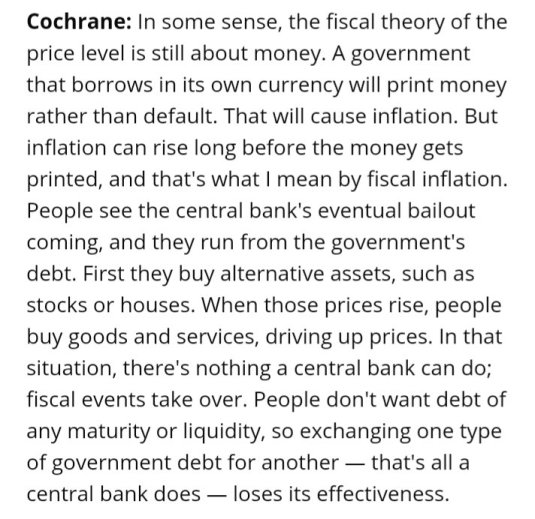
Sums up modern monetary theory too
23 Jan 2020 Leave a comment
in business cycles, economic history, economics of information, financial economics, fiscal policy, macroeconomics, monetary economics Tags: hyperinflation, monetary cranks, monetary policy
Nordhaus on the carbon tax rate
23 Jan 2020 Leave a comment
in applied welfare economics, energy economics, environmental economics, global warming

All gone by the year 2020: Wikipedia rewrites history (2)
23 Jan 2020 3 Comments

This is part 5 in the series on the prediction that glaciers in Glacier National Park will be gone by 2020. You might want to see to part 1, part2, part 3 and part 4 if you haven’t already
This post is a follow-up on a previous post in this series, more specifically the post of Wikipedia rewriting history by suggesting that the 2030 prediction was a “later estimate”, following the 2020 prediction. Contrary to the reality that the 2020 estimate was an update of the 2030 estimate and the 2030 estimate was in fact rehashed after the 2020 claim was abandoned (probably because it became clear that the 2020 estimate would fail).
My take was that the Wikipedia contributor found that the 2030 estimate was made in an later snapshot of a National Park Service webpage and didn’t look at the estimates in the snapshots before 2010…
View original post 1,954 more words
Supreme Court hears vital freedom-of-religion case
23 Jan 2020 1 Comment

Today, the Supreme Court heard the most important case on the intersection of religion and education to arise in decades–Espinoza v. Montana Department of Revenue. A few years back, Montana had passed its first school-choice program, a tax-credit scheme that allowed a small tax credit for donations to scholarship programs that helped kids afford private school.
As in any state, many of Montana’s private schools are religious. Right after the state legislature passed the tax-credit statute, the Montana Department of Revenue promulgated a rule that immediately gutted the program by forbidding students attending religious schools from receiving scholarship money.
The Department based its rule on Montana’s Constitution, which says the legislature can’t “make any direct or indirect appropriation or payment from any public fund or monies . . . for any sectarian purpose or to aid any church, school,” etc. Plenty of states have very similar “no-aid” clauses…
View original post 677 more words
@moturesearch accused @CCDHB of paying mothers less despite having nothing on which female doctors have kids so it can discriminate against them more! @women_nz
23 Jan 2020 Leave a comment
in discrimination, economics of bureaucracy, economics of education, gender, human capital, labour economics, labour supply, law and economics, occupational choice, politics - New Zealand, Public Choice Tags: gender wage gap

Unusual case as allegation made against named employers subject to freedom of information laws. Can ask if they have the information needed to implement their nefarious misogynist plans.
Charles Murray on Coming Apart
23 Jan 2020 Leave a comment
in economic history, economics of education, economics of information, economics of media and culture, economics of natural disasters, economics of religion, human capital, labour economics, labour supply, Marxist economics, occupational choice, politics - USA, poverty and inequality, Public Choice, public economics, transport economics, unemployment, urban economics, welfare reform
Do gender equality policies drive the academic gender pay gap? @moturesearch @women_nz
23 Jan 2020 Leave a comment
in discrimination, economics of education, gender, human capital, labour economics, labour supply, law and economics, managerial economics, occupational choice, organisational economics, personnel economics, politics - USA Tags: gender wage gap, unintended consequences

The United States Goes Dry – Alcohol Prohibition I THE GREAT WAR
23 Jan 2020 Leave a comment
in defence economics, economics of bureaucracy, economics of crime, economics of regulation, health economics, industrial organisation, law and economics, politics - USA, Public Choice, war and peace Tags: economics of prohibition, World War I
A BBC journalist’s portrayal of an armed infiltration from the Gaza Strip
23 Jan 2020 Leave a comment

On the evening of January 21st an infiltration took place on the border with the Gaza Strip.
“IDF soldiers opened fire at a group infiltrating the border fence along the Gaza-Israel border on Tuesday, hitting three Palestinian suspects who used the inclement weather to hide in a wooded area near Kibbutz Kissufim.
The IDF reported that one of the terrorists hurled a grenade or an explosive charge at a force that surrounded the three.”
As local media reported, the IDF released video evidence of the infiltrator throwing the explosive device.
To date the BBC has not produced any reporting on that incident but the next morning the BBC’s Jerusalem correspondent Tom Bateman did put out three related Tweets in which he found it appropriate to focus on the age of the armed border infiltrators and unnecessarily qualify the facts of the incident using the well-worn “Israel says” formula.
View original post 15 more words
History’s most amazing photo?
23 Jan 2020 Leave a comment

I almost never visit the My Modern Met site, but it must be good, as I often get suggestions from readers about articles there. I think I found this one on my own, but probably through Facebook. It’s the story of how an enterprising young photographer, Jon Carmichael, took a spectacular photo of a solar eclipse. Click on the screenshot to see the story.
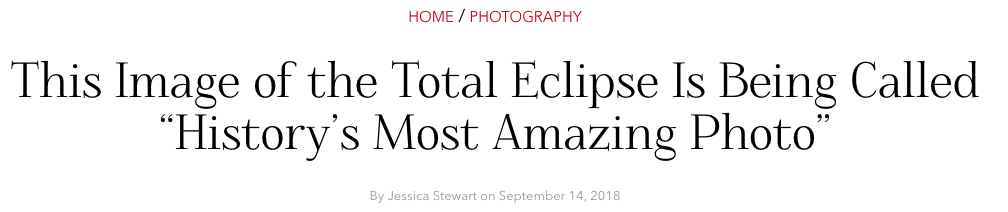
The date was August 21, 2017, and you may remember that there was a total eclipse that day visible in much of the U.S. (I saw part of it, though it was overcast in Chicago). Carmichael decided to try to photograph the eclipse from in the air—on a commercial flight.
He chose a Southwest flight from Portland, Oregon to St. Louis, Missouri, which would put him in the path of the eclipse when he was in the air. But he neglected to buy the early…
View original post 219 more words


Recent Comments