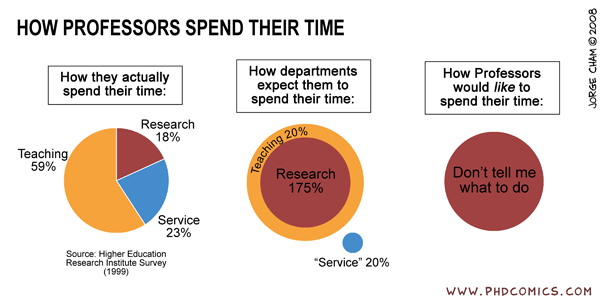
HT: Sinclair Davidson
Celebrating humanity's flourishing through the spread of capitalism and the rule of law
13 Feb 2015 Leave a comment
in economics of education, personnel economics Tags: academics
HT: Sinclair Davidson
09 Feb 2015 Leave a comment
in health and safety, human capital, labour economics, labour supply, managerial economics, market efficiency, occupational choice, organisational economics, personnel economics Tags: modern human resource management
30 Jan 2015 Leave a comment

29 Jan 2015 Leave a comment
in occupational choice, personnel economics, politics - Australia, politics - New Zealand, politics - USA Tags: activists, Greens, Inner-city Left, Leftover Left


Minorities represent nearly 40 percent of Americans, yet account for fewer than 16 percent of workers at the government agencies, nongovernmental organizations called NGOs and foundations that were studied.
…Taylor wrote that an “unconscious bias” exists within the liberal and progressive culture of the groups, preserving a racially homogenous workplace. “Recruitment for new staff frequently occurs through word-of-mouth and informal networks,” the study said. “This makes it difficult for ethnic minorities, the working class, or anyone outside of traditional environmental networks to find out about job openings and apply for those jobs.”
27 Jan 2015 Leave a comment
in entrepreneurship, managerial economics, market efficiency, organisational economics, personnel economics Tags: Alfred P. Sloan, group think

1. Assign someone on your team to the role of “Devil’s Advocate” to ensure a critical eye.
2. Ask part of your group to think like the firm’s competitors (or customers or employees) in order to surface and expose flaws in a set of core assumptions.
3. Establish “ground rules” that will stimulate task-oriented disagreement — but minimize interpersonal conflict.
4. Keep the proceedings “transparent” by making decisions based on what goes on in the meeting and not behind-the-scenes maneuvering.
5. Make sure your team members represent a diversity of thinking styles, skill levels, and backgrounds. And if they don’t, invite people with various points of view to offer their perspectives.
6. Start out with a question and don’t voice an opinion. Once you’ve said, “Here’s what I’m thinking . . .” you have already influenced your team.
7. If you want honest feedback, then be the first person to admit mistakes.
8. Listen (really listen) to everyone’s ideas. Let people know that you value their input and are taking into consideration what they have to say.
9. Pay attention. It’s not enough to listen — you can do that while viewing text messages or pouring a cup of coffee. You also have to be perceived to be paying attention. That means you need to make sure your body language (eye contact, head nods, torso orientation, etc.) sends signals of inclusion.
10. Clearly state the behaviors you want during the discussion (constructive conflict) and as a result of the discussion (shared commitment to the outcome).
via http://www.forbes.com/sites/carolkinseygoman/2012/08/23/10-ways-to-get-people-to-disagree/
25 Jan 2015 Leave a comment
in economics of crime, economics of media and culture, law and economics, personnel economics, politics - USA Tags: Undercover police
24 Jan 2015 Leave a comment
in economics of media and culture, environmental economics, global warming, occupational choice, personnel economics Tags: academic bias, activists, climate alarmism, expressive 13, rational ignorance, rational irrationality

If the public knew the truth, I expect two effects:
- The public would consider scientists to be less authoritative as a neutral source on policy questions, and
- Since scientists are respected, the public would become less conservative and more liberal.
23 Jan 2015 Leave a comment
in managerial economics, organisational economics, personnel economics, theory of the firm Tags: agent principal problems, creative destruction, human resource departments, managerial discretion, measurement without theory, The pretence to knowledge
Kyle Smith in Forbes today launched into human resource departments and called for their abolition. My hypothesis is he doesn’t understand why rigid, rule-bound human resource departments exist in the first place in large hierarchies. The fact that this form of organisation survives in competition with other forms of organisation and modern human resource management has been spreading rather the contracting in popularity over the recent decades is a test of its survival value in market competition.
Smith made the following claims:
This is a classic example of measurement without theory. Of not having a theory to make sense of the facts and explain why this form of organisation – modern human resource departments – is survived and prospered in market competition.

The form of organisation that survives in competition with actual and potential market rivals is that specific form of organisation which allows the firm to deliver the products that customers want at the lowest price while covering costs (Alchian 1950; Fama and Jensen 1983a, 1983b).
Some larger firms may struggle with striking the most profitable balance between greater local managerial discretion and effective corporate governance of a large diverse organisation with professional managers and diffuse ownership structures. It will be shown that very large firms promulgate rigid personnel policies while smaller firms are much more flexible in their deals with individual employees.
Competition between different sizes, shapes and internal organisational forms of firms all vying for sales, cheaper sources of supply and investor support sifts out the keener priced, lower cost, and more innovative enterprises (Alchian 1950; Stigler 1958). These lower-cost firms will be able to under-sell their higher cost rivals. The winning size and shape is that configuration which meets any and all problems the firm is actually facing and seizes more of the entrepreneurial opportunities that are within its grasp (Stigler 1958; Alchian 1950).
As the size of a firm grows, important information is less likely to find its way up hierarchies and reach the appropriate decision-makers and be up-to-date and be comprehended if it does. The top of corporate hierarchies can be overwhelmed with information and much of what information they do receive can be old, incomplete, conflicting and garbled (Williamson 1967, 1975).
Larger firm respond to this loss of up-to-date knowledge of the local circumstances of time and place with a greater dependence on broad rules (Oi 1983a, 1983b, 1988, 1990). For this reason, larger employers will be less effective in assessing individual attributes of employees and assigning employees to the most productive task (Parsons 1997).
Larger firms offset this competitive disadvantage by specialising in the production of standardised goods with larger teams of more homogeneous, more highly trained workers; smaller firms produce more customised goods produced in smaller quantities by smaller teams of less specialised employees (Oi 1983a, 1983b; Oi and Idson 1999). Smaller firms can quickly adapt to changing circumstances of all kinds because top management are closer to and better informed about all operations, employees and customers.
If large firms are to survive in competition, the personnel policies of larger employers must adapt to offset the diseconomies of scale in idiosyncratic decisions by relying on broad inflexible rules. These top-down rules will leave far less discretion in the hands of local managers. This is because the higher layers in a large corporate hierarchy cannot control and direct lower layers that behave in an increasing diversity of ways to the same information and to local events that do not affect the rest of the firm.
Planning and coordination costs increase with organisational size. There will be errors in assigning tasks, deciding rewards, and monitoring performance. Information flows and co-ordination become problems that only increase with the size if the firm. It can be cheaper to monitor compliance with rules and issue general instructions that apply to all employees.
Limits on the degree of local managerial discretion over employment relations in large managerial firms can arise from restrictions on managerial delegations, divided decision making rights, hierarchical approval procedures, and the breath and content of wage and personnel policies. The discretion of supervisors in large firms may be limited to individual performance ratings (Gibbs and Hendricks 2004). Some large firms may have no process or policy to handle requests for a phased retirement.
Good evidence to illustrate the proposition that larger firms prefer rigid rules over discretion in personnel policies comes from the days of mandatory retirement. Mandatory retirements can be viewed as the wholesale substitution of local managerial discretion with a single company-wide rule because larger firms find idiosyncratic decisions to be more costly (Parsons 1997).
Mandatory retirements are near universal in very large workplaces, but in small to medium size firms, there were flexible retirement polices. Few very large firms reported flexible retirement polices.
Smaller firms provided for policies that allowed for exceptions to mandatory retirement rules while most of largest firm reported a policy of zero exceptions to mandatory retirement rules (Parsons 1997). This U.S. evidence from the time of mandatory retirements suggests that larger employers may find it more difficult to handle the idiosyncrasies of phased retirements.
A price of growth in the size of firms is often the standardisation of products, workforce compositions and terms of employment. Standardisation in larger firms constrains wages, reduces managerial slack and aggrandisement, and facilitates performance evaluations and yardstick competition between divisions.
Large employers write personnel policies to govern most aspects of the employment relationship. These human resources policies will be common to all employees and all revisions and exceptions require central approval.
More centralised human resources policies that limit supervisor discretion can reduce favouritism and the cost of employees wasting working time on attempts to influence line managers about their pay and working hours.

The price of more centralised human resources policies is less local adaptability to genuine opportunities. The offset is centralised personnel policies save on the costs to the firm of having to gather and process up and back down a large corporate hierarchy the information need to make decisions with more localised finesse. These rule-bound decisions are less deft but are also cheaper to make.
In other areas, large firms will take steps to empower local managers and foil ill-informed intervention from above to put decisions where the knowledge is held. Reporting and decision procedures and performance pay can all craft a sufficient amount of distance between managerial layers to create an adequate amount delegation to take advantage of local knowledge and overcome the costs of slow and garbled information transfer in hierarchies, managerial overload, and the losses from decisions lagging behind in dynamic and unpredictable environments.
Smaller firms survive and profit from being small because their size allows them to succeed with more workforce diversity and more customised products. The owners are know more and can be directly involved in management. Owner-managers can quickly adapt to new conditions with fewer risks and can sidestep the need to develop policies on phased retirements or revise it on the spot in light of an unforeseen or low-probability contingency.
One reason for larger firms paying higher wages by industry standards is as compensation to offset their requirements for more standardised hours of work. The efforts of the more able entrepreneurs to deploy their talents wisely result in systematic differences in the organisation of production and the structure of the workforces that firms employ. Smaller employers pay less in wages but can offer more flexible work hours. The wage premiums offered in large firms are in part because of their organisational rigidity.
Rigid, rule-bound HR department is doing its job to the letter because this constrains line managers from favouritism and been lobbied for favours by employees was they have very little control over terms and conditions of employment and promotions and perhaps only have input into performance ratings.

A major reason why companies limit pay reviews and performance promotion rounds to an annual process is to prevent everyone wasting time between these annual events on lobbying for pay rises and promotions The HR department is the guardian of the gate to ensure there is no favouritism because it enforces rules rigidly.
The nub of the problem is large firms have several layers of management with fairly strict limits on what each individual line manager can do (Williamson 1975, 1985; Fama and Jensen 1983b). There must be some limits on local managerial discretion because the owners and senior managers of any firm set the strategic direction of the firm, the products it sells, and how many workers are employed and on what wages. All parts of the firm must march in the same direction.
The discovery of monitoring or incentive systems that induce managers to act in the best interest of shareholders are entrepreneurial opportunities for pure profit (Fama and Jensen 1983b, 1985; Alchian and Woodward 1987, 1988; Demsetz 1983, 1986; Demsetz and Lehn 1985; Demsetz and Villalonga 2001).
Investors will not entrust their funds to who are virtual strangers unless they expect to profit from a specialisation and a division of labour between asset management and managerial talent and in capital supply and residual risk bearing (Fama 1980; Fama and Jensen 1983a, 1983b; Demsetz and Lehn 1985). There are other investment formats that offer more predictable, more certain rate of returns.
One type of corporate waste is uncompetitive staff retention policies. The risks to dividends and capital because of this and other manifestations of corporate waste, reduced employee effort, and managerial slack and aggrandisement in large managerial firms are risks that are well known to investors (Jensen and Meckling 1976; Fama and Jenson 1983b). Corporate waste and managerial slack also increase the chances of a decline in sales and even business failure because of product market competition (Fama 1980; Fama and Jensen 1983b).
The reward for forming a well-disciplined managerial firm despite the drawbacks of diffuse ownership is the ability to raise large amounts in equity capital from investors seeking diversification and limited liability (Demsetz 1967; Jensen and Meckling 1976; Fama 1980; Fama and Jensen 1983b; Demsetz and Lehn 1985).
Competition from other firms will force the evolution of devices within the firms that survive for the efficient monitoring the performance of the entire team of employees and of individual members of those teams as well as managers (Fama 1980, Fama and Jensen 1983a, 1983b; Demsetz and Lehn 1985).

Managerial firms who are not alert enough to develop cost effective solutions to incentive conflicts and misalignments will not grow to displace rival forms of corporate organisation and methods of raising equity capital and loans, allocating legal liability, diversifying risk, organising production, replacing less able management teams, and monitoring and rewarding employees (Fama and Jensen 1983a, 1983b; Fama 1980; Alchian 1950).
Entrepreneurs will win profits from creating corporate governance structures that can credibly assure current and future investors that their interests are protected and their shares are likely to prosper (Fama 1980; Fama and Jensen 1983a, 1983b, 1985; Demsetz 1986; Demsetz and Lehn 1985). Corporate governance is the set of control devices that are developed in response to conflicts of interest in a firm (Fama and Jensen 1983b).
A risk of greater local managerial discretion in a large firm is less effective governance (Williamson 1975, 1985; Fama and Jensen 1983a, 1983b). The separation of decision management rights, vested in hired managers, from decision control rights, vested in the board of directors, is a common governance safeguard against conflicts of interest in business, professional and non-profit organisations, large and small (Fama and Jensen 1983a, 1983b).
Decision management rights cover the initiation and the implementation of decisions. Decision control rights involve the ratification and the monitoring of decisions. Managers and division heads carry out the production decisions, budgets and policies on wages, hours, staffing and job designs developed by head office and which are ratified by the board of directors (Fama and Jensen 1983b, 1985).
Managerial firms survive in market competition because divided decision rights and limits on the local discretion of expert managers and corporate boards increase investment returns net of greater scope for managerial slack and the inflexibilities of growing hierarchies (Fama and Jensen 1983b; Demsetz and Lehl 1985; Alchian 1950). More local managerial discretion over conditions of employment and hours of work may strike at the heart of the governance structures that allow many large firms to emerge, survive and prosper despite their separation of ownership from control.
In contrast, entrepreneurial firms are owned and managed by the same people (Fama and Jensen 1983b). Mediocre personnel policies and sub-standard staff retention practices within entrepreneurial firms are disciplined by these errors in judgement by owner-managers feeding straight back into the returns on the capital that these owner-managers themselves invested. Owner-managers can learn quickly and can act faster in response the discovery of errors in judgement.
The owners of a managerial firm advance, withdraw, and redeploy capital, carry the residual investment risks of ownership and have the ultimate decision making rights over the fate of the firm (Klein 1999; Foss and Lien 2010; Fama 1980; Fama and Jensen 1983a, 1983b; Jensen and Meckling 1976). Owners of a managerial firm, by definition, will delegate control to expert managerial employees appointed by boards of directors elected by the shareholders (Fama and Jensen 1983a, 1983b).
The owners of a managerial firm will incur costs in observing with considerable imprecision the actual efforts, due diligence, true motives and entrepreneurial shrewdness of the managers and directors they hired (Jensen and Meckling 1976; Fama and Jensen 1983b).

Poor cost control, budgetary excess and any lack of innovation and initiative over products designs and pricing, input mixes and wage and employment polices will reflect in relative divisional performances and overall corporate profits of a managerial firm.
Any news of less promising current and future net cash flows will feed into share prices and into the labour market prospects of both career managers and the members of boards of directors (Manne 1965; Fama 1969, 1970; Fama and French 2004; Jensen and Meckling 1976; Fama and Jensen 1983a, 1983b; Demsetz 1983; Demsetz and Lehn 1985). To survive, managerial firms must balance delegation with more centralised control (Fama and Jensen 1983a; McKenzie and Lee 1998).
Managerial firm have HR departments, and will continue to have HR departments because their objective is to limit the discretion of individual line managers and ensure that they carry out corporate objectives.
Smaller firms are more likely to be entrepreneurial firms where the owner-managers are on the spot to make the key decisions and keep things in line.
Celebrating humanity's flourishing through the spread of capitalism and the rule of law
Scholarly commentary on law, economics, and more
Beatrice Cherrier's blog
Celebrating humanity's flourishing through the spread of capitalism and the rule of law
Celebrating humanity's flourishing through the spread of capitalism and the rule of law
Celebrating humanity's flourishing through the spread of capitalism and the rule of law
Why Evolution is True is a blog written by Jerry Coyne, centered on evolution and biology but also dealing with diverse topics like politics, culture, and cats.
Celebrating humanity's flourishing through the spread of capitalism and the rule of law
Celebrating humanity's flourishing through the spread of capitalism and the rule of law
A rural perspective with a blue tint by Ele Ludemann
DPF's Kiwiblog - Fomenting Happy Mischief since 2003
Celebrating humanity's flourishing through the spread of capitalism and the rule of law
The world's most viewed site on global warming and climate change
Tim Harding's writings on rationality, informal logic and skepticism
A window into Doc Freiberger's library
Let's examine hard decisions!
Commentary on monetary policy in the spirit of R. G. Hawtrey
Thoughts on public policy and the media
Celebrating humanity's flourishing through the spread of capitalism and the rule of law
Politics and the economy
A blog (primarily) on Canadian and Commonwealth political history and institutions
Reading between the lines, and underneath the hype.
Economics, and such stuff as dreams are made on
"The British constitution has always been puzzling, and always will be." --Queen Elizabeth II
Celebrating humanity's flourishing through the spread of capitalism and the rule of law
Celebrating humanity's flourishing through the spread of capitalism and the rule of law
WORLD WAR II, MUSIC, HISTORY, HOLOCAUST
Undisciplined scholar, recovering academic
Celebrating humanity's flourishing through the spread of capitalism and the rule of law
Res ipsa loquitur - The thing itself speaks
Celebrating humanity's flourishing through the spread of capitalism and the rule of law
Researching the House of Commons, 1832-1868
Articles and research from the History of Parliament Trust
Reflections on books and art
Posts on the History of Law, Crime, and Justice
Celebrating humanity's flourishing through the spread of capitalism and the rule of law
Exploring the Monarchs of Europe
Cutting edge science you can dice with
Small Steps Toward A Much Better World
“We do not believe any group of men adequate enough or wise enough to operate without scrutiny or without criticism. We know that the only way to avoid error is to detect it, that the only way to detect it is to be free to inquire. We know that in secrecy error undetected will flourish and subvert”. - J Robert Oppenheimer.
The truth about the great wind power fraud - we're not here to debate the wind industry, we're here to destroy it.
Celebrating humanity's flourishing through the spread of capitalism and the rule of law
Celebrating humanity's flourishing through the spread of capitalism and the rule of law
Economics, public policy, monetary policy, financial regulation, with a New Zealand perspective
Celebrating humanity's flourishing through the spread of capitalism and the rule of law
Restraining Government in America and Around the World


 Utopia, you are standing in it!
Recent Comments