Eric Crampton writes – New medicines are slow to be authorised for the New Zealand market. Even if a medicine has already been approved by many other trustworthy overseas regulators like those in Canada, the UK, Australia, and the EU, Medsafe can take a very long time to evaluate a medicine.
New medicine approvals plan an exercise in not solving the problem
New medicine approvals plan an exercise in not solving the problem
28 May 2025 Leave a comment
in applied price theory, economics of bureaucracy, economics of regulation, health economics, politics - New Zealand, Public Choice Tags: drug lags
Prepping for the Next Pandemic
24 May 2025 Leave a comment
in applied price theory, economics of bureaucracy, economics of natural disasters, health economics, Public Choice Tags: economics of pandemics
If you are like me, you spend a certain amount of time trying not to remember the pandemic experience. But COVID-19 pandemic did cause more than one million American deaths. In a world of sane and sensible prioritizing and policy-making, spending some time and effort focused on how to reduce the risks and costs of…
Prepping for the Next Pandemic
Excusing the Government
22 May 2025 Leave a comment
in applied price theory, applied welfare economics, comparative institutional analysis, constitutional political economy, economics of bureaucracy, economics of regulation, history of economic thought, income redistribution, international economics, labour economics, law and economics, property rights, Public Choice, public economics, rentseeking, urban economics
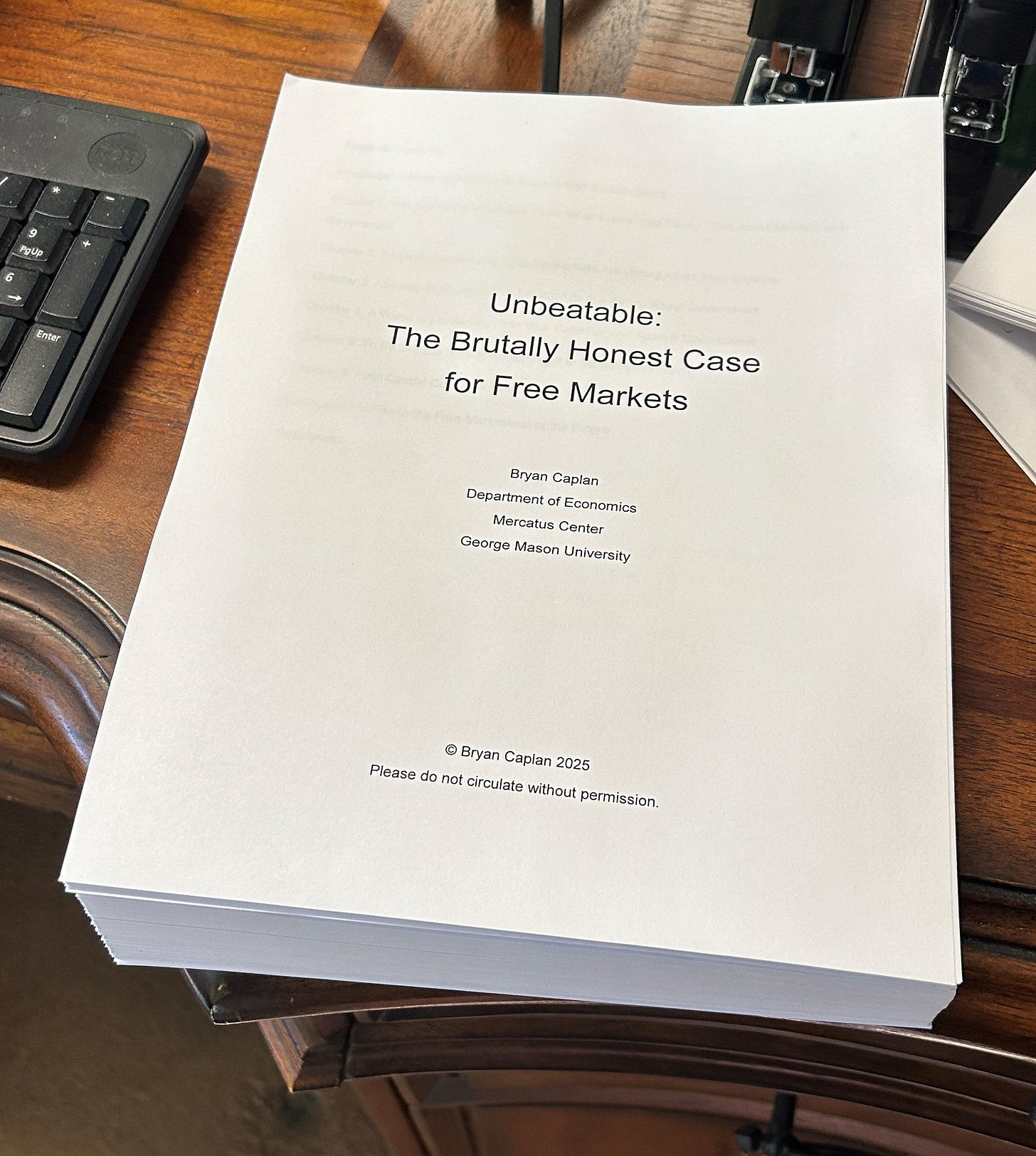
An excerpt from Chapter 3 of *Unbeatable*
Excusing the Government
Trump Admin Sues to Block Blue States From Taking Fossil Fuel Companies To Court Over Climate Change
02 May 2025 Leave a comment
in economics of bureaucracy, economics of regulation, energy economics, environmental economics, global warming, income redistribution, law and economics, politics - USA, property rights, Public Choice, rentseeking Tags: climate activists, nuisance suits
The Trump administration filed lawsuits Wednesday against Michigan and Hawaii in an attempt to block the states from seeking damages in court against fossil fuel companies for alleged environmental harm.
Trump Admin Sues to Block Blue States From Taking Fossil Fuel Companies To Court Over Climate Change
Bad advice on public sector discount rates
30 Apr 2025 Leave a comment
in applied price theory, applied welfare economics, economics of bureaucracy, politics - New Zealand, Public Choice Tags: discount rates

A couple of months ago now I wrote a post about the new set of discount rates government agencies are supposed to use in undertaking cost-benefit analysis, whether for new spending projects or for regulatory initiatives. The new, radically altered, framework had come into effect from 1 October last year, but with no publicity (except […]
Bad advice on public sector discount rates
‘Rule of Two’ medicines approval needs improving
28 Apr 2025 Leave a comment
in applied price theory, economics of bureaucracy, economics of regulation, health economics, politics - New Zealand, Public Choice Tags: drug lags
Eric Crampton writes – Come the next pandemic, we are going to be in the same stupid mess that we were in during the last one. Trusted pharmaceutical regulators overseas, like those in Australia, Canada, Europe, and the UK, will have given provisional approvals for vaccines that are safe. And Kiwis will have to wait, […]
‘Rule of Two’ medicines approval needs improving
Pandemic Preparation Without Romance
25 Apr 2025 Leave a comment
in applied price theory, applied welfare economics, comparative institutional analysis, economics of bureaucracy, economics of regulation, health economics, politics - USA, Public Choice Tags: economics of pandemics
My latest paper, Pandemic Preparation Without Romance, has just appeared at Public Choice. Abstract: The COVID-19 pandemic, despite its unprecedented scale, mirrored previous disasters in its predictable missteps in preparedness and response. Rather than blaming individual actors or assuming better leadership would have prevented disaster, I examine how standard political incentives—myopic voters, bureaucratic gridlock, and […]
Pandemic Preparation Without Romance
It shouldn’t take a Minister for common sense to prevail
23 Apr 2025 Leave a comment
in discrimination, economics of bureaucracy, gender, health economics, law and economics, liberalism, Marxist economics, politics - New Zealand, Public Choice Tags: free speech, political correctness, regressive left, sex discrimination
Radio NZ reports: The coalition has directed Health New Zealand to say “women” instead of “pregnant people” in its communications about health issues. Associate Health Minister Casey Costello wrote to interim chief executive Dr Dale Bramley on 27 March, telling the agency to use “clear language”. “Recent documents that have reached my office from the […]
It shouldn’t take a Minister for common sense to prevail
From Refineries to Fiefdoms: Is Newsom Orchestrating a State Takeover of California’s Oil Industry?
22 Apr 2025 Leave a comment
in economics of bureaucracy, economics of climate change, economics of regulation, energy economics, environmental economics, environmentalism, global warming, industrial organisation, law and economics, liberalism, Marxist economics, politics - USA, property rights, Public Choice, survivor principle Tags: California, climate activists, regressive left
California’s refining capacity is collapsing—not because demand has disappeared, but because it is being deliberately dismantled by regulatory fiat. The recent announcement that Valero Energy will idle or shutter its Benicia refinery by 2026 isn’t just a business decision. It’s the calculated result of a hostile policy environment designed to punish traditional energy producers until they either leave the state or fall into government hands.
From Refineries to Fiefdoms: Is Newsom Orchestrating a State Takeover of California’s Oil Industry?
Tax Privacy
16 Apr 2025 Leave a comment
in economics of bureaucracy, Public Choice, public economics Tags: tax privacy
In an era where many people are highly sensitive to what personal information is being collected about them, and how that information is being used, one sometimes hear the question: Why should the government have any power to know your income? In a US context, the question is often asked around April 15, when income…
Tax Privacy
Finally common sense for drug approvals
12 Apr 2025 Leave a comment
in economics of bureaucracy, economics of regulation, health economics, politics - New Zealand, Public Choice
David Seymour announced: Associate Health Minister David Seymour is welcoming Cabinet’s decision to enable medicines to be approved in less than 30 days if the product has approval from two recognised overseas jurisdictions. This change is included in the Medicines Amendment Bill (the Bill), which amends the Medicines Act 1981. The pathway will be in […]
Finally common sense for drug approvals
Good principles for RMA reform
05 Apr 2025 Leave a comment
in applied price theory, economics of bureaucracy, economics of regulation, environmental economics, law and economics, politics - New Zealand, property rights, Public Choice, regulation, rentseeking, resource economics, urban economics Tags: housing affordability, land supply
Chris Bishop and Simon Court announced principles for the RMA replacement, and they generally look very good (but not perfect). Some key aspects: The new system will be based on the economic concept of “externalities”. Effects that are borne solely by the party undertaking the activity will not be controlled by the new system (for […]
Good principles for RMA reform
Uneducated vs educated
03 Apr 2025 Leave a comment
in comparative institutional analysis, constitutional political economy, economics of bureaucracy, economics of education, economics of information, economics of media and culture, international economics, law and economics, liberalism, Marxist economics, politics, property rights, Public Choice Tags: Brexit, British politics, political psychology
Political battles historically have been framed as contests between left-wing and right-wing ideologies, with clear distinctions based on policy preferences and socio-economic class interests. However, contemporary political dynamics reveal a new axis of conflict: the division between the educated and the uneducated. This emerging distinction marks a significant departure from traditional political alignments, reshaping electoral […]
Uneducated vs educated
Public-Private-Partnerships?
02 Apr 2025 Leave a comment
in applied price theory, economic history, economics of bureaucracy, history of economic thought, industrial organisation, law and economics, managerial economics, organisational economics, politics - New Zealand, privatisation, property rights, Public Choice, public economics
New Zealand’s economic development has always been a partnership between the public and private sectors. Brian Easton writes – Public-Private-Partnerships (PPPs) have become fashionable again, partly because of the government’s ambitions to accelerate infrastructural development. There is, of course, an ideological element too, while some of the opposition to them is also ideological. PPPs […]
Public-Private-Partnerships?
Not much parliamentary scrutiny
01 Apr 2025 Leave a comment
in business cycles, econometerics, economic history, economics of bureaucracy, inflation targeting, labour economics, labour supply, macroeconomics, monetary economics, politics - New Zealand, Public Choice, unemployment Tags: economics of pandemics, monetary policy

This was the post I was planning to write this morning to mark Orr’s final day. That said, if the underlying events – deliberate attempts to mislead Parliament – were Orr’s doing, the post is more about the apparent uselessness of Parliament (specifically the Finance and Expenditure Committee) in holding him and the rest of […]
Not much parliamentary scrutiny


Recent Comments