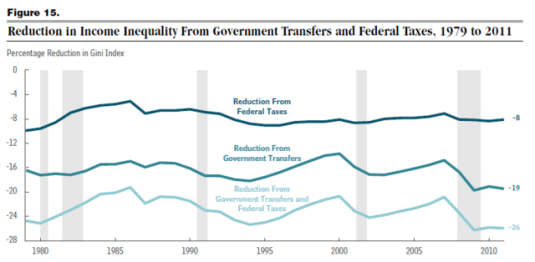
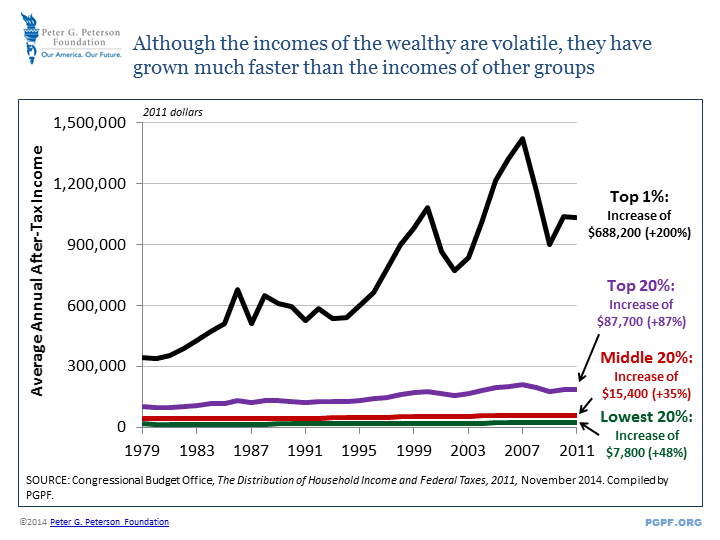
Charts showing everyone is seriously richer after-taxes

income-growth-disparity-full

Everyone is 30-50% richer.

Chart 18

Average Federal Tax Rates, by Income Group, 1979 to 2011

Microsoft PowerPoint - Group C Federal Budget (KF).pptx [Read-Only]

Ordinary Americans do not pay much in taxes.

CBO

Low income Americans receive large amounts of government transfers and increases their income by at least 50%

NY Times

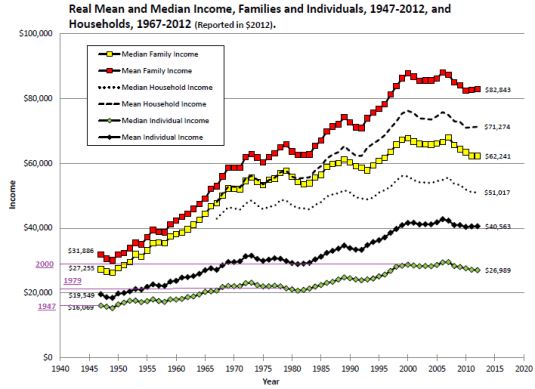
The middle-class is getting seriously smaller because more of them are getting richer

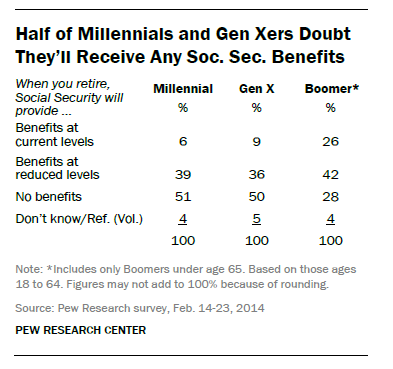
Ricardian equivalence alert: Millennials and the funding of their retirements

image

Image

The working class is missing from US political discourse

One of the things I noticed in the 2008 US presidential campaign was everyone was appealing for the middle class vote. Presidential primary and general election debates were about how things were getting harder for the middle-class and the Republican or Democratic candidate who happen to be pitching for votes would stand up for the middle-class better than their competition in the presidential primary or general election at hand.

Another big feature in the 2008 presidential campaign was Joe the plumber. This was the small businessman who asked then candidate Obama at a rope line three days before the final presidential debate about his plans to put up taxes. Obama replied he wanted to spread the wealth around. Obama’s response was

It’s not that I want to punish your success. I just want to make sure that everybody who is behind you, that they’ve got a chance at success, too… My attitude is that if the economy’s good for folks from the bottom up, it’s gonna be good for everybody.

If you’ve got a plumbing business, you’re gonna be better off… if you’ve got a whole bunch of customers who can afford to hire you, and right now everybody’s so pinched that business is bad for everybody and I think when you spread the wealth around, it’s good for everybody

Andrew Cherlin did the service counting up references to the working class in State of the Union addresses since President Obama was elected.

In his State of the Union addresses, Obama has used the term middle class 28 times. But he has never said “working class” except in 2011, when he described Vice President Biden, who was seated behind him, as “a working-class kid from Scranton.

This dearth of references to the working class is no surprise in light of Director’s Law and the median voter theorem. Politicians who do not pitch to the American middle class will not win elections unless there is a lot of expressive voting by the educated middle class. In general social surveys of Americans, 44% identify as working class and 44%  identify as middle class.

Republicans consistently win voters making $50,000 or more – the U.S. median income. The margin doesn’t vary much: In 2012, Mitt Romney got 53% of this group’s vote; in 2010, Republican House candidates got 55%.

The margin by which the Republicans win income brackets above 50,000 doesn’t vary much if you just look at those earning above $100,000 or those earning between $50,000 and $75,000. These margins only matter in a close election, a very close election.

Democrats consistently win voters making less than the median but the margin varies.  Whether the Democrats win these voters earning less than $50,000 by a 10-point or a 20-point margin tells you who won every national election for the past decade.

The Democrats would also do well among the college educated vote. Obama won this over Romney and 2012 by 10 percentage points. This may explain why the Democrats are slightly conflicting: they must win the working class vote as well as the college educated vote to win.

Andrew Cherlin didn’t give many reasons for the disappearance of working class from modern American political discourse, but he showed some insight into expressive politics when he observed that:

Politicians may prefer to call working-class families by the class position they aspire to rather than the one they hold.

Is the middle-class disappearing?

Hayek supported a guaranteed minimum income for all

Image

What does the media and Left give top athletes a pass on their membership of the top 0.1%?

Postwar vs. New Gilded Age: How did the middle class do?

Noahpinion: Postwar vs. New Gilded Age: How did the middle class do?.

Gordon Tullock on avoiding difficult decisions about saving lives – updated

Gordon Tullock wrote a 1979 New York Law Review book about avoiding difficult choices. His review was of a book by Guido Calabresi and Philip Bobbitt called Tragic Choices which was about the rationing: the allocation of kidney dialysis machines (a “good”), military service in wartime (a “bad”), and entitlements to have children (a mixed blessing).

Front Cover

Tullock argued that we make a decision about how to allocate resources, how to distribute the resources, and then how to think about the previous two choices. People do not want to face up to the fact resources are scarce and they face limits on their powers.

To reduce the personal distress of making these tragic choices, Tullock observed that people often allocate and distribute resources in a different way so as to better conceal from themselves the unhappy choices they had to make even if this means the recipients of these choices are worse off and more lives are lost than if more open and honest choices were made up about there only being so much that can be done.

The Left over Left and union movement spends a lot of time pontificating about how we must not let economics influence health and safety policy rather than help frame public policy guidance on what must be done because scarcity of resources requires the valuation of life in everything from health, safety, and environmental regulations to road building. health budgeting is full of tragic choices about how much is spend to save so lives and where and for how long.

The Left over Left and the union movement deceive themselves and others into make futile gestures to make themselves feel good. These dilettantes cannot assume that they are safely behind a veil of insignificance. They have real influence on how public policy on health and safety are made.

A major driver of the opposition among the Left over Left and the union movement to the use of cost-benefit analysis and the valuation of statistical lives is its adoption makes people confront the tragic consequence of any of the choices available to them.

By saying how dare you value a statistical life does not change the fact that choices made without this knowledge will still have tragic consequences, and more lives may be lost because people want to conceal from themselves the difficult choices that they are making about others as voters and as policy-makers.

One of the purposes of John Rawls’ veil of ignorance and Buchanan and Tullock’s veil of uncertainty is that the basic social institutions be designed and agreed when we have abstracted from the grubby particulars of our own self-interest.   Buchanan and Tullock explain the thought experiment this way

Agreement seems more likely on general rules for collective choice than on the later choices to be made within the confines of certain agreed-upon rules. …

Essential to the analysis is the presumption that the individual is uncertain as to what his own precise role will be in any one of the whole chain of later collective choices that will actually have to be made.

For this reason he is considered not to have a particular and distinguishable interest separate and apart from his fellows.

This is not to suggest that he will act contrary to own interest; but the individual will not find it advantageous to vote for rules that may promote sectional, class, or group interests because, by supposition, he is unable to predict the role that he will be playing in the actual collective decision-making process at any particular time in the future.

He cannot predict with any degree of certainty whether he is more likely to be in a winning or a losing coalition on any specific issue. Therefore, he will assume that occasionally he will be in one group and occasionally in the other.

His own self-interest will lead him to choose rules that will maximize the utility of an individual in a series of collective decisions with his own preferences on the separate issues being more or less randomly distributed.

Behind the veil of ignorance and the veil of uncertainty, we would all agree that resources are limited, including in the health sector and some drugs can’t be funded – choices must be made.

Once we go in front of the veil of ignorance and find out that we are the one missing out on that drug, naturally, our views will change.  We agreed to these rules  as fair for the distribution of basic social resources when, as John Rawls put it:

…no one knows his place in society, his class position or social status; nor does he know his fortune in the distribution of natural assets and abilities, his intelligence and strength, and the like.

Is always the case that someone just falls on the other side of any line in the sand. If you move that line, there is always another set of people who are just on the other side.

George Stigler on income redistribution policies

Robert Lucas on the defining belief of the Left over Left and the Greens

Image

Eamonn Butler on how economical with the truth Oxfam was on global inequality

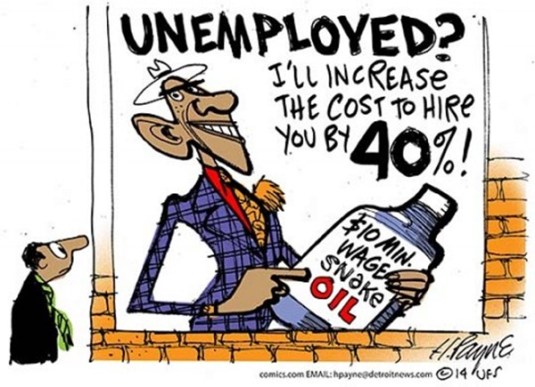
Offsetting behaviour alert: only fools and politicians would believe that a minimum wage increase increases net pay and conditions

John Schmitt  lists 11 margins along which a minimum wage might cause changes in net pay and conditions:

  1. Reduction in hours worked (because firms faced with a higher minimum wage trim back on the hours they want),
  2. Reduction in non-wage benefits (to offset the higher costs of the minimum wage),
  3. Reduction in money spent on training (again, to offset the higher costs of the minimum wage),
  4. Change in composition of the workforce (that is, hiring additional workers with middle or higher skill levels, and fewer of those minimum wage workers with lower skill levels),
  5. Higher prices (passing the cost of the higher minimum wage on to consumers),
  6. Improvements in efficient use of labour (in a model where employers are not always at the peak level of efficiency, a higher cost of labour might give them a push to be more efficient),
  7. “Efficiency wage” responses from workers (when workers are paid more, they have a greater incentive to keep their jobs, and thus may work harder and shirk less),
  8. Wage compression (minimum wage workers get more, but those above them on the wage scale may not get as much as they otherwise would),
  9. Reduction in profits (higher costs of minimum wage workers reduces profits),
  10. Increase in demand (a higher minimum wage boosts buying power in overall economy), and
  11. Reduced turnover (a higher minimum wage makes a stronger bond between employer and workers, and gives employers more reason to train and hold on to worker.
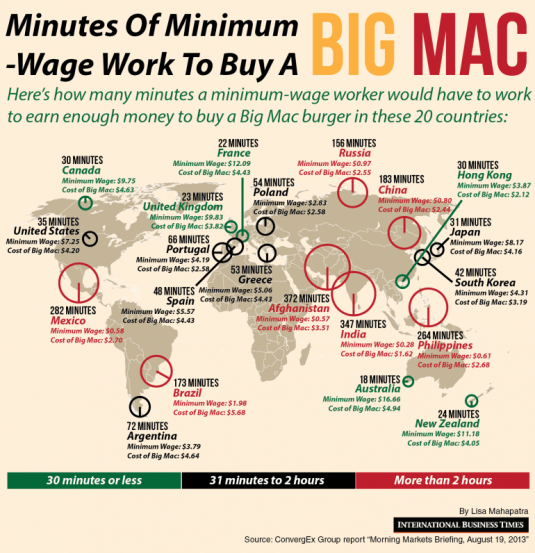
Richard McKenzie argues that the biggest impact  of a minimum wage increase is reductions to paid and unpaid benefits for minimum wage workers, including  health insurance, store discounts, free food, flexible scheduling, and job security resulting from higher-skilled workers drawn to the higher minimum wage jobs:

  • Masanori Hashimoto found that under the 1967 minimum-wage hike, workers gained 32 cents in money income but lost 41 cents per hour in training—a net loss of 9 cents an hour in full-income compensation.
  • Other researchers in independently completed studies found more evidence that a hike in the minimum wage undercuts on-the-job training and undermines covered workers’ long-term income growth.
  • Wessels found that the minimum wage caused retail establishments in New York to increase work demands by cutting back on the number of workers and giving workers fewer hours to do the same work.
  • Fleisher, Dunn, and Alpert found that minimum-wage increases lead to large reductions in fringe benefits and to worsening working conditions.
  • Marks found that workers covered by the federal minimum-wage law were also more likely to work part time, given that part-time workers can be excluded from employer-provided health insurance plans.

McKenzie also argued that if the minimum wage does not cause employers to make substantial reductions in fringe benefits and increases in work demands, then an increased minimum should cause

(1) An increase in the labour-force-participation rates of covered workers (because workers would be moving up their supply of labour curves),

(2) A reduction in the rate at which covered workers quit their jobs (because their jobs would then be more attractive), and

(3) A significant increase in prices of production processes heavily dependent on covered minimum-wage workers.

Wessels found that minimum-wage increases had exactly the opposite effect as intended: labour force participation rates went down; job quit rates went up, and prices did not rise appreciably.

These are findings by Wessels are consistent only with the view that minimum-wage increases make workers worse off, rather than better off in terms of net pay and conditions. After the minimum wage increase, the net advantages and disadvantages of menial jobs are less than before. Fewer workers enter the workforce and more quit their jobs.

McKenzie was the first economist to argue that a minimum wage increase may actually reduce the labour supply of menial workers. Employment in menial jobs may go down slightly in the face of minimum-wage increases not so much because the employers don’t want to offer the jobs, but because fewer workers want these menial jobs that are offered.

The repackaging of monetary and non-monetary benefits, greater work intensities and fewer training opportunities make these jobs less attractive relative to their other options. This reduction in labour supply by low skilled workers is why the voluntary quit rate among low-wage workers goes up, not down, after a minimum wage increase. As McKenzie explains

Economists almost uniformly argue that minimum wage laws benefit some workers at the expense of other workers.

This argument is implicitly founded on the assumption that money wages are the only form of labour compensation. Based on the more realistic assumption that labour is paid in many different ways, the analysis of this paper demonstrates that all labourers within a perfectly competitive labour market are adversely affected by minimum wages.

Although employment opportunities are reduced by such laws, affected labour markets clear. Conventional analysis of the effect of minimum wages on monopsony markets is also upset by the model developed.

McKenzie argues that not accounting for offsetting behaviour led to a fundamental misinterpretation in the empirical literature on the minimum wage. That literature shows that small increases in the minimum wages does not seem to affect employment and unemployment by that much.

…. wage income is not the only form of compensation with which employers pay their workers. Also in the mix are fringe benefits, relaxed work demands, workplace ambiance, respect, schedule flexibility, job security and hours of work.

Employers compete with one another to reduce their labour costs for unskilled workers, while unskilled workers compete for the available unskilled jobs — with an eye on the total value of the compensation package.

With a minimum-wage increase, employers will move to cut labour costs by reducing fringe benefits and increasing work demands

Proponents and opponents of minimum-wage hikes do not seem to realize that the tiny employment effects consistently found across numerous studies provide the strongest evidence available that increases in the minimum wage have been largely neutralized by cost savings on fringe benefits and increased work demands and the cost savings from the more obscure and hard-to-measure cuts in nonmoney compensation.

McKenzie is correct in arguing that the empirical literature on the minimum wage is dewy-eyed. The first assumption about any regulation is the market will offset it significantly.

In the course of undoing the direct effects of the regulation, there will be unintended consequences such as the remixing of wage and nonwage components of remuneration packages of low skilled workers covered by the minimum wage. Greg Mankiw concludes that:

The minimum wage has its greatest impact on the market for teenage labour. The equilibrium wages of teenagers are low because teenagers are among the least skilled and least experienced members of the labour force.

In addition, teenagers are often willing to accept a lower wage in exchange for on-the-job training. . . . As a result, the minimum wage is more often binding for teenagers than for other members of the labour force.

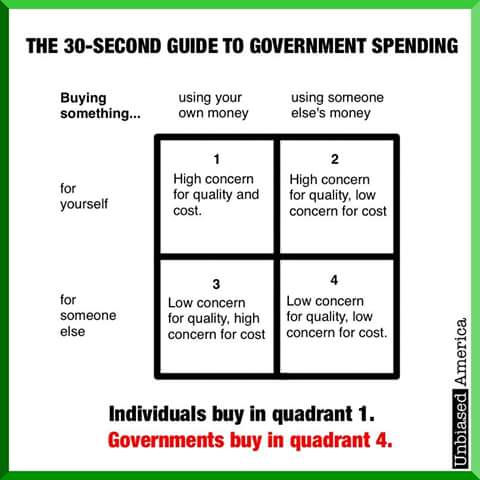
A guide to government spending

image

Image

Piketty and Capital Taxation in the 21st Century

via Capital Taxation in the 21st Century.

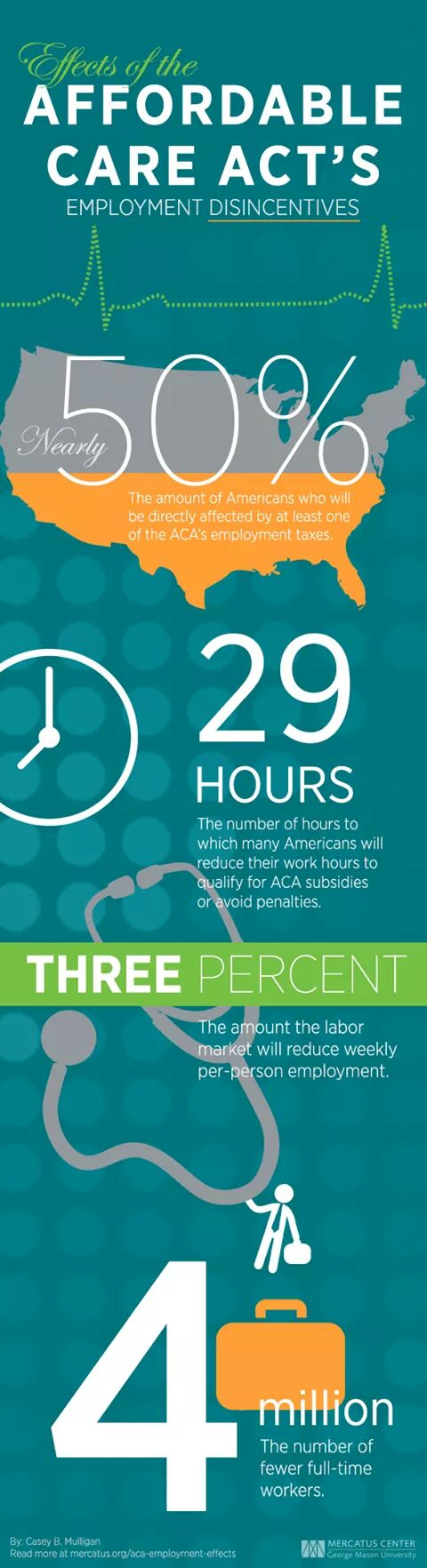
Obamacare is a bad productivity shock

image

Image

Previous Older Entries Next Newer Entries

Bassett, Brash & Hide

Celebrating humanity's flourishing through the spread of capitalism and the rule of law

Truth on the Market

Scholarly commentary on law, economics, and more

The Undercover Historian

Beatrice Cherrier's blog

Matua Kahurangi

Celebrating humanity's flourishing through the spread of capitalism and the rule of law

Temple of Sociology

Celebrating humanity's flourishing through the spread of capitalism and the rule of law

Velvet Glove, Iron Fist

Celebrating humanity's flourishing through the spread of capitalism and the rule of law

Why Evolution Is True

Why Evolution is True is a blog written by Jerry Coyne, centered on evolution and biology but also dealing with diverse topics like politics, culture, and cats.

Down to Earth Kiwi

Celebrating humanity's flourishing through the spread of capitalism and the rule of law

NoTricksZone

Celebrating humanity's flourishing through the spread of capitalism and the rule of law

Homepaddock

A rural perspective with a blue tint by Ele Ludemann

Kiwiblog

DPF's Kiwiblog - Fomenting Happy Mischief since 2003

The Dangerous Economist

Celebrating humanity's flourishing through the spread of capitalism and the rule of law

Watts Up With That?

The world's most viewed site on global warming and climate change

The Logical Place

Tim Harding's writings on rationality, informal logic and skepticism

Doc's Books

A window into Doc Freiberger's library

The Risk-Monger

Let's examine hard decisions!

Uneasy Money

Commentary on monetary policy in the spirit of R. G. Hawtrey

Barrie Saunders

Thoughts on public policy and the media

Liberty Scott

Celebrating humanity's flourishing through the spread of capitalism and the rule of law

Point of Order

Politics and the economy

James Bowden's Blog

A blog (primarily) on Canadian and Commonwealth political history and institutions

Science Matters

Reading between the lines, and underneath the hype.

Peter Winsley

Economics, and such stuff as dreams are made on

A Venerable Puzzle

"The British constitution has always been puzzling, and always will be." --Queen Elizabeth II

The Antiplanner

Celebrating humanity's flourishing through the spread of capitalism and the rule of law

Bet On It

Celebrating humanity's flourishing through the spread of capitalism and the rule of law

History of Sorts

WORLD WAR II, MUSIC, HISTORY, HOLOCAUST

Roger Pielke Jr.

Undisciplined scholar, recovering academic

Offsetting Behaviour

Celebrating humanity's flourishing through the spread of capitalism and the rule of law

JONATHAN TURLEY

Res ipsa loquitur - The thing itself speaks

Conversable Economist

In Hume’s spirit, I will attempt to serve as an ambassador from my world of economics, and help in “finding topics of conversation fit for the entertainment of rational creatures.”

The Victorian Commons

Researching the House of Commons, 1832-1868

The History of Parliament

Articles and research from the History of Parliament Trust

Books & Boots

Reflections on books and art

Legal History Miscellany

Posts on the History of Law, Crime, and Justice

Sex, Drugs and Economics

Celebrating humanity's flourishing through the spread of capitalism and the rule of law

European Royal History

Exploring the Monarchs of Europe

Tallbloke's Talkshop

Cutting edge science you can dice with

Marginal REVOLUTION

Small Steps Toward A Much Better World

NOT A LOT OF PEOPLE KNOW THAT

“We do not believe any group of men adequate enough or wise enough to operate without scrutiny or without criticism. We know that the only way to avoid error is to detect it, that the only way to detect it is to be free to inquire. We know that in secrecy error undetected will flourish and subvert”. - J Robert Oppenheimer.

STOP THESE THINGS

The truth about the great wind power fraud - we're not here to debate the wind industry, we're here to destroy it.

Lindsay Mitchell

Celebrating humanity's flourishing through the spread of capitalism and the rule of law

Alt-M

Celebrating humanity's flourishing through the spread of capitalism and the rule of law

croaking cassandra

Economics, public policy, monetary policy, financial regulation, with a New Zealand perspective

The Grumpy Economist

Celebrating humanity's flourishing through the spread of capitalism and the rule of law

International Liberty

Restraining Government in America and Around the World