Tax summary: here's another honest/informative version of @hmtreasury chart by @StrongerInNos that explains "welfare" http://t.co/SeH9FJIRWq—
Jonathan Portes (@jdportes) November 02, 2014
Taxpayers in every country should get one of these charts
29 Apr 2015 Leave a comment
in income redistribution, politics - Australia, politics - New Zealand, politics - USA, Public Choice, public economics, rentseeking Tags: public sector transparency
UKIP are a bunch of fellow travellers
27 Apr 2015 Leave a comment
in applied welfare economics, constitutional political economy, income redistribution, Public Choice, rentseeking Tags: British election, expressive voting, rational ignorance, rational irrationality, UK politics, UKIP
Should we redistribute money from rich to poor? What voters of each party said. blogs.lse.ac.uk/generalelectio… http://t.co/aqc8yO3OYE—
Martin Hickman (@martin_hickman) April 26, 2015
In another neo-liberal victory, health and welfare spending shares have doubled in the last 50 years
24 Apr 2015 Leave a comment
in income redistribution, politics - USA, Public Choice, public economics Tags: Director's Law, Leftover Left, median voter theorem, neoliberalism, tax reform, welfare state
Median income by race in America
23 Apr 2015 Leave a comment
in discrimination, income redistribution, labour economics, poverty and inequality Tags: racial discrimination, wage gaps

The UK Greens tax and spending plans
22 Apr 2015 Leave a comment
in income redistribution, Public Choice, public economics Tags: British general election, expressive voting, rational ignorance, rational irrationality, Uk Greens, UK politics

The social cost of high company tax rates is just too high
22 Apr 2015 Leave a comment
in economic growth, fiscal policy, human capital, income redistribution, labour economics, macroeconomics, Public Choice Tags: company tax rate, entrepreneurial alertness, tax reform
Still further evidence of the rise and rise of the working rich
21 Apr 2015 Leave a comment
in applied price theory, entrepreneurship, income redistribution, industrial organisation, survivor principle Tags: capitalism and freedom, entrepreneurial alertness, The Great Enrichment, top 1%, working rich
Be careful for what you wish for when you call for moderation and bipartisanship in politics
20 Apr 2015 Leave a comment
in economic history, income redistribution, politics - USA, Public Choice, rentseeking Tags: bipartisanship, expressive voting, growth in government, ideology, median voter theorem, political polarisation, rational irrationality
Lessons for New Zealand from Bob Hawke’s promise that no child need live in poverty by 1990
15 Apr 2015 Leave a comment
in income redistribution, politics - Australia, politics - New Zealand, poverty and inequality
A local doctor thinks we can abolish child poverty in New Zealand with $1 billion in increases to welfare benefits and family allowances.
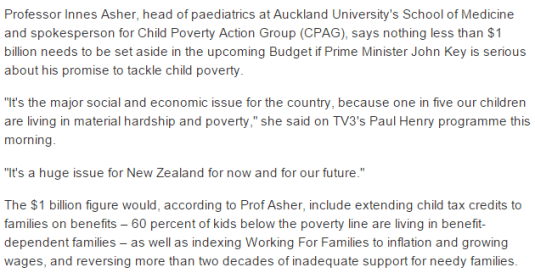
During the 1987 Australian Federal election campaign, Labour Party Prime Minister Bob Hawke announced a Family Allowance Supplement that would ensure no Australian child need live in poverty by 1990.
Child poverty was to be no more in Australia by 1990. These changes in social welfare benefits and family allowance supplements would ensure that every family would be paid one per week dollar more than the poverty threshold applicable to their family situation. I know child poverty was to be done in this way because I worked in the Prime Minister’s Department at this time.

Bob Hawke was not a man for admitting error, most certainly was not, but he admitted that this promise was his greatest error – his pledge that no child will need live in poverty by 1990:
It was a silly shorthand thing,” Mr Hawke has told News Limited newspapers. “I should have just said what was in the distributed speech.” “We set ourselves this first goal: by 1990 no Australian child will be living in poverty,” Mr Hawke said on June 23, 1987 at an election campaign launch. The comment entered Australian political folklore after it was supposed to improve the ALP’s major social welfare reform. The printed version had it as: “By 1990 no Australian child need live in poverty.” Mr Hawke’s words returned to haunt him as his pledge was impossible to keep.
About 580,000 Australian children lived in poverty in 1987. In 2007, at least 13 per cent of children, or 730,000 people, were poor. This was after social welfare benefits and family allowance supplements were increased to $1 above the child poverty threshold.
There is an infallible test of the practicality of Left over Left dreams such as the abolition of child poverty by writing bigger and bigger cheques to those currently poor.
If you could abolish child poverty simply by increasing welfare benefits and family allowances, the centre-right parties would be all over it like flies to the proverbial as a way of camping over the middle ground and winning the votes of socially conscious swinging voters for decades to come. Many people who would naturally vote for the centre-right parties on all other issues vote over to centre-left parties out of a concern for poverty and a belief that centre-left parties will give a better deal to the poor.
Countries all round the world have attempted to buy their way out of poverty by lifting welfare benefits and family allowance rates with no success. Simon Chapple is also quite clear that social welfare benefits reduce the incentive to work.
The payment of welfare benefits to families who do not work creates a number of potential issues. Firstly, as it guarantees an income to people not in paid employment, including those with children, it creates incentives not to work. While theoretically indisputable, much debate surrounds how large this effect is in practice, and how best to offset it.
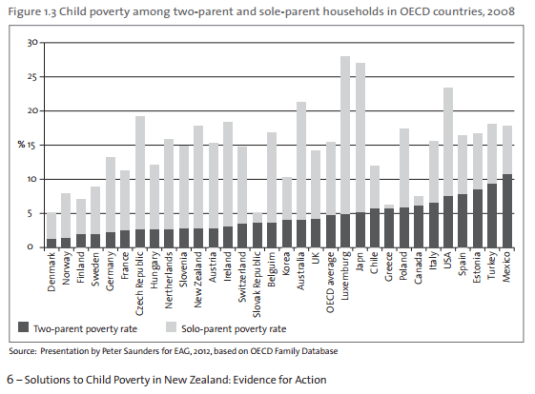
There is child poverty in northern European and Scandinavia despite the most generous possible welfare states. Most of this child poverty is among single parent families in all industrialised countries.
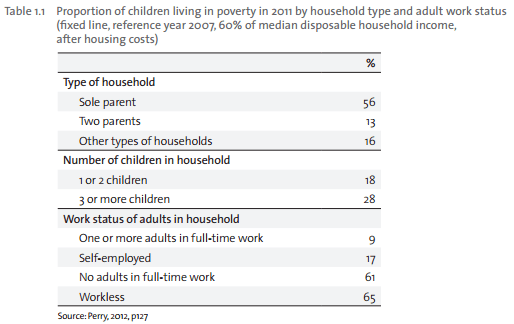
Around 60 percent of New Zealand children in poverty are in social welfare beneficiary households, and most of these are sole-parent households.

Child poverty rates are lower in the Nordic states but the Nordic states expectation that mothers will return to the workforce rapidly – when their child is 1 to 3 years old. Employment is front and centre in the Nordic welfare state strategy to reduce child poverty.

The notion that poverty is simply the result of a lack of money and giving people more money will abolish child poverty has never worked. As the OECD (2009, p. 171) observed:
It would be naïve to promote increasing the family income for children through the tax-transfer system as a cure-all to problems of child well-being.
The only major success in reducing beneficiary numbers anywhere has been time limits in the USA in 1996. Time limits on welfare for single parents reduced caseloads by two thirds, 90% in some states.

After the 1996 US Federal welfare reforms, the subsequent declines in welfare participation rates and gains in employment were largest among the single mothers previously thought to be most disadvantaged: young (ages 18-29), mothers with children aged under seven, high school drop-outs, and black and Hispanic mothers. These low-skilled single mothers were thought to face the greatest barriers to employment. Blank (2002) found that:
…nobody of any political persuasion predicted or would have believed possible the magnitude of change that occurred in the behaviour of low-income single-parent families.
Employment are never married mothers increased by 50% after the US well for a reforms: employment a single mothers with less than a high school education increased by two thirds: employment on-going single mothers string ages of 18 in 24 approximately doubled. With the enactment of welfare reform in 1996, black child poverty fell by more than a quarter to 30% in 2001. Over a six-year period after welfare reform, 1.2 million black children were lifted out of poverty. In 2001, despite a recession, the poverty rate for black children was at the lowest point in national history.
This great success of US welfare reforms was after a quarter of six century of no progress, poverty among single mothers and among black children declined dramatically.
The best solution to child poverty is to move their parents into a job. Simon Chapple is also quite clear in his book last year with Jonathan Boston that a sole parent in full-time work, and a two parent family with one earner with one full-time and one part-time worker, even at low wages, will earn enough to lift their children above most poverty thresholds. Welfare benefits trap children in poverty.
Sustained full-time employment of sole parents and the fulltime and part-time employment of two parents, even at low wages, are sufficient to pull the majority of children above most poverty lines, given the various existing tax credits and family supports.
The best available analysis, the most credible analysis, the most independent analysis in New Zealand or anywhere else in the world that having a job and marrying the father of your child is the secret to the leaving poverty is recently by the Living Wage movement in New Zealand.
According to the calculations of the Living Wage movement, earning only $19.25 per hour with a second earner working only 20 hours affords their two children, including a teenager, Sky TV, pets, international travel, video games and 10 hours childcare. This analysis of the Living Wage movement shows that finishing school so your job pays something reasonable and marrying the father of your child affords a comfortable family life.
Robert Lucas on the irrelevance of income redistribution to the Great Enrichment
15 Apr 2015 Leave a comment

The Scottish National Party manifesto
15 Apr 2015 Leave a comment
in income redistribution, Public Choice, rentseeking Tags: British general election, British politics, Scotland, Scottish National party
SNP manifesto. #PrivateEye http://t.co/oD3iuyajBl—
Wire Spy (@wirespyuk) April 02, 2015
Hillary is running as some sort of class war warrior against the big end of town
14 Apr 2015 Leave a comment
in income redistribution, politics - USA, Public Choice, rentseeking Tags: 2016 presidential election, campaign finance report form, expressive voting, Hillary Clinton, median voter theorem, rational ignorance, rational irrationality, special interests
Top 20 Hillary Clinton campaign contributors, 1999-2014, in case you were wondering. http://t.co/c8KTOkJ30X—
Downtown Josh Brown (@ReformedBroker) April 14, 2015
The NZ Greens want to introduce food stamps, but only for part of the year?!
12 Apr 2015 Leave a comment
in income redistribution, politics - New Zealand, politics - USA, poverty and inequality, Public Choice Tags: expressive voting, food stamps, Left-wing hypocrisy, rational ignorance, rational irrationality, school breakfast programs, soup kitchens, welfare reform, welfare state
The welfare state has a long history of providing some of its support to the needy in kind rather than in cash. This can range from soup kitchens to public housing as well as food stamps.

In the USA, food stamps provide provide food-purchasing assistance for low- and no-income people living. Food stamps can only be exchanged for food.

Instead of requiring the poor and needy to attend a soup kitchen, they can be given vouchers to buy food at supermarkets and take it home and cook at themselves. These days some sort of debit card system can be used where purchases are restricted to food at supermarkets and other participating retailers.
A close parallel with food stamps, properly understood, is free school breakfast programs. The welfare state is providing in-kind support to hungry children. This is done at school, to ensure that the children eat the meals.
Rather than rely on their parents to spend their welfare benefits and income support on food for their children, the food is given directly to the children when they arrive at school in the morning. In New Zealand, these free school breakfast programs are restricted to schools in low income areas.
There is a Feed the Kids Bill in Parliament sponsored by the Green Party. I have frequently criticised this proposal as it doesn’t provide breakfast to needy children at the weekends and school holidays. They are left to go hungry. Abandoned by their so called social justice champions through lack of imagination and self-awareness.
If children are showing up at school without their breakfast on a regular basis, their parents should reported that the child protection authorities for intervention. This can start with budget advice and assistance with applying for any additional and emergency financial support they are eligible for from Work and Income New Zealand.
 Soup kitchens not only provides people with food, it provides various other assistance to help people to get back on their feet.
If you were proposing a food stamps program in New Zealand because children are going hungry, you’ll be laughed at if you suggested it should only apply the part of the year such as during the school term.
That is precisely what the Greens are doing. The only difference is how they are organised the provision of in-kind support to children, this case, food. Instead of their parents collecting a debit card that can only be used to buy food, the food is eaten by their children at school.
A Guaranteed Minimum Income for New Zealand? The Treasury costings
12 Apr 2015 Leave a comment
in income redistribution, politics - New Zealand, politics - USA, welfare reform
The Treasury modelled a Guaranteed Minimum income (GMI) at the request of the Welfare Working Group in 2010. A GMI paying $300 per week – the mean benefit income among those on benefits – would cost $44.5 billion (model 1) or $52.6 billion if we extended it to super annuitants as a replacement for NZ Superannuation or old age pension (model 2). The former could be covered by a flat personal income tax rate of 45.4%; the latter, 48.6%.
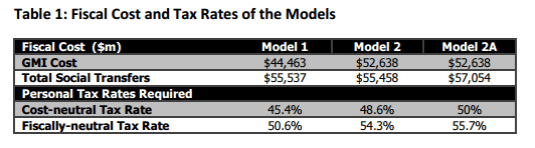
Full fiscal neutrality would require tax rates of 50.6% and 54.4% – the lower tax rates would be just enough to cover the transfers, but income tax revenues are currently also used to fund more than just transfers.
If we recognize that most parents are beneficiaries via Working for Families and compensate them for their loss with a $86 per child per week payment (model 3), we get a $57.1 billion fiscal cost and a personal tax rate of 50% (or 55.7% for fiscal neutrality).
Treasury noted that many beneficiaries (including the disabled, carers and sole parents) currently receive more than $300 per week and would be made financially worse off under a GMI scheme.
Treasury also warned about potential adverse labour supply responses to the necessary higher personal income tax rates. The large gap between company and personal tax rates would increase IRD’s enforcement costs.
In 1987, Finance Minister Roger Douglas announced a Guaranteed Minimum Family Income Scheme to accompany a new 22% flat income tax. The idea did not go ahead.
Richard Nixon also proposed a guaranteed minimum family income plan in 1969 to replace the Aid to Families with Dependent Children (AIDC) scheme at the behest of future Senator Daniel Patrick Moynihan. This was based on the negative income tax proposals of Milton Friedman and George Stigler. Nixon’s plan passed the House but not the Senate after 3 years of infighting.
The final outcome was the earned income tax credit (EITC) in 1975 that was expanded significantly in the 1990s to become the largest single federal income transfer programme. One attraction of the EITC is that because its benefits rise positively with earnings up to the phase-out point, so it can have a positive rather than negative effect on work incentives for workers on a low wage.


Recent Comments