#Dailychart: Where is adultery more morally unacceptable? econ.st/1hUVpUZ http://t.co/elRloS0Bif—
The Economist (@ECONdailycharts) April 16, 2014
The effectiveness of environmentalists in mobilising public opinion
03 May 2015 Leave a comment
in environmental economics, environmentalism, global warming, politics - USA, Public Choice Tags: activists, expressive voting, green voters, rational ignorance, rational irrationality, voter demographics
Swedosclerosis and the British disease compared, 1950–2013
03 May 2015 2 Comments
in economic growth, economic history, entrepreneurship, macroeconomics, Public Choice, public economics Tags: British disease, British economy, Margaret Thatcher, poor man of Europe, Sweden, Swedosclerosis, taxation and the labour supply, welfare state
In 1970, Sweden was labelled as the closest thing we could get to Utopia. Both the welfare state and rapid economic growth – twice as fast as the USA for the previous 100 years.
Of course the welfare state was more of a recent invention. Assar Lindbeck has shown time and again in the Journal of Economic Literature and elsewhere that Sweden became a rich country before its highly generous welfare-state arrangements were created
Sweden moved toward a welfare state in the 1960s, when government spending was about equal to that in the United States – less that 30% of GDP.
Sweden could afford to expand its welfare state at the end of the era that Lindbeck labelled ‘the period of decentralization and small government’. Swedes in the 60s had the third-highest OECD per capita income, almost equal to the USA in the late 1960s, but higher levels of income inequality than the USA.
By the late 1980s, Swedish government spending had grown from 30% of gross domestic product to more than 60% of GDP. Swedish marginal income tax rates hit 65-75% for most full-time employees as compared to about 40% in 1960. What happened to the the Swedish economic miracle when the welfare state arrived?
In the 1950s, Britain was also growing quickly, so much so that the Prime Minister of the time campaigned on the slogan you never had it so good.

By the 1970s, and two spells of labour governments, Britain was the sick man of Europe culminating with the Winter of Discontent of 1978–1979. What happened?

Sweden and Britain in the mid-20th century are classic examples of Director’s Law of Public Expenditure. Once a country becomes rich because of capitalism, politicians look for ways to redistribute more of this new found wealth. What actually happened to the Swedish and British growth performance since 1950 relative to the USA as the welfare state grew?
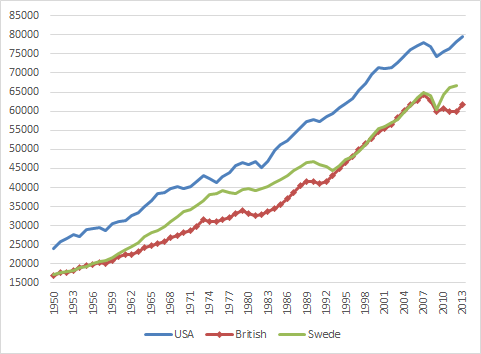
Figure 1: Real GDP per Swede, British and American aged 15-64, converted to 2013 price level with updated 2005 EKS purchasing power parities, 1950-2013, $US
Source: Computed from OECD Stat Extract and The Conference Board, Total Database, January 2014, http://www.conference-board.org/economics
Figure 1 is not all that informative other than to show that there is a period of time in which Sweden was catching up with the USA quite rapidly in the 1960s. That then stopped in the 1970s to the late 1980s. The rise of the Swedish welfare state managed to turn Sweden into the country that was catching up to be as rich as the USA to a country that was becoming as poor as Britain.
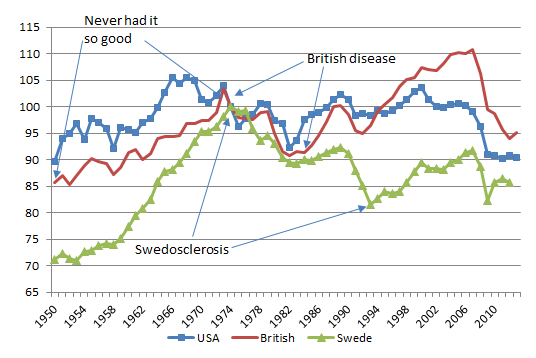
Figure 2: Real GDP per Swede, British and American aged 15-64, converted to 2013 price level with updated 2005 EKS purchasing power parities, detrended, 1.9%, 1950-2013
Source: Computed from OECD Stat Extract and The Conference Board, Total Database, January 2014, http://www.conference-board.org/economics
Figure 2 which detrends British and Swedish growth since 1950 by 1.9% is much more informative. The US is included as the measure of the global technological frontier growing at trend rate of 1.9% in the 20th century. A flat line indicates growth at 1.9% for that year. A rising line in figure 2 means above-trend growth; a falling line means below trend growth for that year. Figure 2 shows the USA growing more or less steadily for the entire post-war period. There were occasional ups and downs with no enduring departures from trend growth 1.9% until the onset of Obamanomics.
Figure 2 illustrates the volatility of Swedish post-war growth. There was rapid growth up until 1970 as the Swedes converged on the living standards of Americans. This growth dividend was then completely dissipated.
Swedosclerosis set in with a cumulative 20% drop against trend growth. The Swedish economy was in something of a depression between 1970 and 1990. Swedish economists named the subsequent economic stagnation Swedosclerosis:
- Economic growth slowed to a crawl in the 1970s and 1980s.
- Sweden dropped from near the top spot in the OECD rankings to 18th by 1998 – a drop from 120% to 90% of the OECD average inside three decades.
- 65% of the electorate receive (nearly) all their income from the public sector—either as employees of government agencies (excluding government corporations and public utilities) or by living off transfer payments.
- No net private sector job creation since the 1950s, by some estimates!
Prescott’s definition of a depression is when the economy is significantly below trend, the economy is in a depression. A great depression is a depression that is deep, rapid and enduring:
- There is at least one year in which output per working age person is at least 20 percent below trend; and
- there is at least one year in the first decade of the great depression in which output per working age person is at least 15 percent below trend; and
-
There is no significant recovery during the period in the sense that there is no subperiod of a decade or longer in which the growth of output per working age person returns to rates of 2 percent or better.
The Swedish economy was not in a great depression between 1970 and 1990 but it meets some of the criteria for a depression but for the period of trend growth between1980 and 1986.
Between 1970 and 1980, output per working age Swede fell to 10% below trend. This happened again in the late 80s to the mid-90s to take Sweden 20% below trend over a period of 25 years.
Some of this lost ground was recovered after 1990 after tax and other reforms were implemented by a right-wing government. The Swedish economic reforms from after 1990 economic crisis and depression are an example of a political system converging onto more efficient modes of income redistribution as the deadweight losses of taxes on working and investing and subsidies for not working both grew.
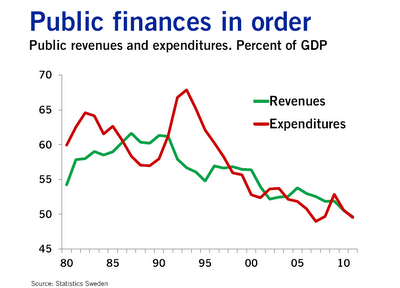
The Swedish economy since 1950 experienced three quite distinct phases with clear structural breaks because of productivity shocks. There was rapid growth up until 1970; 20 years of decline – Swedosclerosis; then a rebound again under more liberal economic policies.
The sick man of Europe actually did better than Sweden over the decades since 1970. The British disease resulted in a 10% drop in output relative to trend in the 1970s, which counts as a depression.

There was then a strong recovery through the early-1980s with above trend growth from the early 1980s until 2006 with one recession in between in 1990. So much for the curse of Thatchernomics?
After falling behind for most of the post-war period, the UK had a better performance compared with other leading countries after the 1970s.
This continues to be true even when we include the Great Recession years post-2008. Part of this improvement was in the jobs market (that is, more people in work as a proportion of the working-age population), but another important aspect was improvements in productivity…
Contrary to what many commentators have been writing, UK performance since 1979 is still impressive even taking the crisis into consideration. Indeed, the increase in unemployment has been far more modest than we would have expected. The supply-side reforms were not an illusion.
John van Reenen goes on to explain what these supply-side reforms were:
These include increases in product-market competition through the withdrawal of industrial subsidies, a movement to effective competition in many privatised sectors with independent regulators, a strengthening of competition policy and our membership of the EU’s internal market.
There were also increases in labour-market flexibility through improving job search for those on benefits, reducing replacement rates, increasing in-work benefits and restricting union power.
And there was a sustained expansion of the higher-education system: the share of working-age adults with a university degree rose from 5% in 1980 to 14% in 1996 and 31% in 2011, a faster increase than in France, Germany or the US. The combination of these policies helped the UK to bridge the GDP-per-capita gap with other leading nations.
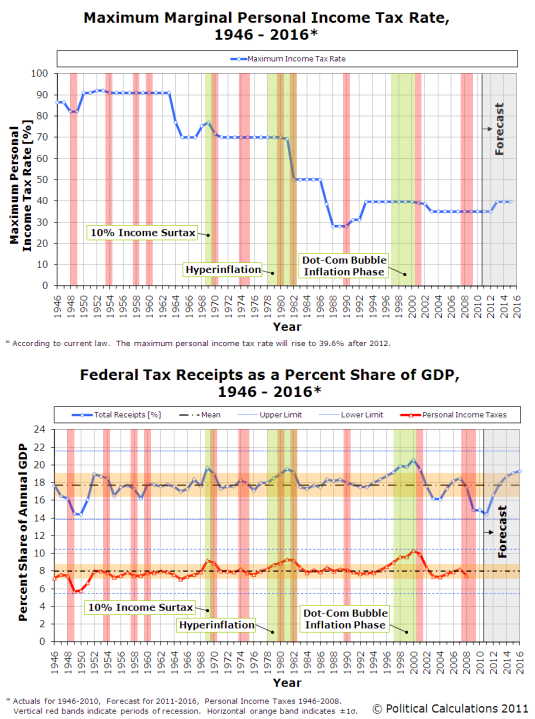
Hauser’s Law: No matter what post-war tax rates have been, tax revenues remained at about 19.5% of GDP in the USA
01 May 2015 Leave a comment
in politics - USA, Public Choice, public economics Tags: Director's Law, laffer curve
The pretence to knowledge has a supply and a demand
01 May 2015 Leave a comment
in applied price theory, Austrian economics, F.A. Hayek, labour supply, occupational choice, Public Choice, rentseeking Tags: consultants, rent seeking, The pretence to knowledge
The life of an economist. http://t.co/gvBLa9Tk3h—
Justin Wolfers (@JustinWolfers) March 02, 2015
In yet another victory for the top 1% and neoliberalism, they pay most of of the income tax in the USA
30 Apr 2015 Leave a comment
in entrepreneurship, income redistribution, Public Choice, public economics Tags: capital of freedom, entrepreneurial alertness, neoliberalism, top 1%
Democrat voters are turning against the idea of lower prices for ordinary families
29 Apr 2015 Leave a comment
in applied price theory, applied welfare economics, international economics, politics - USA, Public Choice, rentseeking Tags: antiforeign bias, expressive voting, rational ignorance, rational irrationality, voter demographics
As America inches towards a big trade deal with Asia, Obama faces a showdown with his party econ.st/1JJMJAE http://t.co/6qmt9GegWF—
The Economist (@EconBizFin) April 27, 2015
Most accurate attack ad ever from 1933
29 Apr 2015 Leave a comment
Prescient 1932 Hindenburg campaign poster showing Commies as Moscow stooges & Nazis as aspiring mass murderers. Yup. http://t.co/5IIYsaYwDy—
Mark Tooley (@markdtooley) April 28, 2015
Taxpayers in every country should get one of these charts
29 Apr 2015 Leave a comment
in income redistribution, politics - Australia, politics - New Zealand, politics - USA, Public Choice, public economics, rentseeking Tags: public sector transparency
Tax summary: here's another honest/informative version of @hmtreasury chart by @StrongerInNos that explains "welfare" http://t.co/SeH9FJIRWq—
Jonathan Portes (@jdportes) November 02, 2014
In another neoliberal victory, income taxes became more progressive in recent decades
28 Apr 2015 Leave a comment
in economic history, politics - USA, Public Choice, public economics Tags: conspiracy theories, Leftover Left, neoliberalism, taxation in the labour supply, top 1%
How much does each income group pay in taxes? bit.ly/1JHSCik by @aplundeen http://t.co/B66ynsUrkc—
Tax Foundation (@taxfoundation) April 14, 2015
The U.S. Income Tax system is progressive bit.ly/1FG9Usm by @aplundeen http://t.co/HXDWbvv1xy—
Tax Foundation (@taxfoundation) April 15, 2015
UKIP are a bunch of fellow travellers
27 Apr 2015 Leave a comment
in applied welfare economics, constitutional political economy, income redistribution, Public Choice, rentseeking Tags: British election, expressive voting, rational ignorance, rational irrationality, UK politics, UKIP
Should we redistribute money from rich to poor? What voters of each party said. blogs.lse.ac.uk/generalelectio… http://t.co/aqc8yO3OYE—
Martin Hickman (@martin_hickman) April 26, 2015
Murphy’s Law of Economic Policy
26 Apr 2015 Leave a comment
in applied price theory, applied welfare economics, comparative institutional analysis, constitutional political economy, economic history, economics of bureaucracy, Public Choice, rentseeking Tags: Alan Blinder, evidence-based policy, expressive politics, free trade, protectionism, rational ignorance, rational irrationality, rent seeking
Greg Mankiw on one of the few things economists agree on: free trade. That's the problem. nyti.ms/1GrLisQ http://t.co/WrLuP3oBSW—
The Upshot (@UpshotNYT) April 25, 2015
The role of the courts in end of life choices for the terminally ill
26 Apr 2015 Leave a comment
in comparative institutional analysis, constitutional political economy, law and economics, politics - New Zealand, Public Choice Tags: assisted dying, assisted suicide, euthanasia, Justice Scalia
Lindsay Mitchell has a nice summary of the latest developments on an application to the High Court of New Zealand by a terminally ill patient for a declaration that her assisted suicide would not be unlawful and subject to the criminal law. This application currently before the court is specific to that individual and is crafted to claim that it will set no general precedent.
I’m with Justice Scalia when he argues that fundamental issues such as these should be decided by parliaments. As he says regarding general social change:
The virtue of a democratic system [with a constitutionally guaranteed right to free speech] is that it readily enables the people, over time, to be persuaded that what they took for granted is not so and to change their laws accordingly.
The amount of social change in the mid to late 20th century has been stunning. Yes, assisted dying years a passionate issue and some people are impatient, but again I believe Justice Scalia is right when he said:
We might have let the People decide. But that the majority will not do. Some will rejoice in today’s decision, and some will despair at it; that is the nature of a controversy that matters so much to so many. But the Court has cheated both sides, robbing the winners of an honest victory, and the losers of the peace that comes from a fair defeat. We owed both of them better. I dissent.
That importance of a fair defeat at the ballot box and in Parliament is important both to when and if a bill on end of life choice is passed, and to how quickly support opposition to that bill will be mobilised before such a bill even is put into the Parliamentary ballot of private member’s bills.
Nothing stirs up the impassioned (and most other people as well) more than depriving them of their right to support or oppose what is important to them through political campaigns and at an election. The losing side, we all end up on the losing side at one time or another, are much more likely to accept an outcome if they had their say and simply lost the vote at the election or in Parliament.

A decision by the High Court authorising assisted dying in some way does not offer the peace of a fair defeat where the votes are added up where your vote counted as much as mine and one side or the other lost as must always be in a democracy. That’s how majority rule works.
The last bill before the New Zealand Parliament to allow a death with dignity through an assisted suicide for the terminally ill was in 2003 and it failed by three votes: 60 votes to 57 votes.
It is not the role of the courts to hurry up the marshalling of those extra few votes to change the law to judicial action and dispensation. Again, when Scalia dissented on a parental rights case:
I have no reason to believe that federal judges will be better at this than state legislatures; and state legislatures have the great advantages of doing harm in a more circumscribed area, of being able to correct their mistakes in a flash, and of being removable by the people
As Justice Scalia explains, the purpose of the law is to slow the impassioned majority down, not speeding it up:
Judges are sometimes called upon to be courageous, because they must sometimes stand up to what is generally supreme in a democracy: the popular will.
Their most significant roles, in our system, are to protect the individual criminal defendant against the occasional excesses of that popular will, and to preserve the checks and balances within our constitutional system that are precisely designed to inhibit swift and complete accomplishment of that popular will.
Those are tasks which, properly performed, may earn widespread respect and admiration in the long run, but — almost by definition — never in the particular case.
The intervention in a court to grant that right before Parliament is willing to act will only mobilise opposition to any future private member’s bill because they have been denied the right to oppose it through normal democratic means. What are those normal democratic means? Scalia explains when discussing the right to an abortion:
The States may, if they wish, permit abortion on demand, but the Constitution does not require them to do so. The permissibility of abortion, and the limitations upon it, are to be resolved like most important questions in our democracy: by citizens trying to persuade one another and then voting.
Assisted suicide has had popular support for many decades in New Zealand. The reason political parties do not act is those who are against assisted suicide are passionately against it and will change their vote because of such a bill. Those who are for assisted suicide are unlikely to change their vote if a bill is not passed by Parliament.
 For these reasons regarding strong passionate minority opposition and weak majority support, the Labour Party’s new leader pressured a member of his caucus to withdraw a private member’s bill on end of life choice.
Similarly, the Green Party showed equal political cowardice in this matter. They don’t regard a death with dignity to be a priority for them, despite their alleged social liberalism and a willingness to champion the right to abortion in the most recent general election in 2014, which is a socially contentious issue.

The reason is a private member’s bill on abortion in New Zealand won’t get anywhere because the current compromise works – a point to which I shall return. A private member’s bill on end of life choice sponsored by a Green MP would attract too much political flak for the Green Party to handle.
The law has long acted to prevent, by force if necessary, suicide – including suicide by refusing to take appropriate measures necessary to preserve one’s life after the point at which life become unbearable. Justice Scalia argued that:
I believe in liberal democracy, which is a democracy that worries about the tyranny of the majority, but it is the majority itself that must draw the lines.
Whether the patient’s wishes to be honoured in this area is left to elected representatives to legislate. Justice Scalia asks
Are there, then, no reasonable and humane limits that ought not to be exceeded in requiring an individual to preserve his own life? There obviously are, but they are not set forth in the Due Process Clause.
What assures us that those limits will not be exceeded is the same constitutional guarantee that is the source of most of our protection – what protects us, for example, from being assessed a tax of 100% of our income above the subsistence level, from being forbidden to drive cars, or from being required to send our children to school for 10 hours a day, none of which horribles is categorically prohibited by the Constitution.
Our salvation is the Equal Protection Clause, which requires the democratic majority to accept for themselves and their loved ones what they impose on you and me.
The biggest threat to an End of Life Choice bill passing the New Zealand Parliament is judicial intervention in this charged social issue that will only mobilises the opponents of the very right the applicants to the court seek. Scalia again this time on the risks of the courts moving in advance of the popular will, and thereby poisoning the democratic process:
Leaving this matter to the political process is not only legally correct, it is pragmatically so. That alone… can produce compromises satisfying a sufficient mass of the electorate that this deeply felt issue will cease distorting the remainder of our democratic process.
As an example of the importance of democratic compromises in securing the votes in Parliament, there is a voluntary euthanasia bill currently before the Scottish Parliament. It has been stuck in committee for two years because it not only promises end of life choice, it also grants a right of euthanasia to those with progressive degenerative diseases.
By overreaching to progressive degenerative diseases, this Bill in the Scottish Parliament is bogged down because euthanasia as distinct from a death with dignity is a step too far from many members of Parliament willing to support end of life choice for the terminally ill such as provided for in the House of Lords Private Member’s Bill on end of life choice.

Any private member’s bill that does pass the New Zealand Parliament on end of life choice will be riddled with compromises and will have a genuine concern to prevent abuse and guard against questionable decisions made when judgements of the terminally ill is clouded in some way. No court in a single judgement can provide all those details and compromises.

The law attracts more than its share of reformers wanting to use the courts and judge-made law for political purposes. If you want to reform the world, do what we ordinary people have to do: change your vote, write to an MP, protest, donate to or even join a political party, or run for parliament.
The great strength of democracy is a small group of concerned and thoughtful citizens can band together and change things by mounting single issue campaigns or joining a political party and running for office and winning elections or influencing who wins.
Indeed, it is that very strength of democracy – small groups of concerned citizens banding together – is what is holding up legislating on an end of life choice. It is not that minorities are powerless and individuals are voiceless. Exactly the opposite.
Many people have passionate opinions for and against an End of Life Choice Bill. These opinions are taken into account by members of Parliament in fine detail depending on how voters will vote at the next election.
What can be undemocratic about members of Parliament paying attention to how a wide range of ordinary members of the community might vote if they disappoint them.
The key safeguard of minorities against the majority is their ability to block vote. Yes, those in the majority will be annoyed at the power of the minority to slow down the passage of a End of Life Choices Bill.
Yet on some other matter passionate to them those currently in the majority will one day or another end up in a minority. The rotation of power is common in democracies, and the worst rise to the top.
It is wise to design constitutional safeguards to minimise the damage done when those crazies to the right or left of you get their chance in office, as they will sooner or later rather than focus on the powers you and those that currently agree with you should have in your few days in which you fleetingly have a majority.
Too many policies and ideas of the one political party or another assume that they are the face of the future, rather than just another political party that will hold power as often as not and always for an uncertain time.
New Zealand Parliamentary elections are always close because of proportional representation. This makes reality of ending up in the minority again very quickly in a few years very real.
Yesterday’s majority of the vote sooner or later and often sooner than they expect will break off into different minorities on the next big issue of the day.
These newly formed minorities will use that same ability to band together as a minority to block vote to protect what they think is important and advance agendas they think are to be wider benefit despite the opinion of the current majority to the contrary. All reforms start as a minority viewpoint.
You can’t complain about democracy not working because it’s working precisely as it should: parliamentarians paying attention to a great number of people from all walks of life vote in light of how they as members of Parliament voted on specific issues that are important to them.


Recent Comments