
The Top 1% of income earners in NZ are lazy – the Occupy Movement have nothing to protest about – updated
25 Oct 2014 Leave a comment
in applied welfare economics, income redistribution, Marxist economics, politics - New Zealand, rentseeking Tags: lost decades, occupy movement, poverty and inequality, prosperity and depression, top 1%
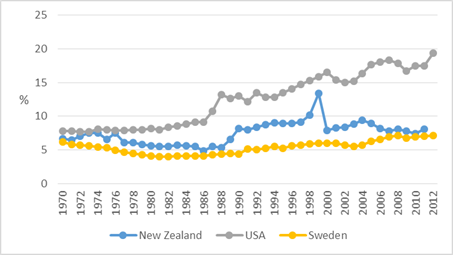
The NZ top 1% share has been steady at 8-9% since the mid-1990s. The top 1%’s share rose strongly in the USA in recent decades, from 13% in the mid-1980s to 19% in 2012.
Figure 1: Top 1% income shares, USA, New Zealand and Sweden, 1970-2012
Source: The World Top Income Database at http://topincomes.g-mond.parisschoolofeconomics.eu/#Database
The top 1% in New Zealand is so lazy that Sweden is overtaking it – See figure 1.
The Occupy crowd blame everything from the global financial crisis to a bad environment on growing inequality and the top 1%. Such an argument has no foundation in fact in New Zealand.
Income inequality as measured by the Gini coefficient has not risen much in New Zealand for 20 years – See figure 2. How can the poor be getting getting poorer, ground under by the yoke of capitalism, if the rich are not getting richer. The occupy movement should apply for unemployment benefits and seek career guidance.
Figure 2: Gini coefficient New Zealand 1980-2015
![clip_image002[7]](https://utopiayouarestandinginit.com/wp-content/uploads/2014/10/clip_image00271.png "clip_image002[7]")
Source: Bryan Perry, Household incomes in New Zealand: Trends in indicators of inequality and hardship 1982 to 2013. Ministry of Social Development (July 2014).
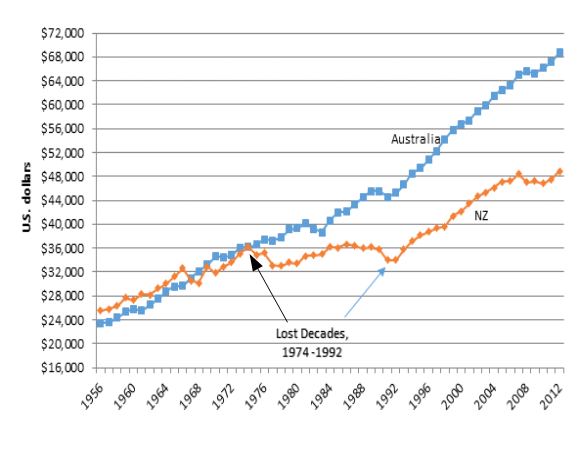
The last major increase in income inequality in New Zealand was in the late 1980s and early 1990s and that was followed by a long economic boom – See figure 3 .
Figure 3: Real GDP per New Zealander and Australian aged 15-64, converted to 2013 price level with updated 2005 EKS purchasing power parities, 1956-2012
Source: Computed from OECD Stat Extract and The Conference Board, Total Database, January 2014, http://www.conference-board.org/economics .
This long boom was after two decades of next to no economic growth in the 1970s and 1980s in New Zealand – see figure 3 . This depression between 1974 and 1992 was New Zealand’s lost decades.
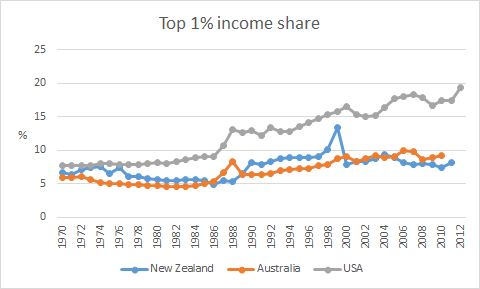
Figure 4 shows that both the lost decades of economic growth in New Zealand and the emergence of the trans-Tasman income gap the seemed to somewhat coincide with the top 1% of earners in Australia increasing their share of income from 6% to 10% of total incomes while the New Zealand top 1% sat on their hands. They are such lazy devils.
Figure 4: Top 1% income shares, USA, New Zealand and Australia, 1970-2012
Source: The World Top Income Database at http://topincomes.g-mond.parisschoolofeconomics.eu/#Database


A Perspective on Ireland’s Economy
19 Oct 2014 Leave a comment
in business cycles, fiscal policy, global financial crisis (GFC), macroeconomics, Public Choice Tags: GFC, Ireland
Dot point 4 is the key. The bank guarantee caused the depression.

Philip Lane is Professor of International Macroeconomics at Trinity College Dublin. He is also a managing editor of the journal Economic Policy, the founder of The Irish Economy blog, and a research fellow of the Centre for Economic Policy Research. His research interests include financial globalisation, the macroeconomics of exchange rates and capital flows, macroeconomic policy design, European Monetary Union, and the Irish economy.
Last week he visited New Zealand as a guest of the Treasury, the Reserve Bank, and Victoria University. During his visit he presented this guest lecture on the troubled Irish economy, drawing on his recent report to the Irish Parliament’s finance committee on ‘Macroeconomic Policy and Effective Fiscal and Economic Governance’.
Some highlights from his talk (also reported here by Brian Fallow in the New Zealand Herald) were:
- Ireland’s is a real depression: 15% fall in GDP 2007-2010
- The Celtic Tiger 1994-2001 was no…
View original post 216 more words


Piketty on inequality: views of the IGM economic experts
16 Oct 2014 Leave a comment
in applied price theory, applied welfare economics, comparative institutional analysis, constitutional political economy, discrimination, economic growth, entrepreneurship, gender, human capital, income redistribution, industrial organisation, labour economics, Marxist economics, Rawls and Nozick Tags: Daron Acemoglu, James Robinson, Piketty, poverty and inequality, The Great Enrichment
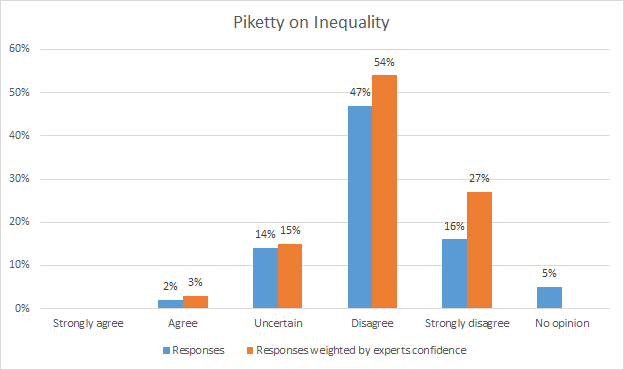
Question: The most powerful force pushing towards greater wealth inequality in the US since the 1970s is the gap between the after-tax return on capital and the economic growth rate?
Daron Acemoglu and James Robinson have a simple explanation for why Piketty is wrong:
But like Marx, Piketty goes wrong for a very simple reason. The quest for general laws of capitalism or any economic system is misguided because it is a-institutional.
It ignores that it is the institutions and the political equilibrium of a society that determine how technology evolves, how markets function, and how the gains from various different economic arrangements are distributed.
Despite his erudition, ambition, and creativity, Marx was ultimately led astray because of his disregard of institutions and politics. The same is true of Piketty.


Recent Comments