Is there a way to understand why some global environmental externalities are addressed effectively, whereas others are not?
The transaction costs of defining the property rights to mitigation benefits and costs is a useful framework for such analysis. This approach views international cooperation as a contractual process among country leaders to assign those property rights.
Leaders cooperate when it serves domestic interests to do so. The demand for property rights comes from those who value and stand to gain from multilateral action.
Property rights are supplied by international agreements that specify resource access and use, assign costs and benefits including outlining the size and duration of compensating transfer payments, and determining who will pay and who will receive them.
Four factors raise the transaction costs of assigning property rights:
(i) scientific uncertainty regarding mitigation benefits and costs;
(ii) varying preferences and perceptions across heterogeneous populations;
(iii) asymmetric information; and
(iv) the extent of compliance and new entry.
These factors are used to examine the role of transaction costs in the establishment and allocation of property rights to provide globally valued national parks, implement the Convention on the International Trade in Endangered Species of Wild Fauna and Flora, execute the Montreal Protocol to manage emissions that damage the stratospheric ozone layer, set limits on harvest of highly-migratory ocean fish stocks, and control greenhouse gas emissions.
The US House of Representatives initially voted down the TARP in a grand coalition of right-wing republicans and left-wing democrats, voting 205–228. The right-wing republicans opposed the bailout because capitalism is a profit AND loss system. Democrats voted 140–95 in favour of the Bill while Republicans voted 133–65 against it.
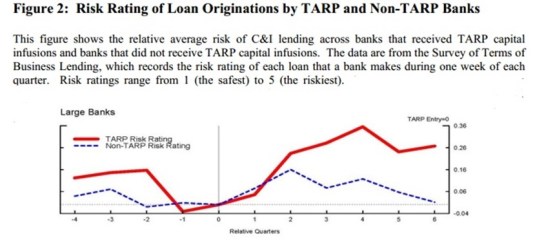
The chart above shows that the degree of risk in commercial loans made by TARP recipients appears to have increased. This is no surprise. In the 1960s, Sam Peltzman published a paper in in the 1960s showing that when deposit insurance was introduced in the USA in the 1930s, the banks halve their capital ratios. They did not need to have as much capital as before to back their lending. The chart below shows that the TARP really didn’t do much for economic policy uncertainty.
In an open letter sent to Congress, over 100 university economists described three fatal pitfalls in the TARP:
1) Its fairness. The plan is a subsidy to investors at taxpayers’ expense. Investors who took risks to earn profits must also bear the losses. The government can ensure a well-functioning financial industry without bailing out particular investors and institutions whose choices proved unwise.
2) Its ambiguity. Neither the mission of the new agency nor its oversight is clear. If taxpayers are to buy illiquid and opaque assets from troubled sellers, the terms, timing and methods of such purchases must be crystal clear ahead of time and carefully monitored afterwards.
3) Its long-term effects. If the plan is enacted, its effects will be with us for a generation. For all their recent troubles, America’s dynamic and innovative private capital markets have brought the nation unparalleled prosperity. Fundamentally weakening those markets in order to calm short-run disruptions is will short-sighted.
A recent IMF study of 42 systemic banking crises showed that in 32 cases, there was government financial intervention.
Of these 32 cases where the government recapitalised the banking system, only seven included a programme of purchase of bad assets/loans (like the one proposed by the US Treasury). These countries were Mexico, Japan, Bolivia, Czech Republic, Jamaica, Malaysia, and Paraguay.
The Government purchase of bad assets was the exception rather than the rule in banking crises and rightly so. The TARP mostly benefited bank shareholders. A case of privatising the gains and socialising the losses from banking was passed on the votes of Congressional Democrats.
We were told [at the Council of Economic Advisers to the President that]… you can’t make policy based on economic theory. … It was clear they weren’t willing to listen to an analytical argument. …
You can go all the way through the regulatory aspects of the government, and you just see that the basic choices are getting filtered out by some other mechanisms than what I would call economic sense.
And the role of the economist there is a stopgap—keep them from doing something completely dumb, just completely dumb.
Few had even heard of the Mont Pelerin Society until the late 1990s and the internet age. The ringmaster of the neoliberal conspiracy still has a very ordinary looking webpage.
Lead conspirator Hayek was so little known at his death in 1992 that finding extensive obituaries of him in newspapers is hard. Some may be behind pay walls. Of those that were found, they weren’t very long and forgot to mention Hayek as the leader of a global cabal that rule the waves :
When Keynesian thought prevailed and his reputation went into eclipse, Mr. Hayek turned to philosophy and psychology, which he first taught at the University of Chicago, where he wrote what many consider to be a second masterpiece, “The Constitution of Liberty “.
His son’s obituaries in 2006 were longer and more fulsome than his father’s mostly on the back of who his now famous father were:
Lawrence Hayek escaped from the formidable shadow of his father, the great economist-philosopher, Professor F. A. Hayek, into high-level medical research within the NHS, only to spend much of his final decade responding to the worldwide interest in the scholar many regard — along with Milton Friedman — as the father of Thatcherism.
Hayek, the Mont Pelerin Society’s and neoliberal conspiracy’s alleged linchpin wasn’t even able to get a job in the University of Chicago economics department. Along with Mises, their salaries were paid by a private foundation. Neither could get paid university appointments in the United States. Hayek was Keynes’s principal critic in the 1930s, and upon Keynes’s death in 1946, the most famous economist in the world at that time.
Despite being a colony of the vast neo-liberal conspiracy, mentioning Milton Friedman’s name in the 1980s at job interviews in Canberra would have been extremely career limiting. Not much better in the early 1990s.
Back in the 1980s, the much less radical Milton Friedman was just graduating from being ‘a wild man in the wings’ to just a suspicious character in policy circles.
If you name dropped Hayek in the 1980s and 1990s, any sign of name recognition would have indicated that you were been interviewed by educated people.
How times has changed. The reasons are well summarised by Bruce Caldwell:
But how important were [members of the Mont Pèlerin Society] in the emerging global consensus that began in the 1980s in favour of trade liberalization and privatization?
Were not, for example, the dismal performance of Keynesian demand management policies in the United States, Britain, and elsewhere in the 1970s; the heavy-handed actions of the trade unions in Britain during the “Winter of Discontent”; the sclerotic performance of countries like India who had embraced a modified version of the planning model for their own; and, of course, the patent economic and political failures of the East Bloc, far more important in turning the tide, however briefly, towards globalization?
Was not George Stigler (himself a founding member of the Society) right in his comment about economists that “our influence appears to be powerful only when we support policies ripe for adoption” (Stigler 1987, p. 11)?
The Road from Mont Pèlerin presents the key debates and conflicts that occurred among neoliberal scholars and their political and corporate allies regarding trade unions, development economics, antitrust policies, and the influence of philanthropy. The book captures the depth and complexity of the neoliberal “thought collective” while examining the numerous ways that neoliberal discourse has come to shape the global economy.
Masters of the Universe traces the ascendancy of neoliberalism from the academy of interwar Europe to supremacy under Reagan and Thatcher and in the decades since. Daniel Stedman Jones argues that there was nothing inevitable about the victory of free-market politics. Far from being the story of the simple triumph of right-wing ideas, the neoliberal breakthrough was contingent on the economic crises of the 1970s and the acceptance of the need for new policies by the political left.
The proposal of any new law or regulation of commerce which comes from this order, ought always to be listened to with great precaution, and ought never to be adopted till after having been long and carefully examined, not only with the most scrupulous, but with the most suspicious attention.
It comes from an order of men, whose interest is never exactly the same with that of the public, who have generally an interest to deceive and even oppress the public, and who accordingly have, upon many occasions, both deceived and oppressed it.
The American political system is complicated with the Republicans and Democrats moving around the political spectrum. Remember, Teddy Roosevelt’s Progressive Party, with its rather left wing agenda split from the Republicans, not from the Democrats in 1912.
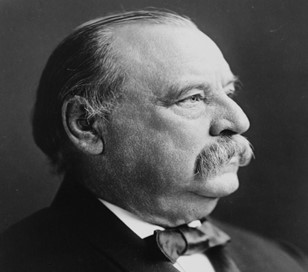
Murray Rothbard saw a lot of anti-big government sentiments in the pre-1896 Democratic Party under the Third Party System, and especially in the Second Party System prior to the Civil War with Andrew Jackson and Martin Van Buren. The 19th century Democratic Party tended to be the party of peace, anti-militarism, and anti-imperialism. Rothbard referred to Grover Cleveland
The Third Party System was dominated by the newly created Republican Party, which supported national banks, railroads, high tariffs, homesteading rights and aid to the land-grant colleges.
The Fourth Party System from 1896 to 1932 was made up of a majority centrist Republican Party against a minority Democratic Party from the South together with urban Catholics in the Northern cities – a volatile brew – which soon had an ideology scarcely distinguishable from the Republicans.
Both parties under the Third party System that operated prior to 1896 comprised broad-based voting coalitions divided between the parties on racial, ethnic and religious lines with high voter turnout and strong partisanship.
Methodists, Congregationalists, Presbyterians, and Scandinavian Lutherans were closely linked to the Republican Party.
Catholics, Episcopalians, and German Lutherans, looked to the Democratic Party for protection from moralism and prohibition.
The Democrats gained more support from the lower classes than did the Republicans.
Bourbon Democrat was a term used in the US from 1876 to 1904 for members of the Democratic Party, conservative or classical liberal, and especially those who supported President Grover Cleveland in 1884–1888 and 1892–1896. Rothbard referred to Grover Cleveland as “a hard-money laissez-faire Democrat” and
the continuity of quasi-libertarian thought that the Democrat Party brought to the United States throughout the nineteenth century
The Bourbon Democrats represented business interests, generally supporting the goals of banking and railroads but opposed to subsidies for them and were unwilling to protect them from competition.
Bourbon Democrats were promoters of laissez-faire capitalism (which included opposition to the protectionism that the Republicans advocated). The Bourbon Democrats opposed imperialism and U.S. overseas expansion, fought for the gold standard, and opposed bimetallism.
The notion that the Democratic Party was once the home of classical liberals in the USA at one time and the Republican Party was the party of regulation and big government is so foreign to the modern party divides in the USA today. Political parties in the United States certainly are big tents as they say.
What World Bank consultant would risk his fee and return business on advising Egypt to specialise in the export of toilets to Italy? But Egypt’s largest single manufacturing export is toilets to Italy where it captured 93% of the market.
Kenya has a booming export business in cut flowers for men to buy for their wives. Kenya has 40% of the European markets for cut flowers. Nigeria has 84% of the Norwegian market for floating docks. The Philippines has 71% of the global market for electronic integrated circuits.
What development expert would have picked these winners? They’re far too far away from the conventional wisdom and the safe bets that are behind picking winners in government circles.
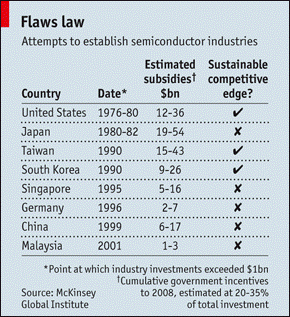
Picking winners by governments requires heroic assumptions not only about the information politicians and bureaucrats have about the present and their ability to predict the future, but also about their motivations and their ability to resist capture by special interests. The Economist explains:
None of these studies addresses a deeper problem with the way industrial policy tends to develop over time.
Earlier efforts have tended to degenerate into rent-seeking, lobbying and cosy deals between incumbent firms and bureaucrats, stifling innovation and the process of creative destruction.
The problem, of course, is that … industrial policy requires disinterested, benevolent policymakers who can do it well. Unfortunately, they do not yet have a recipe for how such policymakers can be created.
Policy is made by real people with political and personal motivations. What they come up with is unlikely to be as well designed as the ones in the models.
Ban feeding of antibiotics to animals that are not sick
Ban companies that do not comply with a Code of Corporate Responsibility
Ban ACC from investing in enterprises that provide products or services that significantly increase rates of injury or illness or otherwise have significant adverse social or environmental effects
Ban commercial Genetic Engineering trials
Ban field testing on production of GE food
Ban import of GE food
Ban Urban Sprawl
Ban non citizens/residents from owning land
Ban further corporate farming
Ban sale of high country farms to NZers who do not live in NZ at least 185 days a year
Ban the transport by sea of farm animals, for more than 24 hours
Ban crates for sows
Ban battery cages for hens
Ban factory farming of animals
Ban the use of mechanically recovered meat in the food chain
Ban the use of the ground-up remains of sheep and cows as stock feed
Ban animal testing where animals suffer, even if of benefit to humans
Ban cloning of animals
Ban use of animals in GE
Ban GE animal food
Ban docking of dogs tails
Ban intrusive animal experimentation as a teaching method in all educational institutions
Ban smacking
Ban advertising during children’s programmes
Ban alcohol advertising on TV and radio
Ban coal mining
Ban the export of indigenous logs and chips
Ban the use of bio-accumulative and persistent poisons
Ban the establishment of mustelid farms
Ban new exploration, prospecting and mining on conservation land and reserves
Ban mining activities when rare and endemic species are found to present on the mining site
Ban the trading conservation land for other land to facilitate extractive activities on.
Ban the further holding of marine mammals in captivity except as part of an approved threatened species recovery strategy
Ban the direct to consumer advertising of pharmaceuticals
Ban sale of chips and lollies on school property
Ban any additional use of coal for energy
Ban fixed electricity charges
Ban further large hydro plants
Ban nuclear power
Ban further thermal generation
Ban private water management
Ban imported vehicles over seven years old
Ban the disposal of recyclable materials at landfills
Ban the export of hazardous waste to non OECD countries
Ban funding of health services by companies that sell unhealthy food (so McDonalds could not fund services for young cancer sufferers)
Ban healthcare organizations from selling unhealthy food or drink
Ban advertising of unhealthy food until after 8.30 pm
Ban all food and drink advertisements on TV if they do not meet criteria for nutritious food
Ban the use of antibiotics as sprays on crops
Ban food irradiation within NZ
Ban irradiated food imports
Ban growth hormones for animals
Ban crown agency investments in any entity that denies climate change!!
Ban crown agency investments in any entity that is involved in tobacco
Ban crown agency investments in any entity that is involved in environmentally damaging oil extraction or gold mining
Ban non UN sanctioned military involvement (so China and Russia gets to veto all NZ engagements)
Ban NZ from military treaties which are based on the right to self defence
Ban NZers from serving as mercenaries
Ban new casinos
Allow existing casinos to be banned
Ban promotion of Internet gambling
Ban advertising of unhealthy food to children
Ban cellphone towers within 300 metres of homes
Ban new buildings that do not confirm to sustainable building principles
Ban migrants who do not undertake Treaty of Waitangi education programmes
Ban new prisons
Ban semi-automatic weapons
Ban genetic mixing between species
Ban ocean mineral extractions within the EEZ
Ban limited liability companies by making owners responsible for liability of products
Ban funding of PTEs that compete with public tertiary institutes
Ban the importation of goods and services that do not meet quality and environmental certification standards in production, lifecycle analysis, and eco-labelling
Ban goods that do not meet quality and sustainability standards for goods which are produced and/or sold in Aotearoa/New Zealand
Ban new urban highways or motorways
Ban private toll roads
Ban import of vehicles more than seven years old unless they meet emission standards
Ban imported goods that do not meet standards for durability and ease of recycling
As people hit middle age their youthful radicalism tends to be replaced with a growing conservatism. There has been a study of the 136,000 people in the World Values Survey. The data was from 48 different countries, during five periods between 1981 and 2008:
Participants were asked to choose whether they saw themselves as left-wing or right-wing.
The results were then compared with their responses to more detailed questions about their views, to determine how closely the participants own perception matched their real position on the ideological spectrum.
Well-educated individuals are more likely to wrongly characterise their political positions as more left-wing than they actually are. Holding down a job and raising a family leads them to adopt a more conservative outlook.
One reason the left-intellectuals do not realise that they have shed their youthful liberalism is that they socialise with people going through the same ideological shift to the right.
These results are no particular surprise given the growing authoritarian nature of the Left both in terms of social regulation and political correctness. Like a true conservative, the Left is a great believer in ordering their inferiors about while exempting themselves from these laws.
The US voting data shows that:
Americans who identify as independents is inversely related to age. More than one-third of the youngest Americans identify as independents, a percentage that drops steadily as the population ages.
The percentage who identify as Republicans follows roughly the opposite pattern. Only around 20% of Americans below 25 identify as Republicans.
Democrats are quite strong among those under age 24. The percentage of Democrats stays at the one-third mark until about age 45, when it climbs slightly and remains higher through the 50s and early 60s, hovering at around the 40% point.
Why specific people change is more interesting, because as Hayek said, aggregates conceal more than they reveal.
The bounty to the white-herring fishery is a tonnage bounty; and is proportioned to the burden of the ship, not to her diligence or success in the fishery; and it has, I am afraid, been too common for vessels to fit out for the sole purpose of catching, not the fish, but the bounty.
Why Evolution is True is a blog written by Jerry Coyne, centered on evolution and biology but also dealing with diverse topics like politics, culture, and cats.
In Hume’s spirit, I will attempt to serve as an ambassador from my world of economics, and help in “finding topics of conversation fit for the entertainment of rational creatures.”







 One reason the left-intellectuals do not realise that they have shed their youthful liberalism is that they socialise with people going through the same ideological shift to the right.


Recent Comments