At least 20% of New Zealand workers are subject to occupational regulation

There are at least 98 regulated occupations in New Zealand covering about 20% of the workforce. In 2011, this amounts to 440,371 workers. The skills that are regulated range across all skill sets and many occupations:

  • 49% of regulation is in the form of a licence;
  • 18% of regulated work is in the form of licensing of tasks;
  • 31% of regulated workers require a certificate; and
  • 4% of regulated workers require registration.

There are 32 different governing Acts that regulated occupations in New Zealand with 55% of the workers subject to occupational regulation are employed in just five occupations:

  • 98,000 teachers;
  • 48,500 nurses;
  • 42,730 bar managers;
  • 32,733 chartered accountants; and
  • 22,749 electricians.

The Health Practitioners Competency Assurance Act 2003 regulates 22 occupations and a total of 89,807 workers. The next best is the 10 occupations regulated by the Health and Safety in Employment Act 2002 which regulates an unknown number of occupations. The Civil Aviation Act 1990 regulates eight occupations and 19,095 workers, the Building Act 2004 regulates seven occupations and 21,101 workers and the Maritime Transport Act 1994 regulates six occupations and 20,500 workers. 12 of the regulated occupations are regulated under laws passed since 2007.

The purpose of occupational regulation is to protect buyers from quacks and lemons – to overcome asymmetric information about the quality of the provider of the service.

Adverse selection occurs when  the seller knows more than the buyer about the true quality of the product or service on offer. This can make it difficult for the two people to do business together. Buyers cannot tell the good from the bad products on offer so many they do not buy to all and withdraw from the market.
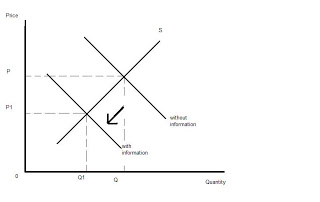
Goods and services divide into inspection, experience and credence goods.

  • Inspection goods are goods or services was quality can be determined before purchase price inspecting them;
  • Experience goods are goods whose quality is determined after  purchase in the course of consuming them; and
  • Credence goods are goods  whose quality may never be known for sure  as to whether the good or service actually worked – was that car repair or medical procedure really necessary?

The problem of adverse selection over experience and credence goods present many potentially profitable but as yet unconsummated wealth-creating transactions because of the uncertainty about quality and reliability.

Buyers are reluctant to buy if they are unsure of quality, but if such assurances can be given in a credible manner, a significant increase in demand is possible.

Any entrepreneur who finds ways of providing credible assurances of the quality of this service or work stands to profit handsomely. Brand names and warranties are examples of market generated institutions that overcome these information gaps through screening and signalling.
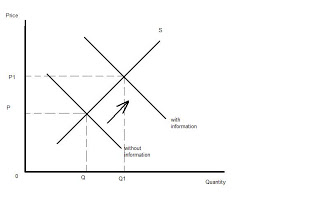
Screening is the less informed party’s effort, usually the buyer, to learn the information that the more informed party has. Successful screens have the characteristic that it is unprofitable for bad types of sellers to mimic the behaviour of good types.

Signalling is an informed party’s effort, usually the seller, to communicate information to the less informed party.

The main issue with quacks in the labour market is whether there are a large cost of less than average quality service, and is there a sub-market who will buy less than average quality products in the presence of competing sellers competing on the basis of quality assurance. This demand for assurance creates opportunities for entrepreneurs to profit by providing assurance.

David Friedman wrote a paper about contract enforcement in cyberspace where the buyer and seller is in different countries so conventional mechanisms such as the courts are futile in cases where the quality of the good is not as promised or there is a failure to deliver at all:

Public enforcement of contracts between parties in different countries is more costly and uncertain than public enforcement within a single jurisdiction.

Furthermore, in a world where geographical lines are invisible, parties to publicly enforced contracts will frequently not know what law those contracts are likely to fall under. Hence public enforcement, while still possible for future online contracts, will be less workable than for the realspace contracts of the past.

A second and perhaps more serious problem may arise in the future as a result of technological developments that already exist and are now going into common use. These technologies, of which the most fundamental is public key encryption, make possible an online world where many people do business anonymously, with reputations attached to their cyberspace, not their realspace, identities

Online auction and sales sites address adverse selection with authentication and escrow services, insurance, and on-line reputations through the rating of sellers by buyers.

E-commerce is flourishing despite been supposedly plagued by adverse selection and weak contract enforcement against overseas venders.

In the labour market, screening and signalling take the form of probationary periods,  promotion ladders, promotion tournaments, incentive pay and the back loading of pay in the form of pension investing and other prizes and bonds for good performance over a long period.

In the case of the labour force, there are good arguments that a major reason for investments in education is as a to signal quality, reliability, diligence as well as investment in a credential that is of no value the case of misconduct or incompetence. Lower quality workers will find it very difficult if not impossible to fake quality and reliability in this way – through investing in higher education.

In the case of teacher registration, for example, does a teacher registration system screen out any more low quality candidates for recruitment than do proper reference checks and a police check for a criminal record.

Mostly disciplinary investigations and deregistrations under the auspices of occupational regulation is for gross misconduct  and criminal convictions rather than just shading of quality.

Much of personnel  and organisational economics is about the screening and sorting of applicants, recruits and workers by quality and the assurance of performance.

Alert entrepreneurs have every incentive to find more profitable ways to manage the quality of their workforce and sort their recruitment pools.

Baron and Kreps (1999) developed the recruitment taxonomy made up of stars, guardians and foot-soldiers.

Stars hold jobs with limited downside risk but high performance is very good for the firm – the costs of hiring errors for stars such as an R&D worker are small: mostly their salary. Foot-soldiers are employees with narrow ranges of good and bad possible outcomes.

Guardians have jobs where bad performance can be a calamity but good job performance is only slightly better than an average performance.

Airline pilots and safety, compliance, finance and controller jobs are all examples of guardian jobs where risk is all downside. Bad performance of these jobs can  bring the company down. Dual control is common in guardian jobs.

The employer’s focus when recruiting and supervising guardians is low job performance and not associating rewards and promotions with risky behaviours. Employers will closely screen applicants for guardian jobs, impose long apprenticeships and may limit recruiting to port-of-entry jobs.

The private sector has ample experience in handling risk in recruitment for guardian jobs. Firms and entrepreneurs are subject to a hard budget constraints that apply immediately if they hire quacks and duds.

Blackboard economics says that governments may be able to improve on market performance but as Coase warned that actually implement regulatory changes in real life is another matter:

The policy under consideration is one which is implemented on the blackboard.

All the information needed is assumed to be available and the teacher plays all the parts. He fixes prices, imposes taxes, and distributes subsidies (on the blackboard) to promote the general welfare.

But there is no counterpart to the teacher within the real economic system

Occupational regulation  comes with the real risk of the regulation turning into an anti-competitive barrier to entry as Milton Friedman (1962) warned:

The most obvious social cost is that any one of these measures, whether it be registration, certification, or licensure, almost inevitably becomes a tool in the hands of a special producer group to obtain a monopoly position at the expense of the rest of the public.

There is no way to avoid this result. One can devise one or another set of procedural controls designed to avert this outcome, but none is likely to overcome the problem that arises out of the greater concentration of producer than of consumer interest.

The people who are most concerned with any such arrangement, who will press most for its enforcement and be most concerned with its administration, will be the people in the particular occupation or trade involved.

They will inevitably press for the extension of registration to certification and of certification to licensure. Once licensure is attained, the people who might develop an interest in undermining the regulations are kept from exerting their influence. They don’t get a license, must therefore go into other occupations, and will lose interest.

The result is invariably control over entry by members of the occupation itself and hence the establishment of a monopoly position.

Friedman’s PhD was published in 1945 as Income from Independent Professional Practice. With co-author Simon Kuznets, he argued that licensing procedures limited entry into the medical profession allowing doctors to charge higher fees than if competition were more open.

Data Source: Martin Jenkins 2012, Review of Occupational Regulation, released by the Ministry of Business, Innovation and Employment under the Official Information Act.

Neoclassical economists think the economy is freestanding and ignore institutions!

The Sveriges Riksbank Prize in Economic Sciences in Memory of Alfred Nobel 1991 was awarded to Ronald H. Coase:

for his discovery and clarification of the significance of transaction costs and property rights for the institutional structure and functioning of the economy

The Royal Swedish Academy of Sciences has decided to award The Sveriges Riksbank Prize in Economic Sciences in Memory of Alfred Nobel for 2009 to

Elinor Ostrom “for her analysis of economic governance, especially the commons” and Oliver E. Williamson “for his analysis of economic governance, especially the boundaries of the firm”

The Royal Swedish Academy of Sciences has decided to award the Bank of Sweden Prize in Economic Sciences in Memory of Alfred Nobel for 1993 jointly to Robert W. Fogel and Douglass C. North

for having renewed research in economic history by applying economic theory and quantitative methods in order to explain economic and institutional change.

The Royal Swedish Academy of Sciences has decided to award the1986 Alfred Nobel Memorial Prize in Economic Sciences to Professor James McGill Buchanan for

his development of the contractual and constitutional bases for the theory of economic and political decision-making.

The best of the online materials by and about Ronald Coase

Ronald Coase

Obituaries

The Telegraph

The Guardian

Financial Times

Independent

New York Times

Economist

University of Chicago on the announcement of his death

University of Chicago Ronald H. Coase, Founding Scholar in Law and Economics, 1910-2013

Steve Medema

Recent interviews and op-eds:

1997 Interview Interview in Reason Magazine

2001 A conversation with Ronald H. Coase

2002 Why Economics Will Change Speech on why economics will and ought to change

2003 Coase Centennial Speech (video) Speech at the University of Chicago Law School

2002 Ronald H. Coase, The Intellectual Portrait Series: A Conversation with Ronald H. Coase 

2010 Interview on 100th Birthday Interview on Ronald Coase’s 100th birthday

2012 Coase on Externalities, the Firm, and the State of Economics

2012 WSJ Opinion Article, with Ning Wang Opinion article by Ronald Coase and Ning Wang concerning the development of modern China, in the Wall Street Journal, April 6, 2012.

2012 Harvard Business Review Article Article by Ronald Coase concerning the need to reengage modern economics with the economy, in the Harvard Business Review, December 2012.

2013 Cato Policy Report Article, with Ning Wang Article by Ronald Coase and Ning Wang summarizing the work of their book on China, in the Cato Policy Report, January/February 2013.

2012 Small Business Economics Interview on 102nd Birthday Interview conducted by Siri Terjesen and Ning Wang.

2013 Interview Interview with Ronald Coase, conducted by Ning Wang. (Some material is in Chinese.)

About Ronald Coase

Nobel award 1991 Bank of Sweden Prize in Economic Sciences in memory of Alfred Nobel

Coase’s work in perspective Nobel Foundation, on the 1991 prize in economics

Essay on Coase’s work The Swedes Get It Right, by David Friedman

Richard Posner on Coase and his methodology 

Don Boudreaux on Coase

Ronald H. Coase. Biography. Concise Encyclopedia of Economics.

Ronald Coase—The Nature of Firms and Their Costs by Robert L. Formaini and Thomas F. Siems

Best of his papers

2013 How China Became Capitalist Cato Policy report with Ning Wang

2013 Saving Economics from Economists Havard Business Review

2000 The Acquisition of Fisher Body by General Motors Journal of Law and Economics, Vol. 43, No. 1 (April 2000), pp. 15-31. pdf

1996 Law and Economics and A. W. Brian Simpson Journal of Legal Studies, Vol. 25, No. 1 (January 1996), pp. 103-119.

1993 Law and Economics at Chicago Journal of Law and Economics, Vol. 36, No. 1, Part 2 (April 1993), pp. 239-254.

1992 The Institutional Structure of Production The American Economic Review, Vol. 82, No. 4 (September 1992), pp. 713-719. pdf

1988 Blackmail Virginia Law Review, Vol. 74, No. 4 (May 1988), pp. 655-676. pdf

1988 The Nature of the Firm: Origin Journal of Law, Economics, & Organization, Vol. 4, No. 1 (Spring 1988), pp. 3-17. pdf

1988 The Nature of the Firm: Meaning Journal of Law, Economics, & Organization, Vol. 4, No. 1 (Spring 1988), pp. 19-32.

1988 The Nature of the Firm: Influence Journal of Law, Economics, & Organization, Vol. 4, No. 1 (Spring 1988), pp. 33-47.

1979 Payola in Radio and Television Broadcasting Journal of Law and Economics, Vol. 22, No. 2 (October 1979), pp. 269-328.

1978 Economics and Contiguous Disciplines The Journal of Legal Studies, Vol. 7, No. 2 (June 1978), pp. 201-211.

1977 Advertising and Free Speech The Journal of Legal Studies, Vol. 6, No. 1 (January 1977), pp. 1-34.

1976 Adam Smith’s View of Man Journal of Law and Economics, Vol. 19, No. 3 (October 1976), pp. 529-546. pdf

1975 Marshall on Method Journal of Law and Economics, Vol. 18, No. 1 (April 1975), pp. 25-31.

1974 The Lighthouse in Economics Journal of Law and Economics, Vol. 17, No. 2 (October 1974), pp. 357-376.

1974 The Choice of the Institutional Framework: A Comment Journal of Law and Economics, Vol. 17, No. 2 (October 1974), pp. 493-496.

1974 The Market for Goods and the Market for Ideas (in The Economics of the First Amendment) The American Economic Review

1972 The Appointment of Pigou as Marshall’s Successor Journal of Law and Economics, Vol. 15, No. 2 (October 1972), pp. 473-485.

1972 Durability and Monopoly Journal of Law and Economics, Vol. 15, No. 1 (April 1972), pp. 143-149.

1972 Industrial Organization: A Proposal for Research, Economic Research: Retrospect and Prospect Vol 3: Policy Issues and Research Opportunities in Industrial Organization

1970 The Theory of Public Utility Pricing and Its Application The Bell Journal of Economics and Management Science, Vol. 1, No. 1 (Spring 1970), pp. 113-128.

1966 The Economics of Broadcasting and Government Policy (in The Economics of Broadcasting and Advertising) The American Economic Review, Vol. 56, No. 1/2 (March 1966), pp.440-447.

1960 The Problem of Social Cost Journal of Law and Economics Vol. 3 (October 1960), pp. 1-44 pdf

 1959 The Federal Communications Commission Journal of Law and Economics Vol. 2 (October 1959), pp. 1-40 pdf

1946 The Marginal Cost Controversy Economica, New Series, Vol. 13, No. 51 (August 1946), pp. 169-182.

1937 The Nature of the Firm Economica, New Series, Vol. 4, No. 16 (November 1937), pp. 386-405 pdf

Reviews of Others’ Work

1977 Reviewed Work: Selected Economic Essays and Addresses by Arnold Plant Journal of Economic Literature, Vo.. 15, No. 1 (Mar. 1977), pp. 86-88.

some via http://www.coase.org/coaseonline.htm

Chicago Unbound | 60+ years of University of Chicago Law Online, mostly ungated

Chicago Unbound contains 60+ years of scholarship, most of it ungated online, of the members of University of Chicago Law School

Faculty_scholarship

Law School Publications

Working_papers

Coase_Sandor_institute

via Chicago Unbound | University of Chicago Law School Research.

Divorce Iranian Style

Divorce Iranian Style is a great documentary about three Iranian couples seeking a divorce. The camera crew sat next to the judge and he often chats with them. Those before the court also talk direct to the camera and are interviewed at home too.

Divorce is frowned upon and the judge is always urging them to reconcile.

Women can bargain for a divorce from their husband by agreeing to return their dowry or not demanding the outstanding amount be paid by their now unwanted husband. The dowries were large: $10,000 for a taxi driver in a poor country. They act as a bond for good behaviour and as insurance against a divorce. The unpaid portion of the dowry hangs over the head of a would be miscreant husband. The film makers found that:

“The women are assertive, demanding, and persistent to a degree that confounds stereotypes of oppression. They challenge the judge, badger the uncooperative clerk for misplaced files, chew out their husbands and their husbands’ families.”

UPDATE: the correct name for what the documentary makers called a dowry is the mahriyeh (bridal treasures): This sum is usually not paid to the bride at the time of the marriage.

The marriage contract provides that the mahriyeh (bridal treasures) is to be paid in the event of divorce or is to be deducted from the husband’s estate before the inheritance is divided according to religious law. The bride-price is a separate up-front payment to the family of the bride to cover the cost of the wedding.

Update 2: see A Separation. This is a 2011 Iranian film about a divorce. HT: FleetwoodMacNCheese

The Chinese capitalist miracle – guest post by Alan Moran

The Chinese economic miracle is the latest and most comprehensive success story since the end of World War II.

Front Cover

Veteran economists Ronald Coase and Ning Wang explain how in the space of three decades one of the world’s poorest countries became the world’s leading manufacturer and investor. They attempt to disentangle the twists and turns of Chinese politics and economics in its voyage to success within a framework which rightly judges that no system other than capitalism (which the book calls the market economy), could ever produce such an outcome.

In retrospect the internal contradictions within Communism (absence of appropriate incentives, attenuated property rights, politicisation of business decisions and prices and so on) made its collapse inevitable. But that was not clear in 1970 or even 1980. Yes, communist economies in both the Soviet bloc and China were stagnating. But there were many believing and hoping that the future was about to emerge to demonstrate that socialism actually does work. Intellectuals in particular thought that socialism, which accorded them the status and perks they considered they richly deserved, with a little more reform would demonstrate that the bourgeoisie were unnecessary.

Though the collapse of Communism took place almost simultaneously across the world, a remarkable contrast is evident between Chinese Communism’s self-control of its demise and the relatively bloodless overthrow of the system in Europe.

The Europeans delegitimised their Communist Parties and ostensibly opted for a western capitalist system that incorporated democracy and liberty-more so in the former satellites than in the USSR successor states. On the other hand, China’s Communist Party continued to maintain its monopoly of political control, vigorously and sometimes brutally suppressing any challenges. Chinese communists adopted capitalism shorn of the democracy and liberty that many considered to be an essential part of its make-up. And in supervising a gradual dismantling of socialism, its raison d’etre, China’s Communist Party watched over the longest and highest rate of economic growth the world has ever seen. One indicator of this is steel production, traditionally a key indicator of industrialisation. Having increased twentyfold in the past 30 years, China’s steel output now accounts for half the world’s supply, up from 7 per cent in 1980.

How did this happen? How did a ruling political party numbering millions of apparently dedicated Marxists-Leninists retain its power in the decades following 1978 while permitting and facilitating an economic development approach totally alien to its proclaimed ideology? And how did that same Party evolve from a proselytising socialist force to one that welcomed diversity? Coase and Wang offer important insights but leave plenty for others to explain. By the late 1950s, Communist China, like underperforming organised societies of yesteryear, was seeking out ways to catch up with the west. Calls for modernisation started to become increasingly insistent on the part of China’s leadership. The first ‘four modernisations’ program was initiated by Premier Zhou Enlai in 1964 and was aborted by the Cultural Revolution of 1971; other modernisations were subsequently endorsed, including in 1978 (Mao died in 1976) by Deng Xiaoping, shortly before one of his downfalls. The catch-up program sought to emulate the successes without adopting the institutions of capitalism-free enterprise, personal ownership, and the rule of law. Progress was therefore transient.

As well as promising a fairer society, socialism had been the supposed key to a more efficient and richer society. But Coase and Wang note early questionings of socialism. By 1984 when Hu Yaobang, as General Secretary of the Communist Party, had taken this further in asking, ‘Since the October revolution (of 1917) more than 60 years have passed. How is it that many socialist countries have not been able to overtake capitalist ones in terms of development? What is it (in socialism) that does not work?’

Hu Yaobang would not have been the first to voice such concerns even though they questioned the party’s core beliefs. Even so, not many people would have had sufficient information to raise such doubts partly because censorship severely limited information-even to senior party members-about the extent of China’s backwardness and how western economies operate. Overseas trips provided rude awakenings as when in 1978, Vice Premier Wang Zhen visited England and found his salary was only one sixth that of a London garbage collector.

While the European Communist systems pursued catch-up by having state enterprises adopt new western technologies and practices, China from the mid-1980s was looking at grafting capitalism itself onto Communism. The proximity of China to the Asian Tigers of Hong Kong, Taiwan, Singapore and South Korea provided an object lesson for success, especially since the entrepreneurial leaders of the first three were the children of uneducated emigrants from China itself. Not only therefore did the Chinese have the failures of socialism as an example but they also could see the astonishing successes of these newly enriched capitalist countries.

Deng Xiaoping was a key player throughout the Chinese transformation process, even eventually managing to persuade the Communist Party that Marxism was a pragmatic ideology willing to try new systems of ownership and trade. Notwithstanding this breathtaking apostasy, the conversion of China to a fully-fledged capitalist economy involved several paths which were only loosely connected.

In the late 1970s, foreign trade and foreign direct investment became the first areas where liberalisation was introduced. Vastly important in this was the Shenzhen (Guangdong) free trade zone adjacent to Hong Kong. As a catalyst for the introduction of free enterprise Shenzhen had its genesis, not as a means of introducing free enterprise, but as a means to halting the flow of economic refugees to Hong Kong. The Communist authorities were involved in considerable expenditures in trying to stop this illegal exodus of the tens of thousands of people each year, an exodus which also involved many hundreds drowning. To their utter astonishment, in examining the cases of refugees who made it to Hong Kong, they learned that they earned one hundred fold as much as those who remained behind.

The establishment of Special Economic Zones (SEZ) operated on capitalist lines in Shenzhen and elsewhere to attract foreign investment which blossomed. Eventually Shenzhen’s SEZ transformed a village of 30,000 people into a vast metropolis which now has 14 million residents.

Agriculture led the way to domestic private enterprise. In 1978, private farming was a criminal activity, but 1976 saw its first secret reintroduction by peasants at a Sichuan village called Nine Dragon Hill. The success of that village and a few others in increasing production was compelling. From 1980 the party instituted a progressive lifting of the ban on private farming. Fairly soon virtually all land had been divided into individual plots, though remaining under state ownership. Productivity soared.

The de-collectivisation also extended to previously moribund village industries. The output of these industries was growing at 20 per cent a year by the end of the 1980s and accounted for 26 per cent of GDP 15 years later. Four-fifths of these enterprises were privately owned, and all of them were subject to the dictates of the market and not any level of government. In 1980, a rural producer and hawker of confectionary, based on watermelon seeds, became one of the first millionaires.

This liberalisation in rural villages took place at the same time as changes in major cities, where unemployment was previously solved by sending youth to rural areas. But the youths started returning in vast numbers from the late 1970s. With little for them to do, the party allowed small businesses to be formed. Elements of the rule of law and contracts were introduced from 1978 initiating the path to the full panoply of property rights law, a process which was not, however, completed until 1988.

An essential attribute of a market-based economy is decontrolled prices for goods and services. Tentative steps were taken towards this in the early 1980s, were reversed in 1983, but soon recommenced and in 1984 most manufactured goods were no longer subject to controls. Nonetheless, even by 1995, 78 per cent of producer goods were transacted at controlled prices (though by then many of these had become much better aligned to market prices).

Share markets are important to facilitate capital accumulation and to allow investments to be traded, but the first stock exchange was opened only in 1986. It was not until 1990 that major stock markets could operate in Shanghai and Shenzhen. Soon after, there commenced a gradual sale to employees of state enterprises, especially those (over half of the total) which were technically insolvent. This was accompanied by reforms that allowed surplus workers to be sacked (an unemployment insurance scheme was introduced at the same time).

Coase and Wang claim that socialism was endorsed by Mao only in the mid-1950s but, if so, this would seem to contradict the basis of the Communist Party. Nor are they systematic in describing the astonishing growth of internal savings (which were 53 per cent of national income in 2010) that propelled industrialisation, and how this was underpinned by property rights laws.

Other intriguing questions with incomplete answers are: how were lumbering and inefficient government-owned firms transformed into the privately owned nimble and highly productive businesses that have led China to dominate world manufacturing? And how was it that the State Owned Enterprises (SOEs) that are still the backbone of heavy industry and infrastructure have, once corporatised, been run at a tolerable level of efficiency without which the private sector propelled growth could not have created the success observed?

Indeed, of the 31 Chinese firms in the Fortune Top 300 in 2011, only one (which is Hong Kong based) did not have majority government ownership. Two of the three biggest were fully government owned.

Though all these firms operate under western type corporate law, according to Coase and Wang, the state firms in monopoly sectors employ 8 per cent of the non-farm workforce but account for 55 per cent of total wages. The inferred high wages in monopoly firms suggests they are less cost-conscious than those facing competition, which, if true, makes the performance of the rest of the economy that much more impressive.

Coase and Wang examine but ultimately dismiss fears of some prominent Chinese about a dearth of entrepreneurs which could stifle growth in the future. They are surely right in this. Similar concerns were voiced by South Koreans when that country’s growth was founded on firms doing the more menial tasks that mature businesses outsourced to them-40 years ago the Samsungs, LGs and Hyundais barely existed. Coase and Wang also note that China is now the largest producer of PhDs in the world, having risen from one of the poorest nations to the second biggest economy.

Chinese Communists, while retaining the name have emasculated and even forgotten the theory on which it rode to power. From Marxist works being virtually the only political books being available in the 1960s, Coase and Wang cite evidence that by 2008 students, even those applying to join the Communist Party, were barely aware of Karl Marx’s Communist Manifesto. The party had become one of many different career paths and was completely shorn of ideology.

In this respect Coase and Wang refer to an interview that China’s Premier Wen Jiabao had with western media where he quoted not only Adam Smith’s Wealth of Nations but the lesser known Theory of Moral Sentiments. Even though the quotation was recruiting Adam Smith in support of measures to combat income inequality in China (a dubious interpretation of Smith’s own view) it is unlikely that any other world statesman would have been adequately versed in Adam Smith in these two guises.

The roots and durability of China’s success remain contentious. Many see the prominence of the SOEs as indicative of strong state guidance or manipulation of the economy.

This is difficult to square with the evidence of economic failures and successes around the world. Government ownership ipso facto has meant poor outcomes for the businesses themselves and eventually, in the case of Eastern Europe, for the economies in which they were housed. Even strong guidance by governments has been associated with failures as was previously the case in the ‘mixed’ pre-1990s Indian economy when government economic manipulation was considerable. Similar guidance and ‘winner picking’ in the West also failed. Where claims have been made of successes from government guidance, as in the case of Japan and Singapore, they have-under closer scrutiny-been found wanting.

Efficiency in China was unleashed by the opening up of the economy to entrepreneurship, the better incentives for productive work and the high rate of savings that followed from a recognition that these are secure from government seizure or wasteful usage. State industry manipulation and even, beyond a point, favouritism by state agencies, would undermine the phenomenal growth that continues to be witnessed.

Since Mao, China has risen from one of the world’s poorest nations to become the second largest economy. It is difficult to see what will stop a continued rise in incomes to levels that may reach or exceed-as some have forecast-as much as 40 per cent of world GDP twenty years from now

Next Newer Entries

David Andolfatto

Celebrating humanity's flourishing through the spread of capitalism and the rule of law

Monetary Non-Neutrality

Celebrating humanity's flourishing through the spread of capitalism and the rule of law

Reason Magazine

Celebrating humanity's flourishing through the spread of capitalism and the rule of law

Coyote Blog

Celebrating humanity's flourishing through the spread of capitalism and the rule of law

Thoughts from the North

Celebrating humanity's flourishing through the spread of capitalism and the rule of law

Fardels Bear

A History of the Alt-Right

Vincent Geloso

Econ Prof at George Mason University, Economic Historian, Québécois

Bassett, Brash & Hide

Celebrating humanity's flourishing through the spread of capitalism and the rule of law

Truth on the Market

Scholarly commentary on law, economics, and more

The Undercover Historian

Beatrice Cherrier's blog

Matua Kahurangi

Celebrating humanity's flourishing through the spread of capitalism and the rule of law

Temple of Sociology

Celebrating humanity's flourishing through the spread of capitalism and the rule of law

Velvet Glove, Iron Fist

Celebrating humanity's flourishing through the spread of capitalism and the rule of law

Why Evolution Is True

Why Evolution is True is a blog written by Jerry Coyne, centered on evolution and biology but also dealing with diverse topics like politics, culture, and cats.

NoTricksZone

Celebrating humanity's flourishing through the spread of capitalism and the rule of law

Homepaddock

A rural perspective with a blue tint by Ele Ludemann

Kiwiblog

DPF's Kiwiblog - Fomenting Happy Mischief since 2003

The Dangerous Economist

Celebrating humanity's flourishing through the spread of capitalism and the rule of law

Watts Up With That?

The world's most viewed site on global warming and climate change

The Logical Place

Tim Harding's writings on rationality, informal logic and skepticism

Doc's Books

A window into Doc Freiberger's library

The Risk-Monger

Let's examine hard decisions!

Uneasy Money

Commentary on monetary policy in the spirit of R. G. Hawtrey

Barrie Saunders

Thoughts on public policy and the media

Liberty Scott

Celebrating humanity's flourishing through the spread of capitalism and the rule of law

Point of Order

Politics and the economy

James Bowden's Blog

A blog (primarily) on Canadian and Commonwealth political history and institutions

Science Matters

Reading between the lines, and underneath the hype.

Peter Winsley

Economics, and such stuff as dreams are made on

A Venerable Puzzle

"The British constitution has always been puzzling, and always will be." --Queen Elizabeth II

The Antiplanner

Celebrating humanity's flourishing through the spread of capitalism and the rule of law

Bet On It

Celebrating humanity's flourishing through the spread of capitalism and the rule of law

History of Sorts

WORLD WAR II, MUSIC, HISTORY, HOLOCAUST

Roger Pielke Jr.

Undisciplined scholar, recovering academic

Offsetting Behaviour

Celebrating humanity's flourishing through the spread of capitalism and the rule of law

JONATHAN TURLEY

Res ipsa loquitur - The thing itself speaks

Conversable Economist

In Hume’s spirit, I will attempt to serve as an ambassador from my world of economics, and help in “finding topics of conversation fit for the entertainment of rational creatures.”

The Victorian Commons

Researching the House of Commons, 1832-1868

The History of Parliament

Articles and research from the History of Parliament Trust

Books & Boots

Reflections on books and art

Legal History Miscellany

Posts on the History of Law, Crime, and Justice

Sex, Drugs and Economics

Celebrating humanity's flourishing through the spread of capitalism and the rule of law

European Royal History

Exploring the Monarchs of Europe

Tallbloke's Talkshop

Cutting edge science you can dice with

Marginal REVOLUTION

Small Steps Toward A Much Better World

NOT A LOT OF PEOPLE KNOW THAT

“We do not believe any group of men adequate enough or wise enough to operate without scrutiny or without criticism. We know that the only way to avoid error is to detect it, that the only way to detect it is to be free to inquire. We know that in secrecy error undetected will flourish and subvert”. - J Robert Oppenheimer.