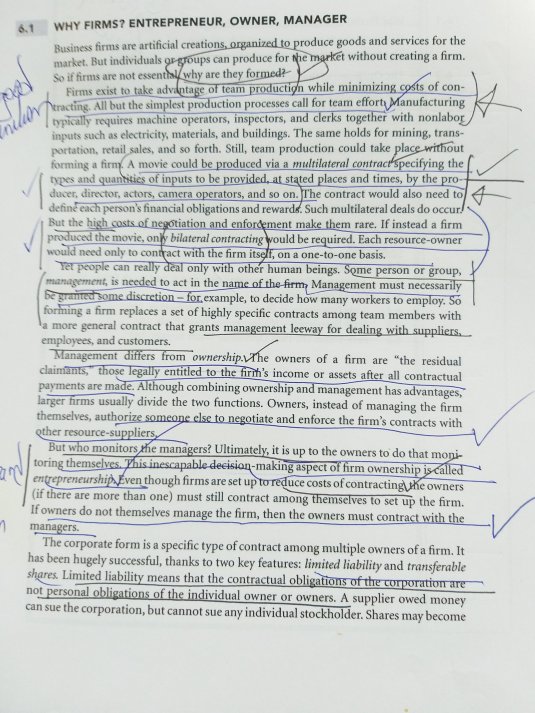
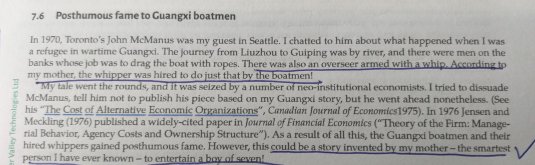
Steven N.S. Cheung has his doubts about the most famous parable about the theory of the firm
08 Jul 2019 Leave a comment
in applied price theory, entrepreneurship, history of economic thought, industrial organisation, labour economics, labour supply, managerial economics, occupational choice, organisational economics, personnel economics, property rights, theory of the firm Tags: China
Friedrich Hayek and James Buchanan: Pattern Prediction and Scientism
16 Jun 2019 Leave a comment
in Armen Alchian, Austrian economics, F.A. Hayek, history of economic thought Tags: philosophy of science
Why Are Some Companies Efficient While Others Are Not?
10 Jun 2019 Leave a comment
in industrial organisation, survivor principle, theory of the firm
David D. Friedman | Market failure
22 Apr 2019 Leave a comment
in applied price theory, applied welfare economics, comparative institutional analysis, constitutional political economy, David Friedman, economic history, economics of bureaucracy, economics of crime, economics of regulation, entrepreneurship, environmental economics, Gordon Tullock, income redistribution, industrial organisation, international economics, law and economics, personnel economics, property rights, Public Choice, public economics, rentseeking, survivor principle, theory of the firm Tags: market failure
Ronald Coase’s Theory of the Firm and the Family
05 Mar 2019 Leave a comment
in applied price theory, comparative institutional analysis, economics of information, economics of love and marriage, law and economics, property rights, Ronald Coase, theory of the firm Tags: marriage and divorce
Ronald Coase speaking about George Stigler’s Coase Theorem
03 Mar 2019 Leave a comment
in applied price theory, comparative institutional analysis, economics of regulation, environmental economics, history of economic thought, law and economics, public economics, Ronald Coase, Ronald Coase Tags: Coase theorem
Pirates & the Theory of the Firm – Intro to Political Economy, Lecture17 Mike Munger
10 Dec 2018 Leave a comment
in applied price theory, comparative institutional analysis, economic history, economics of crime, entrepreneurship, human capital, industrial organisation, labour economics, law and economics, managerial economics, occupational choice, organisational economics, personnel economics, property rights, survivor principle, theory of the firm Tags: asymmetric information, moral hazard, transaction costs
Friedrich von Hayek and Armen Alchian Part I
11 Oct 2017 Leave a comment
in Armen Alchian, F.A. Hayek Tags: Armen Alchain
Supervisory and monitoring costs and occupational segregation by sex
06 Mar 2017 Leave a comment
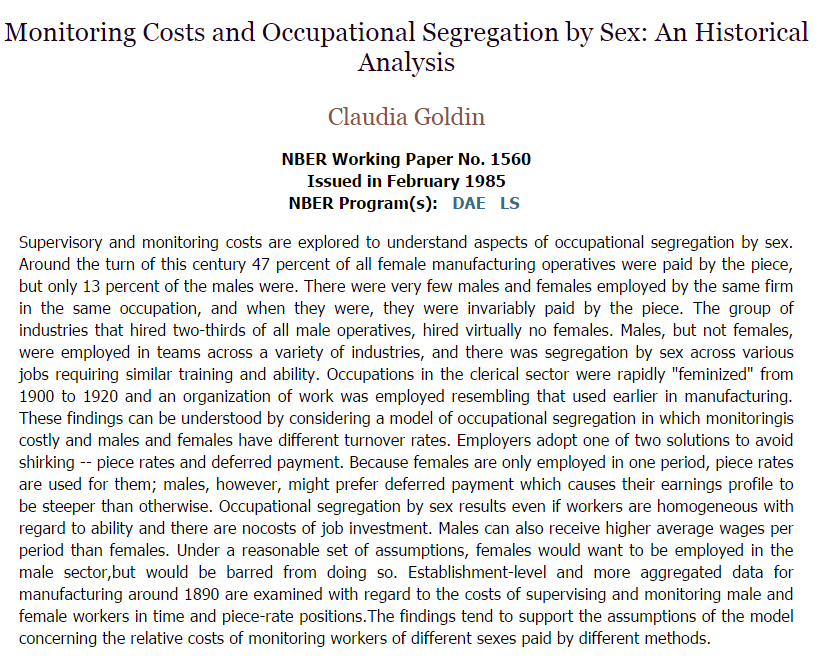
Published: Goldin, Claudia. “Monitoring Costs and Occupational Segregation by Sex: An Historical Analysis,” Journal of Labor Economics, Vol. 4, (January 1986), pp. 1-27.
Alchian and Allen on the superfluousness of economic principles to civilisation
13 Aug 2016 Leave a comment
in applied price theory, Armen Alchian, comparative institutional analysis, constitutional political economy, development economics, economic history, industrial organisation, international economics Tags: industrial revolution, The Great Enrichment, The Great Escape, The Great Fact
Privatizing local bus services could save $5.7 billion
19 May 2016 Leave a comment
in industrial organisation, politics - New Zealand, politics - USA, privatisation, survivor principle, theory of the firm, transport economics, urban economics Tags: privatisation, state owned enterprises
What happened when a restaurant chain abolished tipping?
16 May 2016 Leave a comment
in labour economics, labour supply, managerial economics, minimum wage, occupational regulation, organisational economics, personnel economics, politics - USA, theory of the firm Tags: Edward Lazear, performance pay, tipping

Joe’s Crab Shack tested a no-tip model in 18 of its 130 restaurants. A 12-15% service charge replaced tips. Joe’s Crab capture is the first major restaurant chain to experiment with a tipping policy to experiment with abolishing it. The tipping minimum wage is far less than the federal, state and local minimum wages.

Joe’s Crab Shack had high hopes. The aims were customers would pay less, get a greater value experience, reduce labour costs and increase profits. The reactionary left represented by Salon and Huffington Post have quite strong views on tipping. Salon says
Tipping is a repugnant custom. It’s bad for consumers and terrible for workers. It perpetuates racism. Tipping isn’t even good for restaurants, because the legal morass surrounding gratuities results in scores of expensive lawsuits.
Tipping does not incentivize hard work. The factors that correlate most strongly to tip size have virtually nothing to do with the quality of service. Credit card tips are larger than cash tips. Large parties with sizable bills leave disproportionately small tips.
We tip servers more if they tell us their names, touch us on the arm, or draw smiley faces on our checks. Quality of service has a laughably small impact on tip size.
According to a 2000 study, a customer’s assessment of the server’s work only accounts for between 1 and 5 percent of the variation in tips at a restaurant.
Salon adds that federal and state law requires restaurants to ensure that tips bring employees up to minimum wage, but few diners know that.
![]()
Huffington Post managed to marshal 9 reasons why tipping should be abolished arguing that it was in no one’s interests either employers, employees or customers. The old efficiency at wage argument was rolled out arguing that employers gain in terms of diligent motivate employees by paying a straight wage rather than leaving it up to customer judgements of the services tended.
Not surprisingly this sounded like a business opportunity to Joe’s Crab Shack. Better customer service, better motivated employees and lower labour costs were promised by abolishing tips. You wonder why tipping survived in competition against alternative forms of restaurant service formats for all these decades?

Well, Joe’s Crab Shack got more than it bargained for when it abolished tipping. The pilot restaurants lost an average of 8-10% of customers during the test run.
The restaurant’s research showed that around 60% of customers disliked the policy because it took away an incentive for good service and that they don’t necessarily trust that management is passing along the money to workers.
The no tipping structure worked at four restaurants and will continue to work out why it succeeded there but failed at 14 other places.
What is even more interesting that the abolition of tipping lead to some workers quitting. This outcome at Joe’s Crab Shack is inconsistent with the notion that tipping is a by-product of the inequality of bargaining power between workers and employees. Turnover is supposed to reduce when tipping is abolished rather than increase with the employer losing their best workers.

Lazear found in data for Safelite Glass that average productivity will rise and the firm will attract a more able workforce will rise when it shifts to piece rates. The 44% increase in output per worker suggested the firm previously had a suboptimal compensation system. Half of the increase in labour productivity came from workers quitting when piece rates are introduced and being replaced by workers motivated to apply by the lure of piece rates. The average worker received a 10% increase in pay as a result of the switch to piece rates.
The only economic analysis of any value on tipping was written in 1985 by David Sisk at the Federal Trade Commission. He wrote a paper about both tipping and commissions. Sisk approached tipping not as a motivational device but a form of contracting.
Sisk points out that tipping takes the place of reputation as a way of guaranteeing good services are at a restaurant. Many do not plan to return to a restaurant so an alternative form of contracting emerges to ensure good service because the threat of taking future custom elsewhere does not work.
In the case of a tip, the buyer (or customer) is provided with a final means of automatic redress which serves to prevent unsatisfactory performance on the part of the seller.
The possibility of unsatisfactory performance arises when the brand-name, repeat purchase mechanism is not effective or because employees of the seller are too costly to monitor.
An example is tourists. They are protected from inferior service relative to the locals because they pay tips too and are well able to judge good and bad service.

Sisk argues that once a customer sits down at a restaurant, the customer commits ever increasing amounts of time and the restaurant commits ever increasing amounts of physical resources. As one commits more irrevocable resources, the greater is the incentive of the other to renege on the contract.
A tip allows the customer to withhold a portion of the price without further negotiation. The tip serves to protect the customer from bad service and to protect the restaurant from bad service by an errant employee
The system of tipping provides the motivation for the waiter to properly identify and accommodate the individual desires of customers subject to the profit maximizing constraint of the restaurant owner…
The tip protects the buyer from exploitation by a seller (when the brand-name mechanism is insufficient) or from exploitation by the shirking employees of the seller
The worst tippers are single males; the best are couples and groups. The biggest tippers are single males on a date.
Source: OkCupid, A woman’s advantage.

Recent Comments