Friedrich von Hayek and Armen Alchian Part I
11 Oct 2017 Leave a comment
in Armen Alchian, F.A. Hayek Tags: Armen Alchain
Supervisory and monitoring costs and occupational segregation by sex
06 Mar 2017 Leave a comment
Published: Goldin, Claudia. “Monitoring Costs and Occupational Segregation by Sex: An Historical Analysis,” Journal of Labor Economics, Vol. 4, (January 1986), pp. 1-27.
Alchian and Allen on the superfluousness of economic principles to civilisation
13 Aug 2016 Leave a comment
in applied price theory, Armen Alchian, comparative institutional analysis, constitutional political economy, development economics, economic history, industrial organisation, international economics Tags: industrial revolution, The Great Enrichment, The Great Escape, The Great Fact
Privatizing local bus services could save $5.7 billion
19 May 2016 Leave a comment
in industrial organisation, politics - New Zealand, politics - USA, privatisation, survivor principle, theory of the firm, transport economics, urban economics Tags: privatisation, state owned enterprises
What happened when a restaurant chain abolished tipping?
16 May 2016 Leave a comment
in labour economics, labour supply, managerial economics, minimum wage, occupational regulation, organisational economics, personnel economics, politics - USA, theory of the firm Tags: Edward Lazear, performance pay, tipping

Joe’s Crab Shack tested a no-tip model in 18 of its 130 restaurants. A 12-15% service charge replaced tips. Joe’s Crab capture is the first major restaurant chain to experiment with a tipping policy to experiment with abolishing it. The tipping minimum wage is far less than the federal, state and local minimum wages.

Joe’s Crab Shack had high hopes. The aims were customers would pay less, get a greater value experience, reduce labour costs and increase profits. The reactionary left represented by Salon and Huffington Post have quite strong views on tipping. Salon says
Tipping is a repugnant custom. It’s bad for consumers and terrible for workers. It perpetuates racism. Tipping isn’t even good for restaurants, because the legal morass surrounding gratuities results in scores of expensive lawsuits.
Tipping does not incentivize hard work. The factors that correlate most strongly to tip size have virtually nothing to do with the quality of service. Credit card tips are larger than cash tips. Large parties with sizable bills leave disproportionately small tips.
We tip servers more if they tell us their names, touch us on the arm, or draw smiley faces on our checks. Quality of service has a laughably small impact on tip size.
According to a 2000 study, a customer’s assessment of the server’s work only accounts for between 1 and 5 percent of the variation in tips at a restaurant.
Salon adds that federal and state law requires restaurants to ensure that tips bring employees up to minimum wage, but few diners know that.

Huffington Post managed to marshal 9 reasons why tipping should be abolished arguing that it was in no one’s interests either employers, employees or customers. The old efficiency at wage argument was rolled out arguing that employers gain in terms of diligent motivate employees by paying a straight wage rather than leaving it up to customer judgements of the services tended.
Not surprisingly this sounded like a business opportunity to Joe’s Crab Shack. Better customer service, better motivated employees and lower labour costs were promised by abolishing tips. You wonder why tipping survived in competition against alternative forms of restaurant service formats for all these decades?

Well, Joe’s Crab Shack got more than it bargained for when it abolished tipping. The pilot restaurants lost an average of 8-10% of customers during the test run.
The restaurant’s research showed that around 60% of customers disliked the policy because it took away an incentive for good service and that they don’t necessarily trust that management is passing along the money to workers.
The no tipping structure worked at four restaurants and will continue to work out why it succeeded there but failed at 14 other places.
What is even more interesting that the abolition of tipping lead to some workers quitting. This outcome at Joe’s Crab Shack is inconsistent with the notion that tipping is a by-product of the inequality of bargaining power between workers and employees. Turnover is supposed to reduce when tipping is abolished rather than increase with the employer losing their best workers.

Lazear found in data for Safelite Glass that average productivity will rise and the firm will attract a more able workforce will rise when it shifts to piece rates. The 44% increase in output per worker suggested the firm previously had a suboptimal compensation system. Half of the increase in labour productivity came from workers quitting when piece rates are introduced and being replaced by workers motivated to apply by the lure of piece rates. The average worker received a 10% increase in pay as a result of the switch to piece rates.
The only economic analysis of any value on tipping was written in 1985 by David Sisk at the Federal Trade Commission. He wrote a paper about both tipping and commissions. Sisk approached tipping not as a motivational device but a form of contracting.
Sisk points out that tipping takes the place of reputation as a way of guaranteeing good services are at a restaurant. Many do not plan to return to a restaurant so an alternative form of contracting emerges to ensure good service because the threat of taking future custom elsewhere does not work.
In the case of a tip, the buyer (or customer) is provided with a final means of automatic redress which serves to prevent unsatisfactory performance on the part of the seller.
The possibility of unsatisfactory performance arises when the brand-name, repeat purchase mechanism is not effective or because employees of the seller are too costly to monitor.
An example is tourists. They are protected from inferior service relative to the locals because they pay tips too and are well able to judge good and bad service.

Sisk argues that once a customer sits down at a restaurant, the customer commits ever increasing amounts of time and the restaurant commits ever increasing amounts of physical resources. As one commits more irrevocable resources, the greater is the incentive of the other to renege on the contract.
A tip allows the customer to withhold a portion of the price without further negotiation. The tip serves to protect the customer from bad service and to protect the restaurant from bad service by an errant employee
The system of tipping provides the motivation for the waiter to properly identify and accommodate the individual desires of customers subject to the profit maximizing constraint of the restaurant owner…
The tip protects the buyer from exploitation by a seller (when the brand-name mechanism is insufficient) or from exploitation by the shirking employees of the seller
The worst tippers are single males; the best are couples and groups. The biggest tippers are single males on a date.
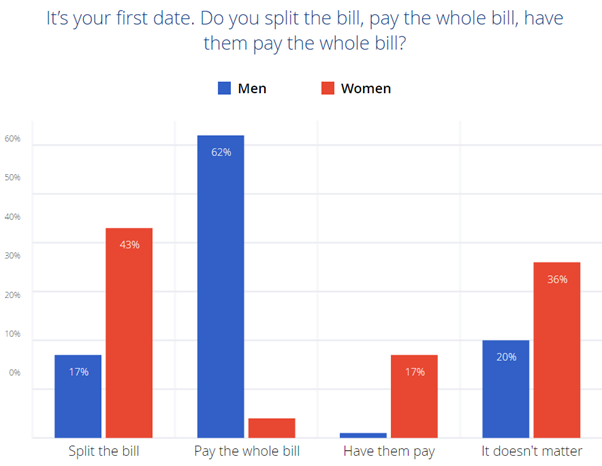
Source: OkCupid, A woman’s advantage.
Profits Are Progressive
10 May 2016 Leave a comment
in applied price theory, economics of media and culture, entrepreneurship, industrial organisation, survivor principle, theory of the firm Tags: anti-market bias, entrepreneurial alertness, profit and loss, rational irrationality, superstars
@Economicpolicy shows that top CEO pay has been a miserable rollercoaster for 15 years
25 Apr 2016 Leave a comment
What a $15 Minimum Wage Would Do
20 Apr 2016 Leave a comment
in applied price theory, economics of media and culture, entrepreneurship, job search and matching, labour economics, managerial economics, minimum wage, organisational economics, personnel economics, theory of the firm Tags: living wage, offsetting behavior, The fatal conceit
Forever Contemporary – The Economics of Ronald Coase | Free book from Institute of Economic Affairs
11 Apr 2016 Leave a comment
in history of economic thought, industrial organisation, law and economics, property rights, Ronald Coase, theory of the firm
Summary:
- R. H. Coase (1910–2013), a leading modern figure in the classical liberal tradition, was awarded the Nobel Prize in Economics in 1991 for his analysis of the significance of transaction costs and property rights for the functioning of the economy.
- Before Coase’s work in the 1930s, there was no real understanding of the relation between the theory of the firm and the theory of markets. Coase showed that the size and structure of firms, and the location of the border between internal exchange within the firm and external exchange through markets, are systematically related to the costs of transactions.
- These transaction costs, which Coase termed ‘costs of using the price mechanism’, include search and information costs (those involved in finding business partners, rather than having to produce your own inputs), bargaining costs (which rise sharply with the number of contractual partners) and enforcement costs (which, in the absence of a strong and effective legal framework, depend largely on trust in partners). When these costs alter dramatically, for example, as a result of introducing innovative technology, we can expect substantial alterations in firm and market structures.
- Coase was a pioneer in the modern analysis of environmental issues. He showed that, with clear property rights and low transactions costs, private solutions to many environmental problems can be achieved without government regulation. Such solutions were logically independent of the initial distribution of property rights. This is highly relevant to a number of modern economic problems which the government currently handles badly, such as land-use planning.
- His work has had a profound effect on later generations of economists, several of whom themselves won Nobel Prizes. His work on environmental issues, for example, influenced another Nobel Prizewinner in Elinor Ostrom, whose work focused on how common pool resources could be used effectively with minimal government intervention. This is especially relevant to debates about environmental and ecological degradation in forestry, fishing and game animal resources – perhaps particularly in developing economies.
- Similarly his work on the firm led to the development of the ‘New Industrial Economics’, now associated with Oliver Williamson, which has changed our understanding of issues of economic governance. This is relevant to current concerns over corporate social responsibility.
- Coase’s editorship of the Journal of Law and Economics over many years did much to stimulate economic analysis of legal institutions, an innovation which has had a major influence on public policy, particularly in the US. It has fed, for instance, into recommendations for accident compensation.
- Coase’s insights have challenged economists’ assumptions about the nature of public goods, which he demonstrated could often be provided more effectively by various forms of private initiative. He also illuminated such varied topics as the allocation of spectrum bandwith, the regulation of financial institutions and water resource management.
- Methodologically, Coase was opposed to ‘blackboard economics’ which relied on theory or econometric analysis at the expense of more practical investigation. He favoured careful examination of case studies and the history of industries when analysing economic policy issues.
- His work retains considerable significance in the twenty-first century. Coase’s analysis of China’s economic advance, published shortly before his death, sheds light on its future prospects, while his transaction cost approach can be argued to explain the new phenomenon of the ‘sharing’ economy which is reshaping businesses and employment. Furthermore his work should continue to be at the forefront of debates surrounding regulation, broadcasting and the environment. If policymakers and the economists who advise them ignore Coase, they are in danger of perpetuating policies which may work ‘in theory’ but do not work effectively in practice.
Source: Forever Contemporary – The Economics of Ronald Coase | Institute of Economic Affairs
@LivingWageUK documents the Achilles heel of the #livingwage
09 Feb 2016 1 Comment
in applied price theory, economics of bureaucracy, economics of regulation, entrepreneurship, managerial economics, minimum wage, organisational economics, personnel economics, politics - New Zealand, Ronald Coase, theory of the firm
Research publicised by a Living Wage UK highlighted the Achilles heel of any living wage proposal. This Achilles heel applies to the voluntary adoption of the living wage and a living wage mandated through minimum wage laws.
The critique to follow accepts pretty much everything claimed by the living wage movement about the benefits of the living wage but simply traces out the consequence of this one promised benefit.

Source: New evidence of business case for adopting Living Wage Living Wage Foundation.
The living wage is substantially above the minimum wage. Offering the living wage will change the composition of the recruitment pool of low-wage employers. This is the Achilles heel of the living wage which Living Wage UK documents in its study it tweeted about and from which I have taken the above snapshot.
Jobseekers would not have considered vacancies by these employers will now apply because of the living wage increase. These better calibre applicants will win those jobs ahead of the jobseekers whose current productivity levels are less than that to justify the cost of the living wage.
Central to the living wage rhetoric is that somehow employees will be more productive because of the adoption of the living wage.
The simplest way of doing that for an employer is to hire more qualified, more productive employers are no longer a hire the type of people you currently hire. They will be unemployed or pushed into the non-living wage sector of the low-wage market.
Best 2 Minimum Wage Cartoons Ever, from Henry Payne, Updated for Seattle's $15 "Economic Death Wish" @HenryEPayne http://t.co/vatUzkHMss—
Mark J. Perry (@Mark_J_Perry) August 18, 2015
A living wage is an exclusionary policy where ordinary workers, often with families who are not productive enough to produce $19.25 per hour living wage plus overheads will never be interviewed.
The workers with the type of skills that currently win those jobs covered by a living wage increase will not be shortlisted because the quality of the recruitment pool will increase because of the living wage.
There will be an influx of more skilled workers attracted by the higher wages for living wage jobs. They will go to the head of the queue and displaced workers who currently apply for and win these jobs before the adoption of the living wage.
Any extra labour productivity from paying a living wage increase is in doubt because low skilled service sectors are notorious for their low potential for productivity gains. They are the bread-and-butter of Baumol’s disease.
The modern theories of the firm focus, in part or in full on reducing opportunistic behaviour, cheating and fraud in employment relationships. The cost of discovering prices and making and enforcing contracts and getting what you pay for are central to Coase’s theory of the firm put forward in 1937.
The profits of entrepreneurs for running a firm is directly linked from their successful policing of the efforts of employees and sub-contractors to ensure the team and each member perform as promised and individual rewards matched individual contributions (Alchian and Demsetz 1972; Barzel 1987). Alchian and Demsetz’s (1972) theory of the firm focused on moral hazard in team production. As they explain:
Two key demands are placed on an economic organization-metering input productivity and metering rewards.
The main rationale in personnel economics from everything ranging from employer funding of retirement pensions to the structure of promotions and executive pay including stock options is around better rewarding self-motivating employees who strive harder and reducing the costs of monitoring employee effort.
At bottom, the efficiency wage hypothesis is entrepreneurs are unaware of the higher quality and greater self-motivation of better paid recruits for vacancies but wise bureaucrats and farsighted politicians notice these gaps in the market. Bureaucrats and politicians notice these gaps in the market before those who gain from superior entrepreneur alertness to hitherto untapped opportunities for profit do so and instead leave that money on the table.
It’s kicking the living wage movement when it is down to mention that low paid workers with families will lose a considerable part of the living wage increase because of reductions in family tax credits and in-kind assistance from the government that are linked to their pay.
Their jobs are put at risk because of a large increase in the cost of employing them to their employers. Their take-home pay after taxes, family tax credits and other government assistance increases by much less. This is a pointless gamble with job security because of the much small increase in the take-home pay of many breadwinners on the living wage.
Workplace safety, spans of control and directors’ duties
19 Jan 2016 Leave a comment
in applied price theory, applied welfare economics, economics of regulation, entrepreneurship, health and safety, industrial organisation, labour economics, law and economics, occupational choice, politics - New Zealand, survivor principle, theory of the firm Tags: job safety, workers compensation
Unharnessed painters work amid the Eiffel Tower. Circa 1910. http://t.co/N7yE7OaKGm—
Old Pics Archive (@oldpicsarchive) June 13, 2015
Workplace safety arises as a by-product of economic growth. Risks in the workplace and outside that would not countenance now were routine a few decades ago because the risk of eliminating them was high.
The soon to take effect New Zealand health workplace safety legislation makes it much more difficult to have independent directors and part-time directors of companies. That will both weaken the ability of shareholders to prevent insider control as well as introduce a diversity of views onto boards of directors.

The resignation of Sir Peter Jackson is an example of this. Talented entrepreneurs are no longer able to run large numbers by sitting on the board and intervening on a management by exception basis.
Rupert Murdoch as an example of an executive able to run a global empire. He would ring up the chief executives of his subsidiaries for one minute to month. If they are talking about something interesting, he would listen for longer. He was the ultimate one-minute manager who built a global empire around his supreme entrepreneurial talent.
The new legislation on workplace safety will increase the cost of building a successful business from the ground up. Entrepreneurs will not be able to quickly intervene in the company and dismiss underperforming executives who look after things while they are away. This is because they are not on the Board of Directors.
One constraint on the growth of any firm is entrepreneurs have a limited span of control (Coase 1937; Williamson 1967, Lucas 1978; Oi 1983a, 1983b). A span of control is the number of subordinates that an individual supervisor has to control and lead either directly or through a hierarchical managerial chain (Fox 2009). There are only so many tasks that even the most able of entrepreneurs can carry out in one day. Over-stretched spans of control motivate entrepreneurs to hire professional managers and delegate to them a wide range of decision-making rights over the firms they own (Williamson 1975; Foss, Foss and Klein 2008).
Entrepreneurs and the professional managers they hired to assist them must divide their respective time between monitoring employees, identifying new business opportunities, forecasting buyer demand and running the other aspects of their business (Lucas, 1978; Oi 1983, 1983b, 1988; Foss, Foss, and Klein 2008). The larger is the firm, the more employees there are for the entrepreneur to direct, monitor and reward. These costs of directing and monitoring employees will increase with the size of the firm and larger firms will encounter information problems not present in smaller firms (Alchian and Demsetz 1972; Stigler 1962)
The time of the more talented entrepreneurs is more valuable because they had the superior managerial skills and entrepreneurial alertness to make their firms large in the first place and remain deft enough to survive in competition. Time spent on the supervision of employees is time that is spent away from other uses of the talents that got these more able entrepreneurs to the top and keeps them there (Williamson 1967; Lucas 1978; Oi 1983b, 1988, 1990; Idson and Oi 1999; Black et al 1999).
Firms in the same industry tend to exhibit systematic differences in their organization of production and the structure of their workforces because entrepreneurial ability is the specific and scarce production input that limits the size of a firm (Lucas, 1978; Oi 1983b). The less able entrepreneurs tend to run the smaller firms while the better entrepreneurs tend to lead both the currently large firms and the smaller firms that are growing at the expense of market rivals (Lucas 1978, Oi 1983b; Stigler 1958; Alchian 1950).
There has been a tremendous improvement in the working conditions over the 20th century. The main driver was the incentive and employers to provide safe workplaces as real wages grew. Adam Smith noted that more dangerous and unpleasant jobs always attracted a wage premium as he explains in the Wealth of Nations:
The five following are the principal circumstances which, so far as I have been able to observe, make up for a small pecuniary gain in some employments, and counterbalance a great one in others: first, the agreeableness or disagreeableness of the employments themselves; secondly, the easiness and cheapness, or the difficulty and expense of learning them; thirdly, the constancy or inconstancy of employment in them; fourthly, the small or great trust which must be reposed in those who exercise them; and, fifthly, the probability or improbability of success in them.
First, the wages of labour vary with the ease or hardship, the cleanliness or dirtiness, the honourableness or dishonourableness of the employment. Thus in most places, take the year round, a journeyman tailor earns less than a journeyman weaver. His work is much easier. A journeyman weaver earns less than a journeyman smith. His work is not always easier, but it is much cleanlier. A journeyman blacksmith, though an artificer, seldom earns so much in twelve hours as a collier, who is only a labourer, does in eight. His work is not quite so dirty, is less dangerous, and is carried on in daylight, and above ground.
Honour makes a great part of the reward of all honourable professions. In point of pecuniary gain, all things considered, they are generally under-recompensed, as I shall endeavour to show by and by. Disgrace has the contrary effect.
The trade of a butcher is a brutal and an odious business; but it is in most places more profitable than the greater part of common trades. The most detestable of all employments, that of public executioner, is, in proportion to the quantity of work done, better paid than any common trade whatever.
Hunting and fishing, the most important employments of mankind in the rude state of society, become in its advanced state their most agreeable amusements, and they pursue for pleasure what they once followed from necessity. In the advanced state of society, therefore, they are all very poor people who follow as a trade what other people pursue as a pastime. Fishermen have been so since the time of Theocritus. A poacher is everywhere a very poor man in Great Britain. In countries where the rigour of the law suffers no poachers, the licensed hunter is not in a much better condition. The natural taste for those employments makes more people follow them than can live comfortably by them, and the produce of their labour, in proportion to its quantity, comes always too cheap to market to afford anything but the most scanty subsistence to the labourers.
Disagreeableness and disgrace affect the profits of stock in the same manner as the wages of labour. The keeper of an inn or tavern, who is never master of his own house, and who is exposed to the brutality of every drunkard, exercises neither a very agreeable nor a very creditable business. But there is scarce any common trade in which a small stock yields so great a profit…
The wages in any particular job will vary with the risks that are known to the worker in that job. That is an important qualification.
Competition in labour markets ensures that the net advantages of different jobs will tend to equality. This theory of the labour market originating in Adam Smith, which drives much of modern labour economics became to be known as the theory of compensating differentials.

Firms can choose their production technology to offer workers greater safety or they can economize on safety and offer the savings to workers in the form of higher wages. There is a trade-off in offering more safety or higher wages, holding constant the level of profits. As Kip Viscusi explains:
Wage premiums paid to U.S. workers for risking injury are huge—in 1990 they amounted to about $120 billion annually, which was over 2 percent of the gross national product, and over 5 percent of total wages paid.
These wage premiums give firms an incentive to invest in job safety because an employer who makes his workplace safer can reduce the wages he pays. Employers have a second incentive because they must pay higher premiums for workers’ compensation if accident rates are high.
One of the effects of safety regulation is the employers no longer have to pay this wage premium in more dangerous or disagreeable jobs but as Fishback wrote:
Studies of wages before and after the introduction of workers’ compensation show, however, that non-union workers’ wages were reduced by the introduction of workers’ compensation. In essence, the non-union workers “bought” these improvements in their benefit levels.
Even though workers may have paid for their benefits, they still seem to have been better off as a result of the introduction of workers’ compensation. Many workers had faced problems in purchasing accident insurance at the turn of the century. Workers’ compensation left them better insured, and allowed many of them to spend some of their savings that they had set aside in case of an accident.
What literature there is about suggest that workers overestimate small risks and underestimate large risks. Surveys of manufacturing employment show that one third of workers quit because they found out the job they accepted was more dangerous than they expected.
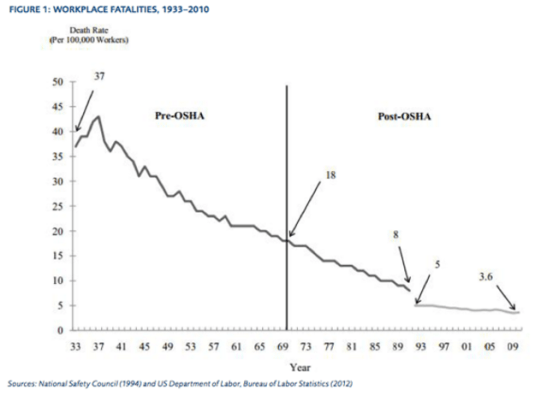
Source: Evaluating OSHA’s Effectiveness and Suggestions for Reform | Mercatus
One clear trend of the 20th century is as countries got richer, workers demanded more safety at work and larger wage premiums. Market incentives for better worker safety dwarf legal incentives such as from being sued, which in turn dwarf regulatory incentives.
There is also evidence of a glass coffin effect. About 95% of workplace deaths of men. Indeed, there are some interesting journal papers about how occupational choice is affected by motherhood, sole motherhood and sole fatherhood. Single parents are more cautious about their occupational choices.
It is unfortunate that the unions in New Zealand opposes a risk based system of workers’ compensation. The current system is not only no fault, employers pay premiums based on the risks of their industry, not of their individual workplace. There is plenty of evidence to show the charging premiums based on the risks of an accident and the previous record of workplace safety greatly reduces workplace deaths and injuries as Viscusi explains:
The workers’ compensation system that has been in place in the United States throughout most of this century also gives companies strong incentives to make workplaces safe. Premiums for workers’ compensation, which employers pay, exceed $50 billion annually. Particularly for large firms, these premiums are strongly linked to their injury performance.
Statistical studies indicate that in the absence of the workers’ compensation system, workplace death rates would rise by 27 percent. This estimate assumes, however, that workers’ compensation would not be replaced by tort liability or higher market wage premiums.
The firm has nothing to do with economies of scale
08 Jan 2016 Leave a comment
in applied price theory, industrial organisation, Ronald Coase, theory of the firm Tags: transaction costs
The average age of managers as a cause of the 1970s productivity slowdown
16 Dec 2015 Leave a comment
in applied price theory, business cycles, labour economics, labour supply, macroeconomics, occupational choice, personnel economics, theory of the firm
Jim Feyrer put forward a clever hypothesis about the sudden decline in the average quality of managers as a major contributor to the 1970s productivity slowdown. His hypothesis is a good contribution to real business cycle theory because what could be more random a shock than a demographic shock arising from the baby boom.
Feyrer’s hypothesis builds on Robert Lucas’s theory of the entrepreneur and the optimal size of the firm. The better entrepreneurs can manage larger spans of control.
Specifically, these more talented entrepreneurs can spread their skills and vision over a larger workforce thereby raising its productivity and that of the firm. Better quality managers are better trainers, better leaders, better problem solvers and better at recruiting and retaining staff.
If managerial skill and talent accumulates with experience, an influx of young workers into the workforce with the influx of the baby boomers into the workforce will lower the average quality of entrepreneurs. This will show up empirically as a decrease in the average age of managers and with that their experience and skills.
With the average age of the labour force lower during the influx of the baby boomers, more marginal managers have to be promoted into managerial positions to supervise younger employees. Lower managerial quality will lower the productivity of the workforce as a whole.
If managerial talent and skill is to have any meaning, a more talented manager should be able to extract greater productivity from the same quality labour force. Lazear points out that
Supervision and management are fundamental in personnel economics and in the theory of the firm… Boss effects are large and significant. Most important, bosses vary substantially in their quality. A very good boss increases the output of the supervised team over that supervised by a very bad boss by about as much as adding one member to the team.
The influx of less able managers in the 1970s, as shown by a five-year reduction in the median age of US managers in the chart below, accounted for 20% of the observed productivity slowdown and resurgence in the 1970s and 1980s according to Feyrer. To fill vacancies, employers had to drop their hiring standards for managers.
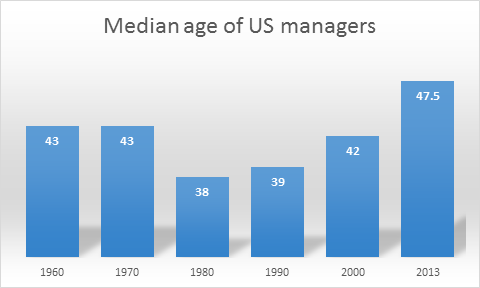
Source: Jim Feyrer The US Productivity Slowdown, the Baby Boom, and Management Quality, Journal of Population Economics (2011) and Bureau of Labor Statistics Employed persons by detailed occupation and age (2013).
When the median age of managers rose in the 1990s, and along with it the average of quality of management, this productivity slowdown was reversed. Both the increase in the decrease in the age of managers are random productivity shocks in the tradition of real business cycle theory.
The average age of the US manager was 38 in 1980 and 39 in 1990. There is no US managerial occupation with an average age of less than 40 in 2013. The fifth managerial occupation with the lowest managing age is food service managers. The highest outside of agriculture is chief executives,
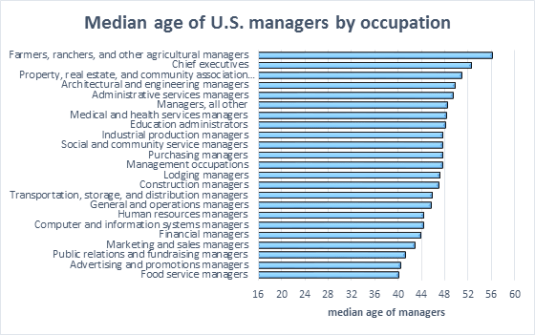
Source: Bureau of Labour Statistics Employed persons by detailed occupation and age (2013).
One of the mocking tones directed at real business cycle theory is it was supposed to require a regular forgetting of technologies so that productivity fell and then the loss technologies were remembered a few years later to have a business cycle.
That forgetting and remembering is what happened with the average age of managers and labour productivity in the 1970s. Management quickly lost five years of experience then slowly regained it with matching productivity swings and roundabouts.
Feyrer is another addition to a long line showing that business cycles can arise from the sum of random shocks, rather than one big shock, as Prescott suggested in 1986:
Another Summers question is, Where are the technology shocks? Apparently, he wants some identifiable shock to account for each of the half dozen postwar recessions. But our finding is not that infrequent large shocks produce fluctuations; it is, rather, that small shocks do, every period.


Recent Comments