Why Cosmonauts Have Never Splashed Down
18 Feb 2018 Leave a comment
in transport economics Tags: space
Why Are Rockets Launched in Florida? @TaxpayersUnion
17 Feb 2018 Leave a comment
in transport economics Tags: space
Driving a Ford Model T Is a Lot Harder Than You’d Think! We Tried It
16 Feb 2018 Leave a comment
in economic history, transport economics Tags: creative destruction
2009 Chevy Malibu vs 1959 Bel Air Crash Test
12 Feb 2018 Leave a comment
in transport economics Tags: road safety
4 Things You’re Not Allowed to Do in Space
12 Feb 2018 Leave a comment
in transport economics Tags: space
How Dangerous is Deep Space Travel to Mars and Beyond ?
10 Feb 2018 Leave a comment
in transport economics Tags: Mars, space
To Mars by 1982 – A Manned Mission Too Far, Too Soon ?
08 Feb 2018 Leave a comment
in transport economics Tags: Mars, space
My driving skills are increasingly obsolete on late model cars
06 Feb 2018 1 Comment
in economics of media and culture, transport economics
Maybe 8 or 9 years ago, I discovered hand breaks had become electronic. After an international flight, a long delay at Tullamarine airport for a storm, subsequent chaos, and arriving in Hobart past midnight, I was upgraded to a sports utility. I could not find the break. Just as I was getting out of the car to go back to see if the office was still open to tell me where the handbrake was I noticed this tiny little retractable button with brake on it.
Next it was starter buttons on cars. I could not find anywhere to put the key in so I went back to the rental office; they told me to press the button and as long as the key was in the car, the car would start.

Recently, I discovered not only did you have to have the key in the car, you had to have your foot on the brake or the car did not start.
To make things worse, this car had an electronic hand brake hidden in the middle of the car next to the gear shaft. It did not retract or stay up or anything to indicate it was on. The only way you knew it was on was a light was on the middle of the speedometer.

Isn’t it more to do with Americans commuting further and faster? Bikes just do not cut it given the distance involved?
04 Feb 2018 Leave a comment
in environmental economics, transport economics

PUBLIC TRANSPORT RECEIVES A FAIR HEARING
28 Jan 2018 1 Comment
in applied welfare economics, politics - New Zealand, transport economics
It is not a case of under-investment denying buses and trains their day in the sun. The overseas evidence is rail cost estimates and passenger forecasts are much more politicised than those for roads because of the political pressures to invest in more public transport no matter what (Flyvbjerg et al. 2006).
There is more organised political support for buses and trains and considerable organised (often NIMBY based) opposition to road building. A major driver of cost blow-outs in the road projects reviewed by the Ministerial Advisory Group on Roading Costs (2006) was scope changes to appease local political pressures to mitigate community and environmental impacts. Community group driven litigation under the Resource Management Act to frustrate NZTA road projects is proliferating. Their High Court loss which prevented the building of the Basin Overpass in Wellington is a recent example.
In contrast, light rail proposals such as a billion-dollar proposal in Wellington City for a few kilometers of track including a $400 million tunnel were entertained for far longer than any sensible benefit cost analysis could justify. Quite fanciful fast-rail proposals costing many hundreds of millions of dollars are floated in by-elections and from time to time by the commentariat and rent seekers.
The proposed upgrade the Auckland to Northland railway line and the rail link to the port was costed by the Taxpayers’ Union (2015) at $198 million. Dreams of fast rail receives a generous hearing despite mind blowing costs and incredulous and sometimes impossible freight and passenger forecasts.
Buses and trains are not the forgotten children of urban transport policy. The Greens are passionate about massive investment in buses and trains at the expense of roads. Labour is also competing for the same urban middle-class votes so it too champions more public transport. In an MMP Parliament, all parties have an incentive respond to political pressures in a fine-tuned way when voting on budgets.
Public transport advocates do well in the scramble for taxpayers’ money. The road with the worst benefit-cost ratio of all in the post implementation reviews was the Auckland Northern Busway, which cost $182 million. It had a cost benefit ratio of a miserable 1.2 at approval and a no better 1.3 after its completion. With a benefit-cost ratio rounding down to one with ease, this bus network upgrade must have had political muscle behind it to dam the taxpayers, full steam ahead.
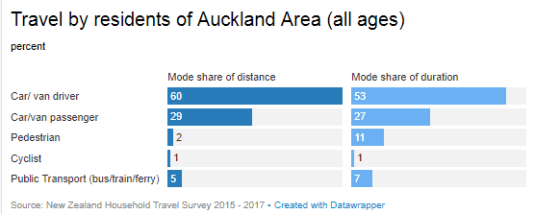

 Utopia, you are standing in it!
Recent Comments