
Source: The social cost of road crashes and injuries | Ministry of Transport.
Celebrating humanity's flourishing through the spread of capitalism and the rule of law
07 Mar 2016 Leave a comment
in economic history, transport economics
02 Mar 2016 Leave a comment
in economics, transport economics
HT: Julian Weeks
01 Mar 2016 Leave a comment
in administration, transport economics

My blog post on bicycles must go at night attracted a fair degree of personal abuse from the cycling sub-reddit. Another local economist is going where angels fear to tread.
28 Feb 2016 Leave a comment
in economics of bureaucracy, environmental economics, global warming, politics - New Zealand, Public Choice, transport economics Tags: carbon footprint, carbon offsets, Left-wing hypocrisy, New Zealand Greens, rational irrationality
Living the clean, green lifestyle means more than just buying carbon-offs in the same way that indulgences for sins were sold by the mediaeval Catholic Church. Russell Norman was an MP for 9 of the 12 months covered by this chart. He consistently had one of the smallest carbon footprints of a Green MP even when he was still co-leader of the Greens and not just a backbench MP.
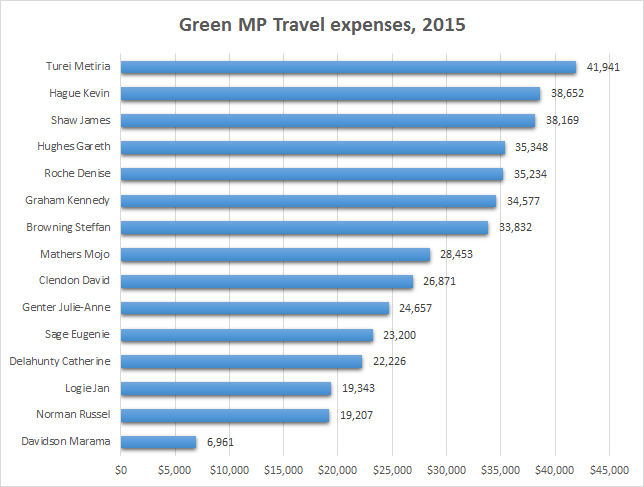
Source: New Zealand Parliament – Members’ expense disclosure from 1 October to 31 December 2015.
28 Feb 2016 1 Comment
in economics of bureaucracy, environmental economics, global warming, politics - New Zealand, Public Choice, rentseeking, transport economics Tags: carbon footprint, New Zealand Greens, rational irrationality
10 of the 14 green MPs have above-average air travel expenses – have an above average carbon footprint for a member of the New Zealand Parliament. It is not easy to be Green.
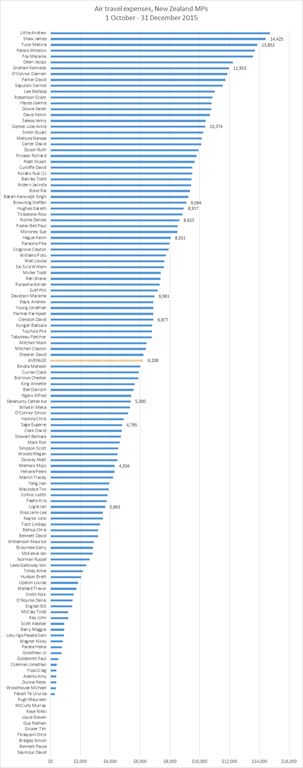
Source: New Zealand Parliament – Members’ expense disclosure from 1 October to 31 December 2015.
28 Feb 2016 Leave a comment
in environmental economics, global warming, politics - New Zealand, transport economics Tags: Green Left, Left-wing hypocrisy, Leftover Left, New Zealand Greens, rational irrationality
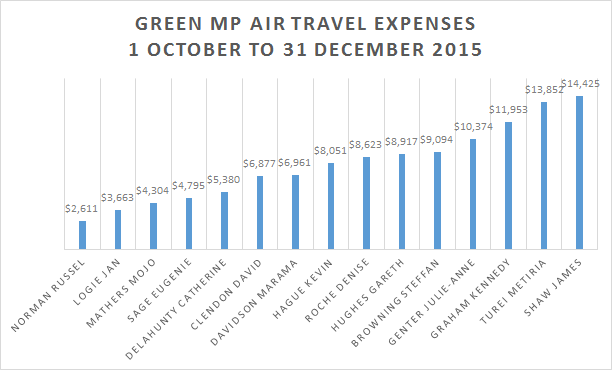
Source: New Zealand Parliament – Members’ expense disclosure from 1 October to 31 December 2015.
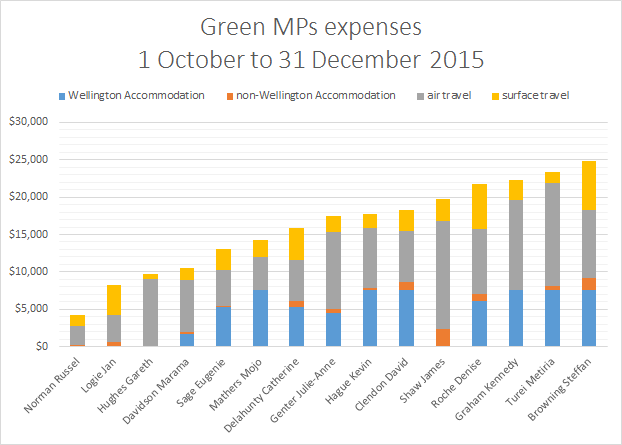
Source: New Zealand Parliament – Members’ expense disclosure from 1 October to 31 December 2015.
23 Feb 2016 Leave a comment
in economic history, transport economics, urban economics
15 Feb 2016 Leave a comment
in administration, economics of regulation, transport economics
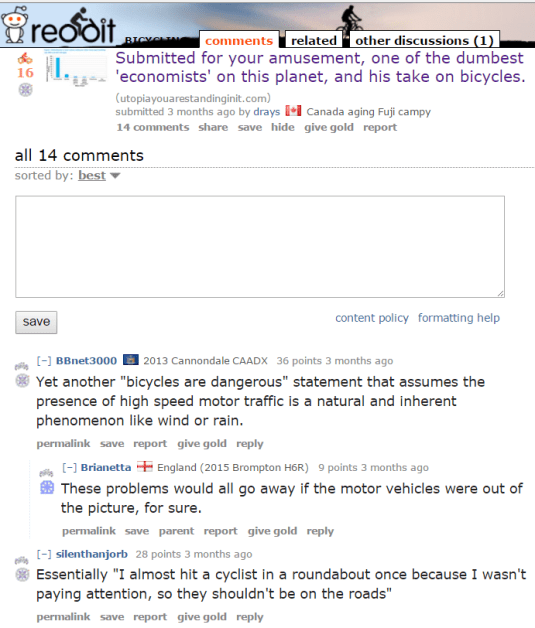
Bicyclists get very upset when they are told about the dangers. They immediately resort to personal abuse about my post arguing that bicycles at night should be banned.
This anger is another reason why bikes must go. Bicyclists are surly people who respond aggressively when they should do more reserved and careful.
11 Feb 2016 Leave a comment
in entrepreneurship, technological progress, transport economics
11 Feb 2016 Leave a comment
in climate change, environmental economics, global warming, transport economics, urban economics Tags: climate change adaptation, Matthew Kahn
10 Feb 2016 Leave a comment
in applied price theory, applied welfare economics, environmental economics, global warming, transport economics, urban economics Tags: climate adaptation
If you do not follow this guy’s blog, there is a serious gap in your education in urban and environmental economics especially with regard to climate change.
09 Feb 2016 Leave a comment
in energy economics, environmental economics, global warming, politics - New Zealand, transport economics, urban economics
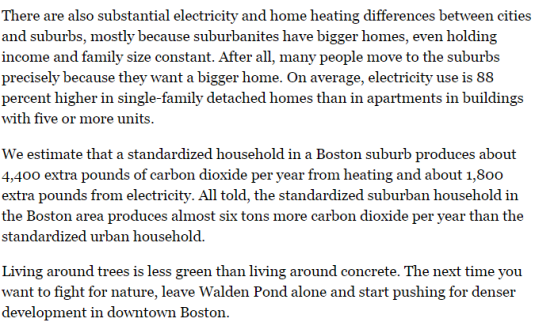
It is hard to imagine any merchant who harmed the environment as much as Henry David Thoreau…
We are a destructive species, and if you love nature, stay away from it. The best means of protecting the environment is to live in the heart of a city.
Ed Glaeser
Source: If you love nature, move to the city – The Boston Globe.
04 Feb 2016 Leave a comment
in discrimination, gender, labour economics, labour supply, occupational choice, transport economics, urban economics Tags: commuting times, reverse gender gap
I lived in Japan so that 60% extra time the Japanese men spend travelling to and from work in those cramped trains is not to be underrated.
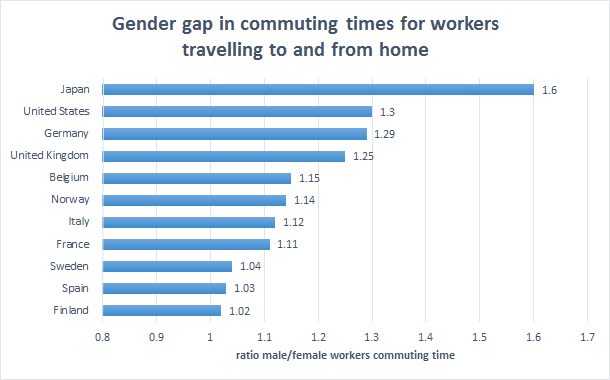
Source: OECD Family Database – OECD.
04 Feb 2016 Leave a comment
in economic history, politics - New Zealand, transport economics, urban economics
Transport Blog was making much of some data about how a lot of people used public transport and New Zealand in the 1950s:
Take Auckland as an example. According to Paul Mees [Transport for Suburbia, p. 21], in 1954 Auckland’s public transport network “accounted for 58 per cent of trips by motorized modes, private transport only 42 per cent. When walking and cycling, which were not surveyed, are taken into account, it is likely that fewer than a third of daily trips were by car.”
… public spending to enable car travel did not respond to existing demand – it was intended to shape future demand. (And in doing so, change the shape of the city).
…
“roads first” transport policies seem less like an exercise in meeting demands, and more of a component of a large social engineering programme.
Transport Blog forgot previous data it dugout on trends in car ownership per capita in New Zealand since 1925. There is an explosive growth in car ownership from the 1950s onwards with the post-war economic boom. The roadbuilding that followed responded to this growing wealth of the New Zealand people rather than the other way round.
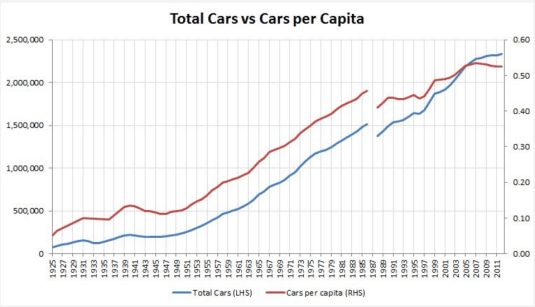
Source: The Infernal Combustion Engine « transportblog.co.nz.
People like owing and driving cars. Transport Blog begrudgingly admits in its post today that cars have some advantages.
Young people save up to buy a car not because they are duped by the enemies of public transport, they save because a car is a good way to get around.
Privately owned cars are more comfortable, faster, more private, more convenient in trip timing, and more flexible for multiple tasks on one trip than any form of public transit. What cannot be avoided as Anthony Downs explains is:
As household incomes rise around the world, more and more people shift from slower, less expensive modes of movement to privately owned cars and trucks.
Downs argues that it is time to settle down and accept what cities are:
…peak-hour traffic congestion is inescapable in large modern metropolitan areas the world over. Business firms want most people on the job during the same hours so that workers can interact efficiently. Many firms also want to locate in low-density establishments scattered across the landscape.
Households want a range of choices of where to live and work, and most want to live in low-density settlements that are separate from poorer households, use private vehicles for most travel and be able to carry out multiple errands on a single trip.
Celebrating humanity's flourishing through the spread of capitalism and the rule of law
Scholarly commentary on law, economics, and more
Beatrice Cherrier's blog
Celebrating humanity's flourishing through the spread of capitalism and the rule of law
Celebrating humanity's flourishing through the spread of capitalism and the rule of law
Celebrating humanity's flourishing through the spread of capitalism and the rule of law
Why Evolution is True is a blog written by Jerry Coyne, centered on evolution and biology but also dealing with diverse topics like politics, culture, and cats.
Celebrating humanity's flourishing through the spread of capitalism and the rule of law
Celebrating humanity's flourishing through the spread of capitalism and the rule of law
A rural perspective with a blue tint by Ele Ludemann
DPF's Kiwiblog - Fomenting Happy Mischief since 2003
Celebrating humanity's flourishing through the spread of capitalism and the rule of law
The world's most viewed site on global warming and climate change
Tim Harding's writings on rationality, informal logic and skepticism
A window into Doc Freiberger's library
Let's examine hard decisions!
Commentary on monetary policy in the spirit of R. G. Hawtrey
Thoughts on public policy and the media
Celebrating humanity's flourishing through the spread of capitalism and the rule of law
Politics and the economy
A blog (primarily) on Canadian and Commonwealth political history and institutions
Reading between the lines, and underneath the hype.
Economics, and such stuff as dreams are made on
"The British constitution has always been puzzling, and always will be." --Queen Elizabeth II
Celebrating humanity's flourishing through the spread of capitalism and the rule of law
Celebrating humanity's flourishing through the spread of capitalism and the rule of law
WORLD WAR II, MUSIC, HISTORY, HOLOCAUST
Undisciplined scholar, recovering academic
Celebrating humanity's flourishing through the spread of capitalism and the rule of law
Res ipsa loquitur - The thing itself speaks
In Hume’s spirit, I will attempt to serve as an ambassador from my world of economics, and help in “finding topics of conversation fit for the entertainment of rational creatures.”
Researching the House of Commons, 1832-1868
Articles and research from the History of Parliament Trust
Reflections on books and art
Posts on the History of Law, Crime, and Justice
Celebrating humanity's flourishing through the spread of capitalism and the rule of law
Exploring the Monarchs of Europe
Cutting edge science you can dice with
Small Steps Toward A Much Better World
“We do not believe any group of men adequate enough or wise enough to operate without scrutiny or without criticism. We know that the only way to avoid error is to detect it, that the only way to detect it is to be free to inquire. We know that in secrecy error undetected will flourish and subvert”. - J Robert Oppenheimer.
The truth about the great wind power fraud - we're not here to debate the wind industry, we're here to destroy it.
Celebrating humanity's flourishing through the spread of capitalism and the rule of law
Celebrating humanity's flourishing through the spread of capitalism and the rule of law
Economics, public policy, monetary policy, financial regulation, with a New Zealand perspective
Celebrating humanity's flourishing through the spread of capitalism and the rule of law
Restraining Government in America and Around the World
 Utopia, you are standing in it!
Recent Comments