In 1971 a woman survived a fall from 10,000 feet into the Amazon Jungle
12 Jul 2016 Leave a comment
in economics, economics of media and culture, transport economics Tags: air crashes, \
Will there ever be self-drive cars?
04 Jul 2016 1 Comment
in transport economics Tags: aviation safety, creative destruction, road safety, self drive cars
An astute commentator on the technology Sub-Reddit pointed out that commercial aircraft fly on autopilot but active involvement of pilots is expected. No one ever contemplates the contrary.
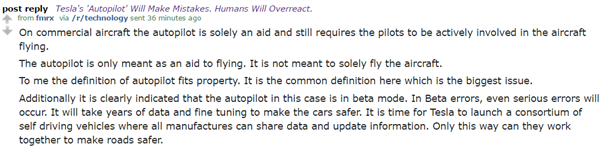
The autopilot on a plane has a far less challenging environment than a self driving. Planes do not have to navigate passed other planes within a fraction a second of collision, along with pedestrians and bicyclists.
Planes do not have the follow hyper-accurate maps and turn and swerve almost continuously to avoid a collision as distinct from turbulence or an error that is quickly corrected by pilot before any danger is encountered.
As far as self drive cars will go, I think they will be confined to driver assist functions with a driver always having to have his hands on the wheel.
A peculiarity of self drive cars is the brand name of Googleand Tesla are so strong that they have been able to hold off the usual Luddite reaction to new technologies.
The Messy Ethics of Self Driving Cars
12 Jun 2016 Leave a comment
in economics, economics of media and culture, transport economics Tags: road safety, self-driving cars
Desperately seeking to agree with @JulieAnneGenter on transport investment quality
11 Jun 2016 Leave a comment
in applied price theory, applied welfare economics, economics of bureaucracy, environmental economics, politics - New Zealand, Public Choice, transport economics, urban economics Tags: cost benefit analysis, KiwiRail, New Zealand Green Party, road pricing
I just wrote an op-ed for National Business Review online (pay-walled) agreeing with an op-ed last week by Green MP Julie Anne Genter on transport investment. My op-ed started
The Taxpayers’ Union welcomes the commitment of the Green Party yesterday to evaluating transport investments without any bias or favouritism to one transport mode over another.
The Taxpayers’ Union could not agree more with Julie Anne Genter when she said that the question ministers should always ask is “what is the best investment we can make?”
This op-ed was my rejoinder to her reply to my op-ed criticising a recent Green Party on national freight policy. That policy called for 25% of all freight by kilometres travelled to each go by rail and road. That would near double their freight market share from 30% currently to 50% when measured by kilometre.
For my troubles I got nothing but criticism and accusations in the comments section in National Business Review Online. A tweet by Genter was far more gracious.
There was no praise in the comment section at the National Business Review online for agreeing with the Green policy. In the first comment I was told I did not understand economics and that
When the policy default is “cut taxes and spending and let me selfishly keep my money” they miss out on the much larger benefit to everyone, including themselves, by nudging or economy to spend more on intrinsically more efficient transport – like rail – and less on alternatives.
No thanks at all for agreeing that transport investments should be the best we can make. After saying that in their recent freight policy, the Greens set targets were specific transport technologies they favour, which are rail and sea freight.

You cannot argue that transport investments should be the best we can make then declare a preference for a particular technology or mode of transport. But let us not quibble over that glaring contradiction.

The broader principle was agreed which is transport investments should be driven by cost benefit analysis and value for money. It should be technology neutral and transport mode neutral. That, of course, means the Greens cannot declare targets for the market shares of particular modes of freight shipment if they want to follow their own policy about value for money.
How Budget Airlines Work
02 Jun 2016 Leave a comment
in applied price theory, economic history, entrepreneurship, transport economics Tags: budget airlines, entrepreneurial alertness
$5.2 billion in rail spending since 2003 budget @JulieAnneGenter @JordNZ
02 Jun 2016 Leave a comment
in politics - New Zealand, transport economics Tags: celebrity technologies, expressive voting, KiwiRail, network economics, picking losers, picking winners, rational irrationality, urban transport
$5.2 billion in rail spending since the 2003 budget! This $5.2 billion does not include any spending on urban rail, commuter train networks or their electrification. The $5.2 billion since the 2003 budget is for the passenger and freight network, not the urban metro contracts
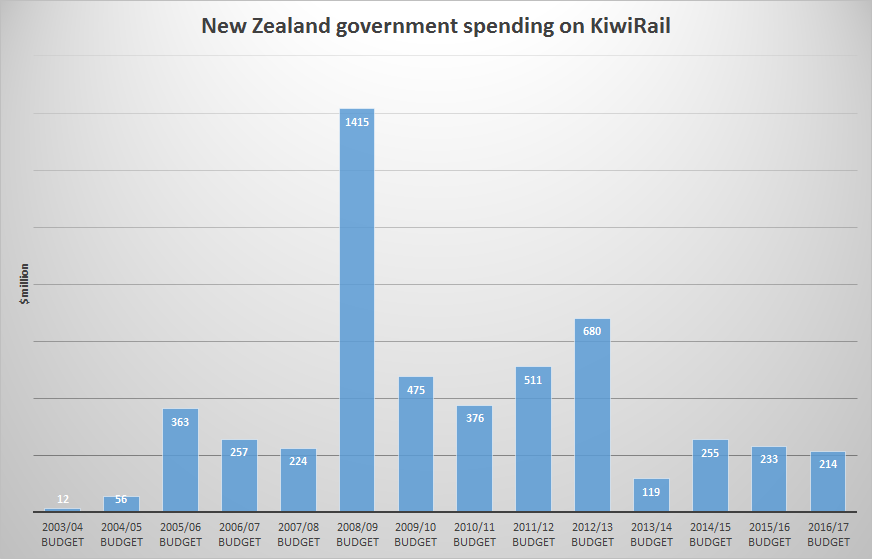
Source: New Zealand Budget Papers, various years.
Desperately waiting for that dividend the taxpayers lose if any of these assets are privatised. The spending listed below in the two charts includes loans, capital injections and the purchase of the track and of the train operator itself. The latter was purchased for $690 million which was soon written down to zero.
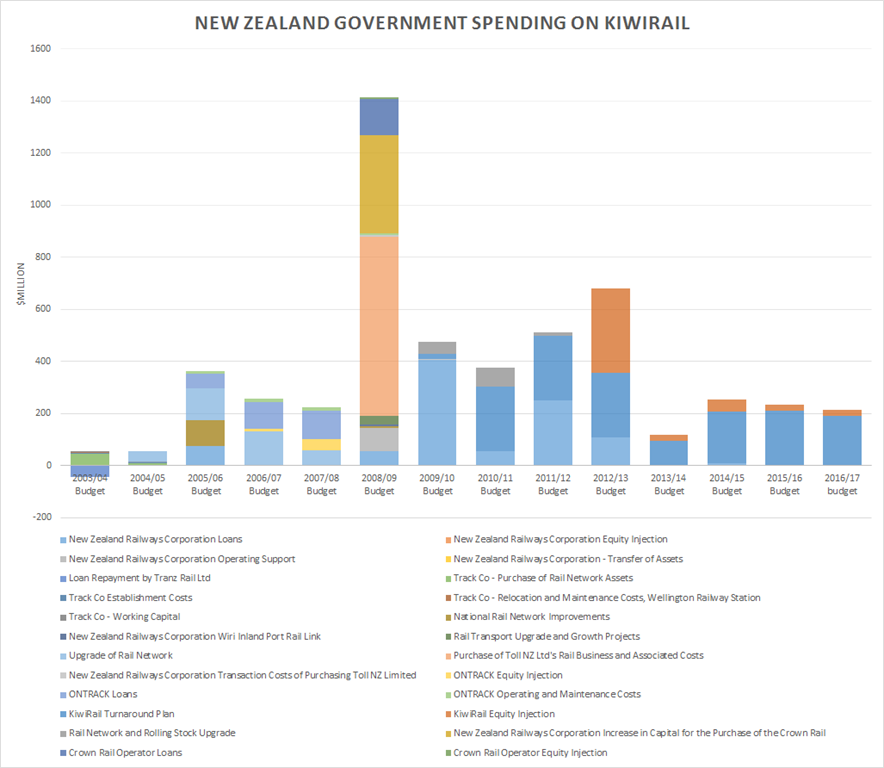
Source: New Zealand Budget Papers, various years.
There is no table because the table format breaks down when blogged.
At various times, OnTrack and KiwiRail was subsidiaries of the New Zealand Railways Corporation, which was the holding company. Now OnTrack is a division of KiwiRail.
#Bikes at night (in the rain) certainly must go
01 Jun 2016 1 Comment
in transport economics Tags: bicycles, club goods, network goods, road safety
 In heavy rain last night, the bike ahead of us with no lights decided to merge into the blind-spot of another car also merging into the central lane. He lived through no good management of his own.
This bicyclist with no lights then joined a pack of three others to slow the traffic down behind them. Only one of the four bicyclists had any lighting or reflective material at all.
They moved in a pack, so the cars including ours could not get around them because the traffic was heavy. Fortunately, the street was well lit so you could see them, just. Bikes must go.
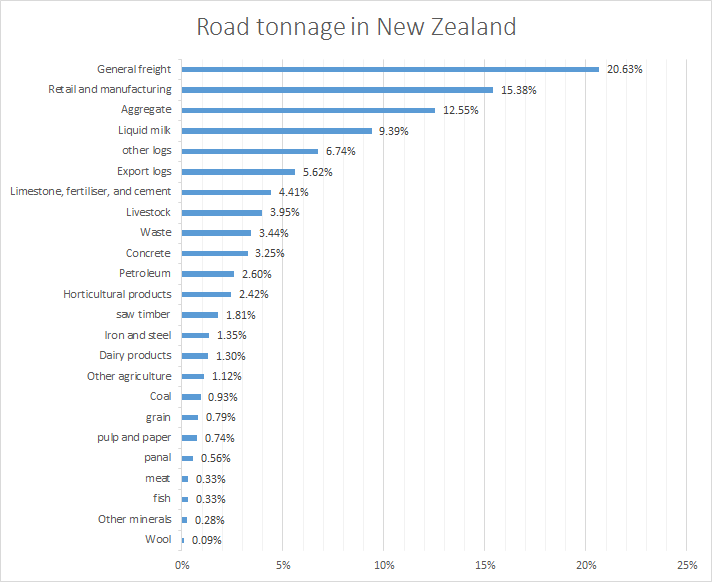
What is freighted by road? @TransportBlog @JulieAnneGenter
26 May 2016 Leave a comment
in environmental economics, industrial organisation, politics - New Zealand, survivor principle, transport economics Tags: celebrity technologies, New Zealand Greens
What is freighted by rail? @TransportBlog @JulieAnneGenter
25 May 2016 Leave a comment
in politics - New Zealand, transport economics Tags: celebrity technologies, New Zealand Greens
The Greens want to expand rail freight but stop mining coal which is 1/5 of rail tonnage.
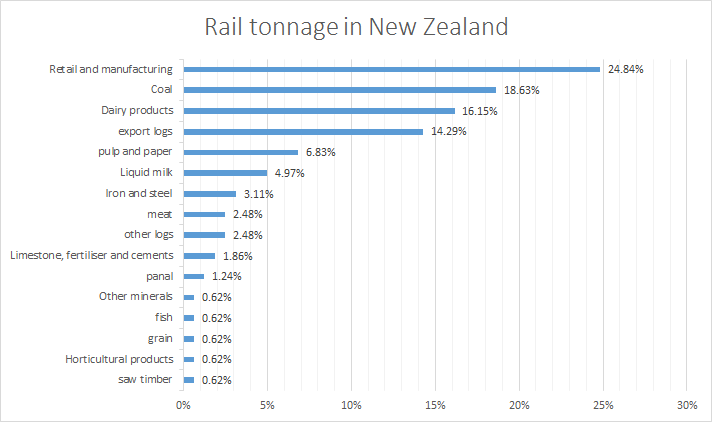
Source: Ministry of Transport (2014). National Freight Demand Study 2014.
@jamespeshaw what do coastal ships ship when they ship 4.2 million tonnes per year?
24 May 2016 Leave a comment
in politics - New Zealand, transport economics Tags: celebrity technologies
If coastal shipping is going to double its freight capacity, and certainly going to need some new ships because the existing ships are unsuited to taking over the current business of road freight.
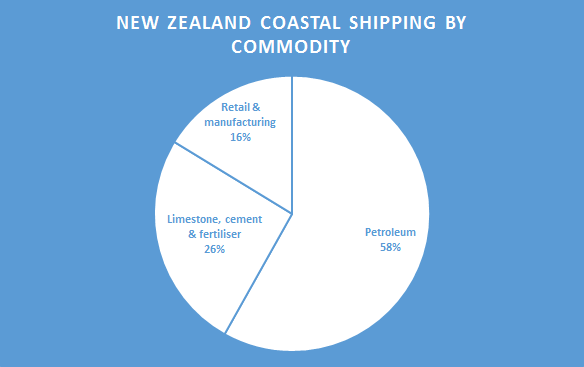
Source: Ministry of Transport (2014). National Freight Demand Study 2014.
@JulieAnneGenter only 21% of freight is contestable by rail
24 May 2016 Leave a comment
in environmental economics, industrial organisation, politics - New Zealand, survivor principle, transport economics Tags: celebrity technologies, New Zealand Greens

Source: International freight transport services | Productivity Commission of New Zealand.

Source: International freight transport services | Productivity Commission of New Zealand.

@jamespeshaw only 8% of freight is contestable by coastal shipping
24 May 2016 Leave a comment
in industrial organisation, politics - New Zealand, survivor principle, transport economics Tags: celebrity technologies, New Zealand Greens
Shipping offers only a tiny bit of competition the rail freight but barely any with road freight

Source: International freight transport services | Productivity Commission of New Zealand.
@JulieAnneGenter road, rail & ships are not substitute modes
24 May 2016 Leave a comment
in politics - New Zealand, transport economics Tags: celebrity technologies, New Zealand Greens
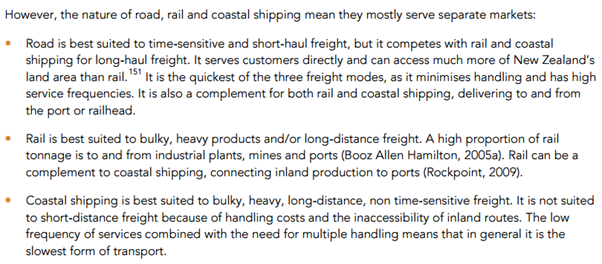
@jamespeshaw how many domestic shipping services in NZ? 16!
24 May 2016 Leave a comment
in energy economics, environmental economics, global warming, politics - New Zealand, transport economics Tags: celebrity technologies, coastal shipping, New Zealand Greens
Of the 4.2 billion million tons of annual coastal shipping in New Zealand, 2.32 million tons of that is petroleum products. The majority of coastal shipping is petroleum products redistributed from the one refinery in New Zealand to the rest of the country. You can’t double that which the Greens wanted to because it is already at its upper limit.

Source: Coastal shipping and modal freight choice | NZ Transport Agency.
@JulieAnneGenter doesn’t know what is shipped through ports
24 May 2016 Leave a comment
in environmental economics, global warming, politics - New Zealand, transport economics, urban economics Tags: celebrity technologies, New Zealand Greens
The Greens today announced a policy to double the amounts of cargo moved by train and shipping. It seems to have forgotten that most cargo moved by ship is bulk cargoes such as cars. Nothing can change the fact that once the ship is unloaded, the cars have to go by truck to the car yard.
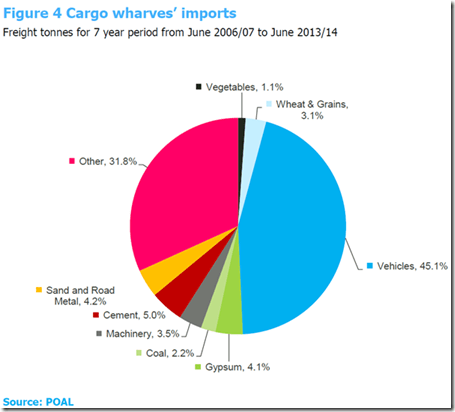
Source: New Zealand Institute of Economic Research. Port study 2 Final report NZIER report to Auckland Council (3 February 2015).
 Utopia, you are standing in it!

Recent Comments