Washington D.C.’s disastrous new streetcar line
21 May 2016 Leave a comment
in technological progress, transport economics Tags: buses, celebrity technologies, light rail
More aircraft should have belly cam as a safety measure
21 May 2016 Leave a comment
in economics, transport economics Tags: air crashes
The surprising number of our accidents result from cabin crew not knowing how badly damaged parts of the aircraft are or the engine is on fire or has fallen off. This should be solved by been able to turn on cameras that give pilots a clear view of the various parts of the aircraft. They should not have to rely on warnings from passengers and cabin crew.
Aircraft cockpits should have dangling fluffy balls as a safety measure against disorientation
20 May 2016 Leave a comment
in transport economics Tags: aircraft safety
A number of aircraft accidents are caused by pilot disorientation regarding the horizon even though they have artificial horizon instruments to tell them their exact orientation. Pilots lose track of up and down and they can even fly upside down through a trick of the inner ear.
I always wondered why this is possible because if you are flying sideways or upside down, should not various loose objects in the cockpit fall and even ending up on the ceiling?

My solution to this is fluffy fur balls in every aircraft cockpit to tell the pilot were they are in addition to the information he gets from his artificial horizon instruments.
Privatizing local bus services could save $5.7 billion
19 May 2016 Leave a comment
in industrial organisation, politics - New Zealand, politics - USA, privatisation, survivor principle, theory of the firm, transport economics, urban economics Tags: privatisation, state owned enterprises
How far can you go with your #Tesla using only their superchargers in USA and Europe?
17 May 2016 Leave a comment
in technological progress, transport economics Tags: electric cars, Tesla
Pierre Desrochers explains why the ‘buy local’ food movement overstates environmental benefits
08 May 2016 Leave a comment
in applied price theory, applied welfare economics, development economics, economic history, economics of media and culture, environmental economics, growth disasters, growth miracles, health economics, industrial organisation, transport economics Tags: food miles
How green art thou? #buswaysforelectriccars not #BuswaysForBuses
06 May 2016 Leave a comment
in energy economics, environmental economics, environmentalism, politics - New Zealand, transport economics, urban economics Tags: busways, do gooders, electric cars, expressive politics, global warming, trade-offs, transport lobby
Finally have something nice to say about electric cars. They will put bus lanes to good use.
A trivial percentage of people take the bus to work In New Zealand. The government has a target of doubling electric car fleet every year (from 2000 in 2016 to 64,000 in 2021).
This decision yesterday to allow them to use busways allows us to relish in seeing environmentalists feud over which technologies are green enough to have access to priority lanes on the road such as those allocated to buses.
Which is more important? Saving the planet or saving the buses; most of them are diesel? Busways are empty at the weekends and many other times.
Queenstown airport night flights another blow to the @WLGAirport runway extension? @JordNZ
01 May 2016 Leave a comment
in transport economics Tags: monopoly pricing, natural monopolies, network industries, rate of return regulation
Queenstown airport has been upgraded to allow for night flights and more international flights. Yet another airport to compete for traffic with the Wellington airport and its $300 million runway extension.
Little wonder the New Zealand-based airlines see this extension is no more than gold plating of the Wellington airport where landing fees will go up to cover this over-capitalisation for little return in value. Over-capitalisation or gold plating is a common way of getting around rate of return regulation of monopolies.

German city installs traffic lights in pavements to protect texting pedestrians
28 Apr 2016 Leave a comment
in economics of media and culture, transport economics Tags: entrepreneurial alertness, road safety, smart phones

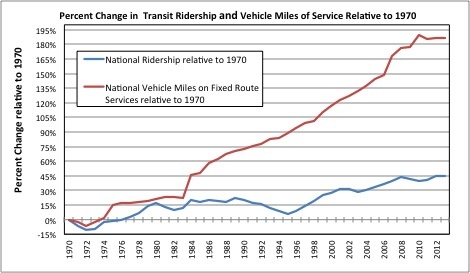
Public Transportation Ridership: Three Steps Forward, Two Steps Back? | @transportblog
19 Apr 2016 Leave a comment
in economic history, transport economics Tags: public transport
Recent data showing declining transit ridership is only the latest news to cast doubt on expectations of a public transit renaissance.
Which occupations have the longest commutes?
05 Apr 2016 Leave a comment
in human capital, labour economics, occupational choice, transport economics, urban economics Tags: commuting times, compensating differentials

Are Electric Cars Really Green?
24 Mar 2016 Leave a comment
in economics, energy economics, environmental economics, transport economics Tags: electric cars
New Zealand’s tourism industry halved in size in the last 2 years but it is only a statistical revision
11 Mar 2016 Leave a comment
in economic history, industrial organisation, politics - New Zealand, transport economics
At 4% of GDP and employment in 2014, that is half estimated size of the New Zealand tourism sector in 2012. Statistics are only estimates. The trouble is politicians and bureaucrats make decisions on the base of them that might not be able to be reversed. Little wonder that Hong Kong prospered by as collecting as few as statistics as possible.
Source: OECD Tourism Trends and Policies 2016 | OECD READ edition.

Source: OECD Tourism Trends and Policies 2014 | OECD READ edition.
The earlier New Zealand data referred to direct and indirect contributions while the latest data refers only to direct contributions. New Zealand is no longer top of the world.
Road crash deaths per 100,000 Americans, British, Germans, French, Italians and Swedes since 2000
09 Mar 2016 Leave a comment
in economic history, transport economics Tags: road safety
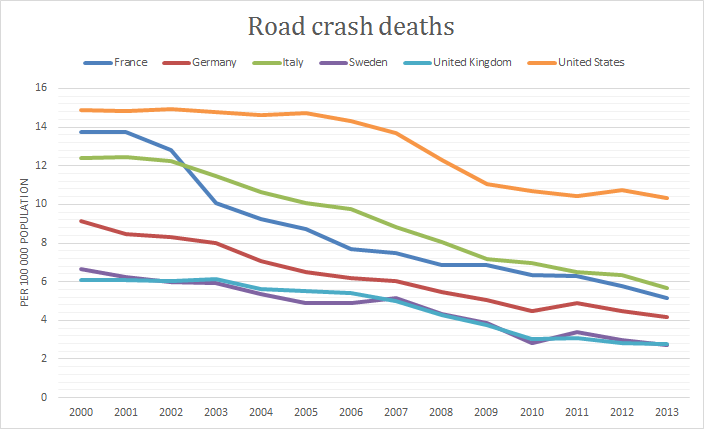
Source: Motor Vehicle Crashes in New Zealand 2014 | Ministry of Transport via International Road Traffic and Accident Database.
International comparison of road crash deaths across the OECD
08 Mar 2016 Leave a comment
in transport economics Tags: road safety
There are surprisingly large differences such as between the USA and Sweden and the UK.
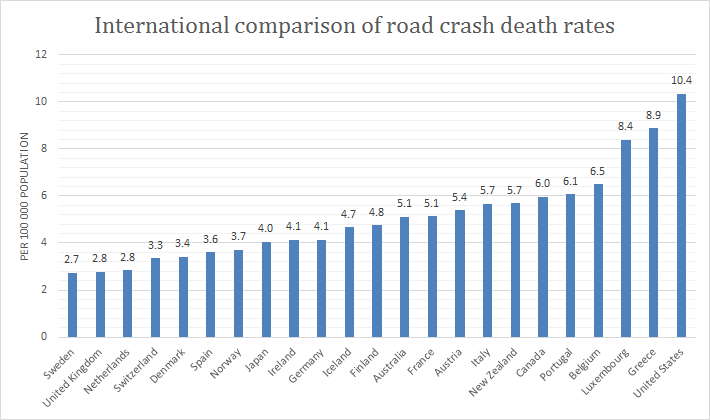
Source: Motor Vehicle Crashes in New Zealand 2014 | Ministry of Transport via International Road Traffic and Accident Database.
 Utopia, you are standing in it!
Recent Comments