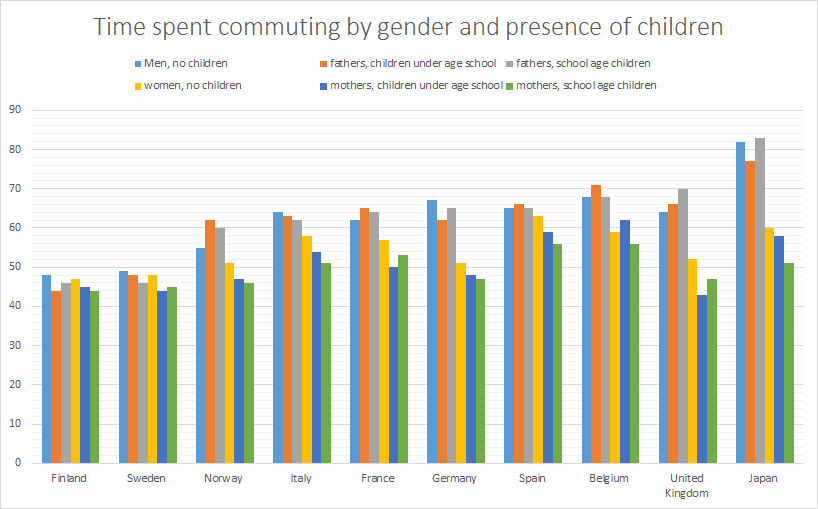
The gender commuting gap between mothers and fathers

The first three bars in each cluster of bars are for men. in almost all countries mothers with dependent children spend less time commuting than childless women. This might suggest that working mothers have found workplaces closer to home than women without children. The gender gap in commuting where it is present in the country is larger than the gap between mothers and other women in their commuting time.
image

Source: OECD Family Database – OECD, Table LMF2.6.A.

The Forgotten American Concordes

World’s first pizza delivery by drone

Moral Machine

A platform for public participation in and discussion of the human perspective on machine-made moral decisions.

Source: Moral Machine

This plane could cross the Atlantic in 3.5 hours. Why did it fail? – Vox

Source: This plane could cross the Atlantic in 3.5 hours. Why did it fail? – Vox

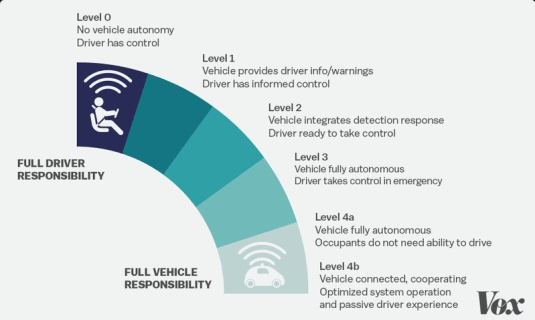
Cars are becoming incrementally more and more automated

Image

The Most Incredible Russian Dashcam Video

https://twitter.com/CrazyinRussia/status/751867934658662401

.@NZlabour wants to crash house prices! @NZGreens take on the NIMBYs! @PhilTwyford

There has been an unexpected outbreak of political courage on the left of New Zealand politics.

The Labour Party wants to crash housing prices by not only abolishing the Auckland urban limit, but ensuring councils can fund the necessary infrastructure to bring new land to the market:

Labour will remove the Auckland urban growth boundary and free up density controls. This will give Auckland more options to grow, as well as stopping land bankers profiteering and holding up development. New developments, both in Auckland and the rest of New Zealand, will be funded through innovative infrastructure bonds.

In response, the Greens want to take on the inner city NIMBYs by greatly increasing housing density and new developments in their pristine suburbs

Like Labour, we believe that people should have a choice about where they live. But a lot of people want to live close to the central city where they work or study. That means delivering more high-quality, inner city housing options, not endless sprawling new suburbs.

It’s often easier and cheaper to revitalise central suburbs than it is to build new suburbs on the city fringes. Infrastructure for new sprawling subdivisions is very expensive.

This outbreak of courage is surprising after the resolute opposition of these parties to any reform of the Resource Management Act to loosen up the land supply.

It is a breakthrough nonetheless because at least the Labour Party admits that housing affordability is about increasing land supply by removing the Auckland urban limit.

In 1971 a woman survived a fall from 10,000 feet into the Amazon Jungle

Will there ever be self-drive cars?

An astute commentator on the technology Sub-Reddit pointed out that commercial aircraft fly on autopilot but active involvement of pilots is expected. No one ever contemplates the contrary.

image

The autopilot on a plane has a far less challenging environment than a self driving. Planes do not have to navigate passed other planes within a fraction a second of collision, along with pedestrians and bicyclists.

Planes do not have the follow hyper-accurate maps and turn and swerve almost continuously to avoid a collision as distinct from turbulence or an error that is quickly corrected by pilot before any danger is encountered.

As far as self drive cars will go, I think they will be confined to driver assist functions  with a driver always having to have his hands on the wheel.

A peculiarity of self drive cars is the brand name of Googleand Tesla are so strong that they have been able to hold off the usual Luddite reaction to new technologies.

The Messy Ethics of Self Driving Cars

Desperately seeking to agree with @JulieAnneGenter on transport investment quality

I just wrote an op-ed for National Business Review online (pay-walled) agreeing with an op-ed last week by Green MP Julie Anne Genter on transport investment. My op-ed started

The Taxpayers’ Union welcomes the commitment of the Green Party yesterday to evaluating transport investments without any bias or favouritism to one transport mode over another.

The Taxpayers’ Union could not agree more with Julie Anne Genter when she said that the question ministers should always ask is “what is the best investment we can make?”

This op-ed was my rejoinder to her reply to my op-ed criticising a recent Green Party on national freight policy. That policy called for 25% of all freight by kilometres travelled to each go by rail and road. That would near double their freight market share from 30% currently to 50% when measured by kilometre.

For my troubles I got nothing but criticism and accusations in the comments section in National Business Review Online. A tweet by Genter was far more gracious.

There was no praise in the comment section at the National Business Review online for agreeing with the Green policy. In the first comment I was told I did not understand economics and that

When the policy default is “cut taxes and spending and let me selfishly keep my money” they miss out on the much larger benefit to everyone, including themselves, by nudging or economy to spend more on intrinsically more efficient transport – like rail – and less on alternatives.

No thanks at all for agreeing that transport investments should be the best we can make. After saying that in their recent freight policy, the Greens set targets were specific transport technologies they favour, which are rail and sea freight. 

You cannot argue that transport investments should be the best we can make then declare a preference for a particular technology or mode of transport. But let us not quibble over that glaring contradiction.

The broader principle was agreed which is transport investments should be driven by cost benefit analysis and value for money. It should be technology neutral and transport mode neutral. That, of course, means the Greens cannot declare targets for the market shares of particular modes of freight shipment if they want to follow their own policy about value for money.

How Budget Airlines Work  

$5.2 billion in rail spending since 2003 budget @JulieAnneGenter @JordNZ

$5.2 billion in rail spending since the 2003 budget! This $5.2 billion does not include any spending on urban rail, commuter train networks or their electrification. The $5.2 billion since the 2003 budget is for the passenger and freight network, not the urban metro contracts

image

Source: New Zealand Budget Papers, various years.

Desperately waiting for that dividend the taxpayers lose if any of these assets are privatised. The spending listed below in the two charts includes loans, capital injections and the purchase of the track and of the train operator itself. The latter was purchased for $690 million which was soon written down to zero.

image

Source: New Zealand Budget Papers, various years.

There is no table because the table format breaks down when blogged.

At various times, OnTrack and KiwiRail was subsidiaries of the New Zealand Railways Corporation, which was the holding company. Now OnTrack is a division of KiwiRail.

#Bikes at night (in the rain) certainly must go

In heavy rain last night, the bike ahead of us with no lights decided to merge into the blind-spot of another car also merging into the central lane. He lived through no good management of his own.

This bicyclist with no lights then joined a pack of three others to slow the traffic down behind them. Only one of the four bicyclists had any lighting or reflective material at all.

They moved in a pack, so the cars including ours could not get around them because the traffic was heavy. Fortunately, the street was well lit so you could see them, just. Bikes must go.

Previous Older Entries Next Newer Entries

Thoughts from the North

Celebrating humanity's flourishing through the spread of capitalism and the rule of law

Fardels Bear

A History of the Alt-Right

Vincent Geloso

Econ Prof at George Mason University, Economic Historian, Québécois

Bassett, Brash & Hide

Celebrating humanity's flourishing through the spread of capitalism and the rule of law

Truth on the Market

Scholarly commentary on law, economics, and more

The Undercover Historian

Beatrice Cherrier's blog

Matua Kahurangi

Celebrating humanity's flourishing through the spread of capitalism and the rule of law

Temple of Sociology

Celebrating humanity's flourishing through the spread of capitalism and the rule of law

Velvet Glove, Iron Fist

Celebrating humanity's flourishing through the spread of capitalism and the rule of law

Why Evolution Is True

Why Evolution is True is a blog written by Jerry Coyne, centered on evolution and biology but also dealing with diverse topics like politics, culture, and cats.

NoTricksZone

Celebrating humanity's flourishing through the spread of capitalism and the rule of law

Homepaddock

A rural perspective with a blue tint by Ele Ludemann

Kiwiblog

DPF's Kiwiblog - Fomenting Happy Mischief since 2003

The Dangerous Economist

Celebrating humanity's flourishing through the spread of capitalism and the rule of law

Watts Up With That?

The world's most viewed site on global warming and climate change

The Logical Place

Tim Harding's writings on rationality, informal logic and skepticism

Doc's Books

A window into Doc Freiberger's library

The Risk-Monger

Let's examine hard decisions!

Uneasy Money

Commentary on monetary policy in the spirit of R. G. Hawtrey

Barrie Saunders

Thoughts on public policy and the media

Liberty Scott

Celebrating humanity's flourishing through the spread of capitalism and the rule of law

Point of Order

Politics and the economy

James Bowden's Blog

A blog (primarily) on Canadian and Commonwealth political history and institutions

Science Matters

Reading between the lines, and underneath the hype.

Peter Winsley

Economics, and such stuff as dreams are made on

A Venerable Puzzle

"The British constitution has always been puzzling, and always will be." --Queen Elizabeth II

The Antiplanner

Celebrating humanity's flourishing through the spread of capitalism and the rule of law

Bet On It

Celebrating humanity's flourishing through the spread of capitalism and the rule of law

History of Sorts

WORLD WAR II, MUSIC, HISTORY, HOLOCAUST

Roger Pielke Jr.

Undisciplined scholar, recovering academic

Offsetting Behaviour

Celebrating humanity's flourishing through the spread of capitalism and the rule of law

JONATHAN TURLEY

Res ipsa loquitur - The thing itself speaks

Conversable Economist

In Hume’s spirit, I will attempt to serve as an ambassador from my world of economics, and help in “finding topics of conversation fit for the entertainment of rational creatures.”

The Victorian Commons

Researching the House of Commons, 1832-1868

The History of Parliament

Articles and research from the History of Parliament Trust

Books & Boots

Reflections on books and art

Legal History Miscellany

Posts on the History of Law, Crime, and Justice

Sex, Drugs and Economics

Celebrating humanity's flourishing through the spread of capitalism and the rule of law

European Royal History

Exploring the Monarchs of Europe

Tallbloke's Talkshop

Cutting edge science you can dice with

Marginal REVOLUTION

Small Steps Toward A Much Better World

NOT A LOT OF PEOPLE KNOW THAT

“We do not believe any group of men adequate enough or wise enough to operate without scrutiny or without criticism. We know that the only way to avoid error is to detect it, that the only way to detect it is to be free to inquire. We know that in secrecy error undetected will flourish and subvert”. - J Robert Oppenheimer.

STOP THESE THINGS

The truth about the great wind power fraud - we're not here to debate the wind industry, we're here to destroy it.

Lindsay Mitchell

Celebrating humanity's flourishing through the spread of capitalism and the rule of law

Alt-M

Celebrating humanity's flourishing through the spread of capitalism and the rule of law