Roads of the Roman Empire
– http://t.co/o0dU4dyF71—
Amazing Maps (@Amazing_Maps) July 14, 2015
Roads of the Roman Empire
25 Sep 2015 Leave a comment
in economic history, transport economics Tags: Roman empire
@nzlabour @NZGreens New Zealand state-owned enterprises dividends paid and capital injections since 2007
25 Sep 2015 Leave a comment
in financial economics, industrial organisation, politics - New Zealand, public economics, rentseeking, survivor principle, transport economics Tags: government ownership, KiwiRail, privatisation, rational ignorance, rational rationality, state owned enterprises, suppressive voting
The New Zealand Labour Party and New Zealand Greens both make much of the fact that when you privatise a state-owned enterprise the taxpayer is no longer entitled to dividends from the privatised business. The fact that the sale price is the net present value of those future dividends is a rating fallacy that is not the subject of this post.
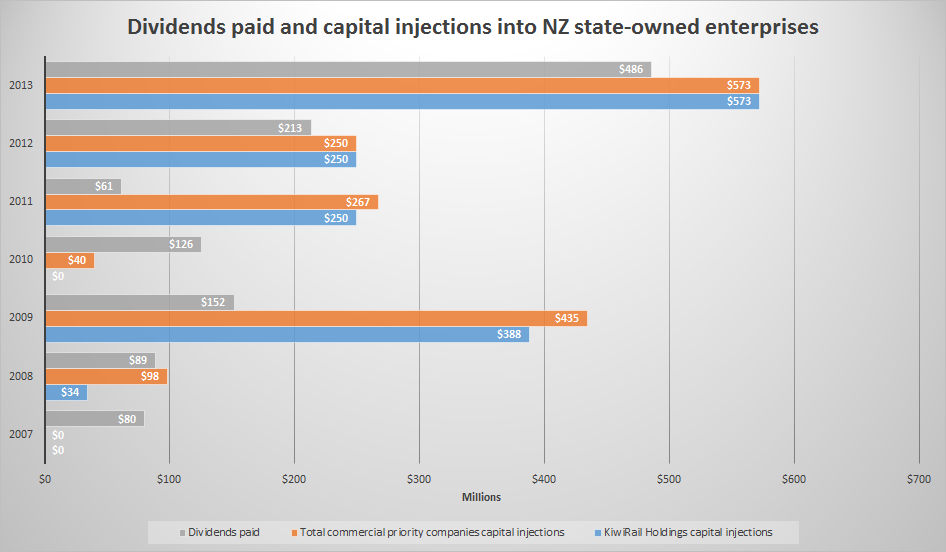
Source: New Zealand Treasury – data released under the Official Information Act.
What is the subject of this post is whether there are indeed any dividends paid to taxpayers after capital injections. 2007 was the last year in which dividends to the taxpayer exceeded capital injections. The reason was that dog called KiwiRail.
Entrepreneurial alertness in vehicle emissions testing
23 Sep 2015 1 Comment
in economics of crime, entrepreneurship, environmental economics, industrial organisation, law and economics, survivor principle, transport economics Tags: air pollution, entrepreneurial alertness, vehicle emissions testing, Volkswagen
Here's how Volkswagen's system for fooling the emission tests worked: nyti.ms/1Fdlcus http://t.co/U7hlLejNK0—
NYT Business (@nytimesbusiness) September 22, 2015
@TransportBlog How Aucklanders and Wellingtonians commute to work, 2013 Census
22 Sep 2015 1 Comment
in politics - New Zealand, transport economics, urban economics Tags: Auckland, bikes, buses, commuting, cycling, trains, Wellington
Bugger all Aucklanders take the bus (6.5%) or train (1.8%) to work. More Wellingtonians take the train (6.4%) or the public bus (7.9%) than in Auckland but more walk or jog than take either of those two publicly funded and subsidised conveyances. Hardly anybody takes a bike to work these days.
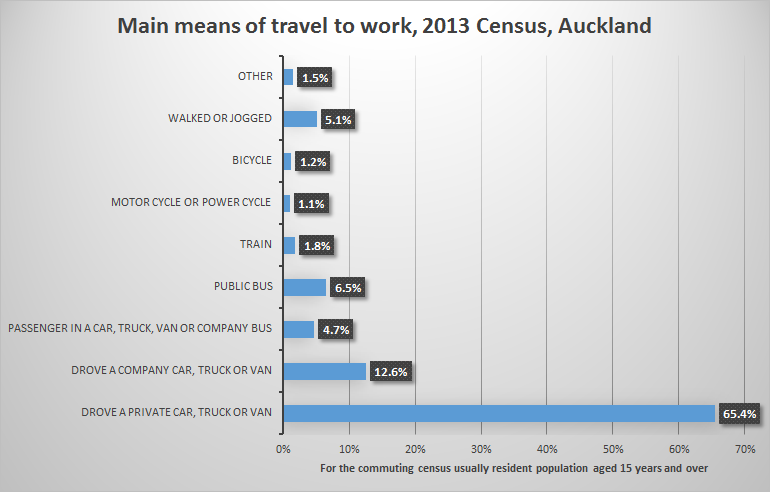
Source: 2013 Census QuickStats about transport and communications.
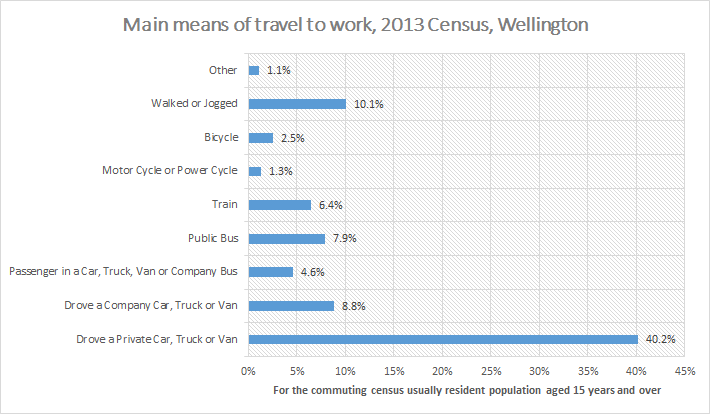
Source: 2013 Census QuickStats about transport and communications
@ChristchurchCC Deputy Mayor is clueless about the criminal justice system
21 Sep 2015 Leave a comment
in economics of crime, law and economics, politics - New Zealand, television, transport economics, urban economics Tags: crime and punishment, evidence-based policy, law and order, local government, rational ignorance, rational rationality, road safety, Yes Minister
 In responding to demands for police to crack down on windscreen washers, some of whom intimidate motorists to pay, the deputy mayor of Christchurch showed a cultured ignorance of youth courts. She has never read newspaper reports that show that youth court defendants are never named and their convictions are not held against them as adults. Furthermore, she is unaware of the spent convictions law in New Zealand that expunges most convictions after seven years, especially petty convictions.
Airline travel is getting safer by the day
19 Sep 2015 Leave a comment
in transport economics Tags: air crashes, Air safety, aviation
Note to billionaires: fly scheduled. It's getting safer, unlike private planes economist.com/blogs/graphicd… http://t.co/7CL4CzKhYv—
Tom Standage (@tomstandage) August 27, 2015
@TransportBlog would #cyclists ever pass the precautionary principle?
16 Sep 2015 1 Comment
in transport economics Tags: bikes, cyclists, road accidents, road safety
If bikes were not invented until today, would they ever be allowed on the road by road safety regulators. Here is the business case: allow pedestrians to move around at high speed on the road including at night with poor visibility as long as they travel on a metal contraption.

Source: Ministry of Transport, Cyclists 2014.

The 820 people killed by police by race in 2015 – updated again
15 Sep 2015 1 Comment
in economics of crime, law and economics, politics - USA, transport economics Tags: crime and punishment, law and order, police, police shootings, road accidents, road safety
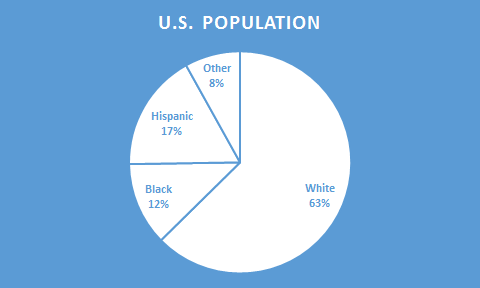
I am surprised that the Guardian did not do this graphical analysis themselves. My analysis below shows the quite a few people were unarmed but many more were carrying guns, knives or other weapons.

Source: The Counted: people killed by police in the United States in 2015 – interactive | US news | The Guardian Accessed 1 a.m. New Zealand standard Time 15th September 2015.
You have to read through every individual data entry to work out how many of those killed had guns, and the many of these were shooting at police when they were shot dead. The same legwork is required to find out how many officers are on murder charges after killing civilians.
Gone are these days, thanks to helicopter parenting, but maybe for the better
12 Sep 2015 Leave a comment
in population economics, transport economics Tags: good old days, helicopter parenting, road accidents, road safety, seat belts
1st drink driving arrest was today 1897
10 Sep 2015 Leave a comment
in economic history, economics of crime, law and economics, transport economics Tags: drink driving, road safety
$100 million for the few that cycle to work in #Wellington @dpfdpf @NZGreens
10 Sep 2015 Leave a comment
in politics - New Zealand, population economics, transport economics Tags: expressive voting, Leftover Left, urban transport
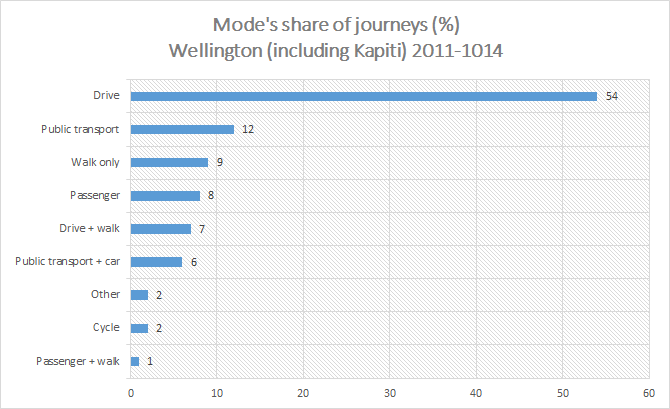
Source: Statistics New Zealand, New Zealand Travel Survey.
Mid-life crisis bikers beware
08 Sep 2015 Leave a comment
in economic history, economics of media and culture, transport economics Tags: road safety
@NZGreens @TransportBlog cars rule in Auckland! Auckland commuting times by transport mode
21 Aug 2015 1 Comment
in job search and matching, labour economics, occupational choice, politics - New Zealand, transport economics, urban economics Tags: Auckland, bicycles, commuting times, compensating differentials, expressive voting, green rent seeking, Inner-city Left, New Zealand Greens, public transport, rational irrationality, search and matching, The fatal conceit, The pretense to knowledge
I am not surprised only 7% of Auckland’s take public transport to work considering it takes much longer than any other form of commuting.
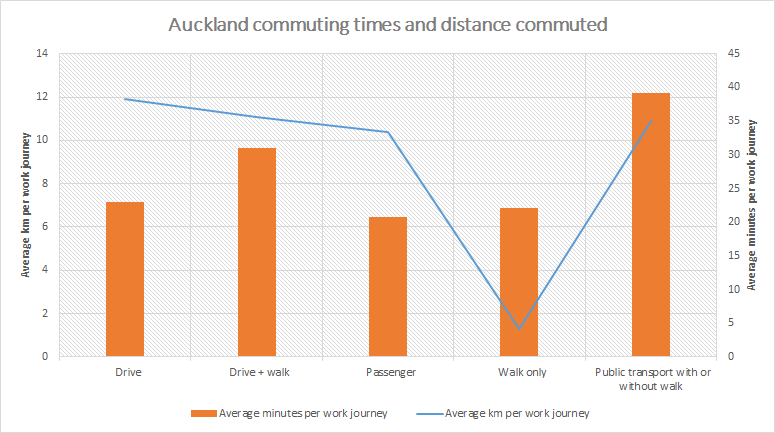
The average commute by public transport is 40 minutes as compared to less than 25 in a car. 74% of Aucklanders drive to work and another 9% are a passenger in a car.
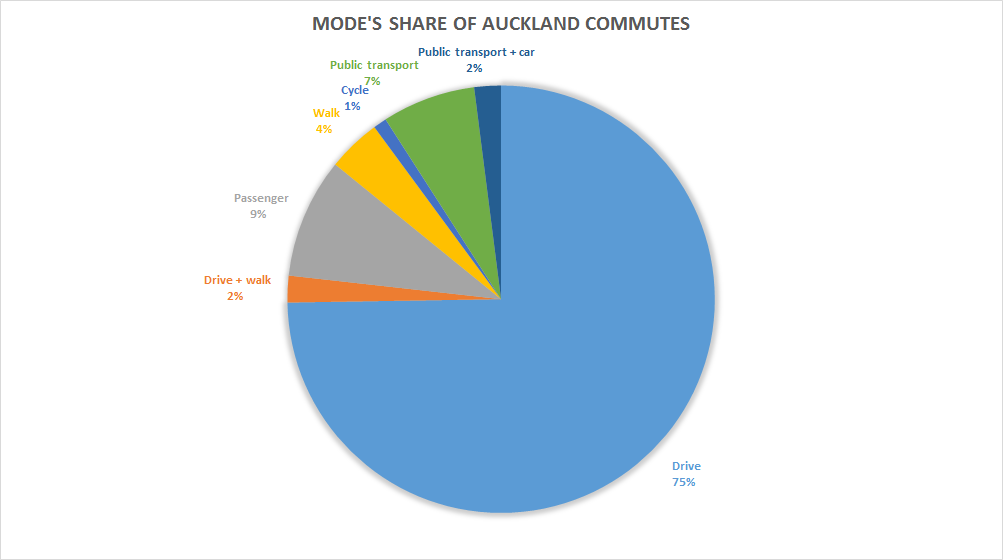
No information was available on those who bike to work because only 1% of Aucklanders bike to work. Only 2% of all New Zealanders take a bike to work. The sample size was therefore too small. Yet another reason to ban bikes at night. Few commute on this mode of transport in Auckland.
The near identical commuting distances irrespective of the mode of transport except walking is further evidence that people are quite discerning in balancing commuting times and job selection as per the theory of compensating differentials. Indeed, average commuting times in Auckland are much the same as the average commuting time in America.

The Auckland transport data showing people commute much the same distance by any mode of transport bar walking also validates Anthony Downs’ theory of triple convergence.

Improving the commuting times in one mode of transport will mean people simply take the mode of peak hour transport that is suddenly become less congested while others who were not going to commute at peak times or start commuting at peak times as Anthony Downs explains:
If that expressway’s capacity were doubled overnight, the next day’s traffic would flow rapidly because the same number of drivers would have twice as much road space.
But soon word would spread that this particular highway was no longer congested. Drivers who had once used that road before and after the peak hour to avoid congestion would shift back into the peak period. Other drivers who had been using alternative routes would shift onto this more convenient expressway. Even some commuters who had been using the subway or trains would start driving on this road during peak periods.
Within a short time, this triple convergence onto the expanded road during peak hours would make the road as congested as it was before its expansion.
 Utopia, you are standing in it!
Recent Comments