The hidden inequality of who dies in car crashes: wapo.st/1QMLqV9 http://t.co/9guJxgQxcn—
Emily Badger (@emilymbadger) October 01, 2015
The hidden inequality of who dies in car crashes
08 Oct 2015 Leave a comment
in transport economics Tags: road safety
Creative destruction in car prices
07 Oct 2015 Leave a comment
in applied welfare economics, economic history, entrepreneurship, politics - USA, technological progress, transport economics Tags: creative destruction
CHART: Since 1995 the CPI for new vehicles has been flat, while the CPI (and wages) increased 60%. What a bargain! http://t.co/DOdlQn8pcK—
Mark J. Perry (@Mark_J_Perry) July 01, 2015
The world’s most dangerous road
07 Oct 2015 Leave a comment
in development economics, transport economics Tags: Bolivia, road safety
The world’s most dangerous road – Yungas Road ("death road") in Bolivia, claims the lives of 200-300 people every yr. http://t.co/P7CvCWHJoa—
The World (@World) September 25, 2015
There should be more traffic roundabouts
06 Oct 2015 Leave a comment
in transport economics Tags: road safety
Why America Shouldn't Fear the Traffic Roundabout:
priceonomics.com/the-case-for-m… http://t.co/CJ1oPQLosn—
Zachary Crockett (@zzcrockett) September 18, 2015
@NZGreens @JulieAnneGenter are right! Government cars should go electric!
01 Oct 2015 Leave a comment
in constitutional political economy, economics of bureaucracy, politics - New Zealand, transport economics
Ministerial cars going electric is a great idea. The range limitations and range anxiety inherent to electric cars would mean ministers will find it much more difficult to do their jobs and therefore will have less time each day to mess up the economy and regulate unnecessarily.

One of the most productive things I ever saw the Green MPs do in Wellington was taking the bus to and from work.
I could not be happier when I saw Green coleaders Russel Norman and Metiria Turei waiting at a bus stop. They are just waiting, they will not working with a colleague, they were not working on their phones. They were just standing there doing nothing. That was the most productive moments of their times in parliament.

Every second a Green MP spends waiting for a bus and travelling on a bus and arranging to fit in with bus timetables is one second less spent making New Zealand a poorer country and deterring investment from coming to New Zealand through their high tax and heavy regulation policies.
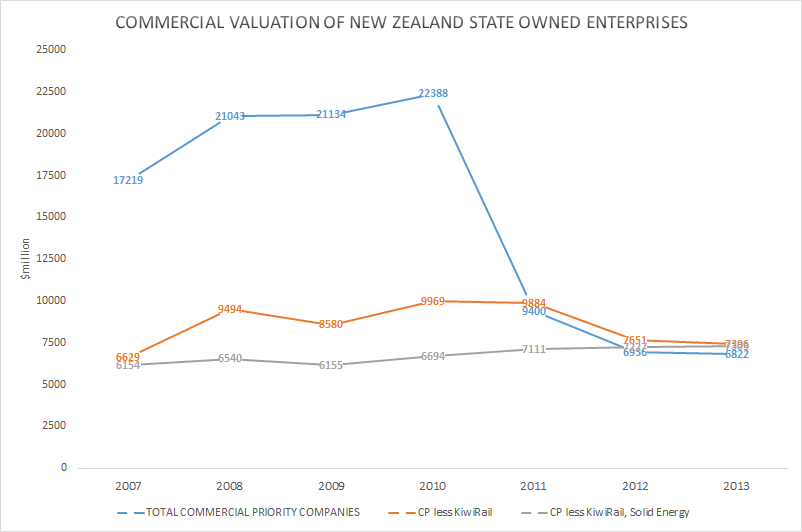
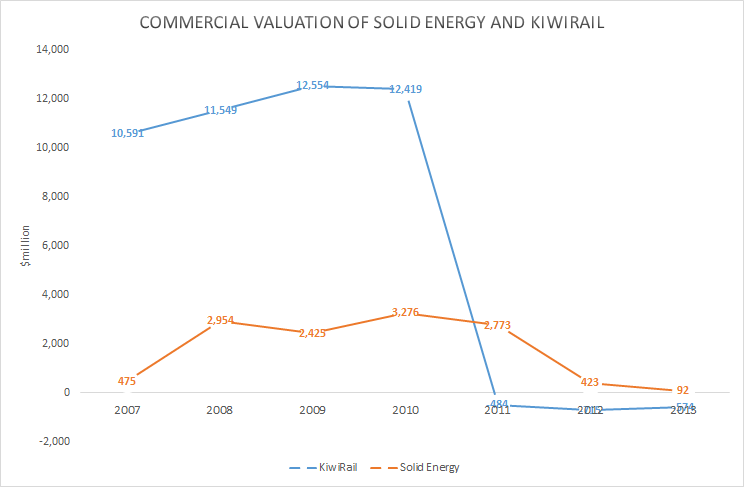
The commercial valuation of the New Zealand state-owned enterprises portfolio since 2007 with and without Solid Energy and KiwiRail
29 Sep 2015 Leave a comment
in economic history, energy economics, financial economics, industrial organisation, politics - New Zealand, survivor principle, transport economics Tags: KiwiRail, privatisation, Solid Energy, state owned enterprises, suppressing voting
Source: The New Zealand Treasury – data released under the Official Information Act.
If the Panama Canal gets a rival
27 Sep 2015 Leave a comment
in transport economics Tags: Nicaragua, Panama, Panama Canal
#China is building a huge canal in Nicaragua bloom.bg/1Jrs7BQ http://t.co/oLT5wAknkN—
Bloomberg VisualData (@BBGVisualData) August 25, 2015
Roads of the Roman Empire
25 Sep 2015 Leave a comment
in economic history, transport economics Tags: Roman empire
Roads of the Roman Empire
– http://t.co/o0dU4dyF71—
Amazing Maps (@Amazing_Maps) July 14, 2015
@nzlabour @NZGreens New Zealand state-owned enterprises dividends paid and capital injections since 2007
25 Sep 2015 Leave a comment
in financial economics, industrial organisation, politics - New Zealand, public economics, rentseeking, survivor principle, transport economics Tags: government ownership, KiwiRail, privatisation, rational ignorance, rational rationality, state owned enterprises, suppressive voting
The New Zealand Labour Party and New Zealand Greens both make much of the fact that when you privatise a state-owned enterprise the taxpayer is no longer entitled to dividends from the privatised business. The fact that the sale price is the net present value of those future dividends is a rating fallacy that is not the subject of this post.
Source: New Zealand Treasury – data released under the Official Information Act.
What is the subject of this post is whether there are indeed any dividends paid to taxpayers after capital injections. 2007 was the last year in which dividends to the taxpayer exceeded capital injections. The reason was that dog called KiwiRail.
Entrepreneurial alertness in vehicle emissions testing
23 Sep 2015 1 Comment
in economics of crime, entrepreneurship, environmental economics, industrial organisation, law and economics, survivor principle, transport economics Tags: air pollution, entrepreneurial alertness, vehicle emissions testing, Volkswagen
Here's how Volkswagen's system for fooling the emission tests worked: nyti.ms/1Fdlcus http://t.co/U7hlLejNK0—
NYT Business (@nytimesbusiness) September 22, 2015
@TransportBlog How Aucklanders and Wellingtonians commute to work, 2013 Census
22 Sep 2015 1 Comment
in politics - New Zealand, transport economics, urban economics Tags: Auckland, bikes, buses, commuting, cycling, trains, Wellington
Bugger all Aucklanders take the bus (6.5%) or train (1.8%) to work. More Wellingtonians take the train (6.4%) or the public bus (7.9%) than in Auckland but more walk or jog than take either of those two publicly funded and subsidised conveyances. Hardly anybody takes a bike to work these days.
Source: 2013 Census QuickStats about transport and communications.
Source: 2013 Census QuickStats about transport and communications
@ChristchurchCC Deputy Mayor is clueless about the criminal justice system
21 Sep 2015 Leave a comment
in economics of crime, law and economics, politics - New Zealand, television, transport economics, urban economics Tags: crime and punishment, evidence-based policy, law and order, local government, rational ignorance, rational rationality, road safety, Yes Minister
In responding to demands for police to crack down on windscreen washers, some of whom intimidate motorists to pay, the deputy mayor of Christchurch showed a cultured ignorance of youth courts. She has never read newspaper reports that show that youth court defendants are never named and their convictions are not held against them as adults. Furthermore, she is unaware of the spent convictions law in New Zealand that expunges most convictions after seven years, especially petty convictions.
Airline travel is getting safer by the day
19 Sep 2015 Leave a comment
in transport economics Tags: air crashes, Air safety, aviation
Note to billionaires: fly scheduled. It's getting safer, unlike private planes economist.com/blogs/graphicd… http://t.co/7CL4CzKhYv—
Tom Standage (@tomstandage) August 27, 2015
@TransportBlog would #cyclists ever pass the precautionary principle?
16 Sep 2015 1 Comment
in transport economics Tags: bikes, cyclists, road accidents, road safety
If bikes were not invented until today, would they ever be allowed on the road by road safety regulators. Here is the business case: allow pedestrians to move around at high speed on the road including at night with poor visibility as long as they travel on a metal contraption.
Source: Ministry of Transport, Cyclists 2014.

Recent Comments