"The rich got richer, true. But…" —@DeirdreMcClosk buff.ly/1Imdv4o http://t.co/M3ERx3JTIn—
HumanProgress.org (@humanprogress) June 28, 2015
And the rich got richer, who cares
16 Jul 2015 Leave a comment
in applied price theory, applied welfare economics, Austrian economics, comparative institutional analysis, constitutional political economy, development economics, economic history, economics of bureaucracy, economics of education, economics of regulation, economics of religion, energy economics, entrepreneurship, environmental economics, financial economics, growth disasters, growth miracles, income redistribution, industrial organisation, international economics, labour economics, labour supply, liberalism, poverty and inequality, Public Choice, rentseeking, survivor principle, transport economics, urban economics Tags: Deirdre McCloskey, entrepreneurial alertness, The Great Enrichment, The Great Escape, The Great Fact, top 1%
Hopeless KiwiRail bailout reporting by Radio New Zealand
10 Jul 2015 Leave a comment
in applied welfare economics, economics of bureaucracy, economics of media and culture, politics - New Zealand, rentseeking, transport economics Tags: corporate welfare, KiwiRail, media bias, privatisation, public ownership, Radio New Zealand, state owned enterprises
This morning on 9 to noon on Radio New Zealand, Kathryn Ryan, the compere of the program, repeatedly claimed that the government pumped $1 billion into the KiwiRail Turnaround Plan between 2010 and 2014. I was so annoyed by this that I made a broadcasting standards complaint while the program was still being broadcast on my mobile as a one finger typist.
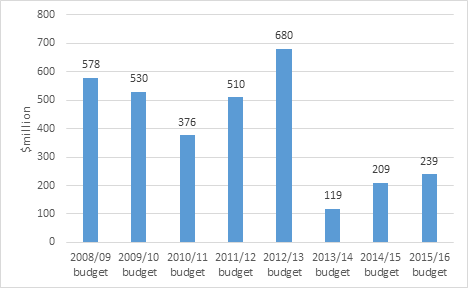
The report on 9 to Noon was in response to the government putting KiwiRail on notice, giving it two years to identify savings and reduce Crown funding required or risk the possibility of closure. Since KiwiRail was acquired in 2008 for $665 million as a commercial investment, Crown investments (taxpayers bailout) totalled $3.4 billion – see Figure 1.
Figure 1: State-owned enterprise welfare, Vote Transport and Vote Finance (KiwiRail), Budgets 08/09 to 15/16
Source: New Zealand budget papers, various years.
Table 1 shows that the KiwiRail Turnaround plan of $1.272 billion since the 2009-10 Budget is only a small part of the bailout of KiwiRail. 9 to Noon simply ignored the $210 million in the 2015 budget for KiwiRail for no explicable reason and instead talked about a $1 billion Turnaround plan rather than the $1.272 billion Turnaround plan.
Table 1: State-Owned Enterprise welfare, Vote Transport and Vote Finance (KiwiRail), Budgets 2008/09 to 2015/16, $million
| 08/09 |
09/10 |
10/11 |
11/12 |
12/13 |
13/14 |
14/15 |
15/16 |
|
|
New Zealand Railways Corporation Loans |
405 |
55 |
250 |
108 |
11 |
|||
|
KiwiRail Turnaround Plan |
20 |
250 |
250 |
250 |
94 |
198 |
210 |
|
|
KiwiRail Equity Injection |
323 |
25 |
29 |
|||||
|
Rail Network and Rolling Stock Upgrade |
105 |
71 |
10 |
|||||
|
New Zealand Railways Corporation Loans |
55 |
|||||||
|
New Zealand Railways Corporation Increase in Capital for the Purchase of Crown Rail |
376 |
|||||||
|
Crown Rail Operator Loans |
140 |
|||||||
|
Crown Rail Operator Equity Injection |
7 |
|||||||
|
Total |
578 |
530 |
376 |
510 |
680 |
119 |
209 |
239 |
Source: New Zealand budget papers, various years.
Other parts of the bailout of KiwiRail include $405 million in loans to the New Zealand Railways Corporation in the 2009-10 budge – see table 1. There was a $323 million equity injection in the 2012-13 Budget – see table 1. KiwiRail has also caused write-downs in the Crown balance sheet of an incredible $9.8 billion since it was repurchased in 2008.
9 to Noon ignored at least two thirds of the cost to the taxpayer of bailing out KiwiRail by only limiting its reporting to part of the KiwiRail Turnaround Plan. It ignored the contribution in the most recent budget to that plan. That does not meet broadcasting standards of accuracy or professional responsibility.
Any reasonable listener will infer, as I did when listening, that the entire cost of the bailout of KiwiRail is represented by the Turnaround Plan of about $1 billion. If listeners were left with that impression, they were misled by 9 to Noon and Radio New Zealand.
It’s Time to Name a Price on KiwiRail – how much more in losses before committing to shutting it down?
09 Jul 2015 1 Comment
in economics of bureaucracy, politics - New Zealand, Public Choice, public economics, rentseeking, transport economics Tags: corporate welfare, hard budget constraints, KiwiRail, privatisation, public ownership, state owned enterprises, state-owned enterprise welfare
In the finest public service traditions of free and frank advice, the New Zealand Treasury in its budget advice this year advised ministers to contemplate shutting down KiwiRail.
Treasury recommended the Government fund KiwiRail for one more year and undertake a comprehensive public study to look into closing the company. The study is public so that people were informed of the costs of running the rail network compared with any benefits it provided. The Government rejected the idea.
Figure 1: State-owned enterprise welfare, Vote Transport and Vote Finance (KiwiRail), Budgets 08/09 to 15/16
Source: New Zealand budget papers, various years.
KiwiRail has been a constant thorn in the taxpayers’ side. Since this rail business was acquired in 2008 for $665 million as a commercial investment, Crown investments have totalled $3.4 billion – see Figure 1.
Fortunately in the 2015 budget, the Minister of Finance signalled that the government’s patience with the KiwiRail deficits is not unlimited. KiwiRail has a 10-year Turnaround Plan to make its freight business commercially viable. The current network of 4,000 km must be reduced to 2,300 km for the company to even breakeven. The Treasury advised, to no avail, that this massive and painful restructuring was required before KiwiRail was purchased. The purchase went through.
The latest developments where Treasury advised ministers to contemplate shutting the network down is an opportunity for ministers, and the opposition spokesmen on finance and transport both to say how much is too much in accumulated KiwiRail losses.
The Minister of Finance and his Cabinet colleagues must say after the public review that there is only so much more left in the cupboard to bailout KiwiRail losses. After that fiscal cap is reached, KiwiRail is on its own. If that means bankruptcy and network closure, so be it.
In the interim, on the side of every KiwiRail train there should be advertising billboards with the following disclosure statements:
- KiwiRail losses adds one percentage point to the company tax rate each year;
- KiwiRail losses takes deny sick taxpayers X number of elective surgeries per year; and
- X number of doctors, nurses, and teachers could have been hired but for last year’s KiwiRail losses!
Electric cars may be worse polluters than gas-guzzling vehicles
08 Jul 2015 Leave a comment
in applied welfare economics, environmental economics, politics - USA, transport economics Tags: expressive voting, pollution, tokenism
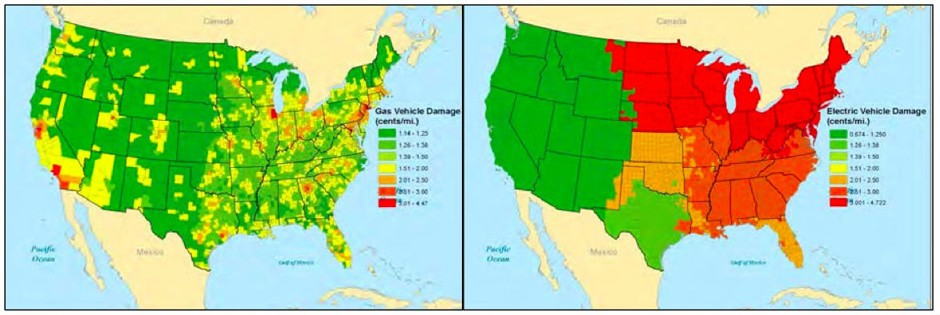
Environmental damage for EVs appears to be worse in the Midwest and Northeast, where the electricity grid tends to rely on coal power plants.
In places like LA, EVs produce less environmental damage because the city’s air shed traps pollutants from gas cars…
The key is where the source of the electricity all-electric cars. If it comes from coal, electric cars produce 3.6 times more soot and smog deaths than gas, because of the pollution made in generating the electricity,
via A New Analysis of U.S. Counties Shows Where Electric Vehicles Cause More Pollution Than Gas Cars – CityLab and CityLab shows how electric cars can be WORSE for the environment than gas-guzzling vehicles | Daily Mail Online.
Flying is definitely safer now
01 Jul 2015 Leave a comment
in transport economics Tags: air crashes air safety
Though it's of little comfort to the families of crash victims, flying has gotten ever safer econ.st/1xyi5cB http://t.co/zTVM3yuLXF—
The Economist (@ECONdailycharts) March 25, 2015
Anthony Downs on the unsustainability of buses and trains as compared to cars
30 Jun 2015 Leave a comment
in politics - New Zealand, transport economics, urban economics Tags: Anthony Downs, antimarket bias, expressive voting, Leftover Left, makework bias, meddlesome preferences, nanny state, rational ignorance, rational irrationality

Bicycles (at night) must go!
26 Jun 2015 5 Comments
in applied welfare economics, health and safety, transport economics
I had an unnerving near miss at my local roundabout tonight with a bike as I was turning left. The bicycle appeared out of nowhere on my right in the middle of the roundabout as I glanced of the left to check again while turning so I crash stopped.
The bike had a light at the front but wasn’t visible to me until it was halfway into the roundabout when I glanced of the right again. The bike rider was going into that roundabout at a good speed against a wall of car lights behind it, so it was impossible to see it until it was close to the door of my car because of the background of car lighting after dark.

Bike riders have an overinflated self-perception of their visibility at night. Not surprisingly, more accidents happen during peak hours when drivers think motorists can see them when they cannot. 
Even on an empty road, bicycles are not easy to see at night – certainly there not as perceived as quickly as cars. Bicycles are a much more dangerous transport mode than driving a car.
A recent study found the bicycle lighting is overrated as a method of making bikes more conspicuous – perceptions of visibility do not necessarily match reality:
The presence of a bicycle light, whether static or flashing, did not enhance the conspicuity of the bicyclist; this may result in bicyclists who use a bicycle light being overconfident of their own conspicuity at night.
Consider this thought experiment. Suppose bicycles have never been invented until tonight. The business case for allowing them on to the road is as follows:
- Certain pedestrians should be allowed to share the road with cars as long as these pedestrians travel quickly on a metal contraption that is slower than cars, but still allows them to move relatively quickly;
- These fast moving pedestrians are near invisible in rear-view mirrors;
- These fast moving pedestrians should be allowed on the road at night when their visibility is poor against an every-varying contrast of a moving landscape;
- These pedestrians moving quickly at night on the road are overconfident in the extent to which drivers perceive their presence against a moving landscape; and
- Older drivers are 50% less likely to perceive the presence of a bike with lights and illumination at night than are younger drivers.
Would that business case pass under the precautionary principle championed by environmentalists, many of whom are bicyclists? Would that business case pass under normal cost benefit analysis? I say no. Bicycles at night must go.
The secret behind chemtrails?
24 Jun 2015 Leave a comment
in transport economics Tags: conjecture and refutation, conspiracy theories
GM’s 1956 vision of a self drive car by 1976
22 Jun 2015 Leave a comment
in economic history, economics of media and culture, entrepreneurship, industrial organisation, survivor principle, transport economics Tags: creative destruction, self drive cars
How planes evolved
21 Jun 2015 Leave a comment
in technological progress, transport economics Tags: aviation, creative destruction, innovation
Someone figured out that planes evolve like birds… and made charts about it! My favorite! sciencecodex.com/law_of_physics… http://t.co/NxqgWtXjZ2—
Tyler Vigen (@TylerVigen) July 23, 2014
Thinking time and stopping distances on wet roads
21 Jun 2015 Leave a comment
in transport economics Tags: road safety
Would you stop in time? Think about your speed & stopping distance when driving on wet roads. #slowdownCBR http://t.co/XJ6ei1xyEt—
(@ACTPol_Traffic) June 18, 2015
New York Times, April 16, 1912, after the Titanic disaster
19 Jun 2015 Leave a comment
in economic history, transport economics Tags: Titanic
The front page of The New York Times of April 16, 1912, after the Titanic disaster http://t.co/w3229clSr9—
History Pics (@HistoryPixs) January 26, 2014
1,800 mass transit systems in the US — 2% report fare revenues exceeding operating expenses
11 Jun 2015 Leave a comment
in politics - USA, transport economics Tags: buses, green rent seeking, public transport, public transport deficits, trains
Of the 1,800+ US mass transit systems ~2% reported that fare revenue exceeded operating costs bit.ly/1EoQyqD http://t.co/Q6t9pB7q8a—
The Hamilton Project (@hamiltonproj) May 14, 2015
Driving a car is a lot safer now
08 Jun 2015 Leave a comment
in transport economics Tags: road safety
CHART: US Traffic Fatality Rate Fell to Record Low in 2014, 85% Lower than 1950s, 'Golden Age of the Middle Class' http://t.co/43uvU3UAyr—
Mark J. Perry (@Mark_J_Perry) June 06, 2015
Why so many bicycles in Germany?
18 May 2015 Leave a comment
in transport economics Tags: bicycle, Germany
Own a bike
Jordan 5%
Egypt 18%
Turkey 26%
Russia 42%
UK 50%
US 53%
India 62%
Germany 80%pewresearch.org/fact-tank/2015… http://t.co/XRd5V8lY2o—
Conrad Hackett (@conradhackett) May 15, 2015
 Utopia, you are standing in it!
Recent Comments