
Source: People: The Social Report 2016 – Te pūrongo oranga tangata.
Celebrating humanity's flourishing through the spread of capitalism and the rule of law
28 Sep 2016 Leave a comment
in applied welfare economics, economic history, politics - New Zealand, urban economics Tags: Generation Rent, housing affordability
26 Sep 2016 Leave a comment
in economic history, urban economics Tags: housing affordability, housing prices, land supply, RMA, zoning
The Resource Management Act was passed in 1993.
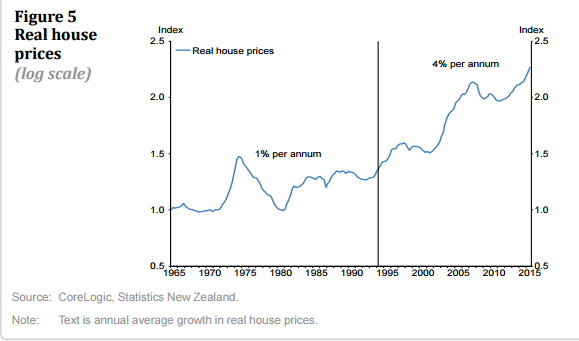
Note that there is considerable regional variation in housing prices in New Zealand.

Source: Property Prices in New Zealand | New Zealand Real Estate Prices.
25 Sep 2016 Leave a comment
in economic history, politics - New Zealand, urban economics Tags: Generation Rent, housing affordability

Source: Housing affordability: The Social Report 2016 – Te pūrongo oranga tangata from Perry (2015), Ministry of Social Development, using data from Statistics New Zealand’s Household Economic Survey.
11 Sep 2016 1 Comment
in applied price theory, economics of regulation, politics - New Zealand, urban economics
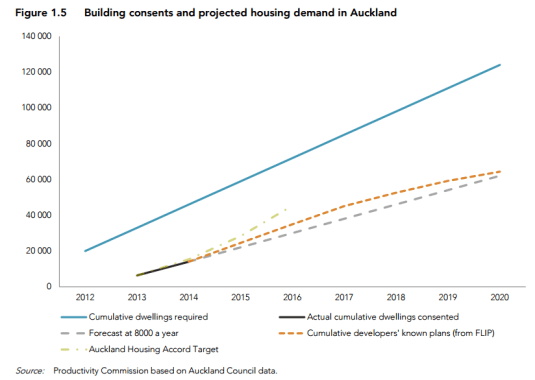
The Greens and Labour both want to build 100,000 affordable houses over 10 years. Neither explain where the land will come from. Nor do the Greens explain how to make houses more affordability without making land cheaper.
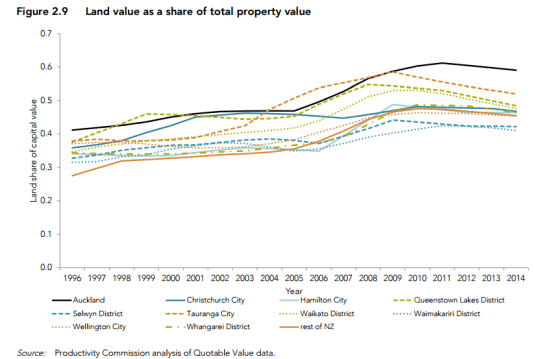
Labour is the best of the two parties because they propose to abolish the Auckland urban limit and the constraint on land supply which that represents. 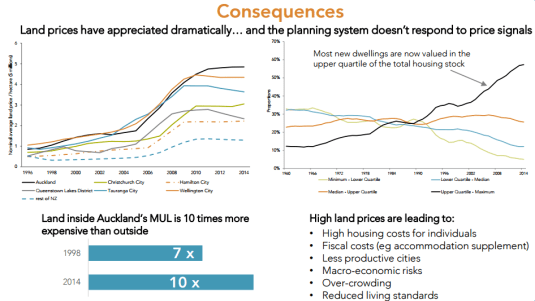
The Greens propose to get to where they want to go with taxes and bans on foreign buyers. Those proposals of the Greens do not increase the amount of land available and therefore the number of houses that will be built.
06 Sep 2016 Leave a comment
in economics of regulation, politics - New Zealand, urban economics
31 Aug 2016 Leave a comment
in politics - New Zealand, urban economics Tags: housing affordability, land supply, RMA, zoning
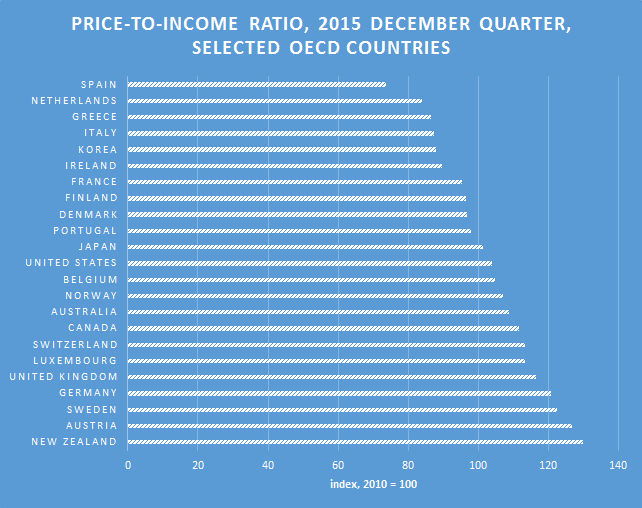
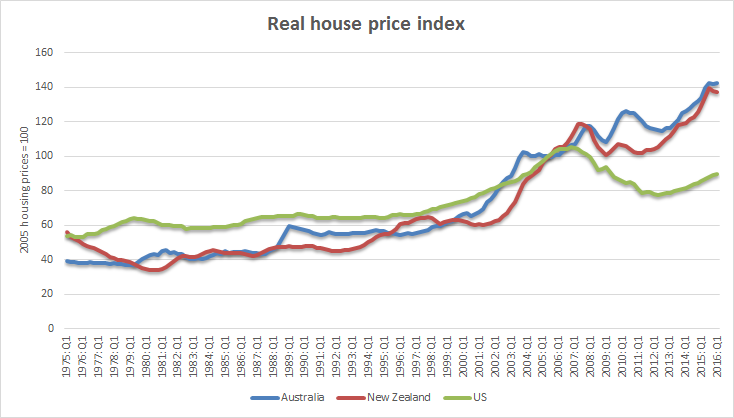
Source: IMF Global Housing Watch
31 Aug 2016 Leave a comment
in labour economics, politics - New Zealand, poverty and inequality, urban economics Tags: homelessness, social insurance, social safety net, welfare state
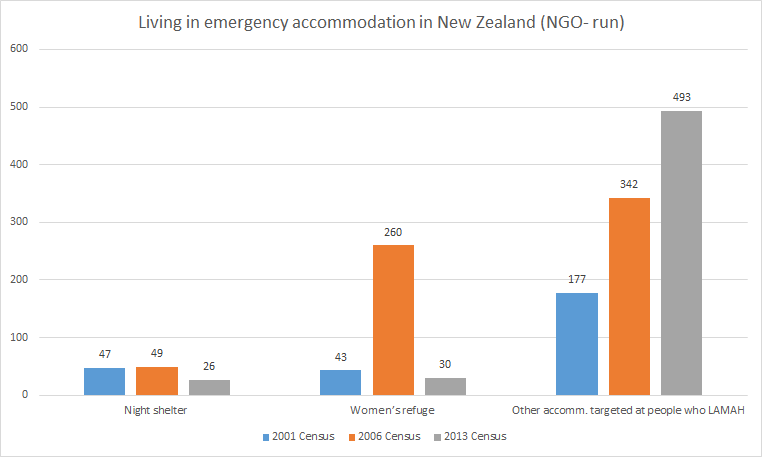
Source: 24 August 2016, Most homeless people working or studying, News, University of Otago, New Zealand, table 4.
30 Aug 2016 Leave a comment
in labour economics, politics - New Zealand, poverty and inequality, urban economics Tags: child poverty, family poverty, homelessness, New Zealand Greens, New Zealand Labour Party, social insurance, welfare state
I cherry picked my previous data on homelessness if the New Zealand sub-Reddit is to be believed and from which I am banned and cannot reply. Plotting the data in full is to cherry pick it. The chart below is simply the first two rows of the source data. The subsequent rows deal with those in emergency accommodation and in temporary accommodation.
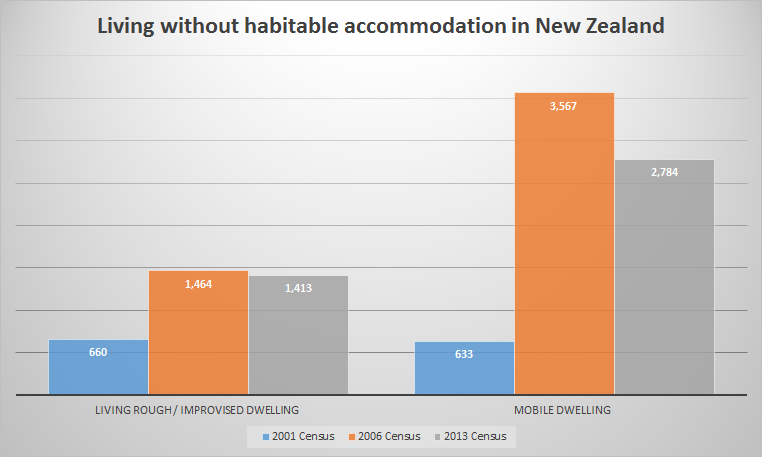
Source: 24 August 2016, Most homeless people working or studying, News, University of Otago, New Zealand, table 4.
When I shared this data on Carmel Sepuloni MP’s Facebook page, she rightly and constructively said
Thanks for your comment Jim. Unfortunately the number living rough has increased since 2001. We want to focus on improving the future, which is why we are holding our homeless inquiries so we can best understand and address this issue:
Rather than pointscoring, the issue is what to do to fix the problem. How desperate is much of the rest of the Left to beat up this issue as the fault of John Key. This is an an important issue that should not be used for point scoring by sufferers of John Key derangement syndrome.
Homeless people are those who I charted above. They are sleeping rough or in a car. They have slipped through the social safety net which is obviously not working for them. If you are in emergency accommodation, the social safety net is working. The issue is making that safety net work better in terms of moving quickly into more permanent accommodation..
27 Aug 2016 Leave a comment
in applied price theory, politics - New Zealand, urban economics Tags: affordable housing, housing affordability, land supply, New Zealand Greens, New Zealand Labour Party, price controls
The Labour Party (and Greens) both plan to build 100,000 affordable homes and sell them within a specific price range. In Auckland, where houses cost in excess of $800,000 on average, they hope to enter the market at the $550,000 point with still quite reasonable housing.
What I ask you is how will Labour and the Greens make sure the affordable houses both are proposing are not snapped up by well-to-do buyers rather than families currently locked out of the market? What will the rationing mechanism be?

Source: KiwiBuild – New Zealand Labour Party.
How will Labour and the Greens ration these desirable houses given that they are priced well below the competition? If two buyers both offer $550,000 for the house, which bid will be accepted?
If the next best available house in Auckland is worth more than that because it is not sold by the proposed Housing Affordability Authority, the first bid for these houses will be $550,000 which is the maximum the government under a Labour Party is willing to accept? What happens then?
It is basic economics that if you price at less than the market clearing rate which in Auckland is somewhere near $800,000, people will queue to buy what you have unless you raise the price. The exercise of building 100,000 affordable houses makes no sense unless the purpose is to undercut what the market currently supplies.
As the houses are to be sold by a government agency, there can be no black market nor dilution of quality to even up supply with demand. How will a deadlock in price bids be resolved if the maximum bid for an affordable house starts at $550,000?
Labour acknowledges the possibility of flipping by restricting resale for 5 years. But what stops investors just waiting 5 years as there is any significant price gap between these affordable houses and the private market alternatives.
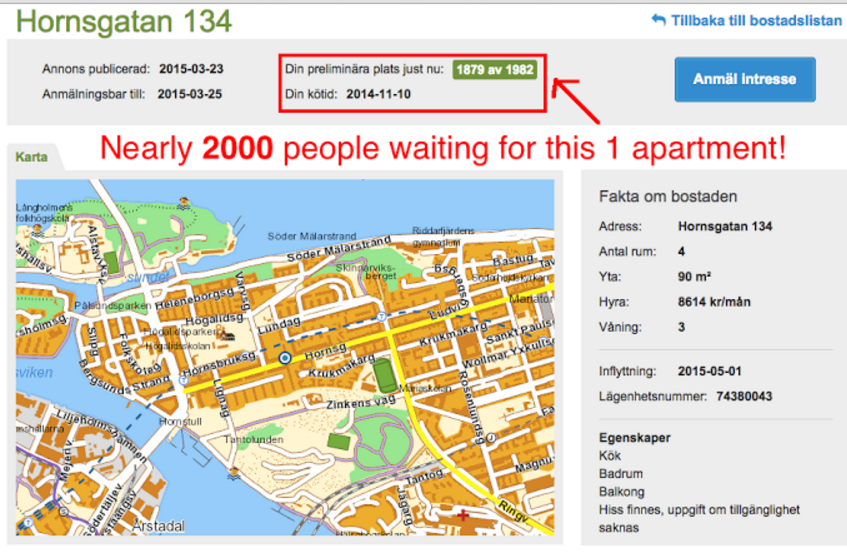
What stops more affluent buyers living in these houses because they so much cheaper than the competing options in Auckland? If you miss out in bidding on one affordable home, do you go back to the end of the queue for the next that is built or get some priority?
16 Aug 2016 Leave a comment
in applied welfare economics, labour economics, labour supply, politics - New Zealand, poverty and inequality, urban economics, welfare reform Tags: child poverty, family poverty, housing affordability, RMA
Today in the Guardian writing on trends in family poverty New Zealand, Eleanor Roy said that
The fact that twice as many children now live below the poverty line than did in 1984 has become New Zealand’s most shameful statistic.
Roy goes back to the 1980s as her base because child poverty has not gone up or down by that much since that sharp rise in the late 1980s.
Child poverty among single-parent households has doubled since 1990 and tripled since 1988. Poverty in families with two parents present is not much higher now than it was in 1988.

Source: Bryan Perry, Household Incomes in New Zealand: trends in indicators of inequality and hardship 1982 to 2014 – Ministry of Social Development, Wellington (August 2015), Table H.4.
Child poverty rates among single-parent families that live with other adults is one-quarter that of single-parent families who live alone. The reasons behind that should be explored more by those concerned with child poverty.

Source: Bryan Perry, Household Incomes in New Zealand: trends in indicators of inequality and hardship 1982 to 2013 – Ministry of Social Development, Wellington (2014), Tables F.6 and F.7.
The evidence is overwhelming that the main driver of the increases in the child poverty since the 1980s is rising housing costs.
In the longer run, after housing costs child poverty rates in 2013 were close to double what they were in the late 1980s mainly because housing costs in 2013 were much higher relative to income than they were in the late 1980s.
– Bryan Perry, 2014 Household Incomes Report – Key Findings. Ministry of Social Development (July 2014).
Any policy to reduce child poverty must increase the supply of houses by reducing regulatory restrictions on the supply of land.
Rather than blame the callousness of government in accepting higher rates of child poverty, Roy should blame its inability to take on the restrictions on land supply in the Resource Management Act that drive up housing costs for the poor. Increased child poverty in New Zealand is a by-product of housing unaffordability.
05 Aug 2016 Leave a comment
in applied price theory, economics of regulation, politics - New Zealand, urban economics Tags: Auckland, housing affordability, land supply, New Zealand Greens, RMA, The fatal conceit, zoning
The Greens are at it again proposing to build 100,000 affordable houses without ever explaining where the additional new land will come from.

There would have to be an amendment to the proposed Auckland unitary plan to free up more land for there to be a net increase in the supply of land in Auckland.
Unless there is that such amendment, a government plan to build 100,000 affordable houses in Auckland and elsewhere will simply be competing for the same fixed supply of land. If the supply of land is constrained from expanding by much, the only thing that will happen is that the price will go up with more money chasing the same amount of land and housing.
27 Jul 2016 Leave a comment
in applied price theory, economics of regulation, politics - New Zealand, urban economics Tags: housing affordability, land supply, New Zealand Greens, RMA, zoning
Just increase the supply of land. Extending the capital gains tax and banning foreigners from buying land will do no good. An average house price 10 times the average income in Auckland is not a demand-side problem.

Source: Is Your Town Building Enough Housing? – Trulia’s Blog.
There are plenty of examples of US cities with different land supply restrictions but common national surges in demand for housing such as prior to the GFC. Cities with liberal land supply experienced only small increases in house prices.

Source: Regionally, Housing Rebound Depends on Jobs, Local Supply Tightness – The Long-Awaited Housing Recovery – 2013 Annual Report – Dallas Fed from Federal Housing Finance Agency; Bureau of Economic Analysis; “The Geographic Determinants of Housing Supply,” by Albert Saiz, Quarterly Journal of Economics, vol. 125, no. 3, 2010, pp. 1253–96.
The Greens should follow ACT and the Labour Party in calling for the abolition of the Auckland urban limit and changes in council finances so they can fund the necessary infrastructure quickly.
Celebrating humanity's flourishing through the spread of capitalism and the rule of law
Scholarly commentary on law, economics, and more
Beatrice Cherrier's blog
Celebrating humanity's flourishing through the spread of capitalism and the rule of law
Celebrating humanity's flourishing through the spread of capitalism and the rule of law
Celebrating humanity's flourishing through the spread of capitalism and the rule of law
Why Evolution is True is a blog written by Jerry Coyne, centered on evolution and biology but also dealing with diverse topics like politics, culture, and cats.
Celebrating humanity's flourishing through the spread of capitalism and the rule of law
Celebrating humanity's flourishing through the spread of capitalism and the rule of law
A rural perspective with a blue tint by Ele Ludemann
DPF's Kiwiblog - Fomenting Happy Mischief since 2003
Celebrating humanity's flourishing through the spread of capitalism and the rule of law
The world's most viewed site on global warming and climate change
Tim Harding's writings on rationality, informal logic and skepticism
A window into Doc Freiberger's library
Let's examine hard decisions!
Commentary on monetary policy in the spirit of R. G. Hawtrey
Thoughts on public policy and the media
Celebrating humanity's flourishing through the spread of capitalism and the rule of law
Politics and the economy
A blog (primarily) on Canadian and Commonwealth political history and institutions
Reading between the lines, and underneath the hype.
Economics, and such stuff as dreams are made on
"The British constitution has always been puzzling, and always will be." --Queen Elizabeth II
Celebrating humanity's flourishing through the spread of capitalism and the rule of law
Celebrating humanity's flourishing through the spread of capitalism and the rule of law
WORLD WAR II, MUSIC, HISTORY, HOLOCAUST
Undisciplined scholar, recovering academic
Celebrating humanity's flourishing through the spread of capitalism and the rule of law
Res ipsa loquitur - The thing itself speaks
In Hume’s spirit, I will attempt to serve as an ambassador from my world of economics, and help in “finding topics of conversation fit for the entertainment of rational creatures.”
Researching the House of Commons, 1832-1868
Articles and research from the History of Parliament Trust
Reflections on books and art
Posts on the History of Law, Crime, and Justice
Celebrating humanity's flourishing through the spread of capitalism and the rule of law
Exploring the Monarchs of Europe
Cutting edge science you can dice with
Small Steps Toward A Much Better World
“We do not believe any group of men adequate enough or wise enough to operate without scrutiny or without criticism. We know that the only way to avoid error is to detect it, that the only way to detect it is to be free to inquire. We know that in secrecy error undetected will flourish and subvert”. - J Robert Oppenheimer.
The truth about the great wind power fraud - we're not here to debate the wind industry, we're here to destroy it.
Celebrating humanity's flourishing through the spread of capitalism and the rule of law
Celebrating humanity's flourishing through the spread of capitalism and the rule of law
Economics, public policy, monetary policy, financial regulation, with a New Zealand perspective
Celebrating humanity's flourishing through the spread of capitalism and the rule of law
Restraining Government in America and Around the World

 Utopia, you are standing in it!
Recent Comments