
Basing policy on a scientific consensus is a new development for environmentalists
06 May 2014 Leave a comment
in economics of regulation, environmental economics, environmentalism, health economics, law and economics Tags: Cass Sunstein, GMOs, killer green technologies, Paul Nurse, precautionary principle
Previously the precautionary principle was used to introduce doubt when there was no doubt. But when climate science turned in their favour, environmentalists wanted public policy to be based on the latest science.
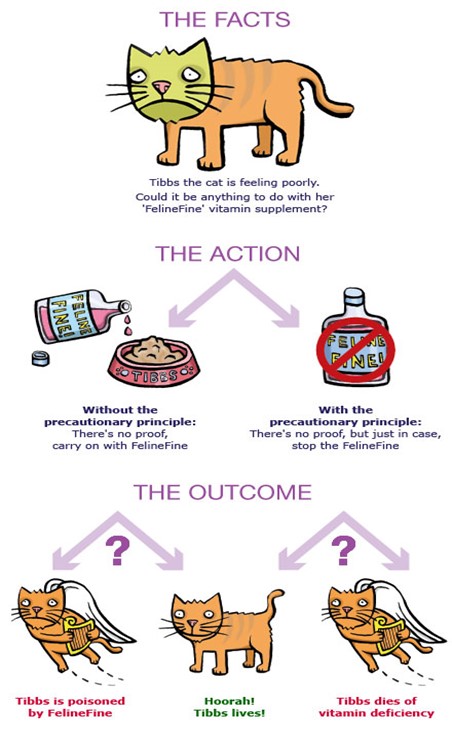
The precautionary principle is deeply incoherent. We should take precautions but there are always risks on both sides of a decision; inaction can bring danger, but so can action. Precautions themselves create risks so the precautionary principle bans what it simultaneously requires.
There is never perfect certainty about the nature and causes of health and environmental threats, so environmental and health regulations are almost always adopted despite some residual uncertainty.
We live in a Schumpeterian world where new risks replace old risks.
The obvious question is it safer or more precautionary to focus on the potential harms of new activities or technologies without reference to the activities or technologies they might displace? Jonathan Alder explains
In any policy decision, policy makers can make two potential errors regarding risk.
On the one hand, policy makers may err by failing to adopt measures to address a health or environmental risk that exists.
On the other hand, policy makers may adopt regulatory measures to control a health or environmental risk that does not exist.
Both types of error can increase risks to public health.
Consider the overwhelming consensus among researchers that biotech crops are safe for humans and the environment
This is a conclusion that is rejected by the very environmentalist organisations that loudly insist on the policy relevance of the scientific consensus on global warming.
In his 2012 Dimbleby lecture, Sir Paul Nurse calls for a re-opening the debate about GM crops based on scientific facts and analysis:
We need to consider what the science has to say about risks and benefits, uncoloured by commercial interests and ideological opinion. It is not acceptable if we deny the world’s poorest access to ways that could help their food security, if that denial is based on fashion and ill-informed opinion rather than good science.
Cass Sunstein wrote that in its strongest and most distinctive forms, the precautionary principle imposes a burden of proof on those who create potential risks, and requires regulation of activities even if it cannot be shown that those activities are likely to produce significant harms:
…apparently sensible questions have culminated in an influential doctrine, known as the precautionary principle.
The central idea is simple: Avoid steps that will create a risk of harm.
Until safety is established, be cautious; do not require unambiguous evidence.
Yet the precautionary principle, for all its rhetorical appeal, is deeply incoherent.
It is of course true that we should take precautions against some speculative dangers.
But there are always risks on both sides of a decision; inaction can bring danger, but so can action.
Precautions, in other words, themselves create risks – and hence the principle bans what it simultaneously requires.
Sunstein is a Democrat whose White House appointment to the head the White House Office of Information and Regulatory Affairs under Obama was opposed by the Left of the Democrat Party because of his views on the precautionary principle and his support of cost-benefit analysis as a primary tool for assessing regulations. Sunstein again:
The simplest problem with the precautionary principle is that regulation might well deprive society of significant benefits, and even produce a large number of deaths that would otherwise not occur.
Genetic modification holds out the promise of producing food that is both cheaper and healthier – resulting, for example, in products that might have large benefits in developing countries.
The point is not that genetic modification will definitely have those benefits, or that the benefits of genetic modification outweigh the risks.
The point is that the precautionary principle provides no guidance
The epitome of anti-science is support for the precautionary principle and opposition to cost-benefit analysis in assessing regulations. Which side of politics is guilty of this?
Environmentalists accept the views of scientists when its suits their anti-progress agenda. In other cases, the precautionary principle is used to delay judgment, reject science such as on GMOs and demand ever more evidence.
Environmentalists are all for the precautionary principle except when applied to natural medicines, organic food and marijuana.
Climate policy targets revisited | Richard Tol
26 Apr 2014 Leave a comment
in applied welfare economics, economics of climate change, environmental economics, environmentalism, politics Tags: global warming, Richard Tol
The IPCC’s Fifth Assessment Report estimates lower costs of climate change and higher costs of abatement than the Stern Review. However, current UN negotiations focus on stabilising atmospheric concentrations of greenhouse gases at even lower levels than recommended by Stern.
This column argues that, given realistic estimates of the rate at which people discount the future, the UN’s target is probably too stringent.
Moreover, since real-world climate policy is far from the ideal of a uniform carbon price, the costs of emission reduction are likely to be much higher than the IPCC’s estimates.

PRTP is the preferred rate of time preference used in net present value calculations.
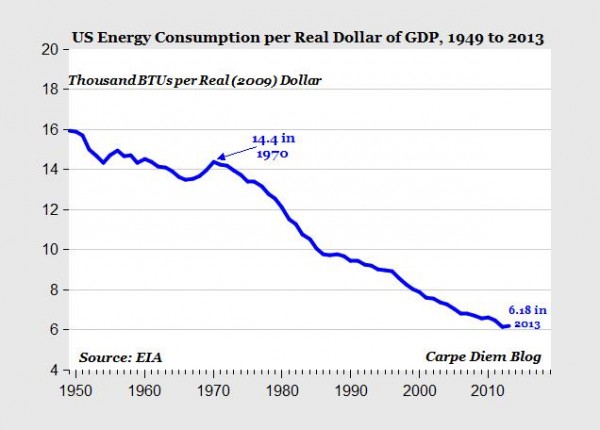
Chart of the day: In 2013, America was more than twice as energy efficient compared to 1970 when Earth Day started | AEIdeas
23 Apr 2014 Leave a comment
in entrepreneurship, environmental economics, environmentalism, liberalism, technological progress Tags: Earth Day, energy conservation
EARTH DAY: SPIRITUALLY UPLIFTING, INTELLECTUALLY DEBASED by Julian L. Simon
23 Apr 2014 Leave a comment
in applied welfare economics, entrepreneurship, environmental economics, environmentalism, liberalism, market efficiency Tags: Earth Day, Julian Simon, Paul Ehrlich
During the first great Earth Week in 1970 there was panic.
The public’s outlook for the planet was unrelievedly gloomy.
The doom saying environmentalists – of whom the dominant figure was Paul Ehrlich – raised the alarm: The oceans and the Great Lakes were dying; impending great famines would be seen on television starting in 1975; the death rate would quickly increase due to pollution; and rising prices of increasingly-scarce raw materials would lead to a reversal in the past centuries’ progress in the standard of living.
… On average, people throughout the world have been living longer and eating better than ever before.
Fewer people die of famine nowadays than in earlier centuries.
The real prices of food and of every other raw material are lower now than in earlier decades and centuries, indicating a trend of increased natural-resource availability rather than increased scarcity.
The major air and water pollutions in the advanced countries have been lessening rather than worsening.

Via Julian Simon memorial site
Great Ed Glaeser quote at Café Hayek
23 Apr 2014 Leave a comment
in environmental economics, environmentalism, urban economics Tags: Edward Glaeser

Obama’s opportunistic record on fighting global warming
18 Apr 2014 Leave a comment
in environmentalism, global warming, politics - USA, Public Choice Tags: global warming, Matthew Kahn, McCain, obama, Yes Minister
Even in the US, where nothing can be done through legislation thanks to Republican delusionists.
The 2008 Republican Party presidential nominee supported cap-and-trade. McCain had a strong legislative record; he introduced a bill with Joe Lieberman to introduce carbon trading in 2003.
McCain has been one of the most outspoken members of Congress on the issue of climate change’ and he “managed to force the first real Senate vote on actually doing something about the largest environmental peril our species has yet faced.
McCain used a Senate parliamentary manoeuvre that forced a floor vote on the climate legislation. The McCain-Lieberman bill lost 43-55.
In 2007 he reintroduced his bill, with bipartisan co-sponsorship. Obama missed the June 2008 vote on McCain’s Climate Security Bill.
In a March 2008 speech, McCain called for a “successor to the Kyoto Treaty” and a cap-and-trade system “that delivers the necessary environmental impact in an economically responsible manner.”
McCain’s climate policy includes several target dates. By 2012, McCain said U.S. emissions should return to 2005 levels. By 2050, he says, the U.S. emissions should be 60 per cent below 1990 levels.
In January 2010, the Pew Research Center asked Americans to rank the importance of twenty-one issues. Climate change came in last.
After winning the fight over health care, another issue for which polling showed weak support, Obama moved on to the safer issue of financial regulatory reform.
There were 5 Republican senators who would have voted for cap and trade in April 2010: Lindsey Graham, Susan Collins, Olympia Snowe, Scott Brown, and George LeMieux. There were 57 Democrat Senators. It takes 60 votes to break a filibuster.
President Obama could have fought harder to get the Bill the House passed through the Senate but he did not.
Blame Obama, no one else. He is supposed to make change happen. He lacked the political skills to build coalitions even within his own party to deliver.
Many others, including McCain softened or reversed positions as voter support waned as the great recession deepened.
In Copenhagen’s final private negotiations, Obama, Brown, Sarko and Merkel sat down with He Yafei, the Chinese vice-minister of foreign affairs. There is a tape of this meeting at Der Spiegel. HT: The Guardian.
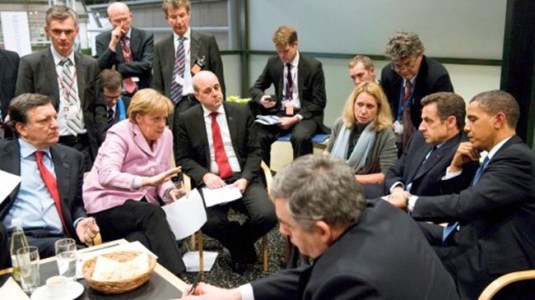
He Yafei was the smartest guy in the room – listen to the tape. Wen Jiabao refused to attend most of the negotiating sessions.
Given the choice of walking out and sitting down with a vice-minister, they chose humiliation. One response of Obama was:
It would be nice to negotiate with somebody who can make political decisions.
Rather than blaming vast right-wing conspiracies, using Google searches for “unemployment” and “global warming”, Kahn and Kotchen found that:
- Recessions increase concerns about unemployment at the expense of public interest in climate change;
- The decline in global-warming searches is larger in more Democratic leaning states; and
- An increase in a state’s unemployment rate decreases in the probability that Americans think global warming is happening, and reduces the certainty of those who think it is.
The middle-of-the-road voters changed their priorities and their political leaders followed them.
It’s the peoples’ will, I am their leader, I must follow them. – Jim Hacker, The Greasy Pole
As Geoff Brennan has argued, CO2 reduction actions will be limited to modest unilateral reductions of a largely token character. There are many expressive voting concerns that politicians must balance to stay in office and the environment is but one of these. Once climate change policies start to actually become costly, expressive voting support for these policies will fall away, and it has.
The World Bank Ignores How Capitalism Can Help Us to Adapt to Climate Change!
05 Apr 2014 1 Comment
in development economics, economics of natural disasters, entrepreneurship, environmentalism Tags: adaptation, global warming

Matt Kahn at Environmental and Urban Economics.
The Household Demand for Low Carbon Public Policies
04 Apr 2014 Leave a comment
in applied welfare economics, environmental economics, environmentalism, politics - USA, Public Choice Tags: Matthew Kahn

Individual tradable birth licences – ecological economics’ finest hour?
02 Apr 2014 1 Comment
in economic growth, environmentalism, labour economics, population economics Tags: birth credits
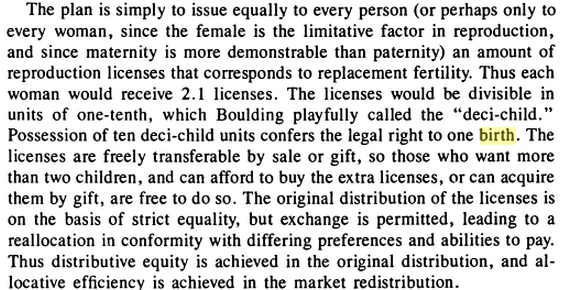
A mate suggested that I look into ecological economics. The self-appointed visionaries of ecological economics were so concerned about the population bomb that they proposed a “choice-based, marketable, birth license plan” or “birth credits” for population control. The Earth’s carrying capacity is a central issue in ecological economics.
Birth credits were promoted by urban designer and environmental activist Michael E. Arth since the 1990s and earlier by economist Kenneth Boulding (1964) and ecological economist Herman Daly (1991). I am not making this up.

Birth credits would allow any woman to have as many children as she wants, as long as she buys a license for any children beyond an average allotment that would result in zero population growth (ZPG). Birth credits are similar to individual tradable quotas for fishing.
- If the allotment was determined to be 1.1 children, then the first child would be free, and the market would determine the cost of the license or birth credit for each additional child.
- The units could be sold in units of 1/10th of a credit with each of us getting 1.1 credits each for free, under some proposals.
Being nice members of the middle class, the penalty proposed for an illegal baby would be community service for the parents. I am sure most parents would welcome the time out of the house and the free child care. Obviously, these nice family unfriendly educated middle class ZPG types do not seem to appreciate the seas and oceans that some with cross to have a child.
Arth, Dally and his fellow prophets were smug enough to think they could see the future and a looming population bomb and food riots, but plainly they got the sign of the demographic crisis wrong.

Sub-replacement fertility is now the demographic crisis. Over half of the world’s population lives in countries with fertility rates at or below replacement level, and nearly all countries will reach low fertility levels in the next decade or two.
A larger population can, as Gary Becker has pointed out, increase the rate of technological progress by increasing the number of creative people working away at inventing new products and ideas. More people means more markets that will reach a critical mass for which people can then profitably invent new products, which further increase innovation and economic growth.
The price of these birth credits would be now lower than an EU carbon credit. You could not give them away.
HT: Steady-State Economics: Second Edition With New Essays – Herman E. Daly – Google Books.
@greenpeaceNZ The expressive politics of action on global warming @RusselNorman
16 Mar 2014 2 Comments
in environmentalism, politics - Australia, Public Choice Tags: Australian elections, expressive voting, global warming, Green vote
Global warming is part of a political theatre that is made up of the symbols we boo and cheer.
People gain pleasure, excitement and self-definition for cheering for particular parties and worthy causes in the same way as they cheer and boo for sports teams.
Geoffrey Brennan, in Climate Change: A Rational Choice Politics View, Australian Journal of Agricultural and Resource Economics, July 2009, argues that we will see many countries acting unilaterally to introduce carbon emission policies because expressive voters cheer for such policies.

Brennan argued that the nature of expressive concerns is such that significant reductions in real incomes are probably not politically sustainable in the long term. This suggested to him that much of the carbon reduction action will be limited to modest reductions of a largely token character.
There are many expressive voting concerns that politicians must balance to stay in office and the environment is but one of these. Once climate change policies start to actually become costly, expressive voting support for these policies will fall away.
Abbott’s big bad new tax rhetoric in the last two Australian elections split away the working class and lower-middle class Labor voters who worry more about bread and butter issues.
The inner city Green voters’ high incomes allow them to be more indulgent as to what they cheer and boo for at the ballot box. As a group, Green party voters have the highest average incomes. These high incomes act as a buffer against policies that are otherwise costly to them. But if you scratch an inner city Green voter’s superannuation entitlements, you will find a rather raw hip-pocket middle-class voter.
In Demand for Environmental Goods: Evidence from Voting Patterns on California Initiatives: Evidence, Journal of Law and Economics, April 1997, Matthew Kahn and John Matsusaka studied voting behaviour on 16 environmental ballot propositions to estimate the demand for environmental goods.
- In most cases, rising incomes and price changes can explain most of the variation in voting; it is not essential to introduce non-economic concepts such as political ideologies.
- An important price of environmental goods is reduced incomes in the construction, farming, forestry, and manufacturing industries.
Kahn has previously argued that the environmental movement should stop saying that half measures will work and the transition to a green economy will be easy and painless.
The Green parties where I have voted do not sell their message of a green economy and action on global warming as a cause requiring more blood, sweat and tears.
The collapse of the Green vote at the recent Australian federal and state elections demonstrates that many vote Green as a protest vote against the other parties and to feel good about themselves.
The Green vote takes a hammering once Green parties enter into power sharing deals with a government. Green policies are symbols and gestures, not something about half of their voters actually want to see passed into law on a large scale and start paying for in real money.
 Utopia, you are standing in it!
Recent Comments