Murray Rothbard and the Bourbon Democrats

The American political system is complicated with the Republicans and Democrats moving around the political spectrum. Remember, Teddy Roosevelt’s Progressive Party, with its rather left wing agenda split from the Republicans, not from the Democrats in 1912.

Murray Rothbard saw a lot of anti-big government sentiments in the pre-1896 Democratic Party under the Third Party System, and especially in the Second Party System prior to the Civil War with Andrew Jackson and Martin Van Buren. The 19th century Democratic Party tended to be the party of peace, anti-militarism, and anti-imperialism. Rothbard referred to Grover Cleveland

The Third Party System was dominated by the newly created Republican Party, which supported national banks, railroads, high tariffs, homesteading rights and aid to the land-grant colleges.

The Fourth Party System from 1896 to 1932 was made up of a majority centrist Republican Party against a minority Democratic Party from the South together with urban Catholics in the Northern cities – a volatile brew – which soon had an ideology scarcely distinguishable from the Republicans.

Both parties under the Third party System that operated prior to 1896 comprised broad-based voting coalitions divided between the parties on racial, ethnic and religious lines with high voter turnout and strong partisanship.

  • Methodists, Congregationalists, Presbyterians, and Scandinavian Lutherans were closely linked to the Republican Party.
  • Catholics, Episcopalians, and German Lutherans, looked to the Democratic Party for protection from moralism and prohibition.
  • The Democrats gained more support from the lower classes than did the Republicans.

Bourbon Democrat was a term used in the US from 1876 to 1904 for members of the Democratic Party, conservative or classical liberal, and especially those who supported President Grover Cleveland in 1884–1888 and 1892–1896. Rothbard referred to Grover Cleveland as “a hard-money laissez-faire Democrat” and

the continuity of quasi-libertarian thought that the Democrat Party brought to the United States throughout the nineteenth century

The Bourbon Democrats represented business interests, generally supporting the goals of banking and railroads but opposed to subsidies for them and were unwilling to protect them from competition.

Bourbon Democrats were promoters of laissez-faire capitalism (which included opposition to the protectionism that the Republicans advocated). The Bourbon Democrats opposed imperialism and U.S. overseas expansion, fought for the gold standard, and opposed bimetallism.

The notion that the Democratic Party was once the home of classical liberals in the USA at one time and the Republican Party was the party of regulation and big government is so foreign to the modern party divides in the USA today. Political parties in the United States certainly are big tents as they say.

Good monopolies and bad price cuts

A surprising number of well-meaning people want to protect consumers from the scourge of lower prices. These abominations come from imports, new entry or cost reductions.

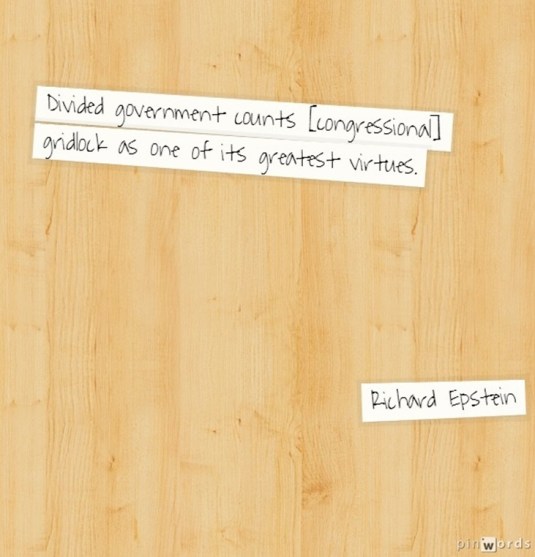
Richard Epstein talked about how progressives think they can tell the difference between a good monopoly and a bad monopoly.

MON_PROF.gif

There is one instance in which monopoly could arise in the free market – exclusive ownership of an essential input (Kirzner 1973):

Monopoly … in a market free of government obstacles to entry, means for us the position of a producer whose exclusive control over necessary inputs blocks competitive entry into the production of his product.

Monopoly thus does not refer to the position of a producer who, without any control over resources, happens to be the only producer of a particular product. This producer is fully subject to the competitive market process, since other entrepreneurs are entirely free to compete with him.

In all other cases, monopoly is the grant by government of an exclusive privilege to produce or sell a product (Rothbard 1962). This definition is from the common law as per Lord Coke:

A monopoly is an institution or allowance by the king, by his grant, commission, or otherwise . . . to any person or persons, bodies politic or corporate, for the sole buying, selling, making, working, or using of anything, whereby any person or persons, bodies politic or cor­porate, are sought to be restrained of any freedom or liberty that they had before, or hindered in their lawful trade.

All Men Are Created Equal – To Kill a Mockingbird

My High School Class read the book. One of the greatest books ever.

Video

John Stuart Mill and dissent and the value of criticism

The Devil’s Dictionary – definition of a cynic

A blackguard whose faulty vision sees things as they are, not as they ought to be. Hence the custom among the Scythians of plucking out a cynic’s eyes to improve his vision.


Super-Economy “pre-reviewed ” Piketty in 2010

The French are poorer that the 3rd poorest American state: Arkansas. The EU-15 as a whole would qualify to be the 49th poorest American state.

The rich in Europe are poor by American standards. The poor in the USA are middle class by European standards. The European middle class has smaller houses, few cars and few consumers durables that the average poor in the USA.

via Super-Economy: Dynamic America, Poor Europe  and Tino Sanandaji

Housing space per capita

via Heritage Foundation

Never had it so good, but people still complain

image

Image

Richard Epstein “The Coming Meltdown in Labor Relations”

Why Does 1% of History Have 99% of the Wealth? | Learn Liberty – YouTube

Throughout the history of the world, the average person on earth has been extremely poor: subsisting on the modern equivalent of $3 per day.


This was true until 1800, at which point average wages—and standards of living—began to rise dramatically.

Prof. Deirdre McCloskey explains how this tremendous increase in wealth came about.

In the past 30 years alone, the number of people in the world living on less than $3 per day has been halved.

The cause of the economic growth we have witnessed in the past 200 years may surprise you.

It’s not exploitation, or investment. Innovation—new ideas, new inventions, materials, machinery, organizational structures—has fueled this economic boom.

Prof. McCloskey explains how changes in Holland and England in the 1600s and 1700s opened the door for innovation to take off—starting the growth that continues to benefit us today.

via Why Does 1% of History Have 99% of the Wealth? | Learn Liberty – YouTube.

Richard Epstein: Income, Wealth and Inequality. Leveling Up or Leveling Down?


The Great Liberator – Larry Summer’s Obituary for Milton Friedman

via The Great Liberator – New York Times.

Chart of the day: In 2013, America was more than twice as energy efficient compared to 1970 when Earth Day started | AEIdeas

gdp-600x430

Chart of the day: In 2013, America was more than twice as energy efficient compared to 1970 when Earth Day started | AEIdeas.

EARTH DAY: SPIRITUALLY UPLIFTING, INTELLECTUALLY DEBASED by Julian L. Simon

During the first great Earth Week in 1970 there was panic.

The public’s outlook for the planet was unrelievedly gloomy.

The doom saying environmentalists – of whom the dominant figure was Paul Ehrlich – raised the alarm: The oceans and the Great Lakes were dying; impending great famines would be seen on television starting in 1975; the death rate would  quickly increase due to pollution; and rising prices of increasingly-scarce raw materials would lead to a reversal in the past centuries’ progress in the standard of living.

… On average, people throughout the world  have been living longer and eating better than ever before.

Fewer people die of famine nowadays than in earlier centuries.

The real prices of food and of every other raw material are lower now than in earlier decades and centuries, indicating a trend of increased natural-resource availability rather than increased scarcity.

The major air and water pollutions in the advanced countries have been lessening rather than worsening.

Julian L. Simon

Via Julian Simon memorial site

HT: The Climate Counsel

PEETA (People Enjoy Eating Tasty Animals)-updated

The web site formally known as People Enjoy Eating Tasty Animals (PEETA) is one of my favourite web sites.

When called PEETA in 1996 or so, this web site was the subject of a pioneering intellectual property court case by PETA.

Grilled Steak Recipe with Garlic-Herb Butter

The web site is a resource for those who enjoy eating meat, wearing fur and leather, hunting, and the fruits of scientific research. More on animal testing later with the help of Penn and Teller.

via People Eating Tasty Animals.

BTW, why are people not allowed to eat tasty animals, but other animals are allowed to eat each other if they can catch them. Should carnivores be required to become vegans? That would be a death sentence for them.

Experts Are at a Loss on Investing

Harry M. Markowitz won the Nobel Prize in economics as the father of “modern portfolio theory,” the idea that people shouldn’t put all of their eggs in one basket, but should diversify their investments.

Markowitz split most of his his own retirement investments down the middle, put half in a stock fund and the other half in a conservative, low-interest investment.

Markowitz invested more wisely than some fellow Nobelists who have significant portions of their nest eggs in money market accounts, some of the lowest-returning investment vehicles available.

via Experts Are at a Loss on Investing – Los Angeles Times.

Previous Older Entries Next Newer Entries

Bassett, Brash & Hide

Celebrating humanity's flourishing through the spread of capitalism and the rule of law

Truth on the Market

Scholarly commentary on law, economics, and more

The Undercover Historian

Beatrice Cherrier's blog

Matua Kahurangi

Celebrating humanity's flourishing through the spread of capitalism and the rule of law

Temple of Sociology

Celebrating humanity's flourishing through the spread of capitalism and the rule of law

Velvet Glove, Iron Fist

Celebrating humanity's flourishing through the spread of capitalism and the rule of law

Why Evolution Is True

Why Evolution is True is a blog written by Jerry Coyne, centered on evolution and biology but also dealing with diverse topics like politics, culture, and cats.

Down to Earth Kiwi

Celebrating humanity's flourishing through the spread of capitalism and the rule of law

NoTricksZone

Celebrating humanity's flourishing through the spread of capitalism and the rule of law

Homepaddock

A rural perspective with a blue tint by Ele Ludemann

Kiwiblog

DPF's Kiwiblog - Fomenting Happy Mischief since 2003

The Dangerous Economist

Celebrating humanity's flourishing through the spread of capitalism and the rule of law

Watts Up With That?

The world's most viewed site on global warming and climate change

The Logical Place

Tim Harding's writings on rationality, informal logic and skepticism

Doc's Books

A window into Doc Freiberger's library

The Risk-Monger

Let's examine hard decisions!

Uneasy Money

Commentary on monetary policy in the spirit of R. G. Hawtrey

Barrie Saunders

Thoughts on public policy and the media

Liberty Scott

Celebrating humanity's flourishing through the spread of capitalism and the rule of law

Point of Order

Politics and the economy

James Bowden's Blog

A blog (primarily) on Canadian and Commonwealth political history and institutions

Science Matters

Reading between the lines, and underneath the hype.

Peter Winsley

Economics, and such stuff as dreams are made on

A Venerable Puzzle

"The British constitution has always been puzzling, and always will be." --Queen Elizabeth II

The Antiplanner

Celebrating humanity's flourishing through the spread of capitalism and the rule of law

Bet On It

Celebrating humanity's flourishing through the spread of capitalism and the rule of law

History of Sorts

WORLD WAR II, MUSIC, HISTORY, HOLOCAUST

Roger Pielke Jr.

Undisciplined scholar, recovering academic

Offsetting Behaviour

Celebrating humanity's flourishing through the spread of capitalism and the rule of law

JONATHAN TURLEY

Res ipsa loquitur - The thing itself speaks

Conversable Economist

In Hume’s spirit, I will attempt to serve as an ambassador from my world of economics, and help in “finding topics of conversation fit for the entertainment of rational creatures.”

The Victorian Commons

Researching the House of Commons, 1832-1868

The History of Parliament

Articles and research from the History of Parliament Trust

Books & Boots

Reflections on books and art

Legal History Miscellany

Posts on the History of Law, Crime, and Justice

Sex, Drugs and Economics

Celebrating humanity's flourishing through the spread of capitalism and the rule of law

European Royal History

Exploring the Monarchs of Europe

Tallbloke's Talkshop

Cutting edge science you can dice with

Marginal REVOLUTION

Small Steps Toward A Much Better World

NOT A LOT OF PEOPLE KNOW THAT

“We do not believe any group of men adequate enough or wise enough to operate without scrutiny or without criticism. We know that the only way to avoid error is to detect it, that the only way to detect it is to be free to inquire. We know that in secrecy error undetected will flourish and subvert”. - J Robert Oppenheimer.

STOP THESE THINGS

The truth about the great wind power fraud - we're not here to debate the wind industry, we're here to destroy it.

Lindsay Mitchell

Celebrating humanity's flourishing through the spread of capitalism and the rule of law

Alt-M

Celebrating humanity's flourishing through the spread of capitalism and the rule of law

croaking cassandra

Economics, public policy, monetary policy, financial regulation, with a New Zealand perspective

The Grumpy Economist

Celebrating humanity's flourishing through the spread of capitalism and the rule of law

International Liberty

Restraining Government in America and Around the World