

Asked about three specific Cuba policies — the Cuban Adjustment Act; wet-foot, dry-foot; and the immigration status of Cuban nationals convicted of state and federal crimes — Sanders said he didn’t know enough about them to opine.
Celebrating humanity's flourishing through the spread of capitalism and the rule of law
24 Nov 2017 Leave a comment
in Economics of international refugee law, International law, Marxist economics, politics - USA
Asked about three specific Cuba policies — the Cuban Adjustment Act; wet-foot, dry-foot; and the immigration status of Cuban nationals convicted of state and federal crimes — Sanders said he didn’t know enough about them to opine.
11 Nov 2017 1 Comment
in economic history, Marxist economics Tags: Berlin wall
02 Jun 2017 Leave a comment
in labour economics, labour supply, Marxist economics, minimum wage, poverty and inequality, unemployment Tags: living wage
Efficiency wages were put forward as a cause of what is now called precarious work. The efficiency wage hypothesis breathed considerable new life into the old theory of dual labour markets (Katz 1986; Dickens and Lang 1985).

The notion of a segmented labour market, of a primary and a secondary labour market, each with distinctly different wage setting mechanisms, was very much a fringe idea prior to the 1980s:
Efficiency wage theory provides a rare common meeting ground for mainstream and radical economists, because the far left in U.S. economics has taken the lead in developing theories of dual labor markets and for setting-out policy proposals for higher minimum wages based on the assumed validity of the efficiency wage approach (Gordon 1990, p. 1157).
The workers privileged enough to hired by firms paying an efficiency wage would enjoy job security, low job quit rates, good working conditions, career advancement, training and higher pay (Akerlof 1982, 1984; Bulow and Summers 1986; Dickens and Lang 1993). The remaining equally productive workers who were unlucky enough to be priced out of these good jobs by the job rationing implicit in an efficiency wage must fend for themselves in a secondary labour market; in precarious work with high quit rates, harsh workplace discipline, few promotions, little training and poor pay (Akerlof 1982, 1984; Katz 1986; Dickens and Lang 1985). Efficiency wages do not motivate greater employee effort unless the prospect of precarious work in this secondary labour market looms large in the back of their minds as their main alternative source of employment for those lucky enough to be employed in the good jobs in the primary labour market (Katz 1986; Bulow and Summers 1986).
Those workers crowded into these bad jobs in the secondary labour market find it to be a slow and difficult process to break into these better paying good jobs in the primary labour market. There are queues for the good jobs because they are paying above-market wages; many of those crowded into the bad jobs are women and minorities (Bulow and Summers 1986; Dickens and Lang 1985, 1993).
Akerlof, in his Nobel Prize lecture on behavioural macroeconomics, contended that the good and bad jobs caused by paying efficiency wages is central to explaining involuntary mass unemployment:
The existence of good jobs and bad jobs makes the concept of involuntary unemployment meaningful: unemployed workers are willing to accept, but cannot obtain, jobs identical to those currently held by workers with identical ability. At the same time, involuntarily unemployed workers may eschew the lower-paying or lower-skilled jobs that are available. The definition of involuntary unemployment implicit in efficiency wage theory accords with the facts and agrees with commonly held perceptions. A meaningful concept of involuntary unemployment constitutes an important first step forward in rebuilding the foundations of Keynesian economics (Akerlof 2002, p. 415).
Living wage activists already doubt that the market can provide steady wages growth and stable employment. Efficiency wages are a leading New Keynesian macroeconomic explanation for that. The living wage movement cannot pick and choose from what the efficiency wage hypothesis says about how well the labour market functions for those who are and are not in efficiency wage jobs.
Living wage activists are unwittingly following a course of action that leads to more job rationing, more precarious work and more unemployment. Those priced out of council jobs by a living wage such as the 17 parking wardens are left to take their chances in the rest of the local labour market. These workers must take bad jobs while queueing for the good jobs in the primary labour market. Instead of being sources of opportunity in their communities, councils through a living wage policy risk becoming drivers of labour market segmentation and the fostering of a precariat.
05 May 2017 Leave a comment
in history of economic thought, Marxist economics
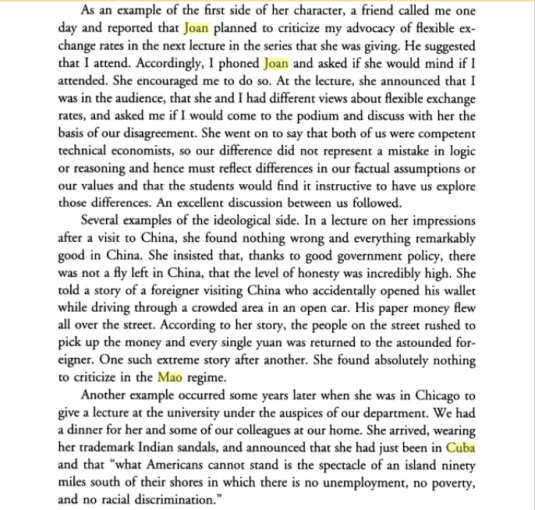
Two Lucky People: Memoirs By Milton Friedman, Rose D. Friedman, p.246.
21 Apr 2017 Leave a comment
in Marxist economics, politics - USA Tags: British politics, Leftover Left
17 Apr 2017 Leave a comment
in applied price theory, development economics, economic history, history of economic thought, Marxist economics, Public Choice Tags: Deirdre McCloskey
11 Apr 2017 Leave a comment
in economics, liberalism, Marxist economics, political change Tags: capitalism and freedom, East Germany, fall of communism
08 Feb 2017 Leave a comment

13 Jan 2017 Leave a comment
in economic history, Marxist economics Tags: Berlin, Berlin wall, fall of communism, Germany
Celebrating humanity's flourishing through the spread of capitalism and the rule of law
Celebrating humanity's flourishing through the spread of capitalism and the rule of law
Celebrating humanity's flourishing through the spread of capitalism and the rule of law
Celebrating humanity's flourishing through the spread of capitalism and the rule of law
Celebrating humanity's flourishing through the spread of capitalism and the rule of law
Celebrating humanity's flourishing through the spread of capitalism and the rule of law
A History of the Alt-Right
Econ Prof at George Mason University, Economic Historian, Québécois
Celebrating humanity's flourishing through the spread of capitalism and the rule of law
Scholarly commentary on law, economics, and more
Beatrice Cherrier's blog
Celebrating humanity's flourishing through the spread of capitalism and the rule of law
Celebrating humanity's flourishing through the spread of capitalism and the rule of law
Celebrating humanity's flourishing through the spread of capitalism and the rule of law
Why Evolution is True is a blog written by Jerry Coyne, centered on evolution and biology but also dealing with diverse topics like politics, culture, and cats.
Celebrating humanity's flourishing through the spread of capitalism and the rule of law
A rural perspective with a blue tint by Ele Ludemann
DPF's Kiwiblog - Fomenting Happy Mischief since 2003
Celebrating humanity's flourishing through the spread of capitalism and the rule of law
The world's most viewed site on global warming and climate change
Tim Harding's writings on rationality, informal logic and skepticism
A window into Doc Freiberger's library
Let's examine hard decisions!
Commentary on monetary policy in the spirit of R. G. Hawtrey
Thoughts on public policy and the media
Celebrating humanity's flourishing through the spread of capitalism and the rule of law
Politics and the economy
A blog (primarily) on Canadian and Commonwealth political history and institutions
Reading between the lines, and underneath the hype.
Economics, and such stuff as dreams are made on
"The British constitution has always been puzzling, and always will be." --Queen Elizabeth II
Celebrating humanity's flourishing through the spread of capitalism and the rule of law
Celebrating humanity's flourishing through the spread of capitalism and the rule of law
WORLD WAR II, MUSIC, HISTORY, HOLOCAUST
Undisciplined scholar, recovering academic
Celebrating humanity's flourishing through the spread of capitalism and the rule of law
Res ipsa loquitur - The thing itself speaks
In Hume’s spirit, I will attempt to serve as an ambassador from my world of economics, and help in “finding topics of conversation fit for the entertainment of rational creatures.”
Researching the House of Commons, 1832-1868
Articles and research from the History of Parliament Trust
Reflections on books and art
Posts on the History of Law, Crime, and Justice
Celebrating humanity's flourishing through the spread of capitalism and the rule of law
Exploring the Monarchs of Europe
Cutting edge science you can dice with
Small Steps Toward A Much Better World



Recent Comments