Like a boss. "Here's Sigourney Weaver Test-Firing the Flamethrower From Alien" http://t.co/rZ7KWZIBgx (via @io9) pic.twitter.com/VqOwPAx8OC
— pourmecoffee (@pourmecoffee) January 19, 2015
The response of biologists to creation theory as compared to climate alarmism
20 Jan 2015 Leave a comment
in economics of education, environmental economics, global warming, movies Tags: climate alarmism, conjecture and refutation, Inherit the Wind, JS Mill, persuasion, Socratic questions
Biologists spent great effort over many decades to rebut creation science is a cold methodical manner designed to change minds through facts and reasoned arguments. Insults and conceit give peoples excuses to not listen.
Labels like denier and alarmist are not conducive for scientists to change their minds or decide they were right in the first place, and that such unpleasantness encourages many to choose other careers or fields of study.
It is better to ask your interlocutor to think more deeply about this or that point that is in debate. Look for common ground that already exists and for a growing number of important anomalies and puzzles their current way of thinking cannot explain. Knowledge grows through critical discussion, not by consensus and agreement.
J.S. Mill pointed out that critics who are totally wrong still add value because they keep you on your toes and sharpened both your argument and the communication of your message.
If the righteous majority silences or ignores its opponents, it will never have to defend its belief and over time will forget the arguments for it.
As well as losing its grasp of the arguments for its belief, J.S. Mill adds that the majority will in due course even lose a sense of the real meaning and substance of its belief.
What earlier may have been a vital belief will be reduced in time to a series of phrases retained by rote. The belief will be held as a dead dogma rather than as a living truth.
Beliefs held like this are extremely vulnerable to serious opposition when it is eventually encountered. They are more likely to collapse because their supporters do not know how to defend them or even what they really mean.
J.S. Mill’s scenarios involves both parties of opinion, majority and minority, having a portion of the truth but not the whole of it. He regards this as the most common of the three scenarios, and his argument here is very simple.
To enlarge its grasp of the truth the majority must encourage the minority to express its partially truthful view.
Three scenarios – the majority is wrong, partly wrong, or totally right – exhaust for Mill the possible permutations on the distribution of truth, and he holds that in each case the search for truth is best served by allowing free discussion.
Mill thinks history repeatedly demonstrates this process at work and offered Christianity as an illustrative example. By suppressing opposition to it over the centuries Christians ironically weakened rather than strengthened Christian belief, and Mill thinks this explains the decline of Christianity in the modern world. They forgot why they were Christians.
Going on about how climate science is settled and the debate is over is bad tactics for the climate alarmists.
Attempts to close the debate this way provokes suspicion among those who expect some attempt to persuade them rather than to instruct them from on high.
Presumptuousness is never a good influencing strategy nor is dismissiveness. Listen here you stupid dupe of corrupt corporate lackeys converts few.
Most know that the defining feature of the growth of knowledge is knowledge grows and that is often by displacing the received wisdom. These instincts come well before any knowledge is required by the philosophy and sociology of science.

Darrow’s polite and careful cross-examination of Bryan in that great movie Inherit the Wind persuaded many to reject religious-based opposition to the theory of evolution. He asked questions and was very polite. The movie was Spencer Tracy at his finest and in black and white.
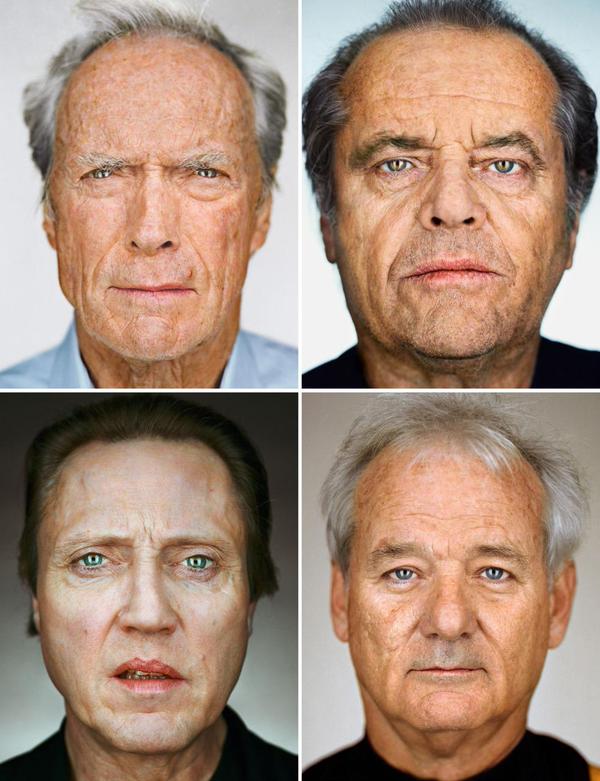
Four Legends by Martin Schoeller
20 Jan 2015 Leave a comment
in economic history, economics of media and culture, movies Tags: movies
Don Corleone with and without make-up
18 Jan 2015 Leave a comment
in movies Tags: Marlon Brando, The Godfather
Cause Célèbre – Gender Split behind Celebrity Charity Work | Information Is Beautiful
18 Jan 2015 Leave a comment
in economics of media and culture, election campaigns, movies, Music, politics - USA, Public Choice, sports economics, televison, TV shows Tags: activists, Celebrities

HT: http://www.informationisbeautiful.net/2014/cause-celebre-gender-split-behind-celebrity-charity-work/
Is Hollywood On A Dystopian Movie Binge? | FiveThirtyEight
17 Jan 2015 Leave a comment
in liberalism, movies Tags: disutopia
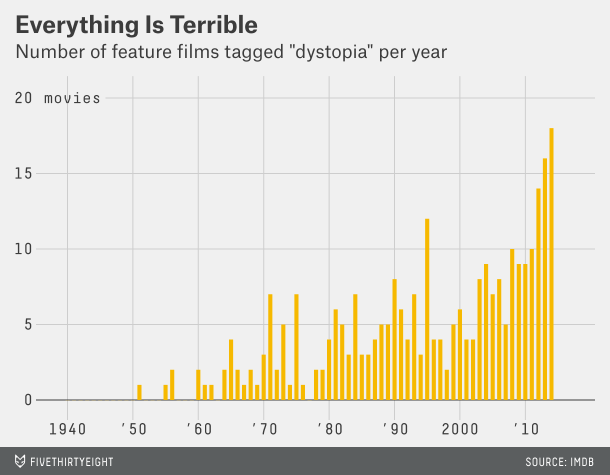
It is also cheaper to make disutopian films.
Via http://fivethirtyeight.com/datalab/is-hollywood-on-a-dystopian-movie-binge/
And the Oscar for “Best Tax Break” Goes to…
17 Jan 2015 Leave a comment
in economics of media and culture, movies, politics - New Zealand, politics - USA, Public Choice, rentseeking Tags: corporate welfare, film subsidies

HT: http://economics21.org/commentary/oscars-tax-break-american-sniper-2015-01-16 and http://www.washingtonexaminer.com/how-this-years-oscar-nominees-got-government-handouts/article/2558717
Four Lions – Top 9 best scenes
16 Jan 2015 Leave a comment
in economics of media and culture, movies Tags: Four Lions
The best ever Christmas movie is without doubt…
25 Dec 2014 Leave a comment
in liberalism, movies Tags: Die Hard
Iconic memory shattered: the banjo player in Deliverance
23 Dec 2014 Leave a comment
in economics of media and culture, movies Tags: Deliverance

The Big Lebowski will be preserved as a historical piece of American culture
19 Dec 2014 Leave a comment
in economics of media and culture, movies Tags: The Big Lebowski
A great movie about a bunch of losers and misfits.
Film review: Mr Turner
11 Dec 2014 1 Comment
in movies Tags: Mr Turner, Timothy Spall
We watched the British bio epic Mr Turner last night. At 150 minutes long, it had to grow when you, but it was a good movie in the end.
It stars Timothy Spall in his best performance to date as a gruff eccentric artist who often spoke in grunts and snorts and who was somehow still something of a ladies man.
The notion of Timothy Spall as a ladies man is a bit of a shock. Timothy Spall is a great character actor but in appearance, he is very much a face for radio.
Turner was a brilliant 19th century artist. The picture captures that superbly through the colour, lighting and scene setting of the Mike Leigh film and through Timothy Spall’s two years to learn how to paint so that he carried off the painting though he was a natural.
As I said, it’s a long movie that takes time to grow on you in part because of the setting up the the life of Turner and the era in which he lived.
We got the tickets as a last-minute gift that someone else won on the radio for a pre-screening.
As we did not pay, it is hard to give a recommendation about a film you largely get for free.
I find something significant in passing over the $16 in terms of focusing your attention on the value for money from a film. I had that view before I studied economics.
Shooting the MGM logo, 1924.
27 Nov 2014 Leave a comment
in economic history, economics of media and culture, movies, technological progress Tags: movies
Shooting the MGM logo, 1924. http://t.co/wp5LCwSUhe—
History In Pictures (@HistoryInPics) June 30, 2014
 Utopia, you are standing in it!
Recent Comments