Dear Deputy Prime Minister,
Earlier this week in your capacity as Minister of Women’s Affairs you sponsored research on the causes of the gender wage gap in New Zealand.
That just published research was seriously incomplete. The Ministry of Women’s Affairs advised today that they were aware of the work of Claudia Goldin but did not reference it.
MWA ignored the research of the world’s top female labour economist Claudia Goldin. Her research shows that the causes of the gender wage gap are completely different to what you have suggested in the research you launched earlier this week and calls for novel policy solutions that are in a completely different ballpark to those that you have raised this week.
When education and accumulated job experience faded away as the statistical explanation of the causes of the gender wage gap, which the research you launched confirmed, Goldin explored how the organisation of work drove what remains. She called this the last chapter of the gender wage gap.
She found that jobs where the willingness to work very long hours, very specific hours and/or maintain continuous contact with co-workers or clients are highly prized and disproportionately rewarded was central to explaining the gender wage gap for well-paid workers.
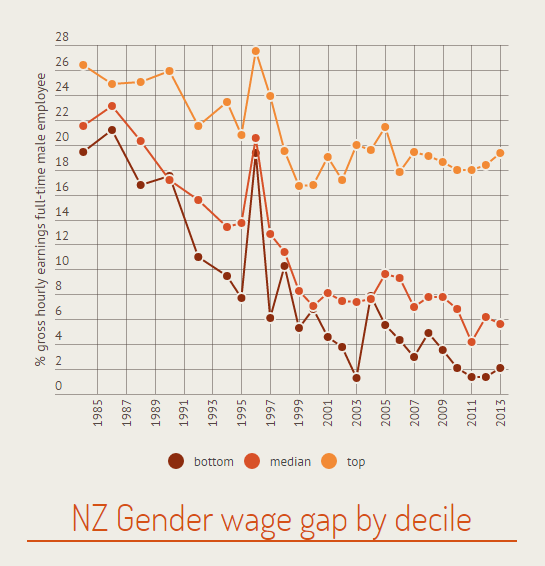
Both her research and that you sponsored this week shows that the gender wage gap is close to zero for the bottom half of the wage distribution but the wage gap is 20% or more for professionals in the top 10% of wage earners.
Rather than hypothesise that employers suddenly develop an unconscious bias against successful career professionals because they are female, Goldin looked deeply into how the organisation of work and design of jobs affected how workers were paid and how women made choices about their careers and what they majored in at university in anticipation of these demanding or rat race jobs.
Goldin referred to pharmacy as the most family friendly occupation in America because pharmacists are completely interchangeable and in America the great majority of them are employed by Walmart and other big companies. Few are self-employed. The only advantage of working long hours in the pharmacy profession is you are very tired at the end of the week.
Goldin contrasted that with law or finance sector jobs which are rat race jobs.
Rat race jobs such as these disproportionately reward people who are willing to work very long hours, work very rigid hours and/or show up whenever the client wants them anywhere in the world. These jobs also severely penalise even the shortest interruption in your career track. You come back reporting to the people you hired 12-24 months ago!
After starting on the same pay, large gender wage gaps in high-powered professional occupations emerge after 5-10 years into a career as successful professionals power up to become partners or highflyers.
Importantly, Goldin found one counterfactual to this large wage gap for high-powered professionals. If your husband earns less, there is no wage gap with your MBA classmates at Harvard but you do work fewer hours per week.
Goldin’s study of the Harvard and Beyond longitudinal study was corroborated by a study she did of the top 100 occupations in the American Community Survey. The gender wage gap is limited to rat race jobs.
Goldin argued that the last chapter of the gender wage gap dependents on changing the way in which we organise work.
That is a profoundly ambitious agenda because much of the way in which high-powered professionals must work long hours and be always on call for clients is from the demands of their clients. For example, you want your lawyer to show up in court on time every time and always be available to you when you are in trouble. The legal system does not work in any other way because of the possibility of urgent applications to court etc.
Women anticipate this because, as an example, female surgeons tend to specialise in areas where they can schedule operations in advance rather than having to rush in to perform emergency surgery.
I suggest to you that you should think more deeply about the quality of advice you have just received from the causes of the gender wage gap in New Zealand.
That advice to you is profoundly at odds with the latest thinking in modern labour economics on what the causes are and what the solutions must now be for the last chapter of the gender wage gap.
A postscript has the key publications of Claudia Goldin to show why she is the world’s leading female labour economist without a doubt. You were not advised of her findings.
Cheers,
Jim Rose
Selected publications of Claudia Goldin on the labour economics of gender
- 2016 “The Most Egalitarian of All Professions: Pharmacy and the Evolution of a Family Friendly Occupation,” (with L. Katz), Journal of Labor Economics (forthcoming).
- 2014 “A Grand Gender Convergence: Its Last Chapter,” American Economic Review 104 (April), Presidential Address, pp. 1091-119.
- 2014 “A Pollution Theory of Discrimination: Male and Female Differences in Occupations and Earnings.” In L. Boustan, C. Frydman, and R. Margo, Human Capital and History: The American Record (Chicago: University of Chicago Press), pp. 313-48.
- 2011 “The Cost of Workplace Flexibility for High-Powered Professionals” (with L. Katz), The Annals of the American Academy of Political and Social Science, 638 (November), pp. 45-67.
- 2010 “Dynamics of the Gender Gap among Young Professionals in the Corporate and Financial Sectors” (with M. Bertrand and L. Katz), American Economic Journal: Applied Economics, 2 (July 2010), pp. 228-55.
- 2008 “Transitions: Career and Family Life Cycles of the Educational Elite,” American Economic Review Papers & Proceedings 98 (May), pp. 363-69.
- 2006 “The ‘Quiet Revolution’ That Transformed Women’s Employment, Education, and Family,” American Economic Review, Papers and Proceedings, (Ely Lecture), 96 (May), pp. 1-21.
- 2006 “The Homecoming of American College Women: The Reversal of the Gender Gap in College” (with L. Katz and I. Kuziemko), Journal of Economic Perspectives 20 (Fall), pp. 133-56.
- 2006 “The Rising (and then Declining) Significance of Gender.” In F. D. Blau, M. C. Brinton, and D. B. Grusky, eds., The Declining Significance of Gender? New York: Russell Sage Foundation, pp. 67-101.
- 2004 “From the Valley to the Summit: A Brief History of the Quiet Revolution that Transformed Women’s Work,” Regional Review, Q1 vol. 14 (2004), pp. 5-12.
- 2004 “Making a Name: Surnames of College Women at Marriage and Beyond” (with M. Shim), Journal of Economic Perspectives, 18 (Spring 2004): 143-60.
- 2002 “The Power of the Pill: Oral Contraceptives and Women’s Career and Marriage Decisions” (with L. Katz), Journal of Political Economy 110 (August): 730-70.
- 2000 “Orchestrating Impartiality: The Impact of Blind Auditions on the Sex Composition of Orchestras” (with C. Rouse), American Economic Review (September): 715-41.
- 1997 “Career and Family: College Women Look to the Past.” In F. Blau and R. Ehrenberg, eds., Gender and Family Issues in the Workplace. New York: Russell Sage Press, pp. 20-58.
- 1995 “The U-Shaped Female Labor Force Function in Economic Development and Economic History.” In T. P. Schultz, ed., Investment in Women’s Human Capital and Economic Development. Chicago, IL: University of Chicago Press, pp. 61-90.
- 1991 “Marriage Bars: Discrimination Against Married Women Workers from the 1920s to the 1950s.” In Henry Rosovsky, David Landes, and Patrice Higonnet, eds., Favorites of Fortune: Technology, Growth, and Economic Development since the Industrial Revolution. Cambridge, MA: Harvard University Press, pp. 511-36.






Recent Comments